It doesn’t matter how many times you launch yourself into new ventures, there is always a frisson of fear, an nagging anxiety, concern over what might happen (even when you know you have prepared, even over-prepared for every eventuality).
There are those nights of unsettled sleep, butterflies in the stomach, irritability, and edginess. It’s the fear of the unknown, and the more you do, the more experiences you have, the more aware you are of what just could, just might, go wrong. I am glad to know the hugely experienced boater Jo from nb Minimal List feels the same. Maybe she, like me, believes ignorance of what might happen can be bliss.
Anxiety like this applies to many circumstances of life and work, and once more, boatlife appears a perfect foil for articulating the trials, tribulations, and triumphs we all face wherever and however we live. The fear as we left the South Oxford (which we’ve travelled before) for the unknown waters of the River Thames, and then leaving the River Thames for the Kennet and Avon. Both waterways come with reputations. The K&A, as it’s abbreviated, is known by many as ‘a canal you only do once’. The mighty Thames, on the other hand, can be capricious, with tidal sections, wide expanses and narrows, shallows and depth.
Like all inland waterways in Britain, these two we’ve encountered for the first time for us in the past week have their own individual characters and practical requirements. The Thames demands an anchor – requiring us to scrabble about in lockers to haul it out with its heavy chain and rope. It’s been buried there since our foray up the tidal Trent some years ago.
The Kennet and Avon resulted in a scrabble for a windlass, which we hadn’t needed all the way along the 96 miles of the Thames from Dukes Cut up to Lechlade and then down to Reading. Having found the windlass, I found I didn’t need it for the first lock on the Thames, and I then got left behind the boat before I could use it in earnest thanks to a bizarre set of traffic lights… as anyone around Reading’s Oracle Shopping Centre last weekend might have been able to testify. I was the puzzled looking woman purposefully striding alongside the waterway railings, looking plaintively at the blue narrowboat passing below being ably skippered by The Skipper looking anxiously for a place to reunite with me. It is a little odd when circumstances mean you really do miss the boat… and it’s your boat, your home, your office, your everything!
That was an anxiety inducing moment I never expected! But then I had seen a note in the navigation guide about a traffic light system in operation on a narrow bridged section, but hadn’t realised it required a push button operation from a boat battling a strong wind and where there was no opportunity to moor or even stand to push anything etc alone a tiny button a few feet above the bow of the boat!
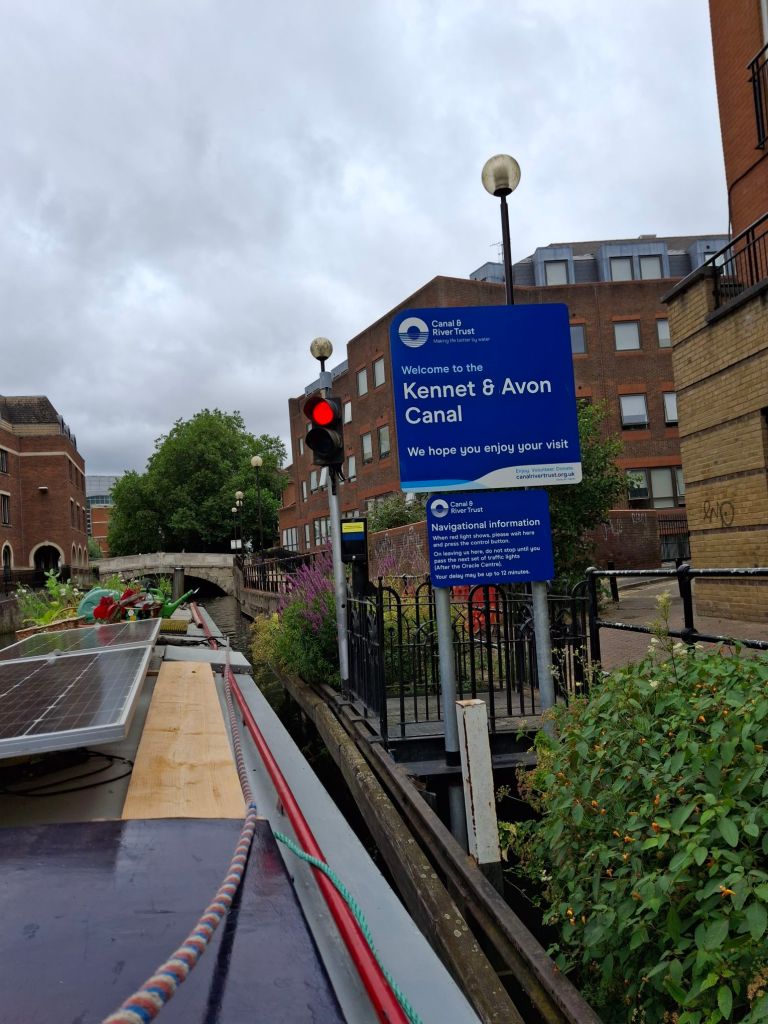
After 3 tries we ended up moored on the opposite side of the navigation and I legged it over a bridge and down the far side to balance on a metal bar to push the button only to find it immediately went green. By the time I legged it back the Skipper had had to move the boat through leaving me to trail in his wake on the shore – right through The Oracle Shopping Centre where bizarrely there is nowhere to moor – not encouraging custom from passing boaters! As you emerge with the boat from this area, you pass under another road bridge and round a bend where your line of sight indicates alarmingly that you are heading straight for a weir. Not until you get a fair way towards it do you see a lock to your left.
On foot, you emerge onto the road above that bridge, and there is a car park area ahead on the left and a towpath on the right. Taking the right leads you to the weir with no access to the lock. Guess which one I took first time? Eventually , we reunited. A start on the K&A that made it seem anything after that would be a doddle.
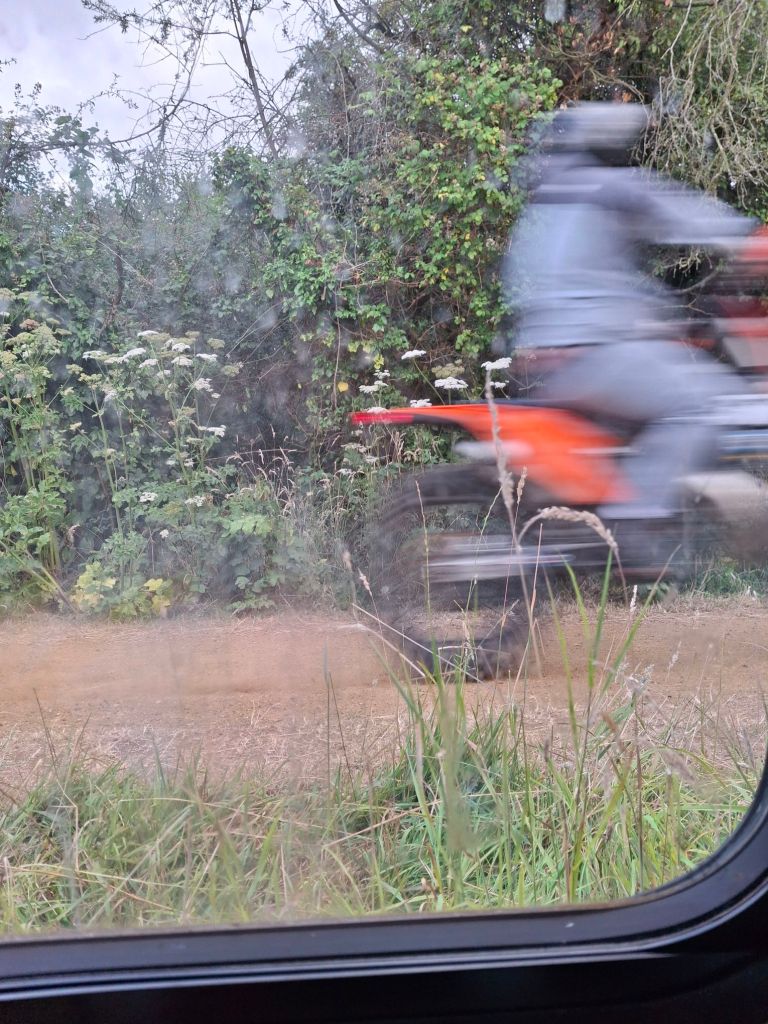
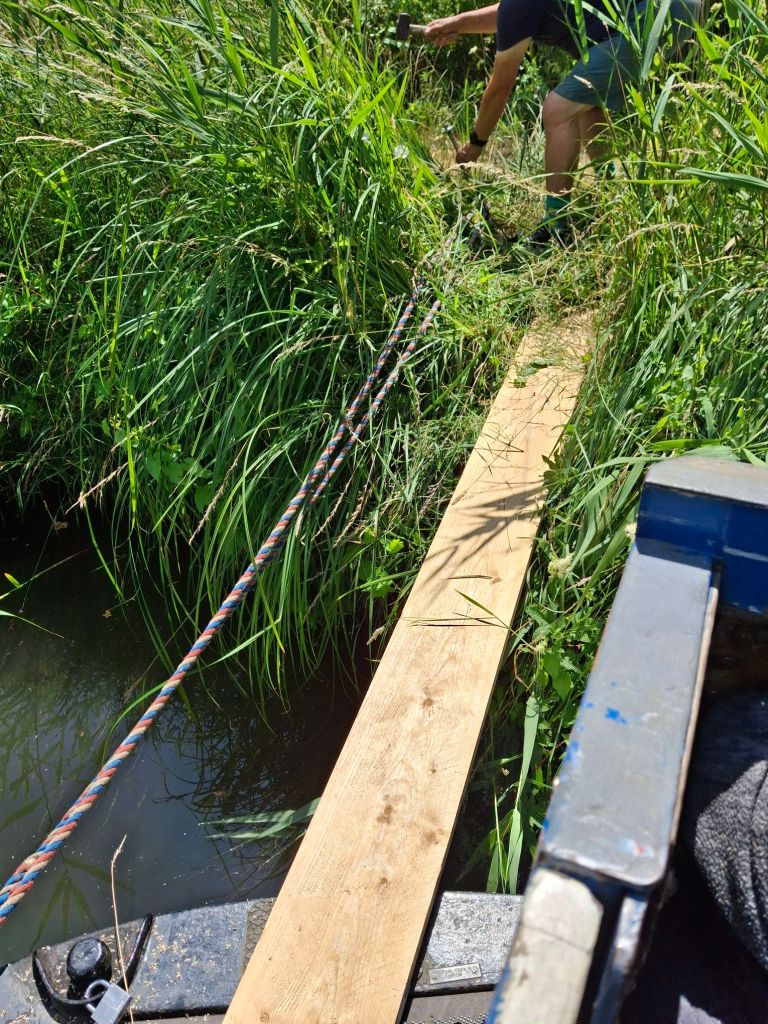
The K&A certainly is unique in very many ways. Like some river/canalised stretches, it alternates with sudden river flows in areas making concentration when navigating a necessity. Mooring on visitor moorings is 24/48 hours in the main so longer moorings are wild and shallow edges make an 8ft gangplank essential. Luckily we are equipped, (sadly acquired without the hilarious Eric Sykes and Arthur Lowe slapstick comedy of The Plank – if you haven’t seen it then head to YouTube for some sheer delight), so this was the start of my commute one day this week – how does it compare with yours?
The K&A harnesses two river navigations – the Kennet and the Avon. The resulting broad waterway with canalisation runs for 88 miles through 106 locks (including a flight at Devizes that forms one of the Wonders of the Waterways). It runs from the Bristol Channel through the historic city of Bath to the River Thames at the modern office blocks of Reading.

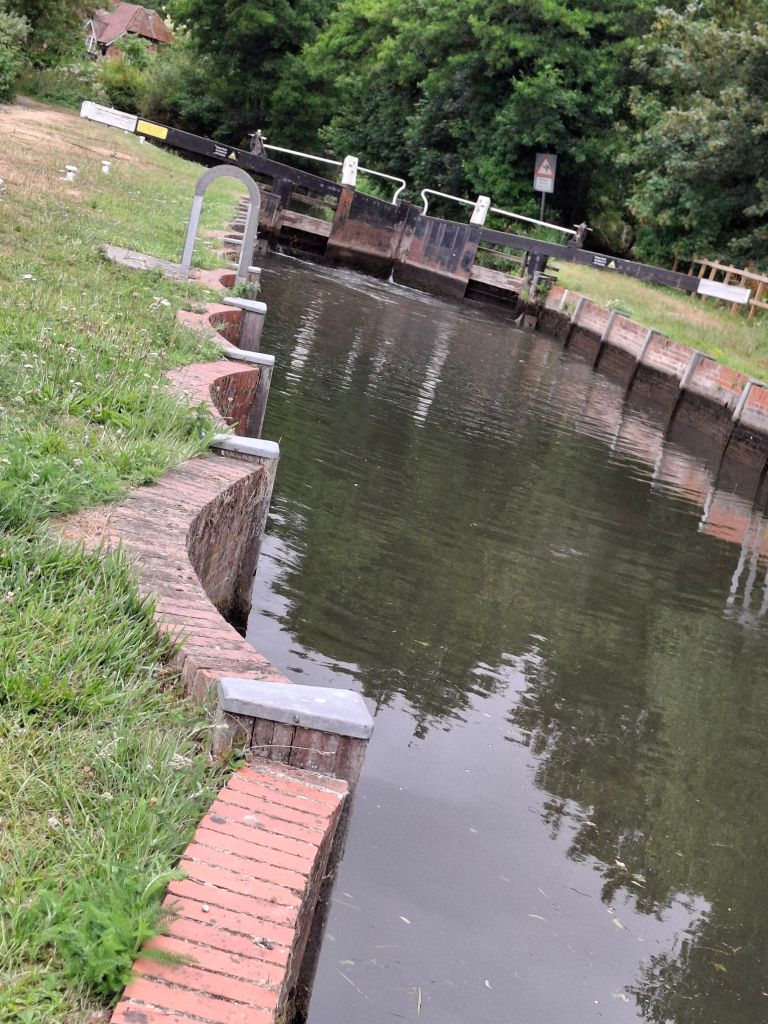
After decades of dereliction the waterway reopened in 1990. It originally featured turf-sided locks, and now scalloped edged locks that replaced some of the original turf sided locks. All the locks were built to take barges that were 13ft 10inches wide so two narrowboats fit with ease.
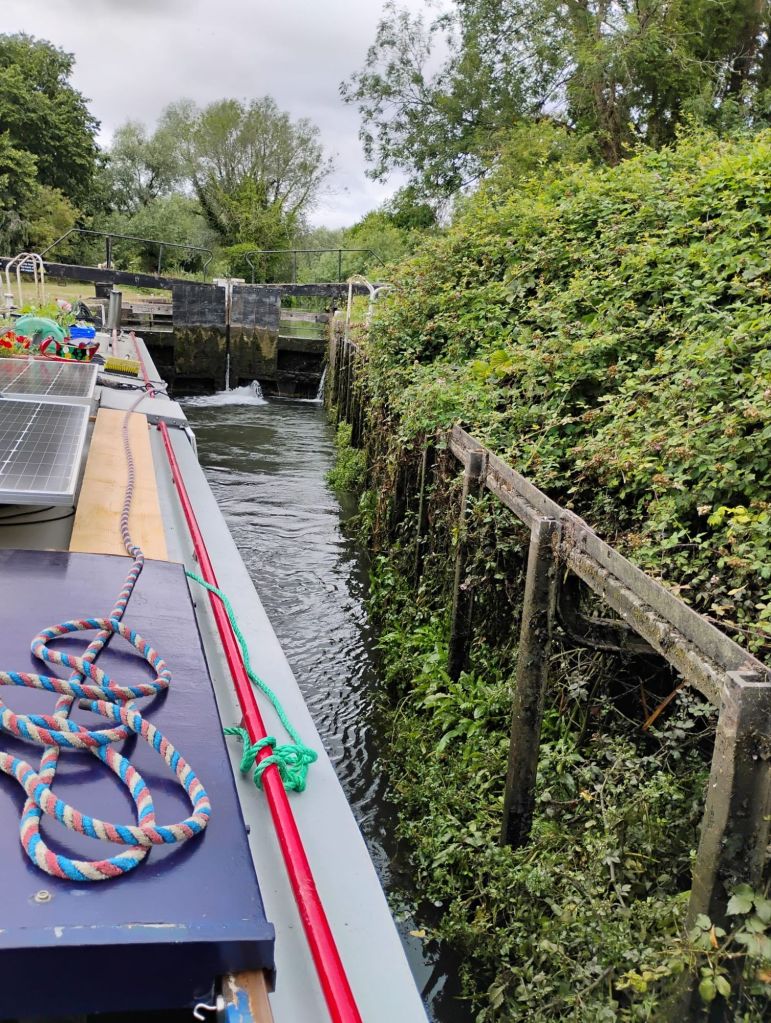
Turf sides were often seen on river locks in the day – they made it cheaper because brick, stone or wooden locks walls were only needed to support the lock gates, and the roots of the grass would hold the sloping earth sides together. The locks took more water and were more prone to leaks but that wasn’t an issue then as it is now. The wider working boats weren’t able to get caught on the sides as the locks emptied.
This was common on river navigations at the time: it was cheaper and easier to just build short lengths of full height masonry (or timber) vertical walls to support the lock gates at the top and bottom ends of the lock, and leave the rest as a sloping earth bank (supported by a low brick or timber wall at the bottom), where grass and other plants would bind the soil together. Sure, it increased the amount of water it took to fill the lock, and it would be more prone to leakage, but on a river navigation there was far less likely to be any issue with water shortage than on a canal.
The biggest issue was the amount of maintenance turf locks took, and that is why there are only two remaining on the K&A with a few others scattered on other waterways on the south and east. Two have been replaces with scalloped edged brickwork. Makes you feel a mite discombobulated, wondering if they’ve warped in the current heat!
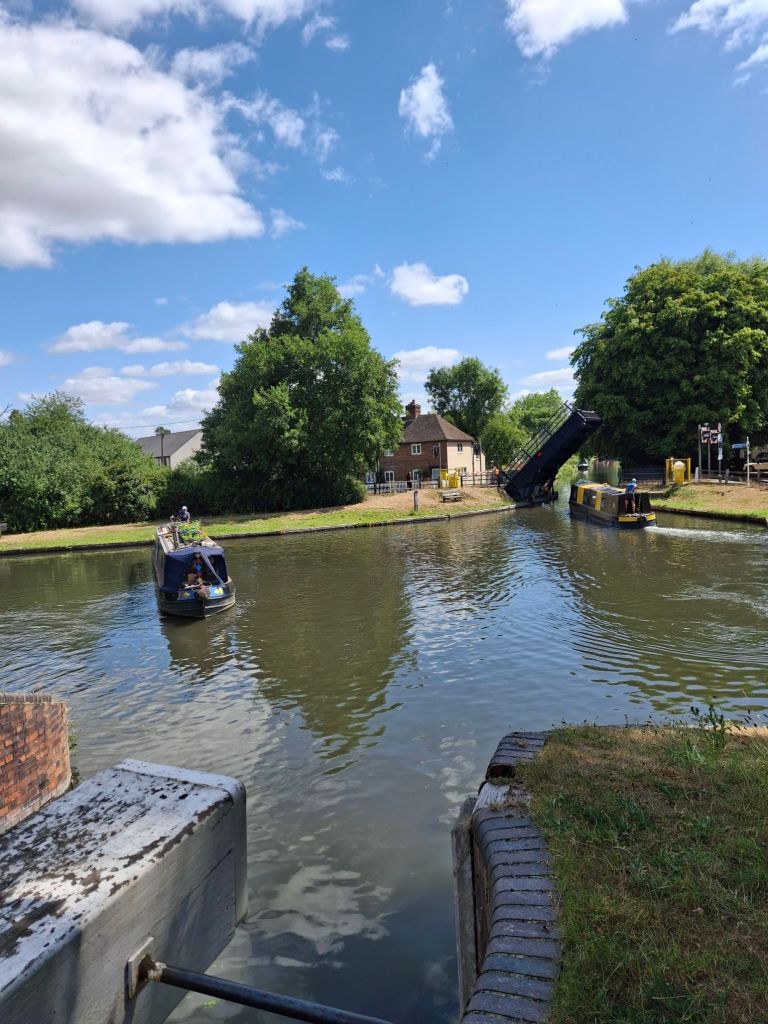
Another feature we are discovering is in swing and lift bridges – some really close to locks which need to be opened before operating the associated bridge. So far bridges have swung and lifted with sheer brute force, the requirement of a British Waterways key to operate electronics and I seem to remember using a windlass too! I can’t think of any other way of raising or swivelling a bridge but I feel the K&A might yet surprise me.
We are taking time to enjoy the environs of the K&A in parts because it runs through an area we came to live close to some 30 years ago when we returned to the UK from Swizerland. We have the sheer delight of staying in touch with many friends from those days and so we have taken the journey from Reading to Hungerford at a suitably sociable pace, allowing plenty of time for leisurely catch ups. We will eventually accelerate but it gives us time to watch the kingfishers and share moments with frogs and fish as well as good friends.
So far we’ve only actually completed 12 miles, 12 locks and 5 moveable bridges, each of which has brought its own unique character to bear on our journey. There’s no sameness about the K&A, no expectation that each bridge or lock will behave as the one before! Anxiety is abating, to be replaced with some excited anticipation of just what lies ahead and what challenges we could face.
Maybe that’s what anxiety is really for – to prepare you for the challenge, and prevent complacency. It needs to be managed so it doesn’t become paralysing but it has its place, like everything in moderation. Perhaps we should welcome it more than we do.
The K&A wends its way close to Highclere Castle where Downton Abbey was filmed. Lady Mary Crawley in the series told her groom at the altar when he expressed concern she might have jilted him: “I should hate to be predictable.” She could have been speaking for Downton’s nearby waterway.
And as I write the whole of the K&A has been issued with a low water warning from Lock 1 ro Lock 106 – so we could be here for a VERY long time!
 Pickingupducks