We did it. The fable of the tortoise and the hare proved valid for (certain) narrowboats and their crews in 2025. Slow, dogged determination won the day against The Drought and The Closure of Locks to Preserve Water (capitals all mine!).
Slow it may have been but stressfree it was not.

We left Thatcham outside Newbury in Berkshire on the Kennet and Avon wondering how near to family in Leicestershire we could get our 50ft floating home and office before an announced lock closure that could continue until significant rainfall, so potentially until winter or next year.
Locks in Northamptonshire at Stoke Bruerne and Long Buckby on the Grand Union Canal would completely close at 3pm on 25 August. Getting any further north up the Leicester Line was already an impossible task, as the locks from Watford (near Watford Gap M1 Services) to Kings Lock outside Leicester closed on Tuesday 29 July.
So how far we wondered could we really get in 9 days?
Sat 16 August – 12 miles, 13 locks and 9 swing/lift bridges moved in 7hours. Moored at Fobney outside Reading.
Sun 17 August – 23.5 miles, 10 locks in 8 hours which took us off the Kennet and Avon Canal and onto the River Thames heading towards London.
Mon 18 August – 14 miles and 6 locks – horror moment in one lock when a widebeam in front of us got their stern rope caught and the whole boat crashed down into the water when they managed to get it free. Luckily all boats in the lock were well secured bow and stern so the resulting wave wasn’t damaging for us. We deliberately made it a shorter day because we have a booking for Wednesday at Teddington Lock and don’t want to be sitting there for 48 hours. We took time to visit Runnymede, home of the Magna Carta – more on this in a future post as it is very relevant to our current times. Met up with nb Siskin also heading up the Grand Union. They are aiming to book the same passage on the tidal section as we are.
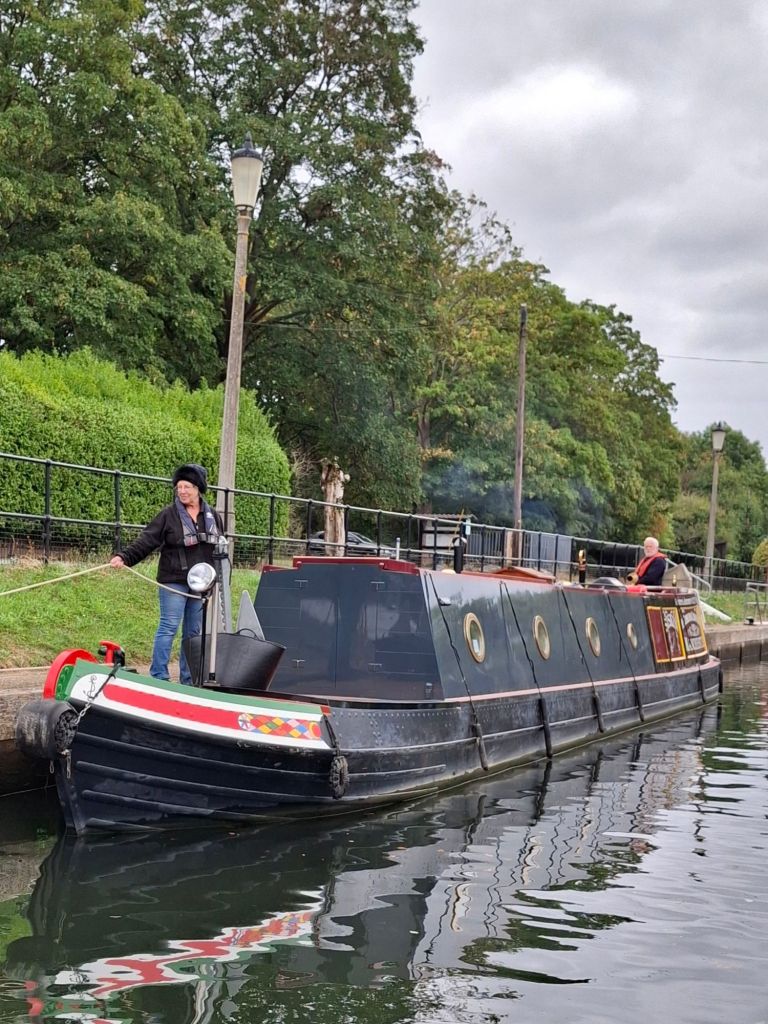
Tues 19 August – 16 miles and 6 locks in 5 hours to Kingston-on-Thames. Time to walk the dog in Hampton Court deer park, and visit a supermarket to restock fridge and cupboards because we won’t have time until we reach our destination. Moored behind John and Linda on their 57ft tug nb Siskin doing much the same preparations.
Weds 20 August – 41 miles and 14 locks. Left Kingston anxious to cover the 30 miles to Teddington in good time. Such good time we had time for a coffee at a café, walks with the dogs and a lot of pacing before the right tide for us to leave the lock. We left Teddington Lock at 1300h, and had a trouble-free cruise to Thames Locks 101 – the Brentford entrance to the Grand Union. As required, I called the Port of London Authority as we left Teddington to warn them we were entering their waters and again as we checked off their patch. Suddenly we were wielding windlasses again, and saving water by keeping our two boats together through the locks – the narrowboat equivalent of 1976’s drought slogan ‘Save Water: Bath with a Friend.”
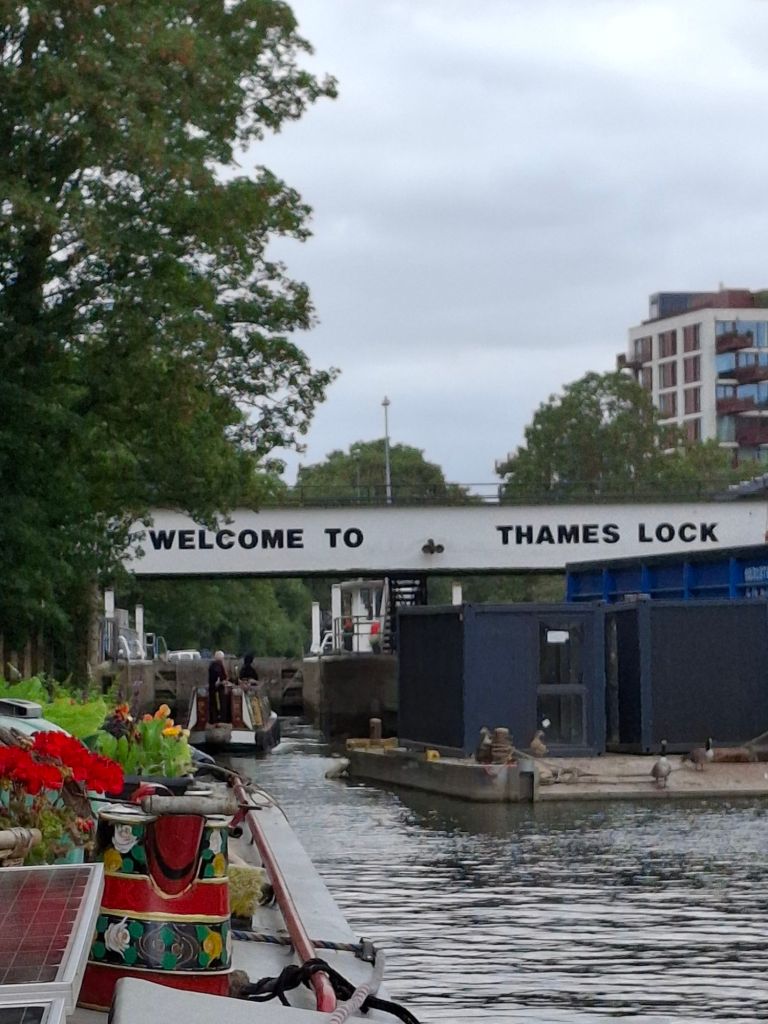
We carried on up to Southall, to the site of the former Passmores Dock. As we moored up a woman under the influence of something fell from a seat at a picnic table, banging her head and losing consciousness. Helped her somewhat inebriated companions put her in the recovery position until the ambulance came and once more – high praise for paramedics doing an incredibly professional job in very trying circumstances.
Thurs 21 August – setting off after an unexpectedly peaceful night we travelled 18.5 miles and 15 locks in 8 and a half hours. That got us to North Watford. We encountered one drained pound (a section between two locks) which we had to manage by letting enough water down to enable both boats to limp through a channel in the centre. A slow section like this had us all doubting we could make it up to Northamptonshire if more of these low water hurdles lay ahead.
Fri 22 August – another long day cruising for 8+ hours took us through 9 miles, 20 locks to Berkhampstead. We still wondered if we could make it to the Stoke Bruerne locks before they were closed and padlocked. Nb Siskin needed to get up the Stoke Bruerne flight of 6 locks to reach their mooring at a marina above them, but we had by this point decided we needed to stay below the locks, in an area which would allow us to cruise south and have access to essential facilities like water, waste and rubbish disposal and shops. We are likely to be wherever we end up for months after all, or until biblical rainfall restores levels in waterways and their reservoirs.
Sat 23 August – We woke with hope this morning. It all seemed more possible. It was a feeling that stayed with us for most of the day until being totally extinguished in the dark of the night. We crossed the Tring summit, the highest point of this section of the Grand Union today, and decided as the light was fading to pull in by The Globe at Linslade, just on the outskirts of Leighton Buzzard. We headed to the side first with the idea that as the pound was shallow Siskin with her deeper draft could moor alongside us in deeper water. That seemed a plan until we got stuck. Light was fading fast as we got clear with the help of Siskin towing us off and our barge pole bending horribly as it took the strain of keeping us away from the gloopy sucking silt. Thanks to a Bob Marley fan the barge pole was reunited with our boat, as was I, and with Siskin in the lead we edged our way in failing light past boats moored at alarming angles. Our plan was to reach the lock mooring at the top of Soulbury Three Locks. Lock moorings usually have less silt because they are subject to regular traffic movement. I swear we held our breath for the whole of painful progress up the 3 mile pound up to Soulbury. Our tunnel lights lit the way, and head torches helped us finally moor up. Just as we arrived heaving sighs of relief a man appeared from the darkness and asked if we were coming down the locks because he was going to run water down to flush his stuck boat through.
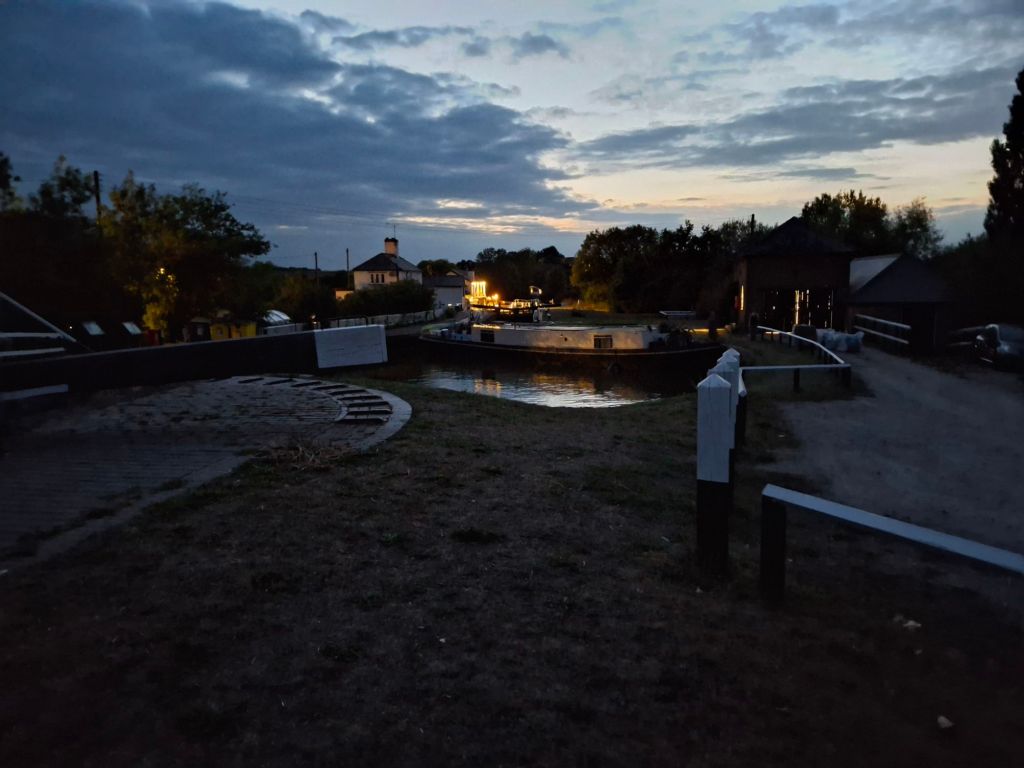
We reacted with horror – there were a large number of boats in that long pound, and taking water away could cause them really serious damage. We pleaded with him to call Canal and River Trust’s emergency line to get advice and help – maybe they have a pumping system for the locks for example, and went back to mooring our boats. As we walked to the (fortunately open) pub at the foot of the locks past the Dutch barge that was side-on in the first pound, calling CRT’s emergency line for them, we heard with relief they were on the other line. By the time we left after a much needed drink, CRT had them moored safely at the side of the pound, and our boats and others at the top of the flight were still afloat. A stressful, exhausting day of 19 miles, 29 locks, 1 swing bridge and the longest day’s cruising we have ever done at 13 hours.
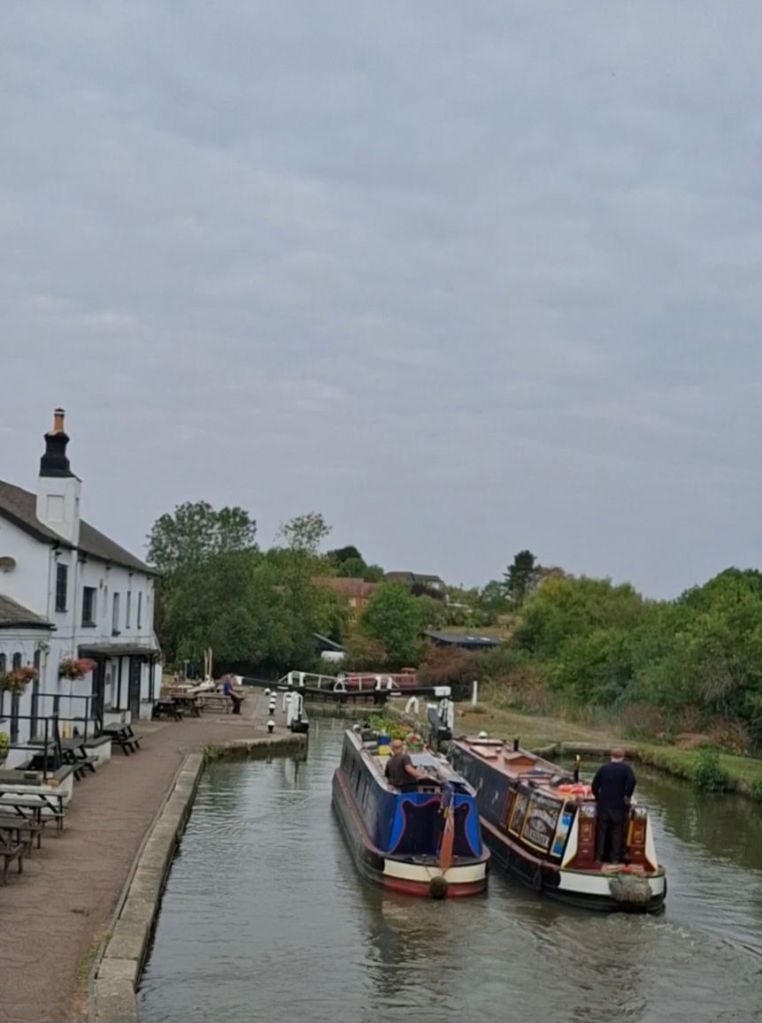
Sun 24 August – If we were going to get Siskin to their home mooring before the literal lock down our aim was to be moored up at the base of the Stoke Bruerne flight by tonight. At 8.22am with the help of a voluntary lock keeper we moved the boats into Soulbury Top Lock. At 5.50pm after 20 miles and a final 6 locks we moored just where we hoped to be. Expecting to find lots of others in a similar situation we found just 1 other boat waiting to go up, and within an hour a third boat had arrived. There were though plenty of boats at the foot of the flight – the Weedon Narrowboats hire fleet has been repositioned there, and fortunately we also found Juels Fuels.
Mon 25 August – nb Siskin joined another boat heading up the flight bound for a marina at the top, and we walked up with Boatdog to lock them through the final 6 locks to their destination. As soon as a voluntary lock keeper unlocked the chains, the boats went in, and at 13.37 nb Siskin left the top lock. Success from a huge team effort!
Walking down after a celebratory visit to The Boat Inn, we glanced at how far we had travelled since leaving Bath 16 days before – along 205 miles, through 196 locks and 28 swing/lift bridges.
Now we have plenty of time to relax, to perfect rain dances and to reflect on the situation that surrounds us.
In 1976 when one of the previous longest and most severe droughts in recorded history happened, Britain’s canals were managed by British Waterways, a government body that operated from 1962 until 2012. Again low rainfall, combined with heat resulted in what was dubbed The Standpipe Drought. Standpipes, ordered by Minister for Drought, Denis Howel, brought communities to queue with buckets at street corners. He hit the media headlines by declaring he was saving water by following advice and sharing baths with his wife, Brenda. Within a short while of the standpipes and his appointment, he became known as the Minister for Floods as torrential rain deluged the UK ending the drought.
In that drought the Birmingham Canal Network was dry and derelict. Parts of Sheffield and Yorkshire’s waterways dried up, and the Grand Union locks at Stoke Bruerne were subject to usage restrictions from June until October. But information about the state of the waterways at the time was overshadowed by roads melting in the heat, railways stopping because of rails overheating, poor harvests, industrial output suffering, and wild fires.
Here in Northamptonshire where we currently are, local newspaper archives recall the 1976 standpipes, hosepipe bans, Pitsford Reservoir down 20ft, and said: “There were no more navigable canals in Northamptonshire and boat hire companies shipped out their craft to canals still open.”
It is worth remembering after a week of heavy rainfall restrictions were lifted on 15 October 1976, and since then, as we know, canal navigation has continued. Indeed, it has flourished.
This year the Ashton, Caldon, Grand Union, Leicester Line, Leeds and Liverpool, Macclesfield, Peak Forest, Rochdale, South Oxford and Trent and Mersey Canals are all affected by the drought. Canal and River Trust have advised boaters in the areas affected to empty waste, fill up fuel and water, consider relocating if they can and stock up on essential supplies if they can’t. When able to travel, boats should share locks to save water, open gates fully to avoid damage that creates leaks, and report leaks wherever they see them.
We are still afloat on our chosen long pound. We are not locked in, so we are subject as normal to the maximum stay in one place of 14 days, and we can move to services (especially good as one of our toilet cassettes has a malfunction). We will keep going and enjoying this life – even if we may seem a bit round the bend to some!

We can return to work rather than being focused every day on moving, and we can relax, enjoying the peace and tranquillity of the waterways which refuels us all, and we are also beginning to learn a few rain dances… Will they work? Who knows, but we’ve already surprised ourselves with what we can achieve in the past few weeks, and as I write we are actually enjoying some petrichor (noun: a pleasant smell that frequently accompanies the first rain after a long period of warm dry weather).
Long may the rain continue.
 Pickingupducks