It’s been a week of many miles across the waterways of four counties as we need to reach a set place in the coming weeks for a family celebration (outside in groups not exceeding 6). This has given time for thought as we chug our meandering way at nearly 4mph along the waterways.
Boats, houses, and cars mean different things to different people. Bought, rented, or borrowed, they can be viewed as status symbols, personal security, harbingers of debt, realisers of dreams, steps or statements.
Just as cars and houses often tell about their owners’ aims, aspirations, and priorities – boats and from my perspective, narrowboats particularly, are fascinating in this respect. For some their boats reflect who they want to be, for others they show who they perceive they are. Some care about the outside over the inside; others care more about the inside, and some just don’t care what anyone else thinks. Every journey there’s a boat that makes us smile – humour is evident everywhere.
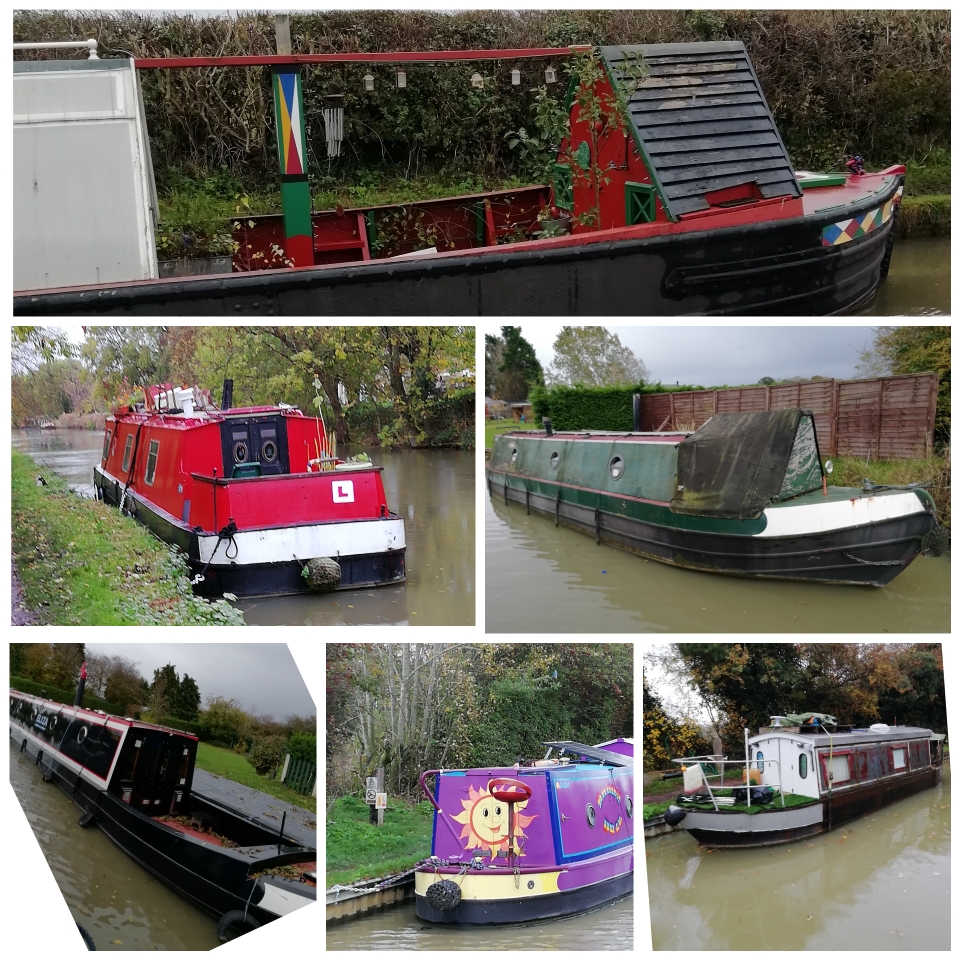
Some spend hundreds of thousands of pounds having a boat built from scratch to be a floating home-from-home with all mod cons they feel essential (yes, that can mean a washing machine and tumble drier, several fridges, a freezer, central heating and several TVs depending on the size of the boat); others invest in restoration of heritage boats, painstakingly returning them to their totally original specification, or giving them contemporary interiors; some scrape together enough to buy a boat that just floats and are glad of it as a place of escape or a home; some sink themselves into debt to achieve their dreams and some, like us, are determined to achieve their boat reality without loans. It means thinking twice or thrice about what we need and what we want, and whether they really equate. For all boat owners their boats are projects – whether realised by a boat builder or by themselves.
Live-aboard boaters also come in multiple formats. Some have home moorings. They may live on smart purpose-built marinas with Moorers’ lounges hosting regular social events with many facilities (including laundrettes). Others inhabit smaller marinas with few facilities but often a strong community feel. Some rent or own land and mooring alongside the towpath or on the offside. Some live-aboard owners we have met never move their boats – they are floating, not travelling homes. And then there are the continuous cruisers (CC) like us, who by the terms of their Canal and Rivers Trust licence have to keep moving:
“Boats without a home mooring must be engaged in genuine navigation throughout the period of the licence.” (CRT)
If we find a 14-day spot we can stop if we wish for that length of time. We don’t have a permanent ‘home’. Walk along any towpath and at some point you are likely to see mooring signs, 48 hours, 14 days, no mooring etc.
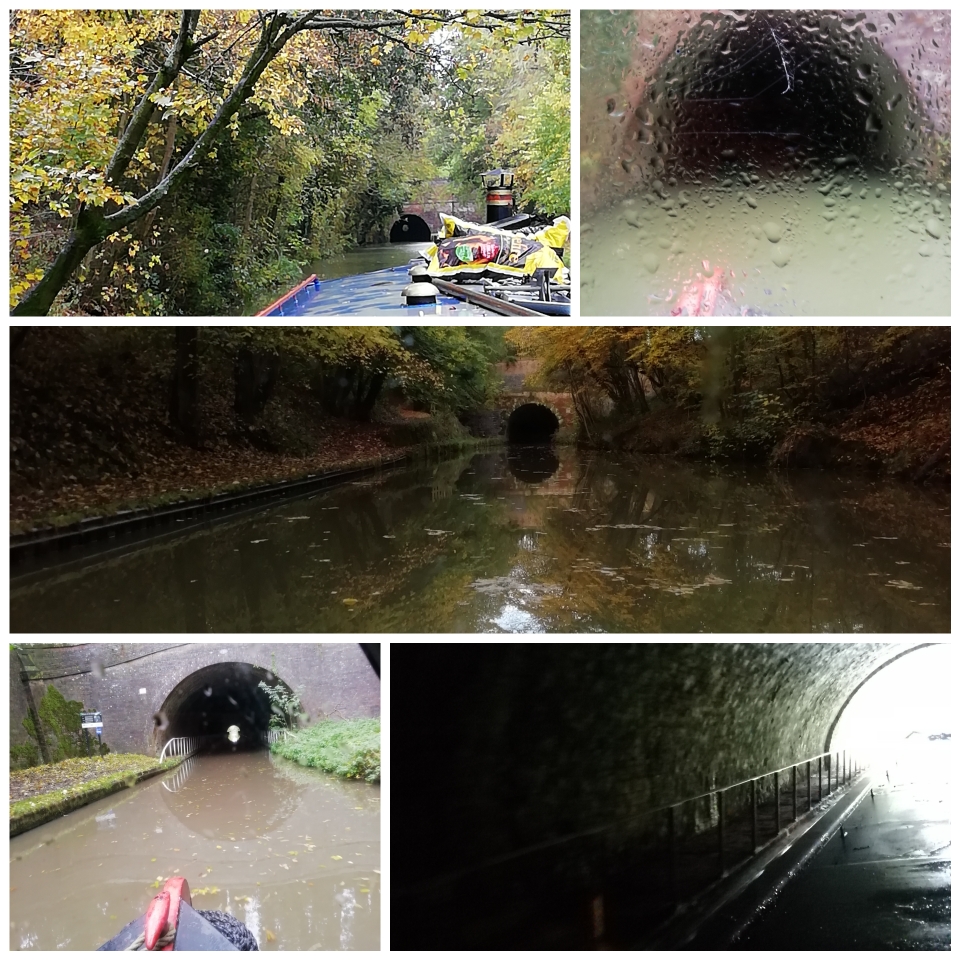
As I start writing this we are travelling in Northamptonshire, through the dripping wet Braunston tunnel, 2042 yards of it, which opened in 1796. Quicksands caused problems in construction and although you can see the light at the end from the start, it was built with a slight S bend in it. Steve’s at the tiller in the damp darkness and I am with the dog by the blazing stove in the lit, warm cabin. No question who has the better deal in my mind! I will pull (and push) my weight shortly for the 6 locks at the end of the tunnel taking us down into Braunston where we need to stop to fill up with water and empty our bins.
It may take longer through this tunnel if we meet a nervous holiday boater coming the other way. We have had boaters bouncing from one side of the tunnel to the other in panic, but the single tunnel light we can see now coming the other way seems to be steering a straight route. It is easy to hit the sides of these long tunnels because it is so mesmeric steering in the dark. If there are boats with children out on half term holidays I can guarantee that we will hear ghoulish shrieks and screams in the darkness.
So it is time I introduced you to our key partner in this Covid new normal lifestyle of ours, our 50ft long, semi traditional (semi trad) NB (Narrowboat) Preaux.
Being semi trad means we have an engine under the floor at the back which we stand above to steer in a small contained space which happily fits two of us and the dog. Cruiser sterns have big spaces at the back where a whole boatload can congregate and a traditional (trad) stern has a much smaller space at the back, an engine exposed in a cabin area beyond the boatman’s tiller, but giving warmth and protection to the boatman.
Our boat was built by Brummagem Boats in 1989, an auspicious year for us, the one when we were married and when our current (very modern by our standards) house was built. Preaux’s vital statistics are: Length 15.24 metres ( 50 feet) – Beam : 2.07 metres ( 6 feet 9 inches ) – Draft : 0.64 metres ( 2 feet 1 inch ). She has a steel hull and was originally called Isis. We renamed her after the village where we lived in France and where our daughters were born, a place that is very special to us. Preaux is French for playgrounds – appropriate for a boat which takes us to so many wonderful places to explore and enjoy.
Our philosophy for this Covid inspired new normal ilife is to reduce our impact on the planet. To live more simply in multiple ways – in what we eat, how we travel, shop, cook and to see whether that makes us happier and healthier in the process. We aim to recycle, reuse and repurpose. Our cutlery is housed a series of burlap-covered tin cans; our hand towel hangs in an old stirrup from my riding days; and our shelves are made from recycled wood to name but a few. They all do the job and give us pleasure when we look at them.
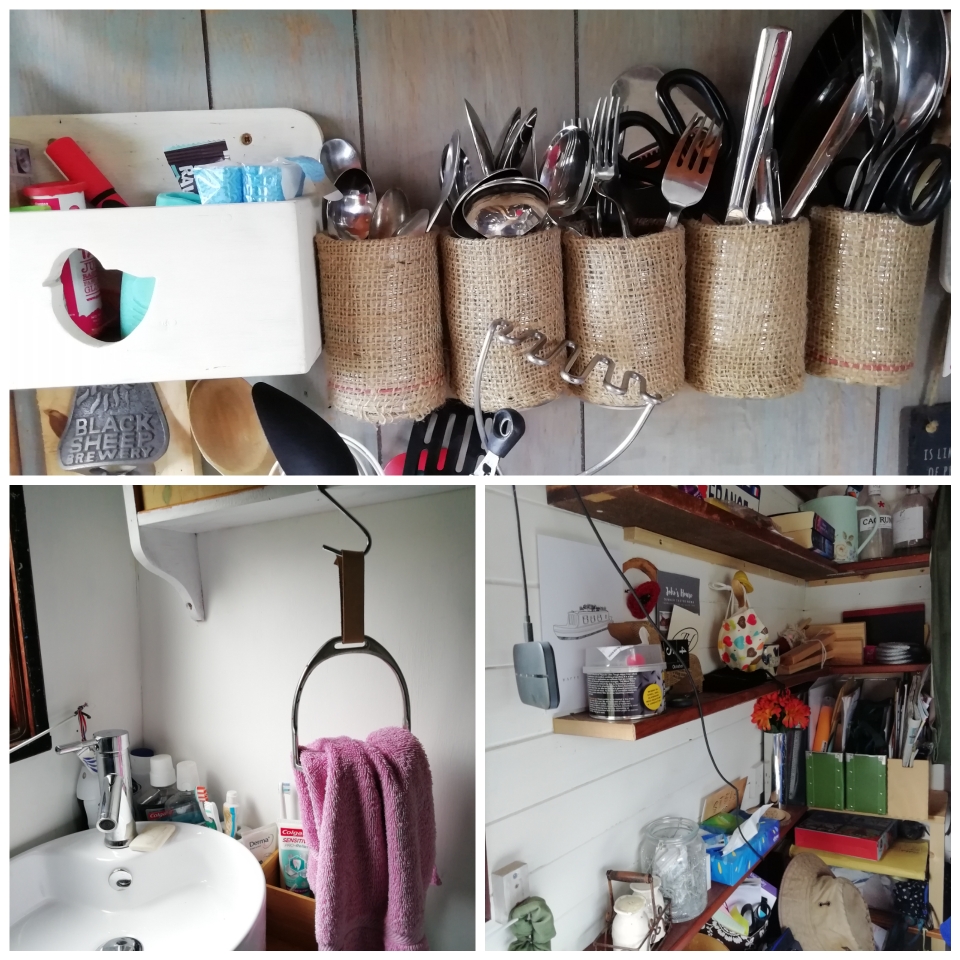
Our boat is cosy, haphazard in design, has a lived in look both inside and out, and I (no doubt like every boat owner) like to think she has her own unique style. By living more sustainability and frugally, we aim to create more time for the things we enjoy and in turn reduce the time we need to spend earning. Put simply – if we reduce our consumption then we should reduce our outgoings, giving more time to spend with each other enjoying life. Will this result in happiness? Time will tell.
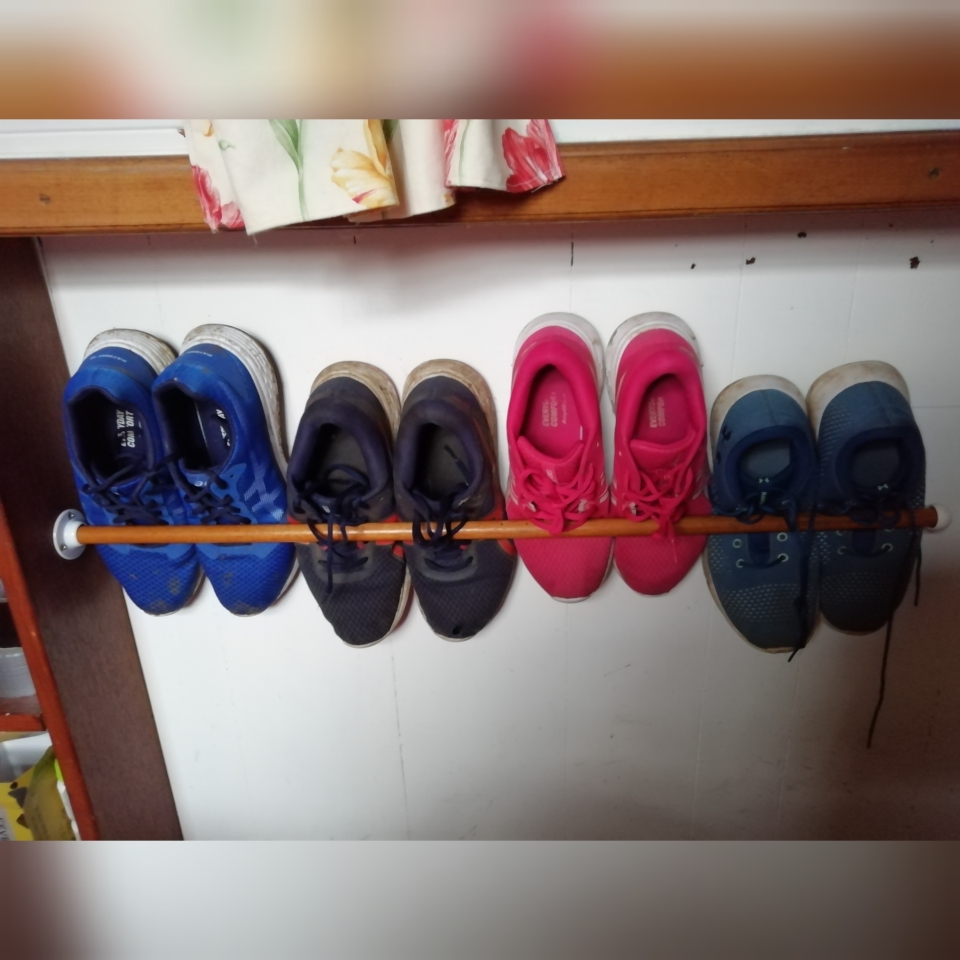
Our make do and mend approach has been harnessed to resolve the issue of our shoes. Regular blog readers will remember they were being singly carried around by the dog, and often taken alarmingly close to the water. Even in such a confined space, we were forever hunting the missing shoe or trying to fish its partner from the canal with our plastic-catching net. Using what we had on board we now have a shoe rail which takes shoes out of the dog’s interest zone if not his height. It fits neatly under the gunwale so is using currently wasted space. The next project is to sort something similar to protect crucial wellies and walking boots from our retriever!
The other project of the week was lighting. The kitchen (galley if you prefer) had existing lights on the ceiling and wall behind the person cooking or washing up. Made a good excuse for not washing up the evening meal debris until it was daylight so you could see what you were doing…but wasn’t ideal when chopping vegetables. Injuries are something we need to avoid. Steve’s solution has imbued the kitchen with a touch of Hollywood glamour with a strip of glitzy LEDs above the hob and sink area – so no more injured fingers or morning piles of washing up!
Washing too is getting easier – thanks to the historic French wine making technique. Trampling clothes during my shower and rinsing them off afterwards is proving very effective for many items. Economical with water too which is always important. They dry well above the stove but are now left to drip into the shower tray for a while as my pathetic first attempts at wringing out resulted in buckets and bowls catching the cascading drips to stop the boat flooding from the inside! Maybe I need a mangle? Has anyone one they don’t want any more?
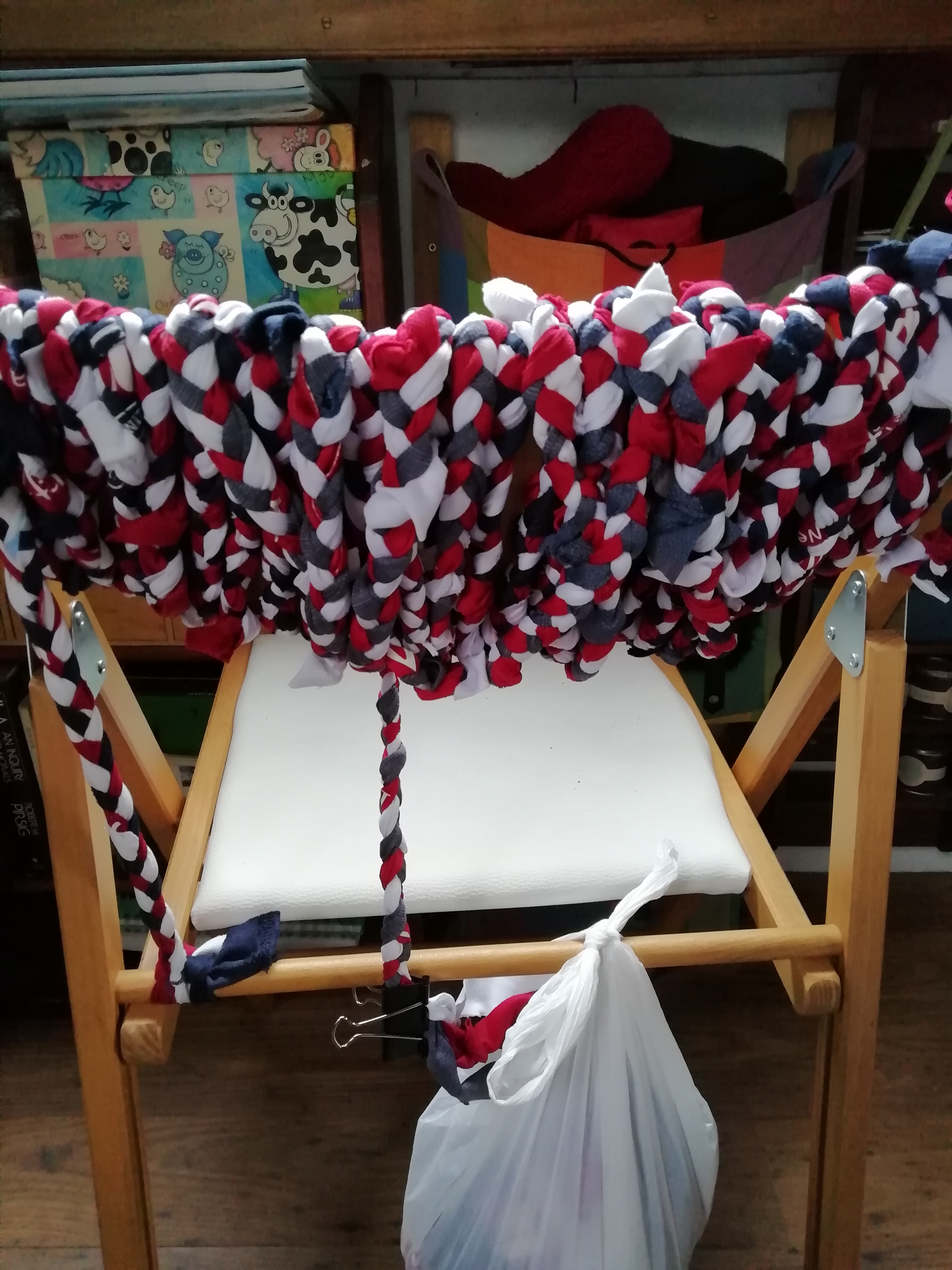
A key requirement has been a rug for the wood floor, so I have made a start. T-shirts from the days we could run and race together (and donations – thanks Emma) are reduced to long strips which I plait before sewing together into a rag rug. Should keep me entertained in the now dark evenings and one chair is getting a comfier back whilst I wind the ever-increasing plait round it to stop it from tangling up or becoming a dog toy! If any of you crafty people out there have any idea how long the plait needs to be for a 2m x 1m rug please let me know – it seems never-ending right now!
Several people have been contacting us saying they’d like to visit which is lovely (although after my description of our boat you may change your minds) but Covid has us confused again. If people come and visit us and they are in a Tier 3 or 2 area do they need to stay outside the boat or does a boat with all doors and windows open count as inside? We are currently heading back into Leicestershire having travelled via the Grand Union, Oxford, Coventry and Ashby Canals.
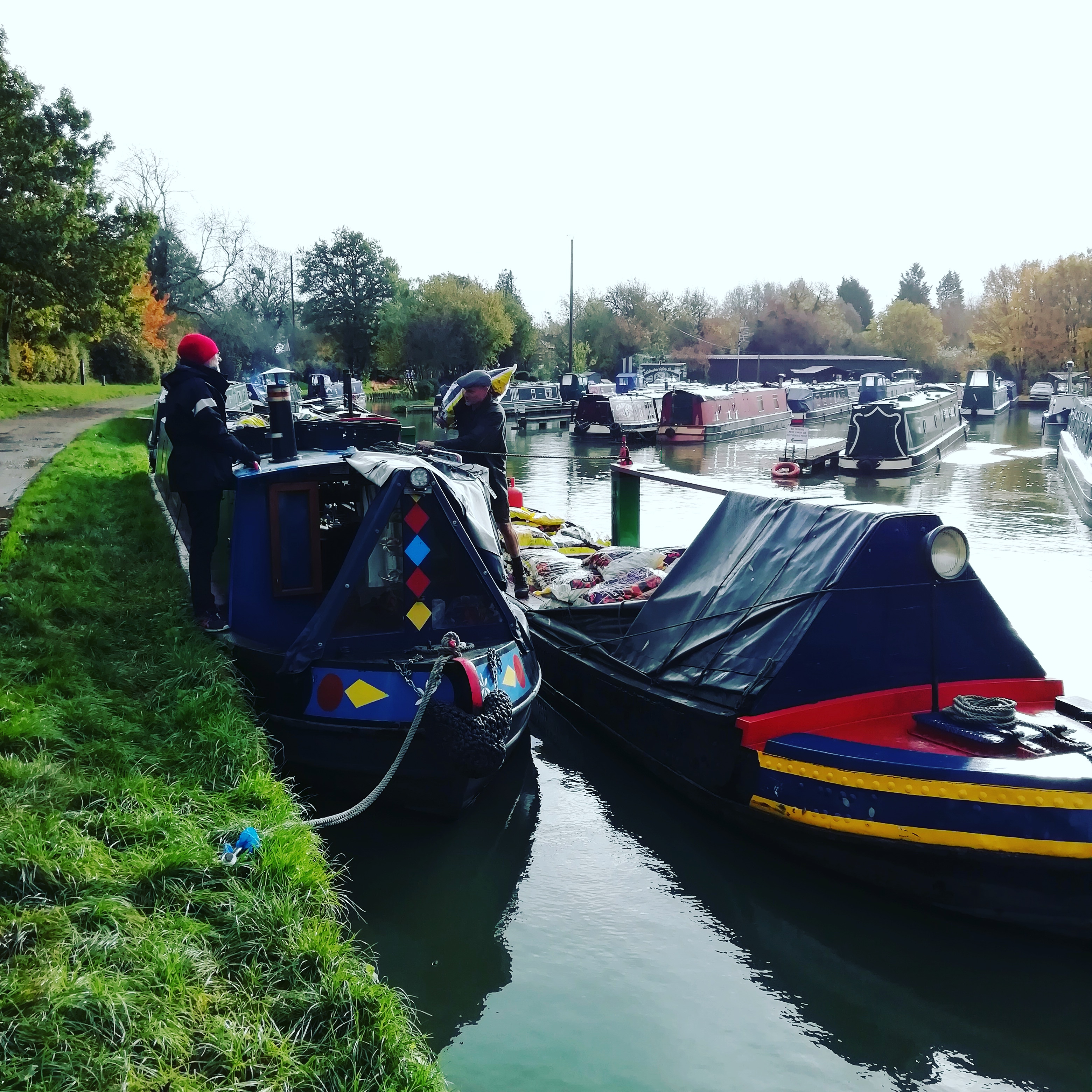
I have begun planning a 2-week store cupboard in case we get frozen in when winter hits but now I am thinking of it as a Covid-lockdown store. One thing we should be alright for a while is fuel for the essential stove – Mark on Callisto, one of the working boats, delivered to us whilst we were moored on the Welford Arm so we have enough fuel for warmth and cooking for a while.
In France we know friends are back in lockdown – if it happens to us again, where will we be if we are forced to stop travelling? We will have to wait and see. The one thing we know for sure – it will certainly be a very different lockdown for us from the last if it happens.
 Pickingupducks
I loved reading this. What an intrepid pair you are! My few months of living on a barge in Paddington Basin lead me to believe it if I could keep dry and live in layers then I was happy. Just awful when the calor gas canisters ran out because we were really bad at planning ahead. I think what you are doing is brilliant and I look forward to the book filled with photos! Xxx
LikeLike