This Storm Goretti, aka Storm Spaghetti as a certain 8-year old dubbed it this week has kept us guessing.
We had a warning of “significant snowfall” so someone was expecting a snow day of making snowmen and sledging (as were his teachers). They weren’t the only ones severely disappointed when the snow failed to materialise but slushy roads and pavements emerged instead. Friends just a few miles away were meanwhile sharing pictures of snowy drifts, closed schools, and white fields.
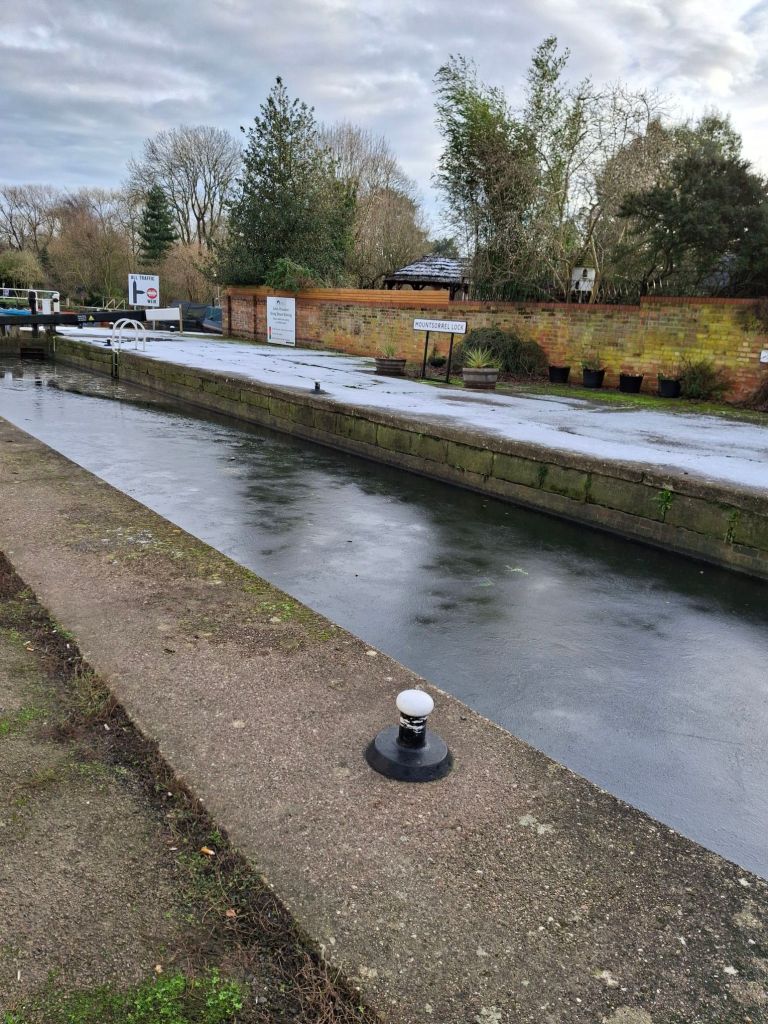
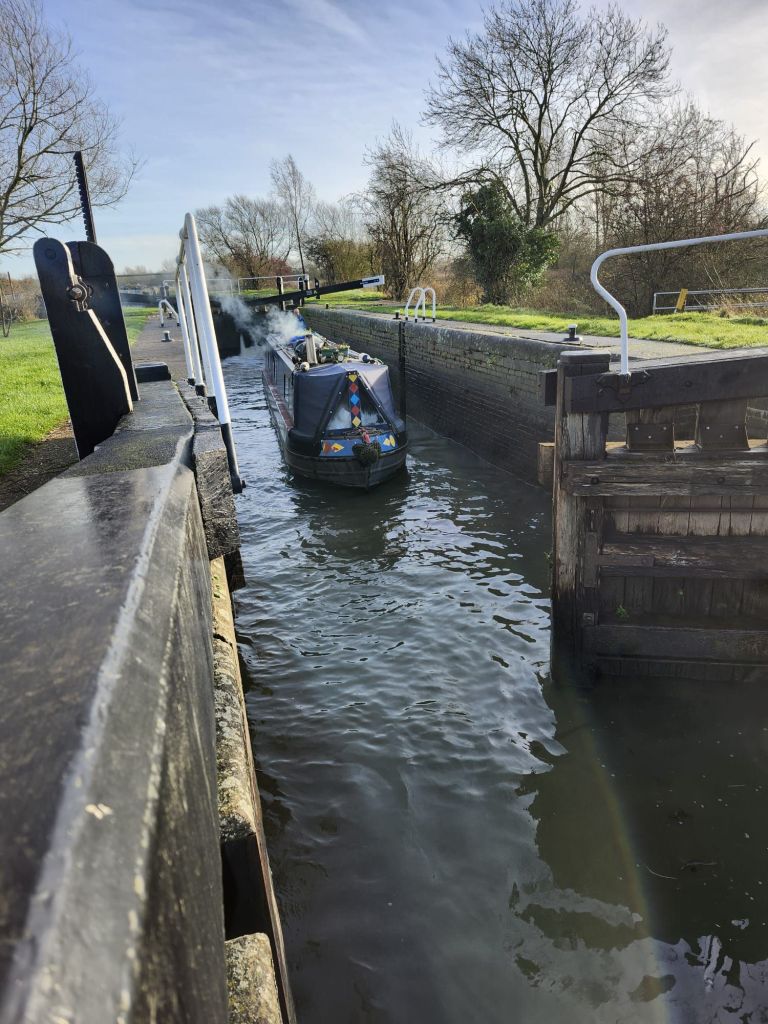
The river didn’t freeze but the lock did
Being on a river above a weir where water is moving continuously means we won’t get frozen in, but we have seen many boating friends on canals are immobile due to thick ice. The lock froze when no one used it. There has been quite an (ironically) heated debate on social media groups about whether boats should be moving in these conditions. Thick ice can damage the blacking on narrowboats and actually tear a hole in a fibreglass boat, but some boats such as the traditional coal boats who are literal lifelines to those who need the fuel they carry for power, heat and cooking have been trying heroically to make it through frozen waterways.
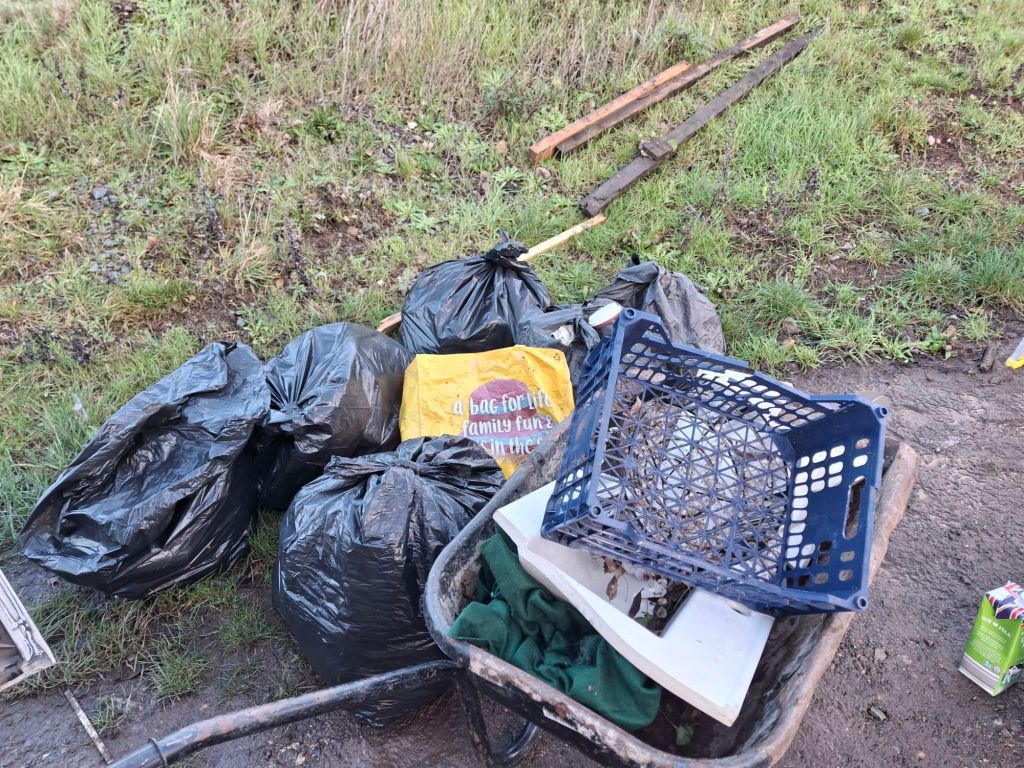
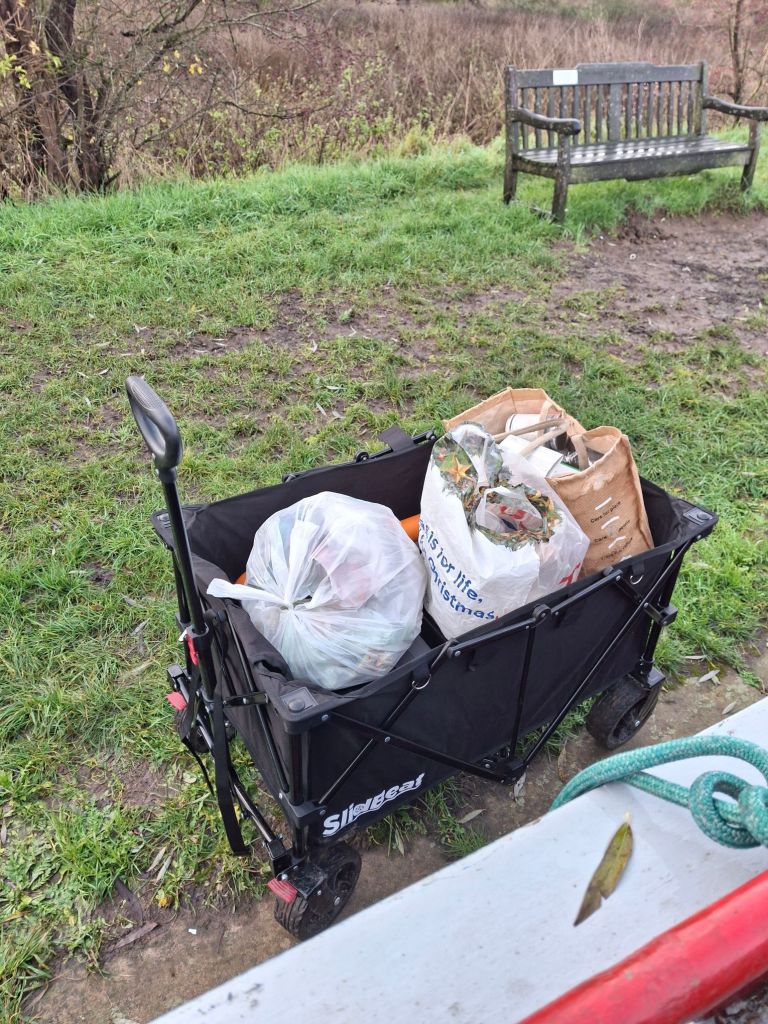
For us this week has seen biting winds and some torrential rain. Volunteering for Canal and River Trust this week was a chilly affair but worthwhile. Boatdog and I were particularly impressed with a significant haul of litter which as Shrek would say is “better out than in”. If you fancy volunteering where you are, there are many options – just visit https://canalrivertrust.org.uk/volunteer
A satisfying haul
Water levels have been rising with the rain, and further downstream CRT have this week taken action to lower levels downstream between two locks heading towards Loughborough. This they did based on the predicted rainfall, reducing levels for the length of that 3 mile long pound by 30cms, about a foot. This was to try and mitigate the risk of flooding which some households in Loughborough experienced for the first time last year when levels rose.
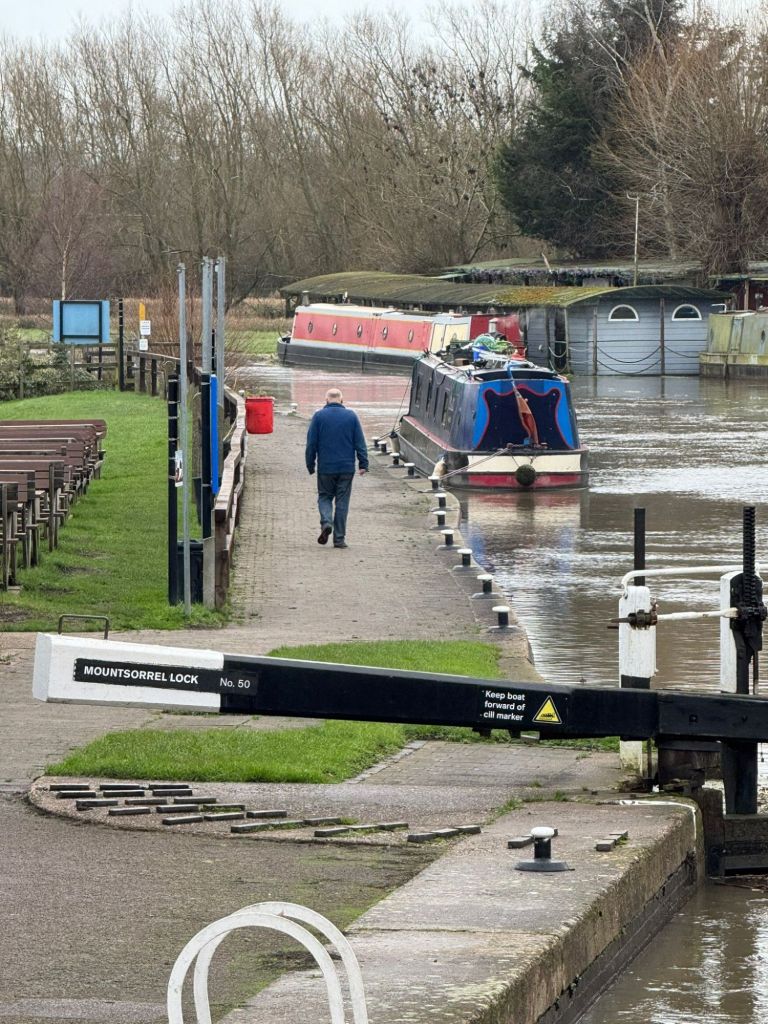
The Skipper and our home by Chris Roulston
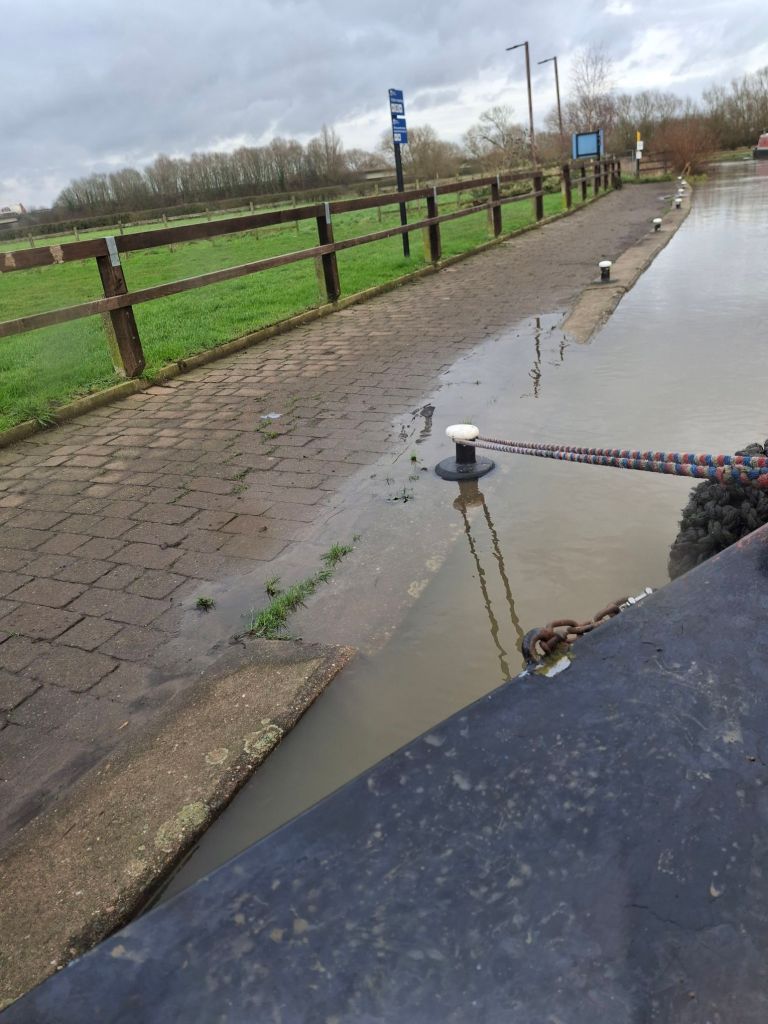
It appears it worked. For us upstream the situation has been different. We have risen about that height today as water thunders past us heading towards Loughborough the weir. If things get really nasty we could head into the lock and sit there but for now we are loosening our ropes to allow the boat to keep floating up. She would have to rise a very long way to float up onto the towpath which is a comfort and we aren’t yet at the point of needing to buy more, longer ropes to ensure she rises straight in the water and doesn’t start tipping because the ropes are too tight or short. Tipping narrowboats are not good. There are vents and exit points for water that can, under pressure and at the wrong angle become water access points, resulting in a sinking boat. For that reason we are checking ropes every couple of hours and have adjusted our fenders too. Unfortunately all our fenders are the floating variety and the side of the river at this mooring point slopes in well under the water so we are not protected from bashing against it as the flow moves us but we are fine.
As the tiver water has started seeping onto the towpath we won’t be going up much more because water will then flow away from the river across the land alongside. Some years ago when we lived in bricks and mortar near here we watched as a narrowboaters was rescued by the Fire Service from flooded fields. He had set off despite the warnings and was unaware of where the river started and stopped. His propellor became embedded in the grass and soil of the flooded fields.
On a lighter note, Boatdog has adjusted to jumping up much further to get onto the boat today than she did yesterday, and even adopted a rather ridiculous tippy toe walk to avoid most of the slush.
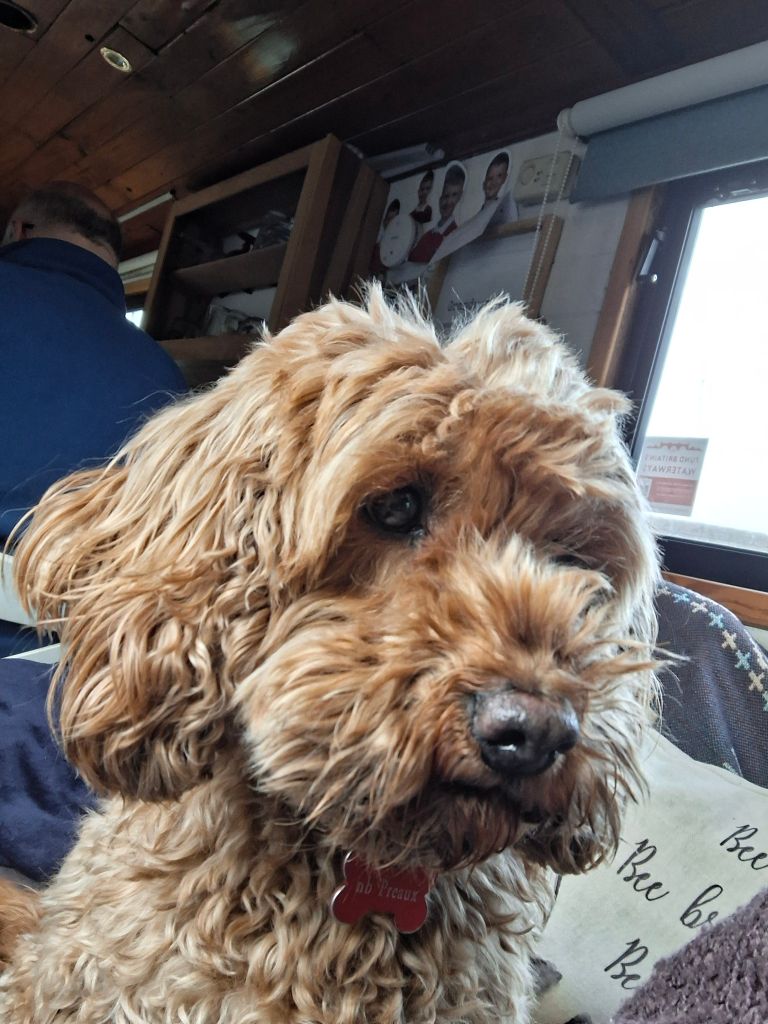
Boatdog looking somewhat disheveled after s wet walk
All this is basically displacement activity along with a jigsaw, making market bags, work and starting 10,000 hours of watercolour painting, has a positive bonus. It serves to keep us occupied while we wait with increasing impatience to meet the new arrival.
Many of us start a new year with a reflective look back at the old, but for us circumstances have resulted in a rather further look back than usual.
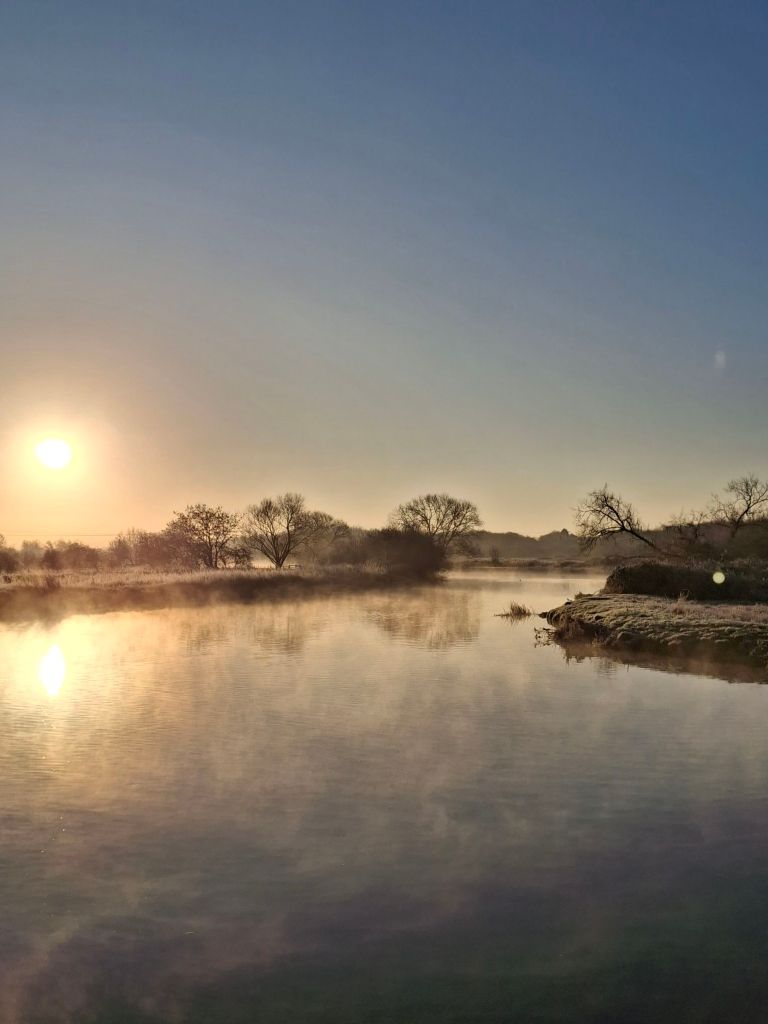
A new day, a new dawn
With a new grandchild very imminent we are back in the area where we started our narrowboat living journey over 5 years ago, and that has meant a chance to catch up with many acquaintances who we haven’t seen in person for that time. Volunteering on New Year’s Day back at the parkrun we were fortunate to help get underway (Dishley Loughborough if you need a D!), proved an unexpected spur for reflection.
Many people seemed astonished we were now on our 6th year living afloat. Some (not following our progress online) could not believe we had made it through even our first winter afloat and totally failed to be convinced when I explained how warm it is on board (we only have to heat the equivalent of a large room after all). Others said it seemed only a couple a years since we cast off. Lots wanted to know where we had been and what we had seen (north to Gargrave and Selby, east to London and Lincoln, west to Llangollen and Bath and we’ve seen far too much to fit in one conversation!).
Some were happy they had maintained the status quo of the homes and jobs that they had when we set off. Some were astonished that we continue to live our boatlife, a life we set off onfilled with trepidation. Others, who have visited us afloat or vicariously voyaged with us via our blogs and social media updates, have an understanding of the pull, the joy and the unexpected delights of this life. There are also, and always, in any of these conversations those who say they wish they could do what we are doing but feel powerless to make the move.
This week the floods abated and we managed a move to exactly where we wanted to be for the arrival of grandchild no. 2. A friend who has been to the boat but never when moving, joined us for a cruise to where we wanted to be, a chance to view the village where she too used to live from a very different perspective, and a chance to take the tiller. Anyone who has done this with us talks about what a different view they have of the world around them as they move so slowly onwards, of the delight of floating on water watching calming reflections and ripples.
A narrowboat is a mode of travel that unfolds new vistas as well as giving time for fuller appreciation of what is around – in our case the pure snowy white of a little egret set against the dark green of the invasive pennywort; the sudden flash of turquoise and russet as a kingfisher hurtles from branch to branch alongside; the sombre stare and stance of a statuesque grey heron frozen in silent expectation of catching an unsuspecting snack.
These are tiny, often fleeting, moments, glimpses of the world around us that are so important and so gloriously common for us living as we do. It is moments like this that make me, for one, wonder if I could return to living in bricks and mortar again, without the constant, almost continuous, nature boosts we are delivered. It isn’t just birdlife but animals too – shy shadowy forms of deer edging cautiously to the water for a drink, occasional playful otters, swimming squirrels, and unexpected encounters with badgers and stoats. It is nature in the round – sunsets, sunrises, weather of all types, of which we feel an immediate part, living like this. Bricks and mortar are by their very nature static, and being able to move from place to place amid nature, to be bathed by it and feel a part of it, is a remarkable privilege.
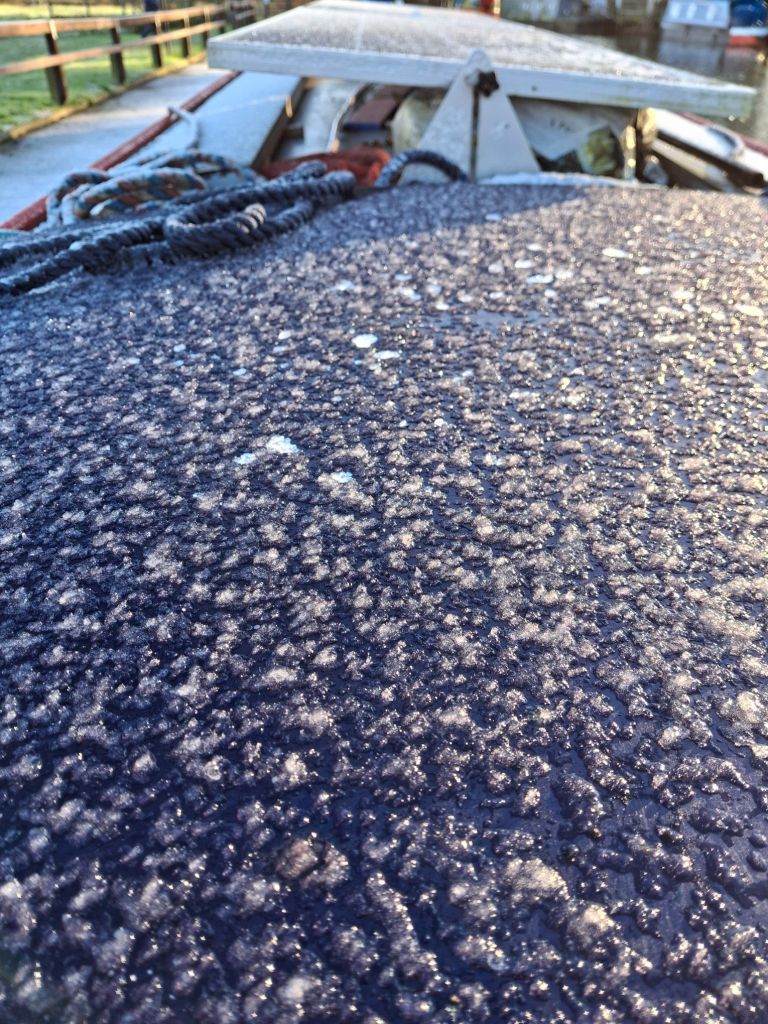
Yes, there are downsides to this life. Mud that seems never-ending in winter, a constant grumble on our boat about hot water (lack of is getting resolved…), the carrying of heavy winter fuel, the excesses which affect how we move and live from droughts to floods, the occasional moments of getting stuck somewhere you don’t want to be, today it’s frozen ropes, iced hatches and slippery towpaths…
Ice
Sometimes we wistfully dream of country cottages with flourishing gardens, with flushing loos that don’t have to be emptied, and yet the balance always seems to come down firmly in favour of living afloat.
We don’t have a bath on board, but that makes going somewhere that does a massive treat. We don’t have unlimited space but that means we will be offering our soon-to-be-multiple grandchildren very individual attention (one staying at a time!). We don’t have a garden where I can grow whatever I like (but I can grow many things, I don’t get affected by slugs and am already planning a different fruit and flower combo for this summer’s roof garden).
What we do have are unlimited boosts to the spirit, multiple times a day. Changing places and people, new experiences and new delights on a regular basis. A community which is built on shared experiences and values. Priceless – and all wrapped up in an offgrid lifestyle that means we travel as lightly through the environment as we can, actively and positively trying to live thoughtfully in the world, doing our bit to leave it better for our grandchildren.
What we have on a daily basis is more than dreams. What we do in daily life is more than just imagining. How we actuallylive now is more than fantasy. There are compromises, but a lot fewer than people imagine.
We know from experience that it is better to LIVE your dream, than dream your life away. In 2026 we can hope that many more people are able, like us, to live their dreams and make them work.
May we all, like Boatdog, live our dreams – in her case to firmly hog the sunny spot!
2025 has been been a dramatic year living afloat on the inland waterways. It started on New Year’s Day with a large breach of the Bridgewater canal at Little Bollington in Cheshire, a breach which is still being repaired.
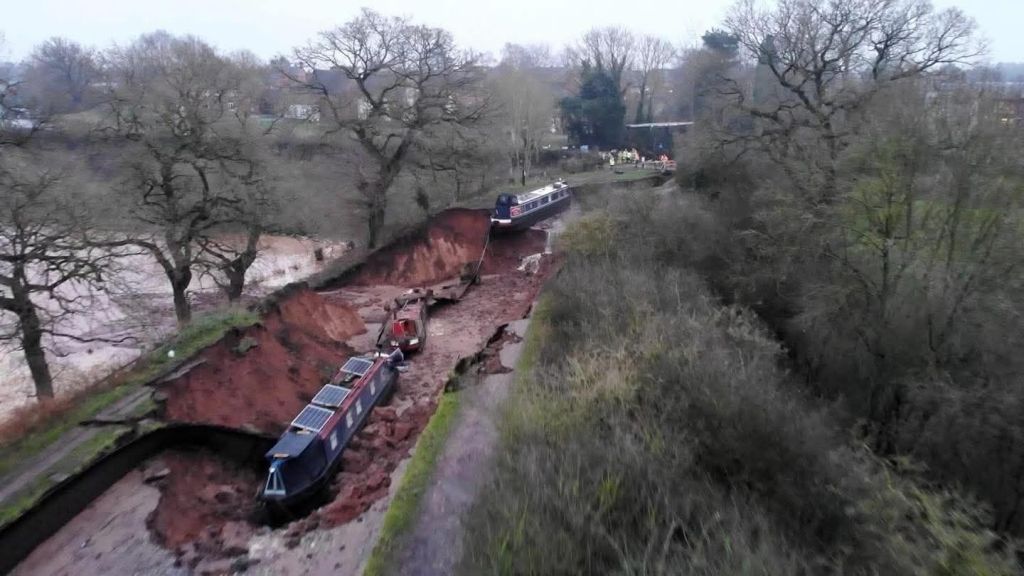
It ends with a dramatic breach on the Llangollen Canal near Whitchurch.
Luckily neither of these led to injuries although the most recent has damaged boats and left some boaters homeless. It has also seen the significant raising of funds to support them by boaters and others, hire boating companies rapidly stepped in and offered temporary floating homes, other people came forward with clothes, Christmas gifts and support.
Crises such as these bring out the best in people, and in the floating community we know just how strong that supportive, helping, positive spirit is. We haven’t been hit by breaches this year but our thoughts go out to all who have.
Two major canal breaches this year, along with some other less severe ones, makes it highly likely that these issues will be something we all need to navigate or at least anticipate over the coming months and years.
This year we have faced unprecedented flooding that led to an emergency evacuation around us – we survived better than those around, staying safe and checking, loosening ropes every few hours as the waters rose. We also had to contend with drought leading to low water levels – just as discombobulating to be honest, albeit drier underfoot.
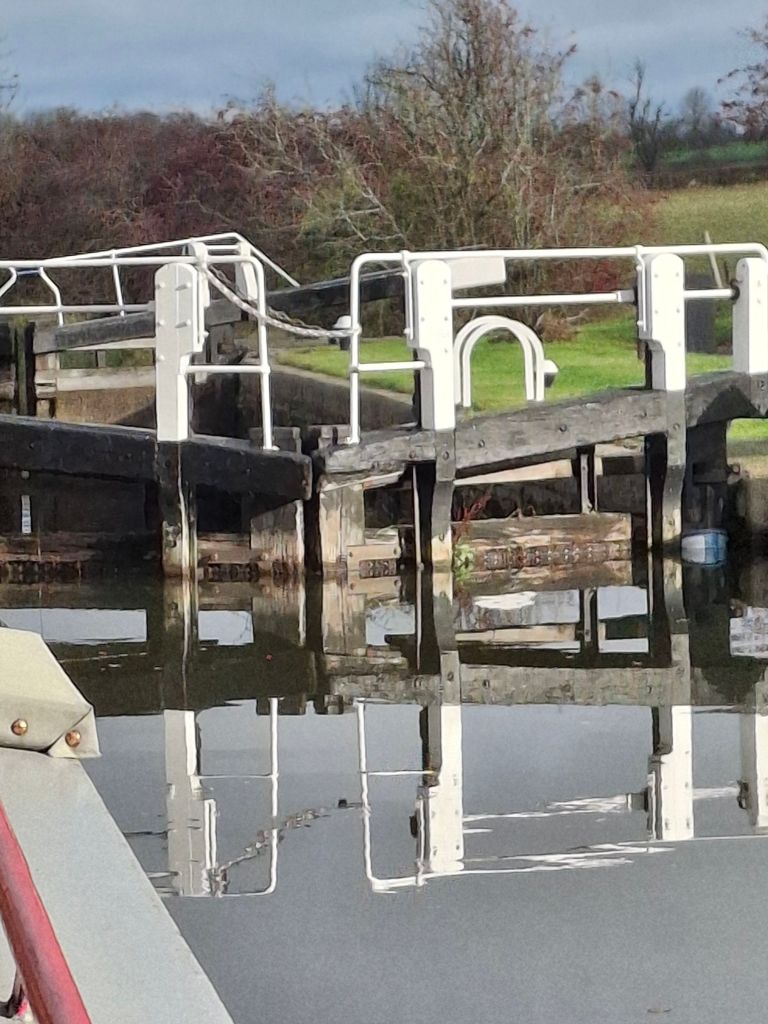
Chained locks
It has led us to think differently about our year ahead, as continuous cruisers we need to keep moving to stay within the terms of our licence. This year though, we have found ourselves not moving as much because of the conditions brought about by excessive water and crippling drought.
We experienced flooding at the start of the year and now at the end of the year has resulted in river levels being too high to safely navigate. We are ending 2025 as we began 2026, back on the River Soar in flood, so we are once again unable to move. We also had several months when we were unable to move in the summer because locks were locked to stop navigation due to a lack of water. We joined queues for locks about to open and experienced the anxiety of wondering if we would get through before they were closed again. We made it through 5 storms without incident – Eowyn (January), Florian (August), Amy (October), Claudia (November) and Bran in December.
Next year we are likely to experience the same issues of floods, storms and the network is likely to face more breaches because of conditions, so we shall manage what we can, pray the damage during those incidents we cannot manage is minimal, and ensure our insurance is up to date.
Whatever happens we anticipate an exciting and memorable 2026. We are back on the River Soar waiting for the arrival of our second grandson in a matter of a few weeks. Once he is safely here we shall be cruising for a while before returning to Leicestershire for the arrival of grandchild no. 3 at the end of May! Our daughters have very conveniently arranged things for us that this can be the year of babies!
Boatdog volunteering for litter picking duties
2
All this means we can be volunteering for CRT in areas and with teams we have got to know which will be a delight. This year took us (volunteering en route) from the River Soar along the Leicester Line, the Grand Union, down the Aylesbury Arm, onto the now closed (breached) Wendover Arm, then a lock outage sent us back along the GU to the Oxford canal, onto the River Thames, the Kennet and Avon to Bath, back along the Thames and tidal Thames to rejoin the GU at Brentford, and up onto the Leicester Line. For those who love stats (and I know there are many who do) that was 794 miles, through 598 locks (one of which – Grants Lock -we were towed through by CRT staff and volunteers due to lock damage).
Next year we anticipate low mileage again as we explore nearer to the family, heading into and around the Birmingham Canal Navigation. This year because of stoppages, detours and navigation issues we have met many delightful new people on and off boats, so we now look forward to halts and dramas with delighted anticipation.
This year we’ve had a gorgeous solid wood kitchen with ingenious storage and beautiful finishes – thanks Ben at Holm Oak Trading, and a new well deck – thanks Kev Kyte.
I think our mantra for 2026 has to be – expect and enjoy the unexpected, and always leave phones, shoes and a bank card within reach for handy grabbing in case we have to leave the boat in a hurry. We don’t have to worry about Boatdog being left behind anywhere – where I go she goes with alacrity!
Being on a boat does have its risks, but it has immense rewards that still outweigh the drawbacks of bricks and mortar for us so we shall keep cruising as and when we can. That’s our goal, oh and to at last get hot water on board that doesn’t come from boiling a kettle! It’s good to have dreams.
All that really matters is a happy and healthy year – and that is what we wish for all you wonderful people who have travelled with us via this blog. We look forward to travelling together for another eventful year.
It’s been looking a lot like Christmas this week. The on/off flood situation continues and water remains an issue both around and in the boat. And Christmas is edging nearer.
Last weekend saw our annual four generational family meal, which the boating community made easier. The river was rising as Boatdog (in a coat to reduce clinging mud) and I (in wellies) plodded through the mud and fields above the lock, her food and bowls in my backpack and my weekend bag containing a skirt (not worn one of the one for a while in the wet and mud). By the time we got to the road and the immaculate car of my lovely brother-in-law we were ready to shed muddy coats and boots into the bags I’d brought for them so we weren’t totally obnoxious passengers! Flood water was just beginning to cover the road as we drove away.
One of the major advantages of this floating life can be the community around. Moored near us is another boater who has been having engine issues. He assured me he would keep an eye on the boat, loosening ropes as necessary, and so did two of the permanent moorers nearby, one of whom has my number, and a man from the nearby boatyard. So nb Preaux was facing rising waters but with more attention than she would have had with just me on board (the Skipper headed north before me to stay with his mum).
Leaving the boat alone on a river at this time of the year is always a worry, even though we’ve done it so many times that I should be used to it by now. Equally I know from experience that other boaters are generous with their support.
After the family weekend Boatdog and I squelched our way back to the boat after a lift from our youngest daughter back from the north in foul driving conditions (glad it was her behind the wheel with her youthful reaction speeds rather than me). The wind was howling and rain still falling as we slithered back across soaked ground to the boat to find her exactly as we had left her. Within 5 minutes the dog bowls were filled and back in their place and the stove was lit. That for me instantly makes a cold boat feel like home.
No sooner was I back onboard than I was repacking bags and heading off to housesit in Derbyshire, swapping places with the Skipper so he has the boat to himself for a change. I love the regular times when I have the boat to myself, but am also aware that the Skipper rarely gets that treat. I have no idea what he wil choose to do buy for me solo time allows me an opportunity to potte, craft, write and ignore the frustrating interruptions of refular mealtimes. When I do eat it is nearly always fish on these indulgent weekends because the Skipper is allergic to fish.
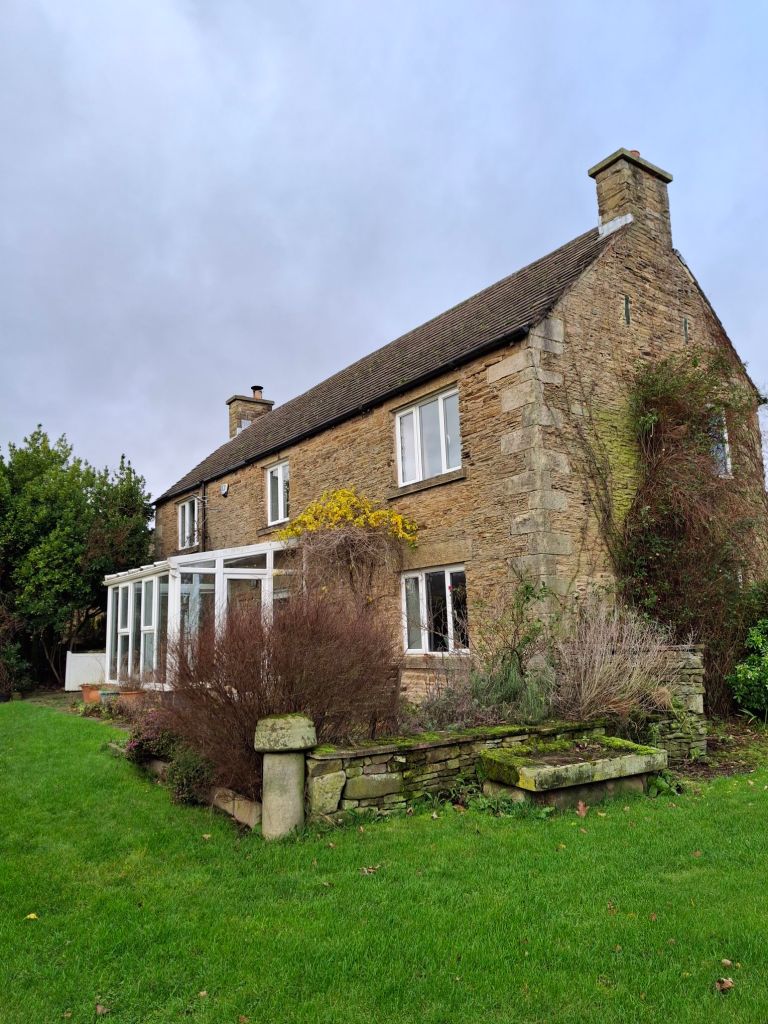
So he’s been on the boat for part of this week by himself, and I have been rattling round a stone farmhouse. It seems vast, and just getting from bed to the kitchen takes a trek rather than 20 steps!
Bit bigger than a 60ft narrowboat!
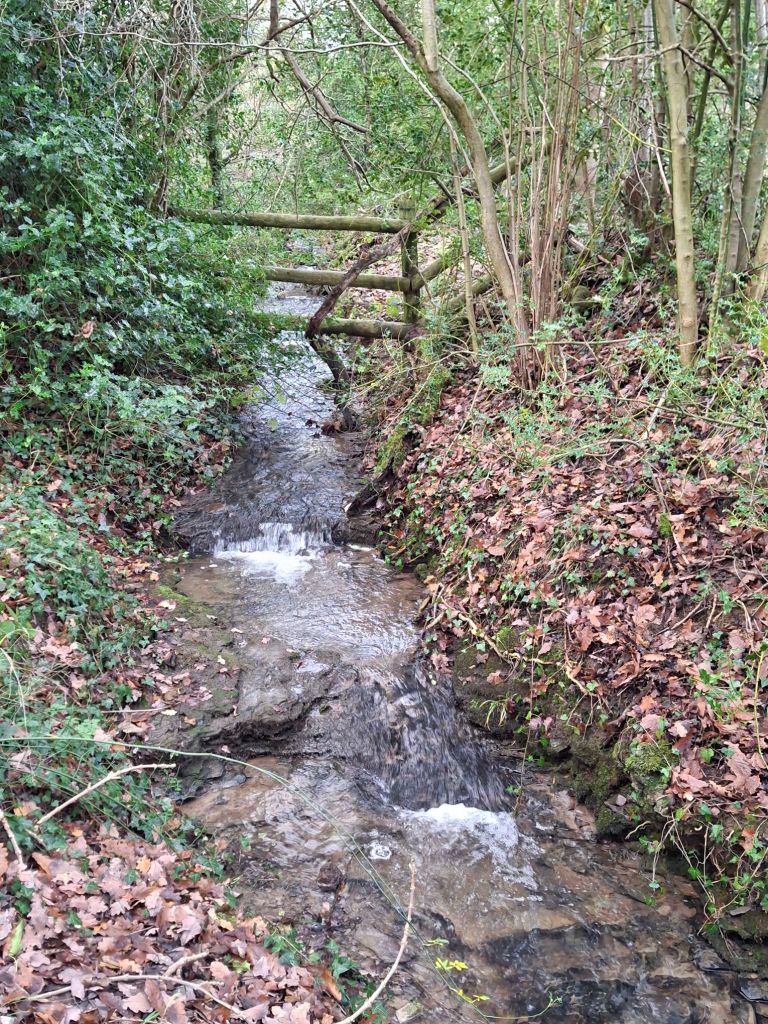
Boatdog is tentatively exploring her new environment with growing confidence although she and the resident cats have a bit of a stand off – demanding some new feeding arrangements. She adores the fields that run down from the farmhouse to a stream at the bottom which is flowing fast after this week’s rain.
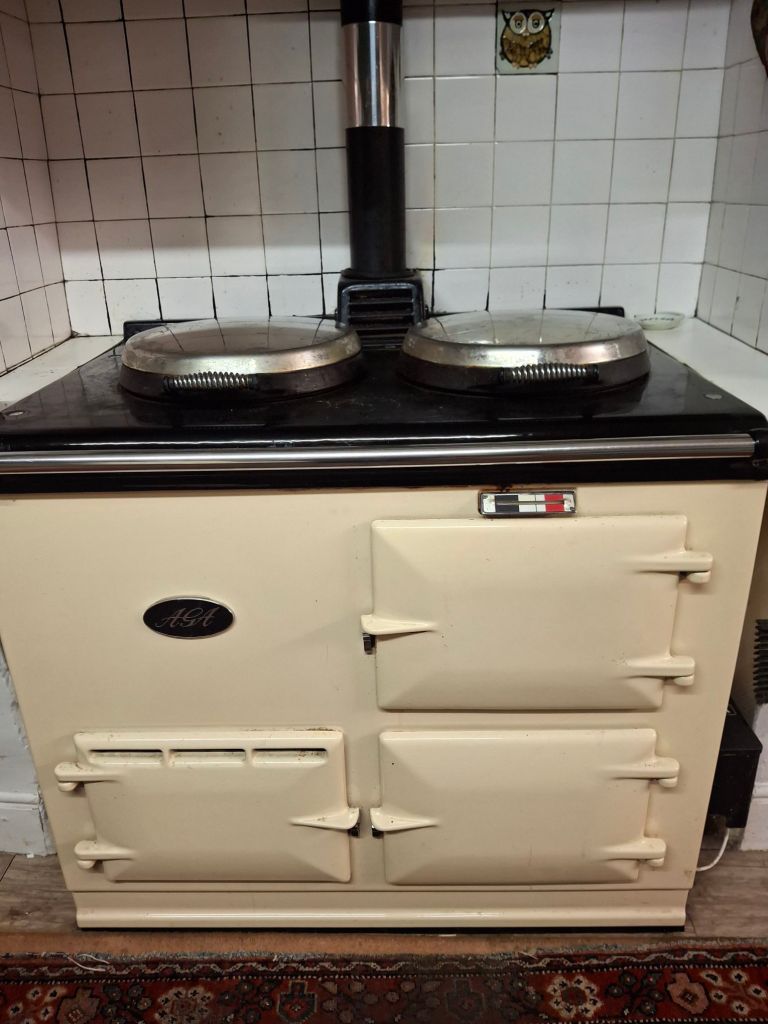
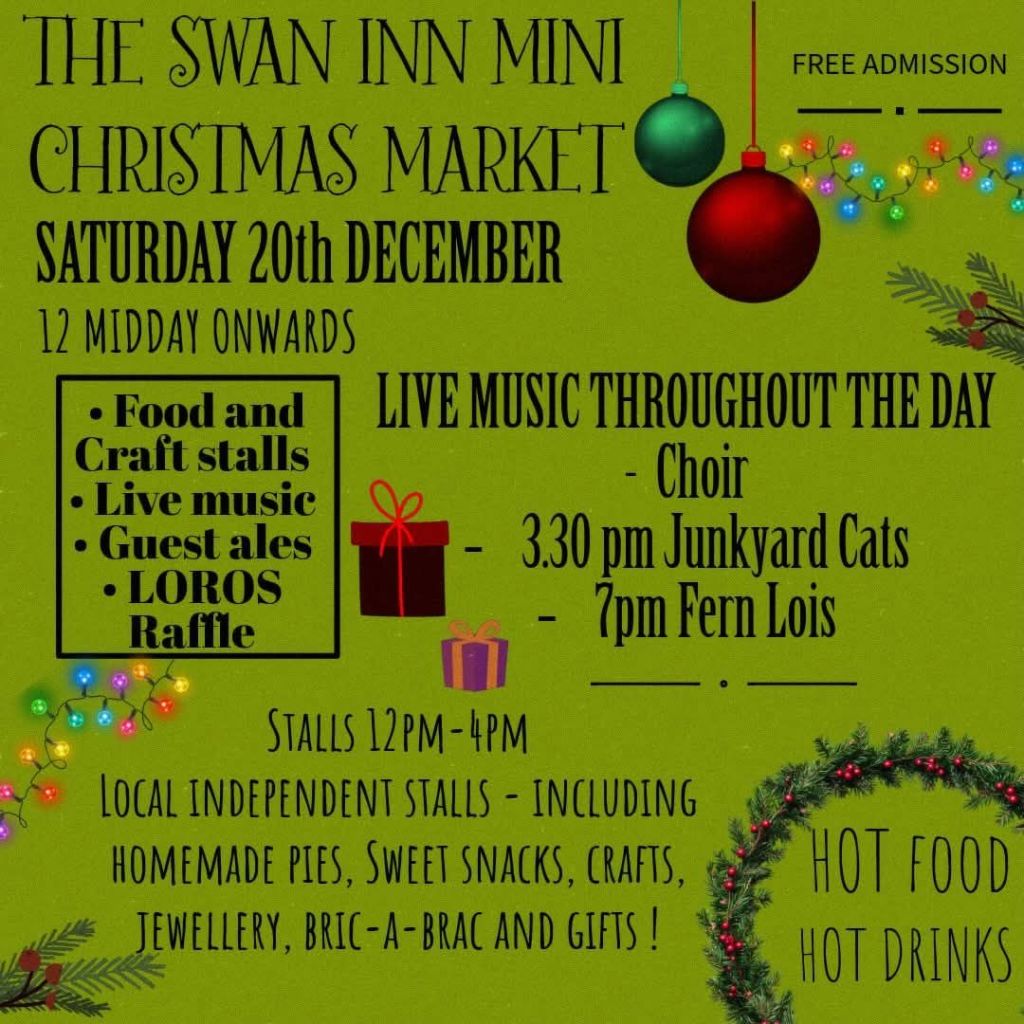
I have enjoyed a farmhouse kitchen with a table I can indulgently spread out looms and weaving, crafting and painting ready for my final craft market back in Leicestershire on 20th. I’m also preparing to take advantage of the Aga to cook Christmas fruit cakes (a little later than stir-up Sunday but better late than never).
Parcels ready for festive stocking are being delivered to our elder daughter’s address and by the time I get back I will be armed with wrapping paper as well as cakes!
Back on the boat the flood waters are subsiding and the Skipper is anxious about the water tank is getting very low so he really wants to move the boat this weekend with support from the sons-in-law and of course if there is no return of the river to flood. Will he make it? Where will our floating home be by the time I get back? Will I even find it? Watch this space to find out or if you find yourself near Mountsorrel on 20th – come and join the fun (and find out in person!). Be great to see you.
Oh yes it has, oh no it hasn’t, been one of those weeks! Seems appropriate as Christmas and panto season is arriving with alarming alacrity.
Having cancelled our floating trading licence after the weather conspired against me continuously in 2023-4, this year I have focused on land-based markets, and this week was the first. Like millions, I love crafting, but on a narrowboat there is only a limited amount of space for all the things I love to make, so the only thing to do is to sell and donate them to charity when we get to the limits!
This year’s first market was the Christmas Lights Switch On Fair in our former home village of Mountsorrel. It was a glorious moment to catch up with people as well as have fun listening to people appreciating the things I have made. It coincided with the river coming out of flood, so we did a quick recce of possible downstream mooring spots en route to the market. We found none. Two wide beams and a cruiser on the next, and some distance away the winter moorings were full but there were some possible towpath spaces where we could use mooring pins but we had other things to think about that day (oh yes we did).
Sunday we turned our thoughts again to moving but the strong wind put us off, and we weren’t at the 14 m-day winter limit anyway, so we snuggled up to the fire and stayed put. Both of us have had a week of seeing lots of people in indoor spaces and it was evident that we hadn’t come away from those meet-ups with only happy memories. At first we thought we’re imagining it, but then the colds sneak up on you (it’s behind you).
They say you shouldn’t marry someone until you’ve lived through a heavy cold with them. Having lived through decades of colds together we would add to that – don’t move onto a narrowboat with someone until you’ve both lived through heavy colds onboard together. It adds real challenge – in a house you can get away and shut yourself in a bedroom with tissues, hot water bottles and your misery. If both of you have colds you can usually find your own space to sweat out the worst. It is very different on a 50ft narrowboat, but narrowboat Preaux is also a delightfully cosy space to just snuggle up and embrace a bit of feeling ill-time. It is also combined of course with regularly donning wellies for a slippery, squelchy walk in the bracing air with Boatdog and myriad wildlife. That is something which probably helps my recovery quicker than anything else (oh yes it does).
We also benefitted from being outdoors each giving a day of volunteering to Canal and River Trust this week. Fence repairs, painting (said new fencing plus overpainting graffiti), and for Boatdog and I, a lot of litter picking.
The river had gone back into flood (oh yes it had) so there was no boat traffic to help through the lock where we were working. It also constrained the distance I could litter pick. A few hundred yards after the lock the river was lapping at the towpath and within a few steps we were splashing rather than walking but also able to pick litter washed up onto the slimy mounds alongside.
The bright green is living pennywort – the brown mounds decaying cleared pennywort
These browning mounds are piles of decaying pennywort at the side of the river that has been (at significant expense to CRT) moved out by one of the small weed boats. Once removed from the water it does decay rapidly, but in the water – it creates horrendous dense mats of weed that stifle wildlife, water oxygenation and boat movement. It is one of those baddies (boo, hiss) that is invasive. Originally introduced as an aquatic plant for garden ponds (oh yes it was) it soon escaped to cause chaos to our canal and river network (oh yes it did – BOO HISS).
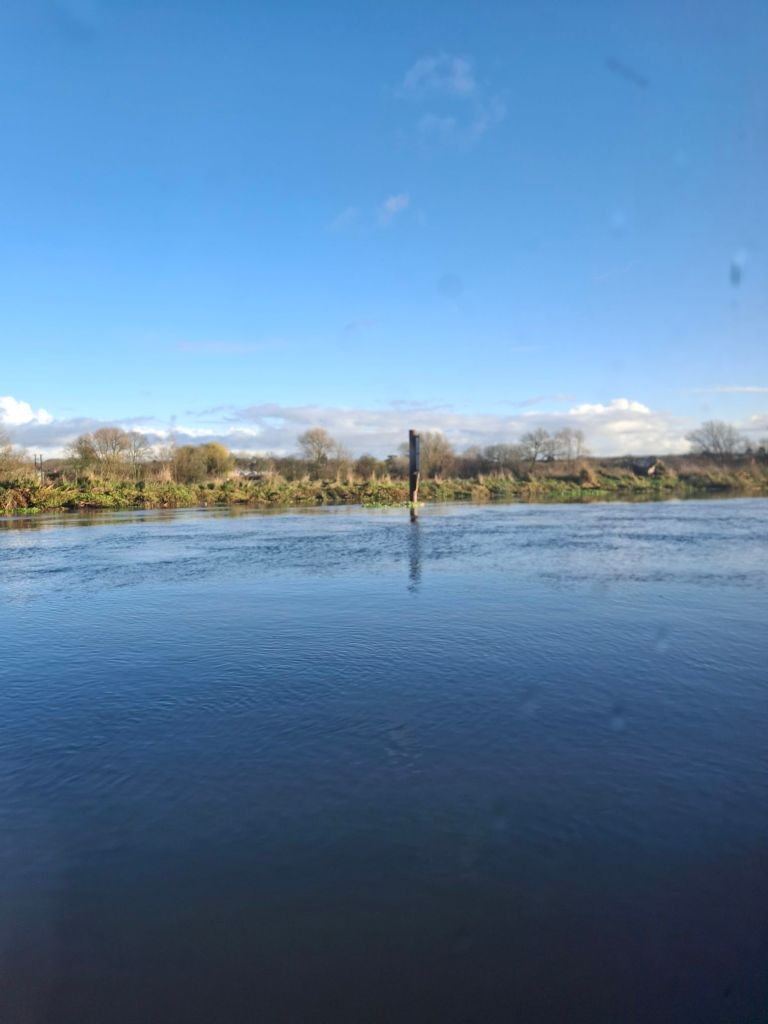
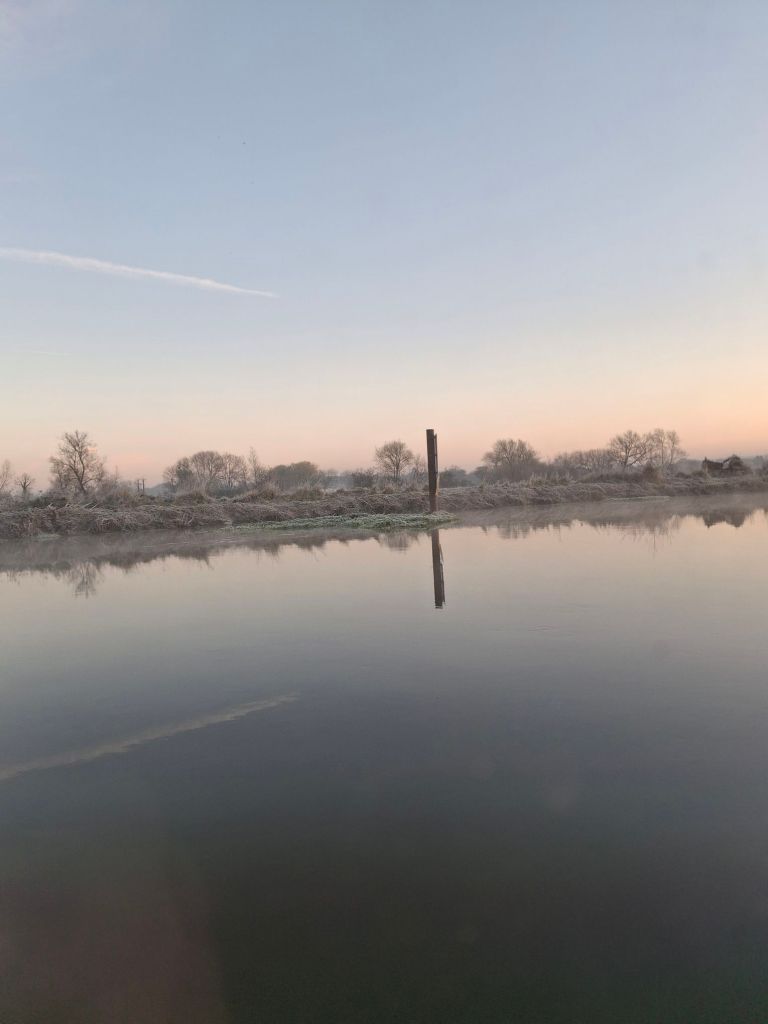
Opposite our mooring is a warning arrow on a substantial metal pole telling boaters to keep left to avoid the plunging weir. In its own way it has become a collector for the dreaded pennywort, and also a very good indicator of water levels for us (oh yes it has).
We have appreciated that, although we monitor Environment Agency river levels and get alerts from CRT it has been easier this week to keep an eye on levels in situ. At one point we had an alert saying navigation was open as river levels had dropped but the weather clearly wanted to ensure we all knew who was in charge and literally as I walked the dog in sunshine reading that message the clouds gathered (oh yes they did). Arriving back drenched (good thing the stove is now on 24/7) I watched as the boat rose and the river began to flow faster. Within hours we had a navigation closed notification! We all know who’s in charge (oh yes we do!). I’m sure a pantomime dame would make much of regularity of rising and falling river levels… (!)
So we have a new conundrum – 14-day moorings obviously cannot include days we cannot move because we have been advised against navigation, so do we add all the days that we could have moved together to give our 14 days in one spot, or do we start 14 days from each time we are allowed to move? Will the CRT licence checkers do the same? Basically CRT’s website advises just that casual towpath moorings such as the area where we are, are 14-days. It appears that safety, common sense and pragmatism must be the order of the day for us all to achieve the required happy ending in these winter weather conditions.
It does appear that the weather is contributing to a better outcome for the summer too – of the 13 reservoir groups feeding the navigable network all bar one (Grand Union South) have increased. Two lesser used canals, Grantham and Lancaster now have over 93% reservoir capacity, so usage obviously has a bearing. Having said that, the Grand Union North where we were stopped earlier this year because of a lack of water had a reservoir capacity last month of 48.5%, it dropped from the previous month by -0.6% but was a level only 3% higher than its historical lowest in November 2003.
So far from despairing about the rising river levels and sodden fields, the closed roads and dripping coats above the stove, and moaning about lugging our waste trolley through mud, we are welcoming them if it means that for all of us, this summer will be one we are able to handle better as boaters, farmers, consumers of that so precious and vital resource – water. We hope the marriage of winter weather with wise water management will give us all the essential and hoped for happy outcome (oh yes we do).
In one of his 43 poems – yes, 43 – about the life of a river, Ted Hughes observes:
The winter floods have ruined her.
She squats between draggled banks, fingering her rags
and rubbish.”
And so it is as the flood waters drop on a river leaving debris hanging from overhanging branches and piled on flattened banks like tattered Christmas decorations.
The danger sign on its metal pole is getting nearer to the water as the levels rise
The connections between rivers and humanity, nature, and life itself are myriad. Rivers are made by nature. Canals are made by man.
Rivers may by subverted by man, as a tiger may be tamed, but at heart we all acknowledge their wildness, their potential to revert, the latent danger in that lurking power.
In his book Is a River Alive? Robert Macfarlane explored whether a river is a living entity, with ensuring rights and demands. Macfarlane hails from Nottinghamshire, a river’s journey from where we are currently moored on the River Soar. It is on the county border of Leicestershire and Nottinghamshire that the Soar ceases to be a single entity as it merges with the mightier River Trent and together they head out to sea through the mouth of the Humber.
The Soar has reminded us this week of its demand, its requirement, for respect. When we arrived at our current mooring the river had just come out of flood. Our passage along its length had been strewn with the debris and detritus the waters had sucked up and spat out as levels changed. Tree branches near the water trailed plastics and fabrics. We fished much out as we travelled, the boating equivalent of plogging, but in a narrowboat you can’t get too near to the edges without getting stuck fast in silt, so what we removed with net or by delving deep in our weed hatch had been floating rather than caught or draped.
At this time of year the Soar is subject to sudden and often quite significant fluctuations in level. Rainfall can make the river rise rapidly, by up to 4ft.
This week we saw that on Saturday. The nearest Environment Agency measuring station is at nearby Pillings Lock, some miles down stream. It indicates what is happening, albeit after it has begun to happen up here. We were both out at separate family social events when the Skipper saw from his phone that levels were rising, and rising fast. Boatdog and I were nearest and set off rapidly to check the situation.
When we left the boat where we had moored her at 11am that day we had to step up about a foot from the stern (back) to get onto the river bank. By the time I returned around 4 hours later, I had to step up onto the boat from the riverbank.
I loosened the ropes, checked my knots, checked the mooring pins at the bow, and banked up the stove to give us warmth to dry clothes and ourselves as the rain hammered down. Going out every couple of hours to check ropes aren’t too tight, dragging the boat down, invariably ends up with wet coats.
We are moored above a lock with two weirs close by. One weir is behind us, and one off to our left. If our ropes were not holding us firm, the boat would likely end up on that weir and probably overturn within a short period of time. In marinas and on permanent moorings, poles and rings on them, allow boats to rise and fall with the flood waters, but one still needs to keep a weather eye that they don’t catch, generally as the waters subside and the boat descends. We though are moored to a fixed short bollard at the stern and our own mooring pins banged into the sodden ground at the bow.
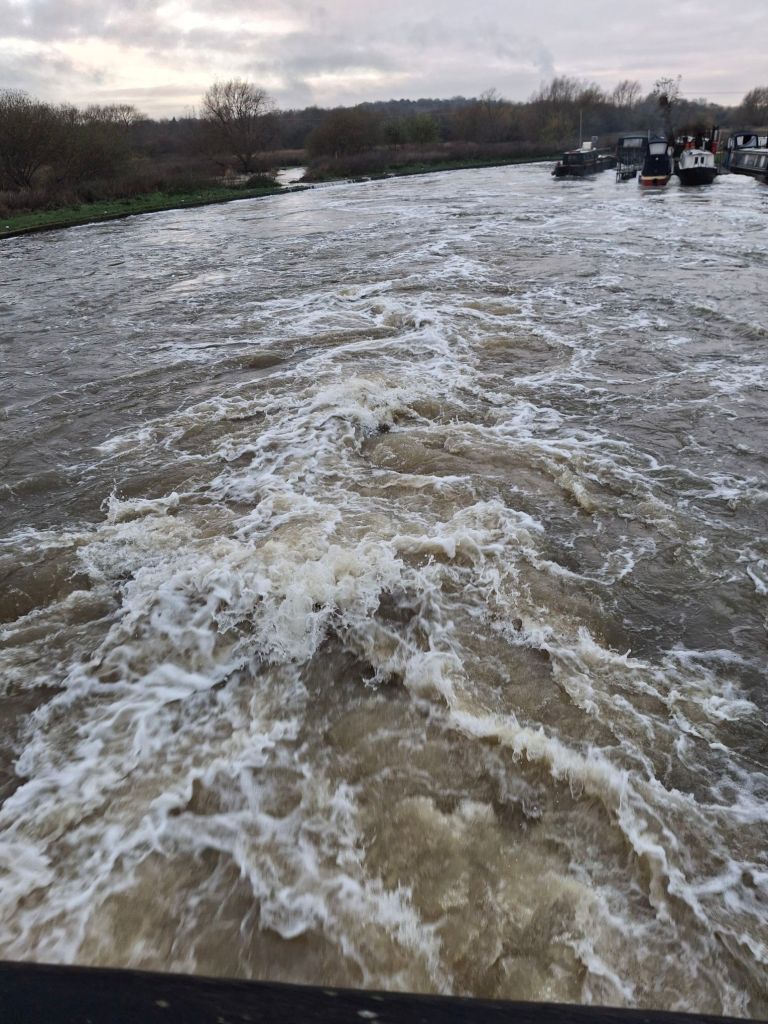
The name of the Soar stems like so many other rivers from ser- which means “to flow” and it lives up to its name. It is constantly soaring, constantly flying. It thunders down the weirs and rushes through gaps in the lock gates, and it is more obviously flowing at times of flood.
Within days of the sudden rise though, it was back to a more gentle flow as the flood waters abated, leaving paths sticky with mud, and grassy banks sodden and slippery.
This is one of the differences of a canal and a river. While one is made by man and one by nature, the constant movement is probably the single most obvious difference between the two. Rivers flow, it is in their DNA, their nature, their life force that they have to keep moving. Even though the flood has abated, I can still hear the white noise of the water cascading over the two weirs. This is winter though, and the nature of the river is that we know we should expect flooding regularly.
Water cascading down one weir at force
The river is also deeper than the canal. It is noticeable that the boat handles differently. With a depth of water beneath her she travels more smoothly, more easily, and faster too as we go with the flow.
So the sound and the feel of the river is different from a canal. It looks different too, wider in so many places, and the constant movement makes for a different smell in the air. It smells fresh, unlike the stale water of the canal we passed through to get here. At times when I let water into a lock, leaves which were gathered and had been lying under the water for months suddenly were churned up with the silt that had been quietly coalescing. The resulting released whiff was hardly pleasant.
But on the river the water is racing, it is tumbling at the weirs and gasping in air as it charges headlong.
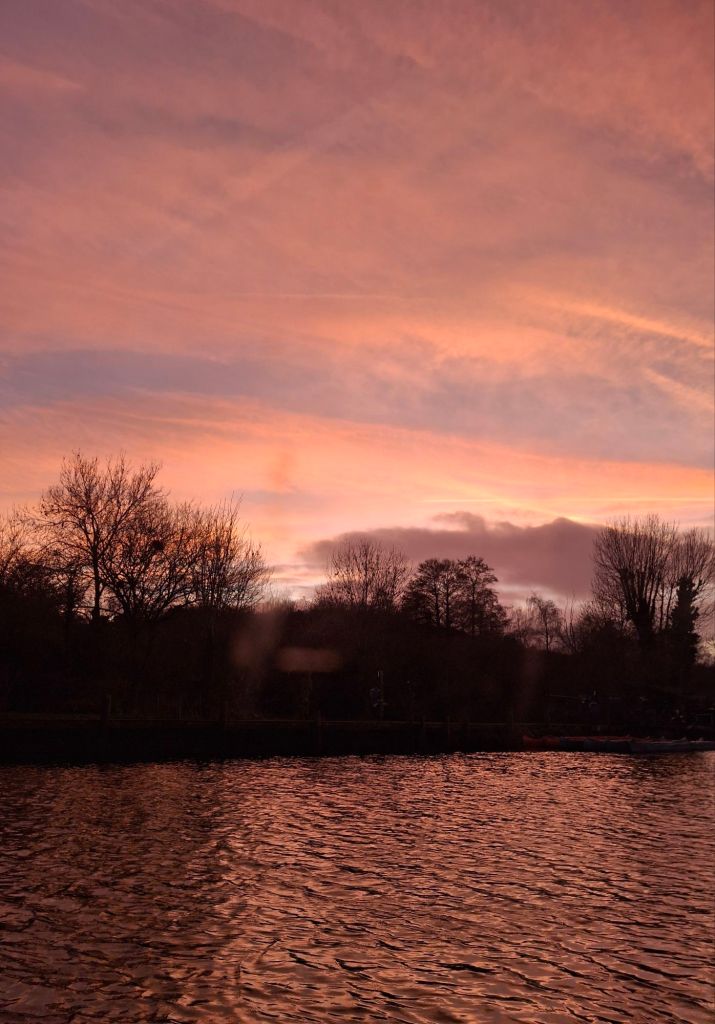
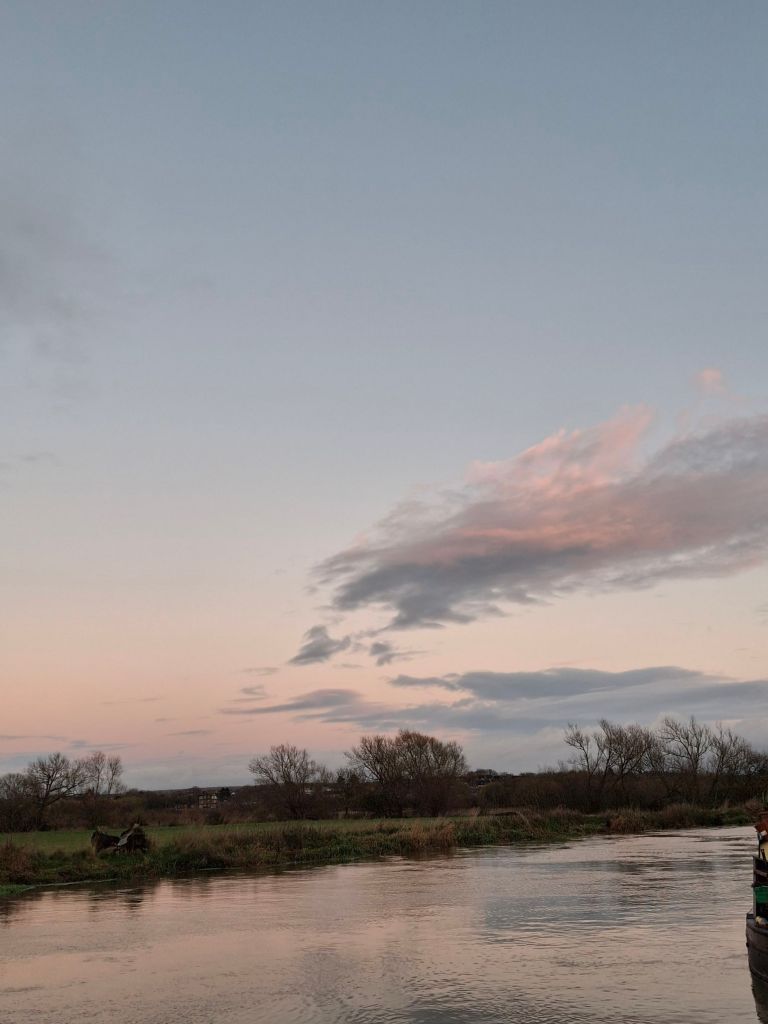
We have sections of the Soar which have been canalised during the time when water transport was a commercial operation. That gives us locks from time to time. At one stage in its history, the textile industries of which the Soar was a fundamental part, in terms of transporting raw materials, finished goods and providing water during the manufacturing process, turned the river pink.
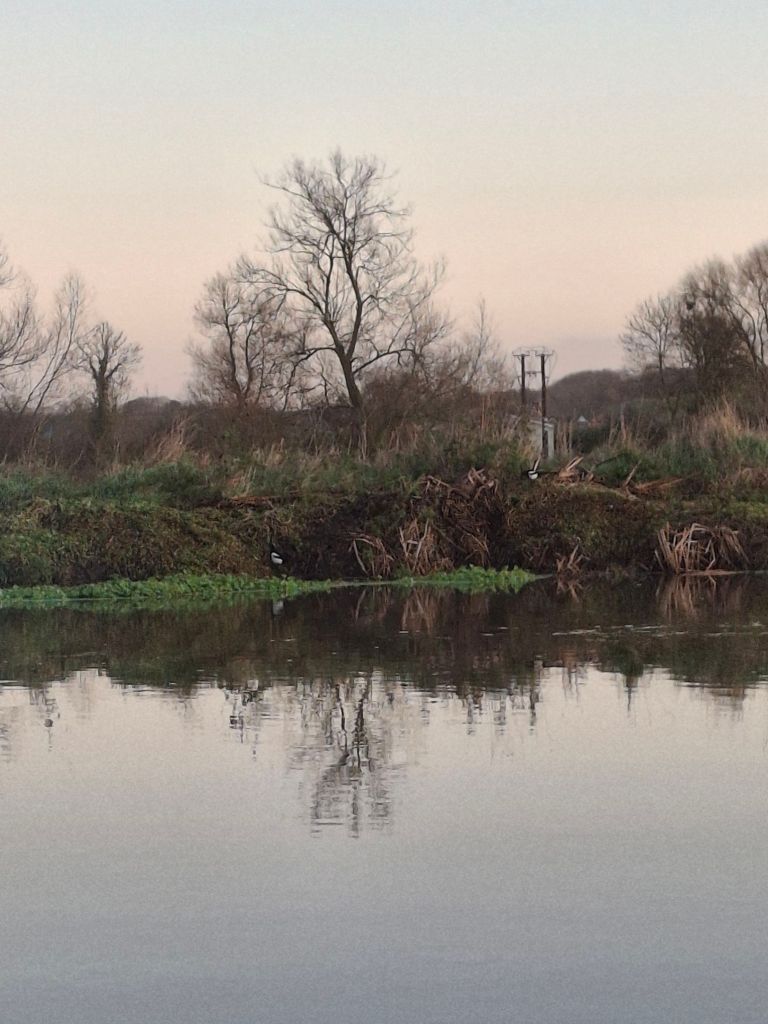
The river – pink now from evening clouds
At its height, around 1895 there were 231 hosiery manufacturers listed in Leicestershire, one of whom was my great grandfather and then in later years my grandfather took over the family factories at Leicester, Burbage and Market Harborough.
The Soar was vital for their business, and it is now vital for our way of life.
The fact it is moving, living, and (like us) constantly travelling, gives us an affinity with the Soar. But like any travelling companion, it demands its own space, and our respect. I hope in ecological terms, we and future generations will respect the needs of the Soar more than those who came before us did. We wish to nurture not pollute and to celebrate its capacity for leisure, and living rather than diminishing the river, its health and strength.
Crisp white frozen edges but still the deep waters flow
For the first time the passage of our 50ft floating home (plus office,studio, and workshop) along inland waterways in sub zero temperatures made a man dash out onto his balcony in just his dressing gown to see us.
Despite his fetching black and white striped gown with bare legs and just slippers he must have been freezing but he wanted us to know we were the first boat he’d seen on that stretch of the Leicester Line for months.
Here we are on the Leicester Line- couldn’t bring you the man in his nightwear!
The Leicester Line of the Grand Union Canal has been a casualty of the driest Spring and Summer this year and also of the sudden downpours of Storm Claudia. One end of the waterway was closed because of a lack of water but then reopened when reservoirs rose slightly. A mid section simultaneously remained closed because it had insufficient water for navigation, and at the same time heavy rains caused the river sections to flood. A perfect micro storm perhaps.
So we had begun to think that our plan to bring our boat nearer to our family whose homes straddle the River Soar which forms a large part of the Leicester Line, was probably not going to happen. Last Tuesday, having returned from a week’s holiday in the West Country, we headed onto the Market Harborough Arm passing through the manual swing bridge at the foot of the still closed lock flight at Foxton.
We thought we could spend a month or two pootling along to Market Harborough and back until perhaps the water levels meant we could finally head to Leicester and beyond. Not ideal but here seemed no choice.
Until late on Tuesday that was. During the day we got a message to say the closed section that had been short of water was going to open on Wednesday morning because levels had risen. Foxton Locks was also to reopen (not relevant to our travel plans as that would take us in the wrong direction). A further message said the River Soar was now declared out of flood and so navigable.
So everything (apart from the fact we were pointing the wrong way) aligned to give us hope that we might, just might, make it through to be near family before our newest grandson arrives. We debated whether it was safer to stay out, but by late Tuesday evening the decision was made and at first light on Wednesday we set off, through a swing road bridge to turn the boat at the nearest winding hole (a place for turning boats). Once facing the right way, it was back through the swing road bridge again, and then we had to open and close the swing foot bridge a before we could start our journey proper.
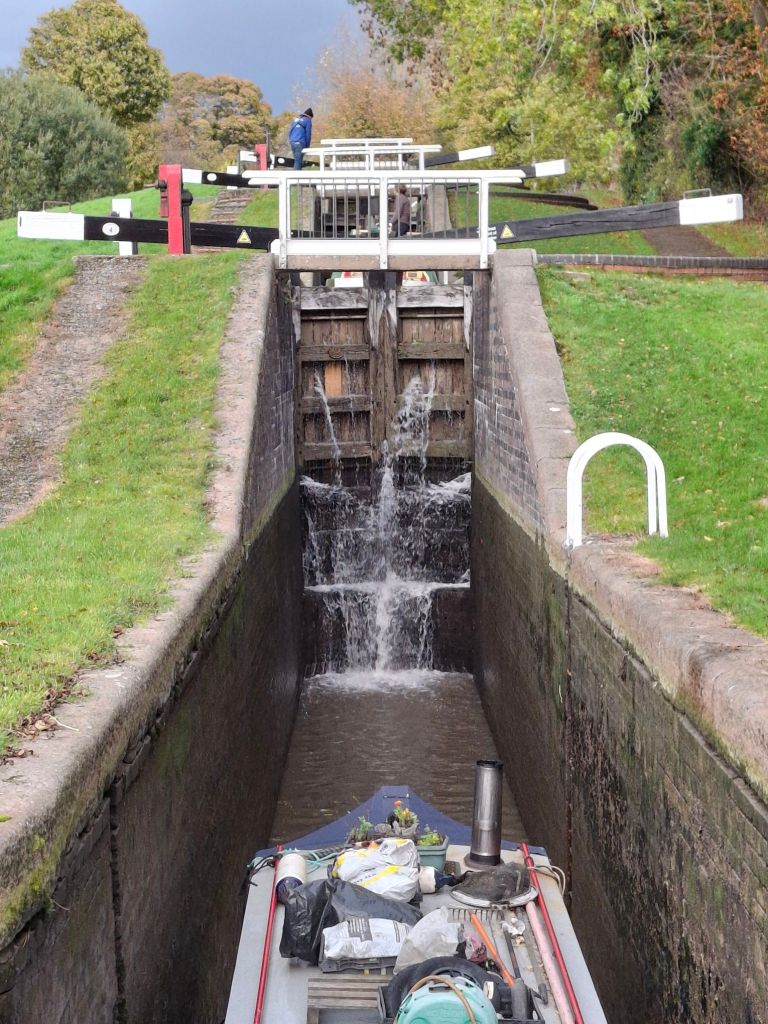
It was very windy on Wednesday, and we battled into a gale on our first leg which with unexpected delays en route turned out to be 10 miles and 8 locks long. It was a busy day, we got a load of washing done whilst we were cruising; headed through Saddington Tunnel where we were grateful for a little respite from the battering, biting wind; were kept company by a heron as we travelled along his patch; and all was going well until we approached Kibworth Top Lock, the first of those that had been closed for months… to find them still closed with a padlock and chain.
Spot the chain
A quick call to the wonderfully human and helpful Sharon at Canal and River Trust East Midlands resulted in someone being despatched asap, and we kept ourselves amused as we waited. The washing was hung on the racks above the stove to dry, an industrial tub of paint half full was fished out of the canal along with a rucksack, innumerable cans and plastic bottles. All except the paint went into our waste box that we keep ready as we go. Martin from CRT took the paint after unlocking the gates for us, and also undertook to arrange the removal of a poor sheep which had drowned by the lock.
As I opened the gates it was clear we were the first boat for months. Ash which had been used to seal the gates was apparent as I pushed the gates apart. The water flowing into the lock churned up stale water and rotting vegetation, a smell no doubt familiar to those incredible pioneers who returned the abandoned canals to us after their commercial decline.
On we travelled with swans and ducks, moorhens and a jay at one point for company but not a single other moving boat in sight. Just as the light was fading we were two locks from where we aimed to stop for the night when we encountered more closed locks, fortunately these were only tied with blue twine and the knots were easy to undo. We made it through and moored up just as the sun began to set spectacularly on what we felt was an unexpectedly successful day’s travelling.
An early Thursday alarm had us up and ready to set off again with the sunrise. We felt early starts could help if there were more unexpected hold ups although we couldn’t envisage what those might be. The wind had dropped although it was still chilly, and we had some flakes of snow by the second lock of the day, but we were well wrapped up and weather sun was shining too.
Two kingfishers, 1 cormorant, ducks, moorhens, and a couple of swans were our companions on the continuing journey. We stopped to get rid of waste at a services while we passed. Again the entire waterway seemed to belong to us and us alone. And when we started to pass houses, the celebrity status of us as a novelty in people’s lives became apparent. Not only did the gentleman emerge in his dressing gown but others in their gardens and dog walkers on the towpath, as well as a CRT fundraiser wanted to tell us what a novelty we were and ask us where we had come from.
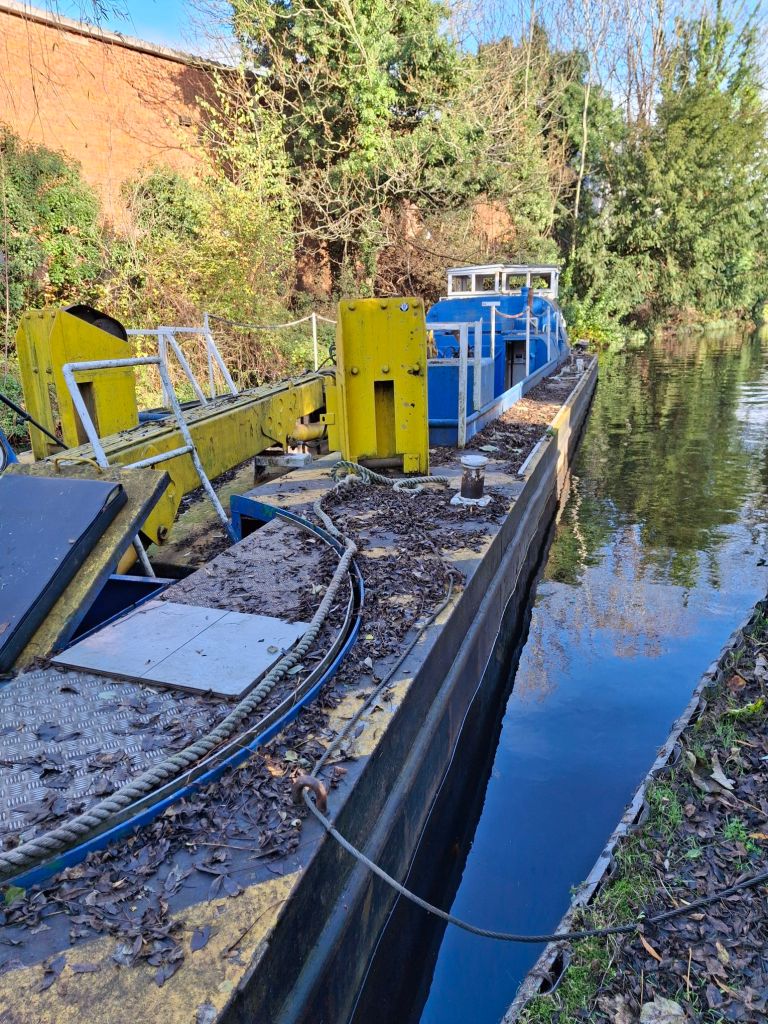
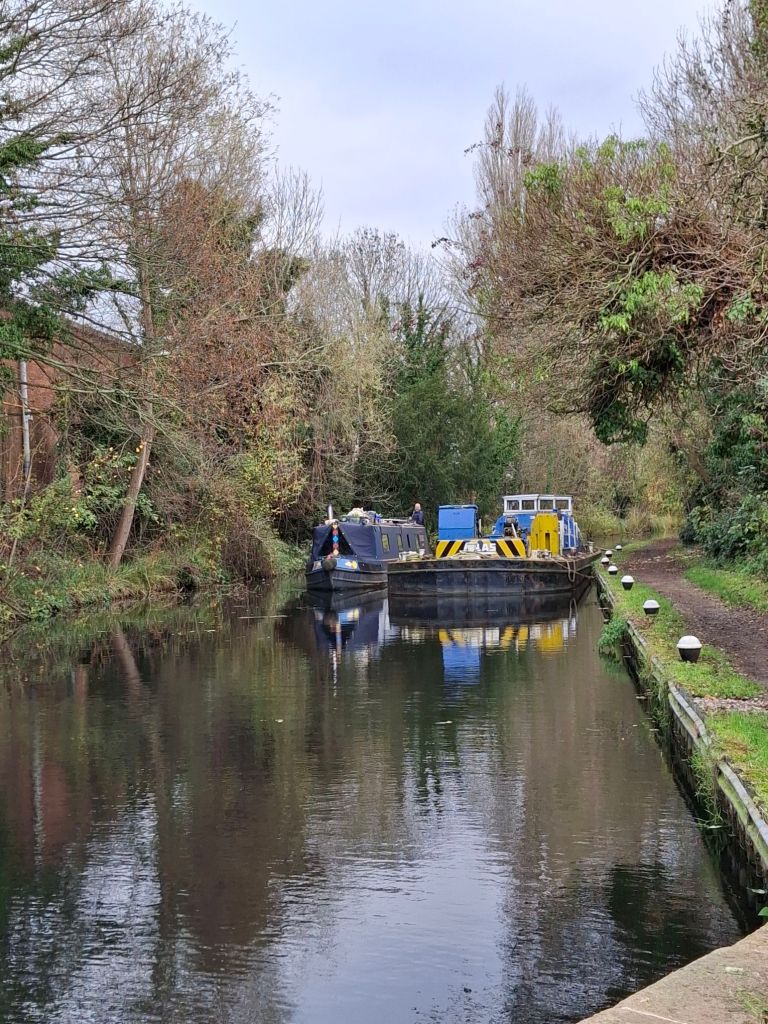
It took time to answer them (would have been rude not to judging from their excitement), and yet we were doing well, until that is we approached Whetstone Lock. We had been told of a CRT workboat Pride of Lincoln, which had suffered tens of thousands of pounds worth of damage at the hands of criminal vandals, but we hadn’t expected to find it adrift blocking our path. As we pulled up it became apparent the bow was still attached but the stern was loose, resulting in the boat being right across the canal.
I jumped aboard and crunched over broken glass as I made my way to the stern to look for a rope or some way of dragging the huge vessel back to moor it. There was a massive heavy rope, and some thinner chain but it wouldn’t stretch far enough for me to take it all the way back with me to the towpath, and it was too heavy to throw effectively to the Skipper who was trying to keep out boat from drifting off.
He fortunately saw something that looked like a metal rod in the water just ahead of our bow and began fishing it out to avoid damage. It turned out to be a heavy, long boat hook which it seemed likely must have come from the stricken workboat.
After rescuing it we managed to use it to hook the thick hawser-like rope and the Skipper held it as I made it back to the towpath and we used it to both pull the workboat alongside and remoor it. I also took a chain attached to the workboat and knotted it around the piling as another mooring device. Anyone trying to undo that will need wire cutters, and I rather hope vandals don’t carry those routinely. I rang Sharon at CRT again to relay this latest day’s adventures, updated her on everything and sent pictures. We also put the boat hook on our boat for safe keeping rather than risk it being chucked into the canal again, and arranged a CRT contact to take it when we meet up.
Getting through at last
After 7 miles and 12 locks we made it despite delays to Kings Lock, the last before the river section, and adjourned to the handy Tearooms for a late (and excellent) lunch. As we moored up, we had to pull in front of two moored boats. The owner of one came out and shook our hands telling us we were the first moving boat he’d seen for months and sharing the terrible fright he had suffered during the sudden recent flooding. CRT had got him up into the lock for safety. I never cease to be amazed how fast the Soar rises in flood and again how quickly it abates.
We dropped down through the lock to the delight of some Danish tourists (yet again we were a novelty) and moored up after answering as many of their questions as we could.
At the moment we are travelling with a car but we had left it at Foxton, so the Skipper armed with his trusty bus pass took 5 buses to go and fetch it and move it ahead. I took the chance to walk Boatdog along Aylestone Packhorse bridge to the meadows beyond where the flood waters were still evident, and then returned aboard to do some work.
It began to look like we might, just might make our goal. Only Leicester lay ahead. After a night of fireworks after midnight, a complaining barn owl and a cyclist with music blaring cycled past in the early hours, we were ready to set off again early. Ropes were frozen and gloves stuck to the metal of the first locks as I worked them.
A kingfisher sped across our path just as we approached the Leicester City stadium, and then the straight mile into the City was as usual crammed with swans. Terns too were in evidence and ducks. Just as we approached the Castle Gardens mooring another boat was pulling off and we greeted each other like long lost friends – the delight of seeing someone else on the move was immense! Our goal was definitely in sight and we were feeling hugely excited, until we got to North Lock.
As the Skipper walked up to operate the lock another boater appeared with a windlass. Apparently he was moored on the other side and had woken to find himself on his boat at an alarming angle. He was heading up to let water down to increase the levels.
We brought a lockful of water down with us, and I began the painstaking task of travelling through an low pound – staying in the centre channel and moving only at tick over speed. The Skipper walked the towpath because there was no way I could pull over to pick him up after the lock.
Low levels in urban canals show you brickwork and rocks, shopping trolleys and debris as well as fish. We were passed by a small weed removal boat whose operator shouted he was off to let down water but it could take an hour and he thought we would not get through in the meantime. Unable to do much more, I carried on limping along, inching my way towards the next lock, passing puzzled swans and a rather disappointed heron whose fishing appears to be curtailed.
As I neared the next lock, I lost all steering as something fouled the prop. A short reverse cleared it enough to get some propulsion back and I limped through water so shallow ice had formed on it. Eventually after half an hour of feeling like I was holding my breath all the time, I edged into the lock. The Skipper took the opportunity to don his full arm veterinary gloves and head down the weed hatch to remove the weed and plastic clogging the prop, and then we were underway once more.
10 locks and 12 miles brought us to the area we want to winter in. Yes it’s on the river, yes it is going to flood again in the next few months, and yes when that is likely we will aim to move to a slightly safer spot but we are here, we are close to family, to the winter craft markets I have booked and we are now in situ, ready and able to help with the latest addition to the family when he arrives, which we hope won’t be for several weeks yet. We were lucky to be able to make the journey when we did, and it felt as if the whole waterway was ours and ours alone, maybe the first and last time we will experience that. We felt like privileged pioneers and as always we recognise that living and working like this is not only energising, demanding problem solving and effective team work, but also a huge amount of enjoyment. Can’t ask for more.
Water – essential, but not the same for everyone or everywhere.
For everyone water is vital to keep us alive, to keep our bodies going, to make us and the plants and animals we depend on, growing.
For us as boat dwellers, water is vital to keep us moving. Without it, as now in the Midlands with water shortages, we cannot move. With too much of it (as also now in the Midlands) we cannot move as navigation halts because of dangers surrounding flooding and resulting strong river flows.
On holiday this week we have been watching and hearing just how different water can be. The rain drums on a boat roof very differently from a house roof. In a boat you are always aware of the type of rainfall outside from the sound inside – gentle tiptapping to fierce hammering.
Rain also drenches you just as much on holiday as it does when out in it at home! As Storm Claudia swept in we were relieved that we had left our home in a marina as she was 215 miles away. If waters rise or trees fall in a storm at least we know she will be looked after, mooring lines will be checked and she will be secure.
Out of storm time for us in inland waterways we are always aware of the water, and the backdrop of gentle water sounds as swans and ducks particularly move past us, as the boat moves through the water. These quiet calming noises are interspersed by sudden loud water movements, with flows at weirs, locks and sluices. Down here in the south west of England, we have become very attuned to the new sounds of water we are exposed to.
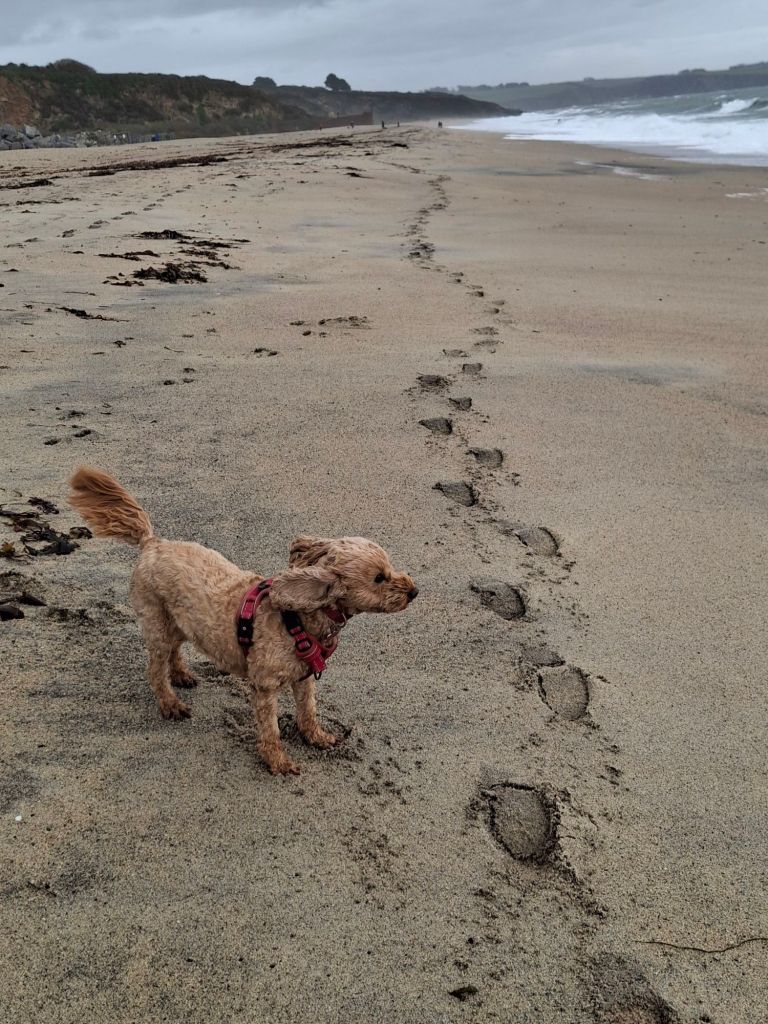
Boatdog loving sandy beaches despite thudering waves and ear-pinning winds
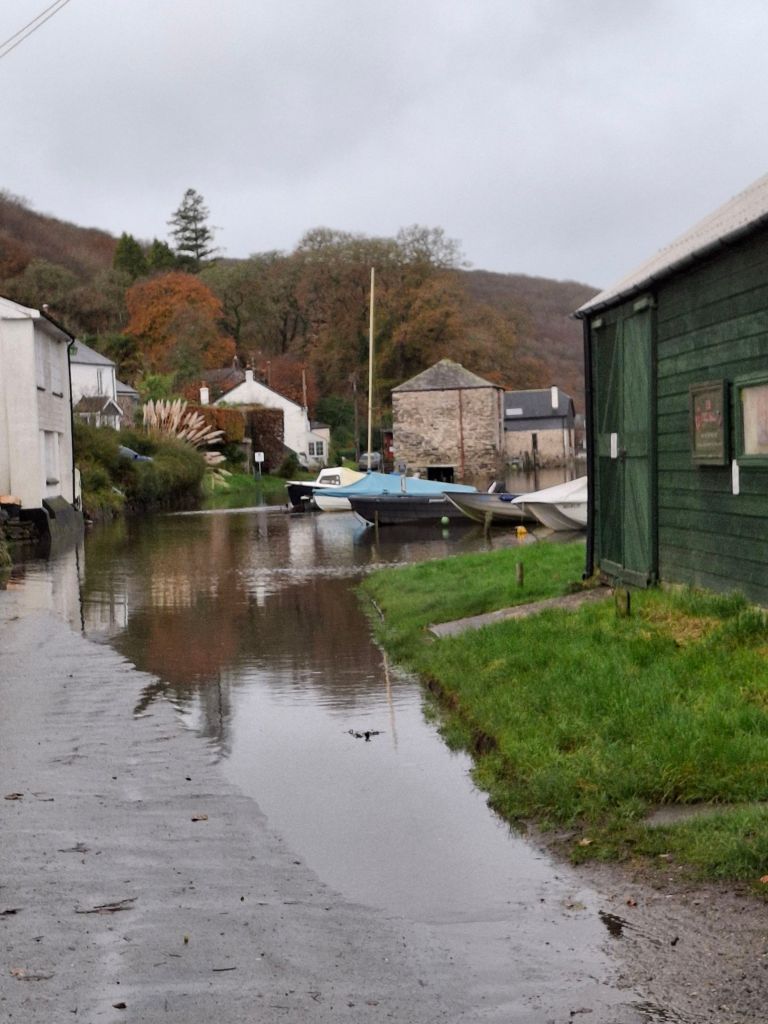
We are surrounded, and to some extent controlled, here by the tides. At high tide the road outside our holiday cottage floods. We have to remember to check the tide tables and not to park opposite the house but at the highest end of the public car park a short walk away.
Road 0: Tide 1
The noise of the tide going out, sucking water from the creek and leaving brown mud with listing boats in its wake is surprising. It gurgles, it splashes, it is never silent. This morning I watched a pair of cormorants fishing, and they just swam in the shallow channel that was slowly emptying, occasionally putting their heads down into the murky waters for food but never actually having the water depth to fully submerge their sleek black bodies. Beside them on the exposed mud a little pure white egret was an extreme contrast as he delicately picked his way through seaweed and slime, finding tasty titbits en route.
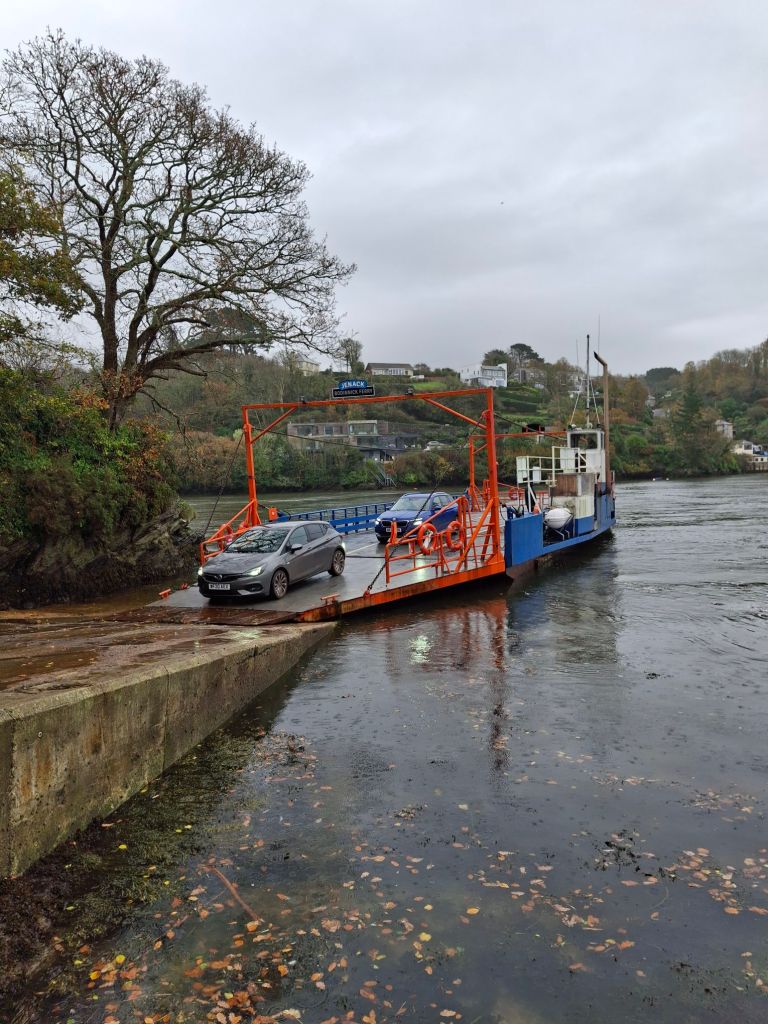
Bodinnick Ferry
Coastal waters lead to different ways of life. For centuries they have brought employment through fishing, running ferries, and now sightseeing trips. For many living close, they control lifestyles creating opportunities or limitations. Tides and high seas affect work or pleasure, from surfing to knowing which roads to avoid or detours to take because of tides or surges.
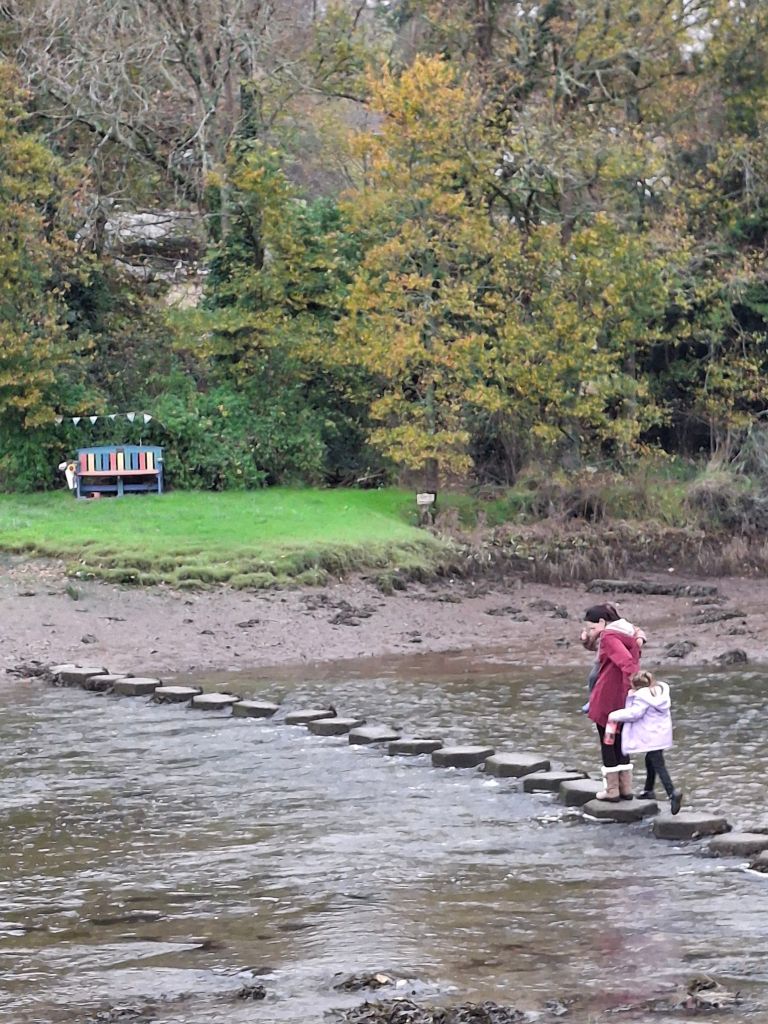
Just as we have adapted and take for granted our awareness of the conditions of locks, canals and rivers that alter how we live our lives, so coastal dwellers do the same. Walking to and from school at low tide in the village of Lerryn, whose creek inspired Kenneth Grahame to write Wind in the Willows, can involve stepping stones. At any time other than low tide, it involves a walk round to the bridge crossing the creek.
At Bodinnick getting to and from secondary school across the estuary at Fowey demands a “cool” ferry trip. It becomes the norm but still, like us on the inland waterways, it’s not taken for granted.
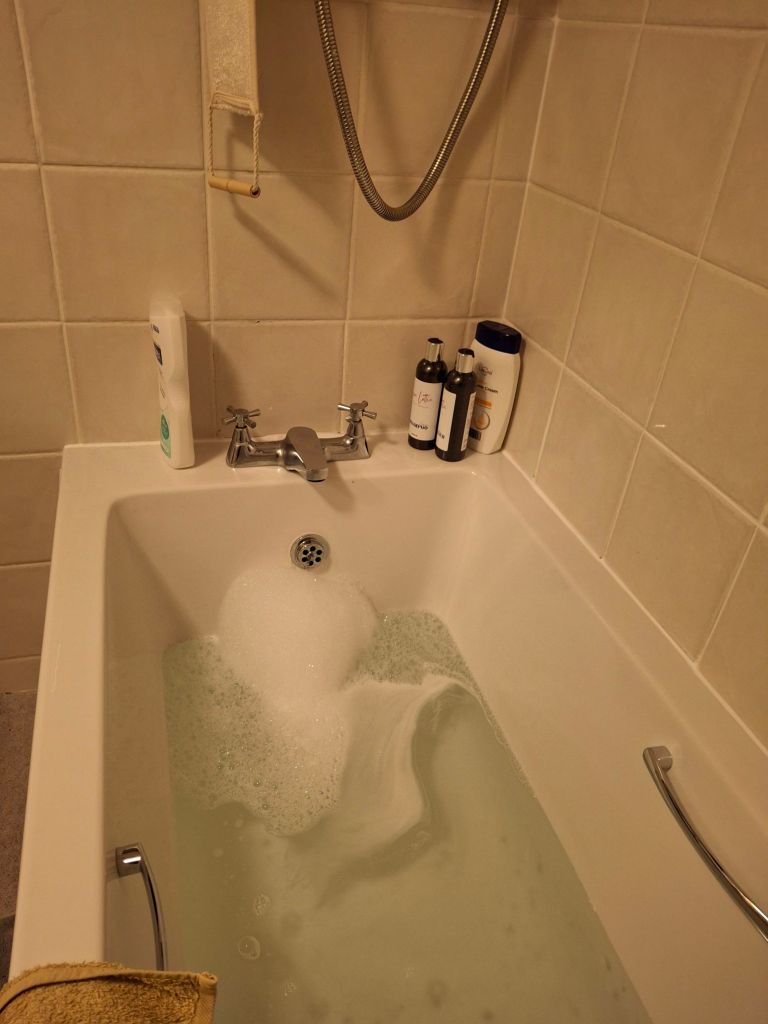
We have been “playing house” this week. Recognising and indulging in the things that we don’t have on the boat – an electric kettle, an electric toaster, a television, an oven, a flushing mains toilet and a BATH (with unlimited hot water). Some people have some of these on their narrowboats, but we don’t see the need for them, so this week I have felt spoilt but also aware I am missing the consciousness, the mindfulness that comes with living on a narrowboat. Living in a house I am oblivious to how much water we are using, and how much power. It feels wasteful and somewhat irresponsible. I am alarmed how quickly I have become attuned to not switching lights off if I am not in a room, or overfilling the kettle unnecessarily.
We have had a week of not having to think about moving our home, although since 1 November we are now into winter mooring times so every spot becomes a 14-day haven on the network.
We haven’t had to think about emptying toilet waste, or even being aware how many toilet cassettes are full and how many remain empty, mentally calculating as we constantly do, the available days before we MUST empty them.
Not once have I thought about how much water we have available in our tank. On mains water you just mindlessly turn on the tap.
I have never glanced at the fuses and meter cupboard in this cottage – I have no idea how much power we have used because I haven’t needed to know. I don’t need to think about what to cook for supper based on what heat sources are available – if the stove is on then I will gleefully use that ‘free’ heat for cooking. I have not needed to calculate how much power we have available, because attached to the mains, it is unlimited.
All of this strangely makes me feel detached, a little as if I am drifting through life in a a rudderless, uncontrolled way, unaware of my surroundings and disconnected from the daily basic rhythms of life. These have become as commonplace to me as the daily tides. I am conscious we live differently, our off grid lifestyle isn’t for everyone but it has its own rhythms, it’s own ebb and flow, its own regular constants by which we govern the way we live. These are as a heartbeat. You are unaware of them until they are not there.
For now, as we prepare to return from a wonderful holiday seeing family and friends, enjoying different sights and sounds, I am running another indulgent deep bath to revel in its novelty and at the same time reflecting on how much I am looking forward to getting back to our 50ft home. We won’t have a bath on board. It will be cold on board after a week without heat but within minutes we will have the stove lit, the kettle on its hot plate, and we will be back on our gently rocking home with all the familiar, reassuring sounds of the waterways around us.
History isn’t something in the past if you live on the waterways. It is part of the present, entwined in daily life, in constant reminders, as we walk on and in the very footsteps of the past worn into stones and steps, past bridge rubbing bands worn into deep grooves by the ropes attached to horses pulling boats along the canals, and as we stand on lock landings where boatmen have stood for centuries watching their boats rise and fall just as we do now.
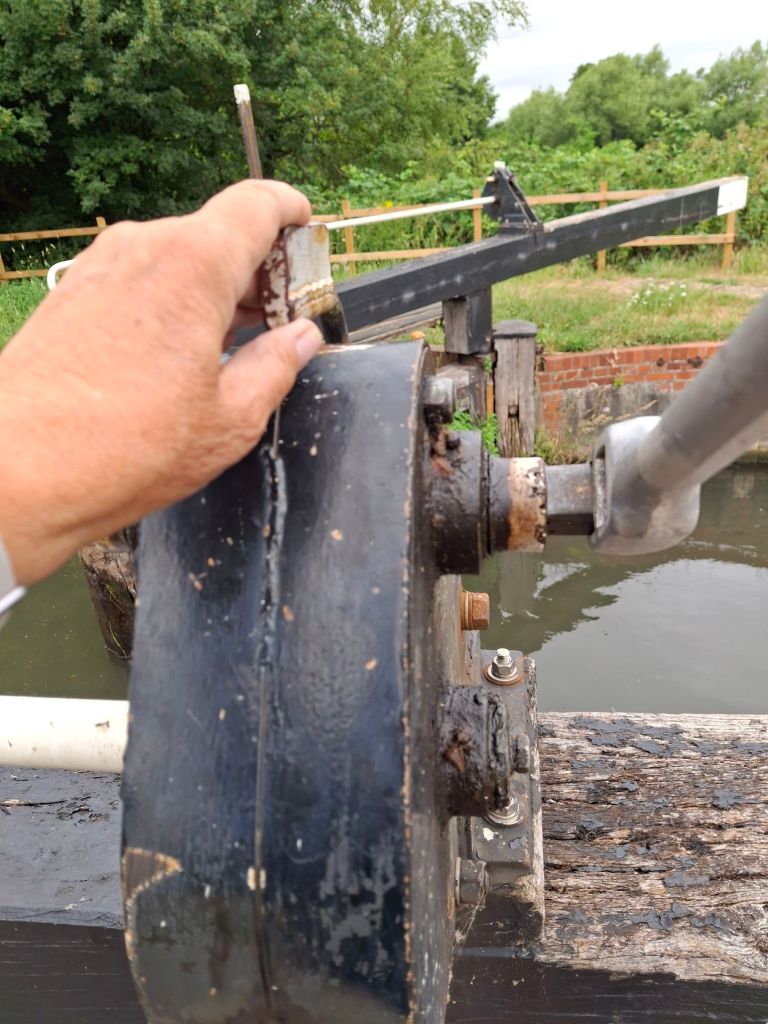
History on the waterways is current. It is yesterday and today spliced together in structures, routes, and water. The sights, the sounds, and the smells of the waterways combine – unchanged and yet totally different. Woodsmoke drifts across our nostrils but is fortunately no longer combined with sewage and horse manure in most places! Rural landscapes roll out ahead as they have done for decades but the wharf buildings which once meant working locations and money for the boaters are now often modernised into offices and homes or flattened entirely.The sounds of mooring pins being hammered in, and the rattle of the ratchet as you turn the windlass to open the paddles remain the same as they always have been. They tell you someone’s coming, or going, or staying nearby.
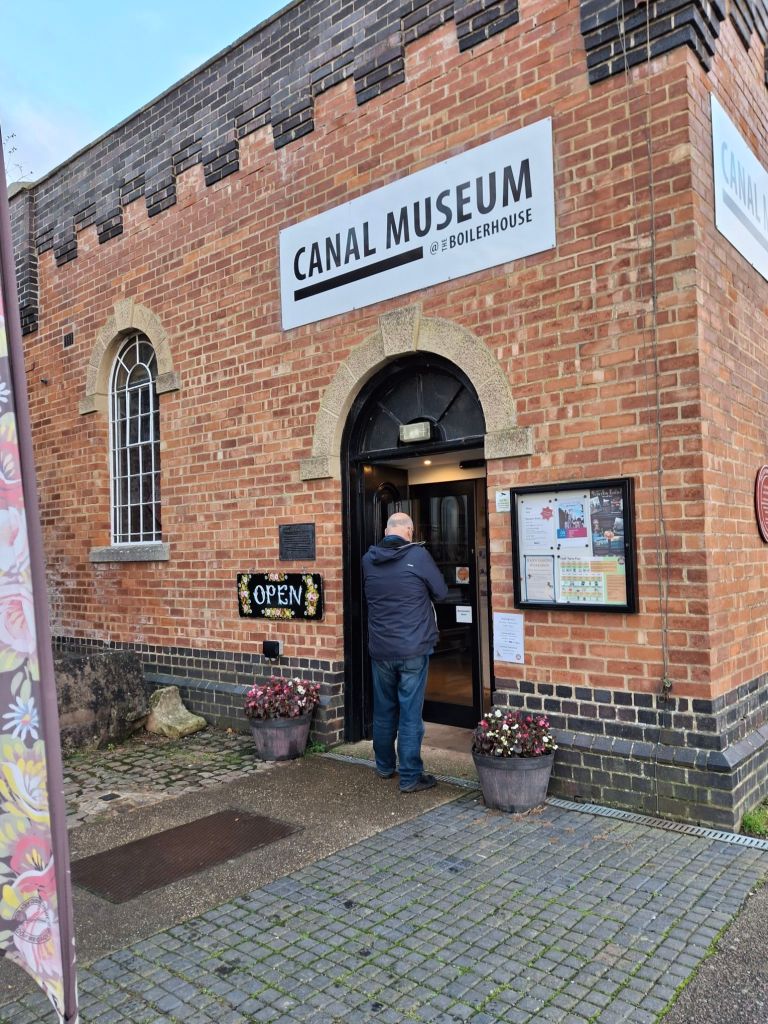
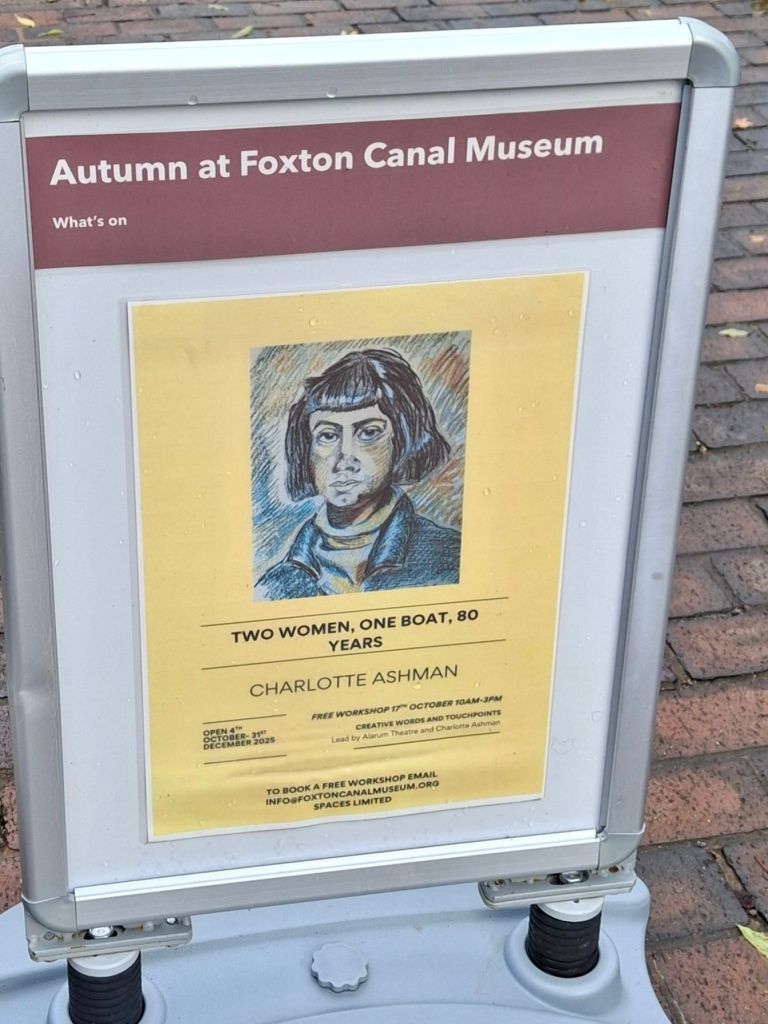
An atmospheric, multi-media and unique exhibition embracing the similarities and differences of the past and present is now available to everyone, boater or not, at the Foxton Canal Museum until 31 December. Two Women, One Boat, 80 Years by the boatwoman, artist, and printmaker Charlotte Ashman, is a rare glimpse into a remarkable shared story that spans time.
Charlotte and her daughter live and work aboard a 72 foot-long boat, Hyperion, with her butty Hyades (also 72ft towed behind, no engine). Hyperion was built in 1935. Just four years later, she and her butty were in service as part of the war effort. At the tiller, Christian Vlasto, a female artist and printmaker (one of the so-called “Idle Women”). Hyperion plied the waterways between London and Birmingham carrying steel, aluminium, coal, and sometimes munitions.
As she stands at the tiller, Charlotte is vividly aware that she shares a view along her boat that would have been exactly the same for Christian, she stands in the same spot, making the same movements and adjustments to maintain navigation, her hand on gears and throttle operating in the precise shadow of the past. She sees from and in the cabin much that Christian’s eyes would also have seen. The resulting project looking at the intersection of heritage and female perspectives on the water – particularly the unique connections between the two women themselves, as artists and printmakers united by their work and the huge working boat Hyperion, brings a remarkable insight into shared similarities than span the years.
These two women know, and knew, a life many men on the working boats found hard, and many men gave it up because it was too tough. It isn’t easy now, even basic day-to-day living on a historic boat is hard work, but both these women like countless others, thrive on it, revelling in its freedom. Both Charlotte and Christian vividly reflect the places, people, and nature of the waterways in their work.
The soundscape of working boats remains unique, the heartbeat throb of the engine, the soft splashes and ripples as the boats move through the water, the birdsong around, and the creaking of the ropes when moored. In the exhibition at Foxton, visitors have a rare chance to go aboard Hyperion, to hear how Charlotte lives and works aboard today, and to see the inspired work both she and Christian created and create onboard.
The famous locks at Foxton have closed again this week due to a lack of rainfall and reduced capacity in the reservoirs. That means we are restricted for cruising but the life of the waterways remains alive thanks to this remarkable exhibition in a museum that whilst small is packed with multimedia insights into the world that was and in so many ways still is, in existence today. Conveniently sandwiched between two pubs and a cafe, this museum is a MUST VISIT for families, individuals, and schools. Two Women, One Boat, 80 Years is fascinating, informative, and thought-provoking, as well as an artistically beautiful multi-media voyage back and forward across time.
It is an exhibition that will be pulling us back to Foxton as often as I can until the end of the year. See you there!











 Pickingupducks