SOAR-ing Peace – beware complacency

Peace is good for us all, as individuals, as businesses, as a nation, but is only really valued and appreciated after turmoil. We can become complacent when faced with Peace that endures which is dangerous. Stability and growth require Peace.

We humans need constant reminders of the importance and beauty of Peace to prevent us taking it for granted.

Boaters, walkers and canoeists on the canalised section of the River Soar now have a unique opportunity to appreciate and share Peace. On the private land of the Sileby Lock island now stands a beautiful Peace Pole created and carved by local artist and boat-dweller, Angel.

The Pole rises from a cairn of stones, collected and placed by local children and adults. Her idea is for all of us to expand and spread Peace by bringing stones for the cairn and taking some to other places. At this time particularly, with conflict in Ukraine destroying and threatening the world, it is pertinent to reflect on how we are all vital to create and sustain Peace.

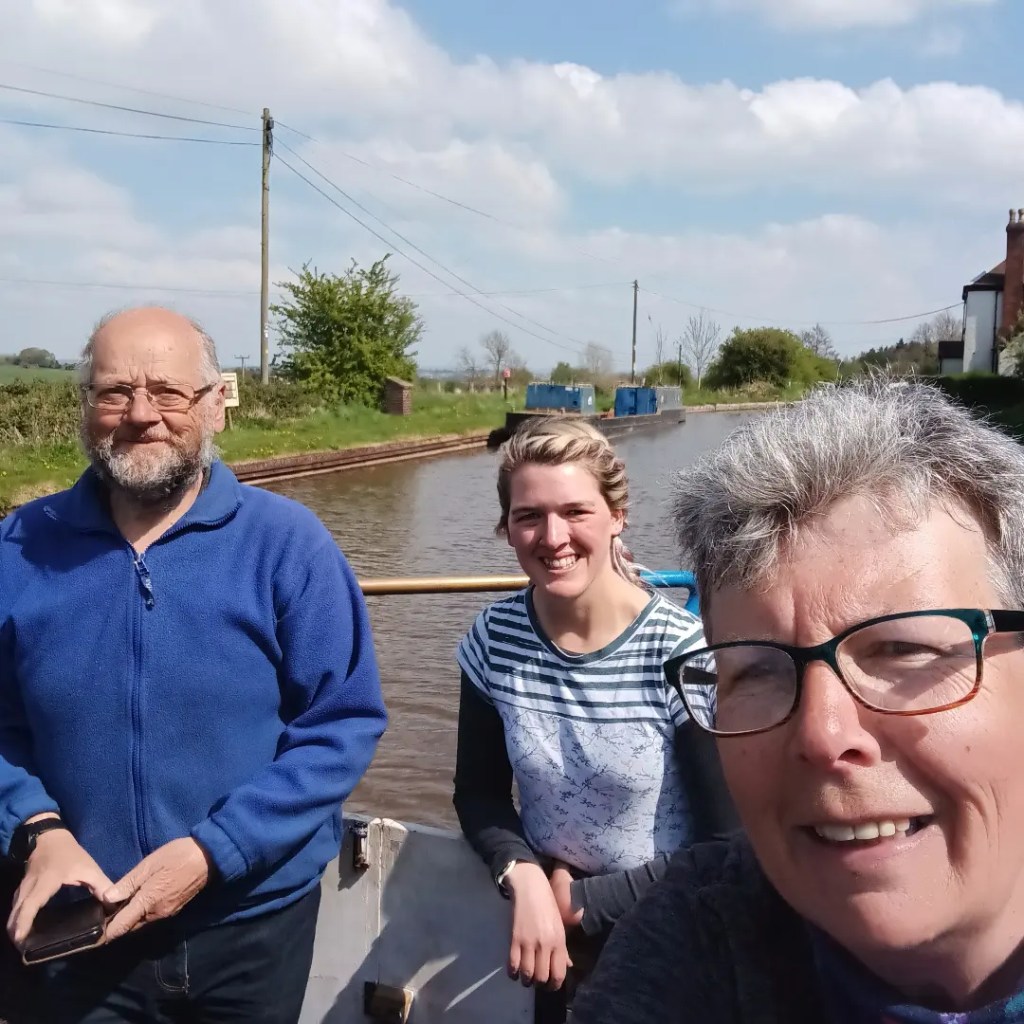
Let’s hope Angel’s not too unhappy with me for this image of her!

The intricacy of this Peace Pole, created from recycled materials, has to be seen to be appreciated. Animals and birds, fish and messages of Peace flow along its length, carved by Angel as a reminder of how nature flourishes in times of Peace. It is a glorious celebration of what we have in our world, and well worth making a trip to see.

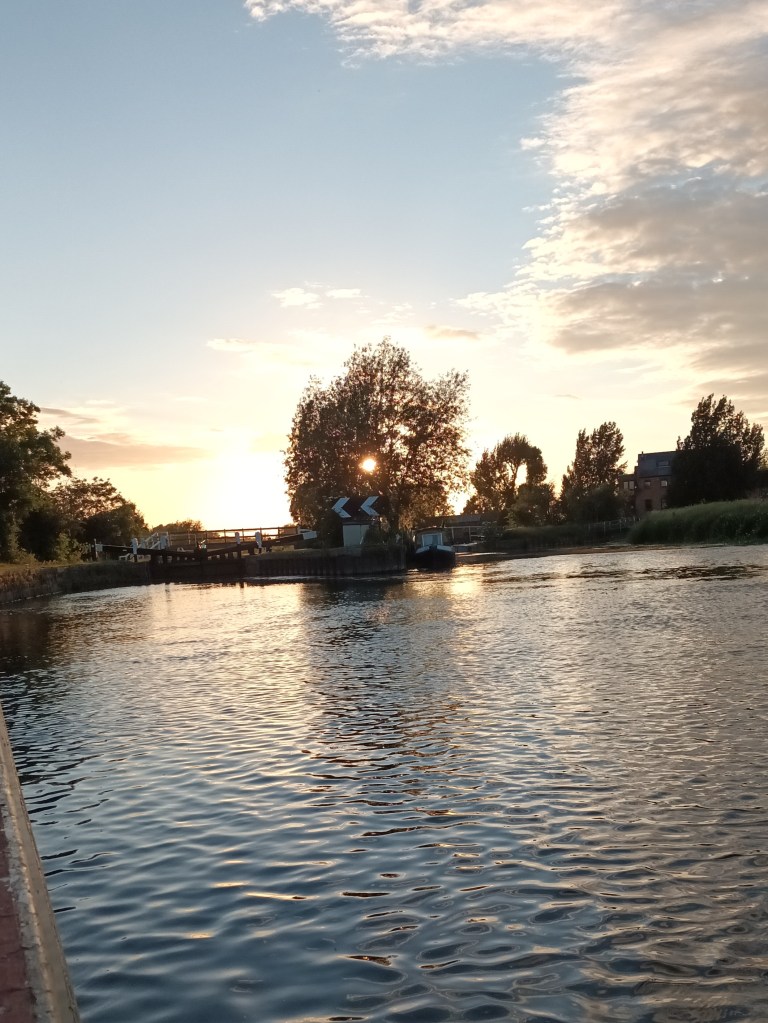
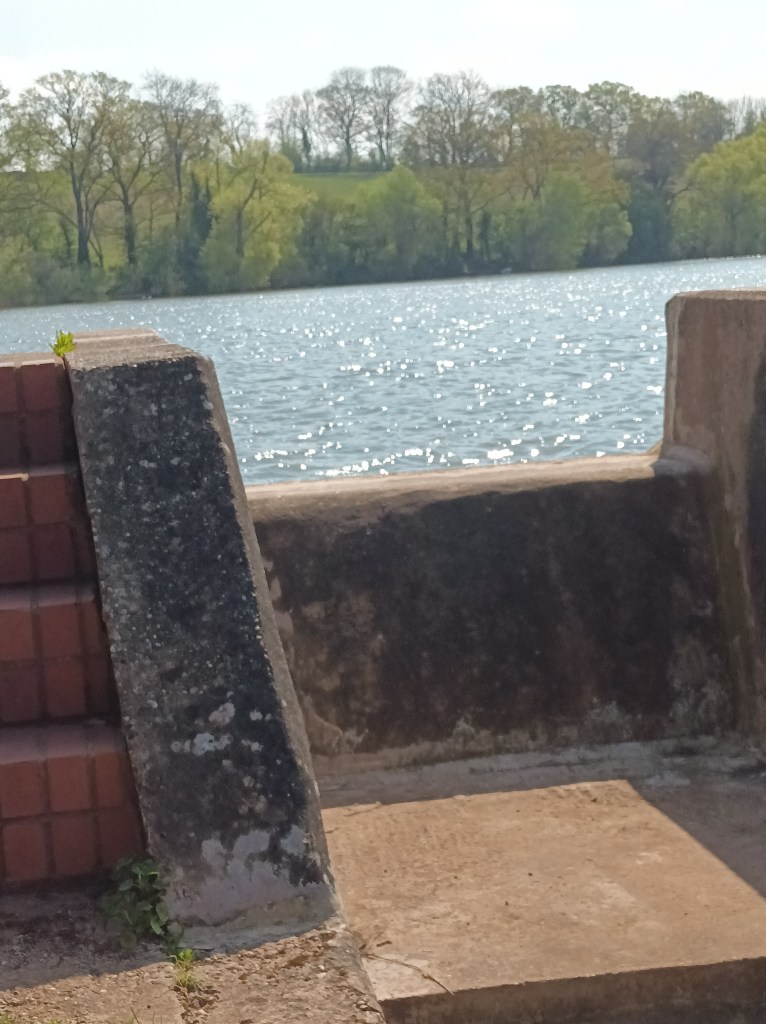
The beauty of the River Soar and this stretch of the Leicester line is a fitting place for such a beautiful reminder of peace. Its location is significant too. The Pole stands between the Lock and the weir, The rushing weir which constantly harks back to the situation at some points of the year when heavy rains and melting snow can turn the  calm flow of the Soar into a fierce, flooding, threatening torrent. At those times the river is un-navigable. The Lock is man’s attempt to calm and manage the waters, but when the indicator boards show the waters at a red level then nature takes control.

At this time of the year though, this is a lovely stretch to navigate, packed with wildlife and well worth adding to your agenda for a walk, cruise or paddle. The new Peace Pole is an added and important attraction to this glorious route.

Angel’s unique work inspired by Quaker Peace poles across the world, stands in this beautiful corner of Leicestershire as a necessary reminder that we can need to keep the Peace.

Its an issue for the human race that so often we can become complacent when faced with Peace that endures. Complacency can be dangerous. Growth benefits from awareness, stability and peace. That goes for each one of us too – we need Peace to allow us to flourish as individuals.

If you’re on the Soar enjoy a peaceful moment at the Peace Pole – bring your stone to leave some of your peace and take a stone from the cairn to spread peace around where you go.

The glory is, you can take a little bit of the beautiful peace of the Soar with you wherever you go ❤

If you can’t get to the Soar just hold on to not becoming complacent, holding onto what really matters and recognise the need to keep the Peace.

Goal setting for life

Goals are strange things – they can motivate and inspire but also leave us feeling bereft when we achieve them, or failures when we find them unattainable.

Since the autumn of last year when we left London after Steve had achieved his goal of running the London Marathon, we’ve been heading slowly, circuitously around the country with one particular goal in mind. We needed to replace the decades old cover at the front of the boat which provides us with vital additional space. It has had a hard life and despite remedial treatment was leaky and torn.

We talked to other boaters for recommendations, visited various companies, and spoke to others for quotes online and over the phone. We chose a supplier. The upshot was that whilst we could have ordered one from them and they could have visited us at a series of locations for measuring and fitting, we decided to travel to them, as they’re in a pleasant part of the country. The appointment was suitably canal-time: “Come around the end of March, beginning of April.”

Through the winter and burgeoning spring, through storms Dudley, Eunice and Franklin, we journeyed and diverted to explore new areas, managing work on the way and always with the goal that we were heading eventually at the end of March/beginning of April for Kinver in Staffordshire.

We travelled 577 miles, tackled 351 locks, moved 31 bridges (swing or lift), plunged underground for 5 miles, 6¾ furlongs via 14 tunnels), and crossed high over 2 major adqueducts (Chirk and Pontycyllte) twice in pursuit of our goal to replace the cratch cover as it’s called. Our circuitous route took in sections or complete lengths of 11 canals, and encompassed 425 miles 3 furlongs of narrow canals, 152 miles 1½ furlongs of broad canals, 233 narrow locks and 118 broad locks if you want the specifics!

This week, on Monday after a final week’s 69 mile, 69 lock journey from Whitchurch on the Llangollen we arrived at our destination. Forewarned, the next morning at 8.30am Harry arrived to template the boat’s cratch, and discuss the final details of what we wanted.

By that evening he had returned in the company of another Harry and a beautifully stitched, watertight cratch cover. It was fitted, adjusted, and installed. The speed took us somewhat aback to be honest – we had fully expected to be waiting for days – had even prewarned CRT that we would be expecting to outstay the 1 day mooring for work and wham – the long-awaited goal was achieved before we even caught breath! It was disconcerting somehow, and also helped me reflect on how rudderless we can feel when we achieve our goals when they are very specific.

SMART goals as we know from business and academia are designed to be just that – Specific, Measureable, Achieveable, Realistic and Timebased (i.e. they have a deadline). SMART goals support us to set targets and benefit from the realisation of them. If we are so focused on a single goal, that can leave us feeling lost when it is achieved. This can be the successful end of a project, or a career stage – striving for one thing and then wondering where to go or what to do when you reach it.

New challenges dawn after old goals are met

PhD candidates (myself included) talk of spending years working to achieve their doctorate and struggling with mixed emotions of elation and deflation when finally Dr So-and-so. What they’ve worked on intensely for so long can no longer be their sole focus. Athletes talk of spiralling into depression after training for a specific race, event, or medal. When it’s over their entire focus is gone, they feel lost and bereft. Authors say the same when they reach the end of a book, and face another blank page.

We have started this week by planning new goals, new destinations, new journeys to move towards to fill the gap we are experiencing, but it has also made me realise how important it is to keep multiple SMART goals ticking over at the same time. Yes, we need the recognised SMART objectives for specific purposes, and we need goal setting support from experts such as Dr Cheryl Travers, but perhaps it is time for some more sustainable SMART goals too.

I propose:

  • Share/See;
  • Make (a positive difference)/Marvel;
  • Appreciate/Admire;
  • Reflect/Relax
  • Thank/Try/Treasure.

What will your SMART objectives be to run continuously through life to never be short of positive, meaningful goals?

Our long-term goal is to continue to share, appreciate, relish and be thankful for everything that living afloat brings.

In the short term we welcome a family Easter, and then a journey to the end of the Staffordshire and Worcestershire, onto the mighty River Severn, up the Worcester and Birmingham Canal to the Stratford-upon-Avon Canal. It’s a little jaunt of 76 miles with 6 moveable bridges, 1 major aqueduct at Edstone, 6 tunnels totalling 2 miles 4¾ furlongs underground and – wait for it – 127 locks. This is because it takes in the Tardebigge Flight of Locks – described by Pearson’s Guide as a Boater’s Rite of Passage. This, the longest flight in the UK with 30 locks over 2¼miles, with no overnight mooring, must be done in a single ascent or descent, and looks like a millipede on the map!

That will be a day devoted to boating with no external work to intervene. We rather hope to meet lots of enthusiastic and energetic holiday boaters there! Anyone wanting a walk and some exercise when we get there – we have spare windlasses for temporary crew!

Travelling through time and place

This week has taken us 47 miles and 46 locks through Shropshire into Cheshire, back to Shropshire and then to Staffordshire.

We left the Llangollen Canal in glorious sunlit days preceded by moody misty starts.

Through lush green Cheshire countryside we made good time, going with the flow of the River Dee waters hastening down to Hurleston Reservoir.

Beside the Reservoir is the final 34ft drop taking boats down from the Llangollen onto the Shropshire Union. Through Nantwich and over the Chester- Nantwich Road Road on an  impressive cast iron aqueduct, the result of landed gentry not wanting to see a canal and industrial barges plying near their county seat. 

Then it was hush hush territory- Hack Green, the now far from secret (or perhaps a double bluff) scene of a WW2 radar station converted into a nuclear bunker to house Regional Government if the Cold War demanded. Now a tourist attraction it sent eerie chills through me – and not just because of the lack of heating.

Then amid a weather change back to winter on to Audlem, passing the once bustling Shroppie Fly, remembering the barges which were the 24-hr operating delivery service of their day. Audlem’s flight of 15 locks are resplendent in battleship grey and white rather than the familiar magpie colours elsewhere. Remnants of a WW2 paint surplus bought up cheap.

In return for 15 locks by 11.30am rewards awaited at the delightful and delicious honesty stall of Kinsell Farm.

Up the Adderley Flight of 5 locks and into the haunted Betton Cutting where tough old boatmen of yore never lingered…neither did we.

Quick pause for supplies at Market Drayton mooring at the delightfully named Ladybird Moorings.  Then through through Tyrley flight of 5, remembering that this sandstone cutting and deep lock chambers were all cut by hand with picks and shovels.

The Shelmore Embankment was another engineering and construction feat in its day – taking 6 years to build. At the start stands the wharf overseen by a duty heron as we passed where cocoa nibs used to be loaded from the factory beyond to travel by barge to Bournville. Bet those Cadbury barges smelled delicious!

On then through Grub Street Cutting (nothing here for writers) but again a route painstakingly created with picks and shovels, wheelbarrows and sheer hard graft. At the end stands the famous double-arched High Bridge. Living up to its name it is well known for the short telegraph pole standing in its centre. It too is said to be haunted after a boatman was killed here in the 19th century. Either our imagination was lacking or the bitter chill kept the spectre at bay…unless you can see him?

We still have 22 miles and 23 locks to our Monday destination – will we make it? We’re ploughing on through sun, rain, hail and snow so hope springs eternal as ever!

Dramatic revolution afloat

Three key lessons this week: Take NOTHING for granted in your life. Be patient – good things are worth waiting for. Technology can be marvellous in many ways!

Loyal blog, Instagram or Facebook followers will be familiar with stories of hand washing on towpaths alongside water taps, hunting down laundrettes and lugging bags of washing along towpaths to streets and car parks over our time afloat. Steve’s mother and our eldest daughter (or more correctly their washing machines) have also become used to our laundry-laden visits!

Last year we began working on a solution to washing our dirty linen in public… or rather Steve was working on one, and injuring himself in the process as happens when working in confined spaces.

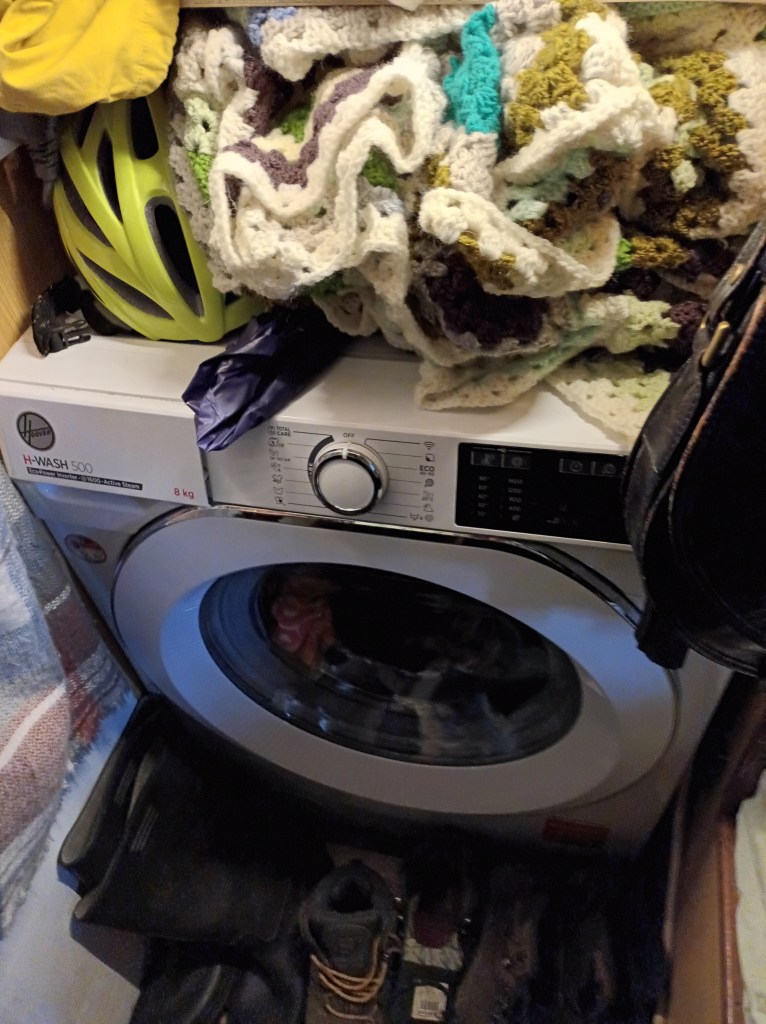
But everything has paid off and finally – it has arrived. This is a week that has totally revolutionised boatlife for us. No more laundrette hunting across Great Britain – a unique but time consuming experience. Thanks to Steve’s efforts replumbing, rewiring, carpentry to construct space for a washing machine in what was the wardrobe, and thanks to the efforts of our younger daughter and partner – look what our 50ft home now boasts!

Thanks to social media and knowledgeable contributors on Canal World Forum it also now works without clouds of smoke – more on that in a moment.

Fitting a washing machine in a bricks and mortar home is pretty straight forward compared to doing the same thing on a boat. You can’t just slot it in and connect it to power and water so it works… you need to get the power and the water in and out to make it work. You also need to balance your boat – so we had to get the floor up and remove 84 kg of ballast from underneath it.
We run 12 volt from batteries on board because we aren’t connected permanently to a fixed mooring with shoreline mains power. Washing machines (along with many other pieces of household equipment we all take for granted) function on mains power – 230 volts. To turn the power from the batteries into power which can run a washing machine we needed an inverter. Enter a Victron Phoenix 12/3000 plus all the relevant cables, fuses, and a residual current device (18kg in weight). Space had to be made for that to fit on board, and it had to be connected into the system…

We needed water in and out – the out demanded making a hole in the side of the boat – always alarming! The in required plumbing a cold water fill and also connected up the pressure release valve from the water tank which used to drain into the bilge for us to mop out but now drains straight out of the new drain.

And then having found the machine we wanted – a Hoover H500 (65kg weight) with a 1600 spin and a cold wash and most important of all a 52cm depth… we then had the issue of how to get it delivered to a boat! It was a military operation. Enter AO.com and Blackwater Meadow Marina at Ellesmere. The latter agreed we could use their address for delivery so we moored outside the marina ready and waiting for the moment of arrival.

Whilst AO were approaching so was the family muscle, making their way from Leicestershire, and Steve was removing doors, plus all the gubbins which usually clutters the back of the boat so it’s handy when we’re travelling. By 12 noon the deck was clear, the scene set and the delivery van appeared. AO say they’ll deliver your washing machine to where it needs to fit!

We were the first time these two had ever delivered to a boat – they were very excited and probably still talking about it now!

Machine on the back deck we then had to get all the packaging off in order to fit it through the doors and down the steps that descend and turn in the process. This was achieved by daughter and partner with straps round the machine. My job was keeping the dog out of the way and Steve was directing operations! It is such a tight space that there’s no room for spectators!

Finally the machine was manouevered into place at the foot of the bed into base of the old wardrobe. It was connected up…

…and with huge excitement and total glee I added the washing and started it going on a cold wash…only for clouds of smoke to emerge from the engine bay. The electrical monitoring app on Steve’s phone showed that the alternator that generates the 12 volts into the batteries was working so hard it was smoking! Everything off… and a trip out for lunch to reward the workers and pause to rethink.

Back at the boat we tried a rinse and spin which worked fine so the issue was clearly the washing part of the programme. Steve turned to the social media to see if other boaters had experienced something similar and what solutions they could suggest. Within moments 20 replies had arrived. Advice varied from installing a thermostatic valve connecting up the hot water tank, refurbing the alternator (which is probably 20+ years old) so it’s clean, disposing of the boatdog (dog dander lying on things that get hot tends to smoke) and pouring a kettle of hot water into the washing machine as the cold water’s going in as the cold water from our tank may be too cold for the machine’s cold wash…

The latter worked brilliantly and suddenly washing is not something to be planned, to take half a day to arrange. This morning the washing did itself as we cruised in the sunshine to arrive at a mooring spot where I put up the washing line and had superbly spun washing to hang out.

Life as we know it has been changed afloat this week by technology and a team effort. We are now self-sufficient in laundry terms. Half days taken up with laundry are a thing of the past! Let’s hope the wonder at the revolution continues to delight us for years to come.

It should repay us within the year for the machine and the inverter in laundrette costs, but having the inverter also means we can now power other things like the battery charger for the cordless drill, the soldering iron and I guess maybe a vacuum cleaner??? Maybe that’s the solution to the dog dander! Where will this revolution stop?!

Full Monty shows the power of volunteers

This week we’ve been on one of the shortest stretches of canal new to us – the 7 miles of the Montgomery Canal (known as the Monty).

This stunning canal which straddles the Anglo Welsh border is beautiful, special (site of special scientific interest SSSI) peaceful (at the moment) and well worth a visit by boat, on foot or in a kayak, canoe or stand-up paddle board. It is accessible today thanks to the work of volunteers and campaigners.

The canal was abandoned for commercial traffic in 1944 but by the late 1960s a move was afoot to restore it, led by the Shropshire Union Canal Society. Volunteers gave up their time to lobby councils, physically dig out debris and silt, campaign for funds, and persuade the then British Waterways (now Canal and River Trust, CRT) to back restoration.

Many of those hundreds of volunteers remain anonymous so we can’t thank them in person. One though was Graham Palmer, who organised the London and Home Counties Working Party Group of the Inland Waterways Association which became the Waterway Recovery Group. His remarkable work is remembered on the Monty at the Graham Palmer Lock.

The Waterway Recovery Group published a journal called Navvies Notebook which co-ordinated volunteer activity on the canals across Britain. Their vital work continues to this day – with numerous volunteering opportunities including working holidays or ‘canal camps’.

For many communities along canals the income from carrying cargoes on water have long since gone but the work of volunteers and canal restoration projects have brought new commercial benefits through tourism. Hire boat companies, canalside pubs and cafes bring income streams to often remote areas . Boaters, walkers, cyclists and holiday makers are able to discover new places which are beautiful, peaceful and historic. These are places which in turn play a vital role in supporting the nation’s mental health and physical fitness.

We who live and work afloat travelling the canals have much to be grateful to them for – we may not know their names individually, but we enjoy the lasting impact of their efforts as future generations will do. Volunteering is a remarkable way of giving to our communities, both individually or as businesses, and research shows it is a fulfilling way to increase our own wellbeing. When the full length of the Monty is reopened to navigation, volunteers will have been integral to that happening. It is evident they’ve already achieved so much to get to the current length by galvanising and supporting bodies like CRT.

So – where might you or your company benefit from volunteering so your legacy can live on? What will you give to get back and make yourself feel good in 2022?

Going international

Let’s be honest – travel between nations with a narrowboat in the UK is limited unless you are prepared to pay for trucks to transport your boat! To get to Scotland or Ireland trucking is required, but to reach Wales – you just keep cruising which is what we’ve done this week.

We’ve spent the week gently moving towards Wales, and in and out of Wales too. The border is far from straight, and the canal crosses and recrosses it.

We started in England on Monday morning with a necessary fill up of water (no idea of the size of our tank but we know about a fortnight with the two of us plus dog on board is a good time to refill).

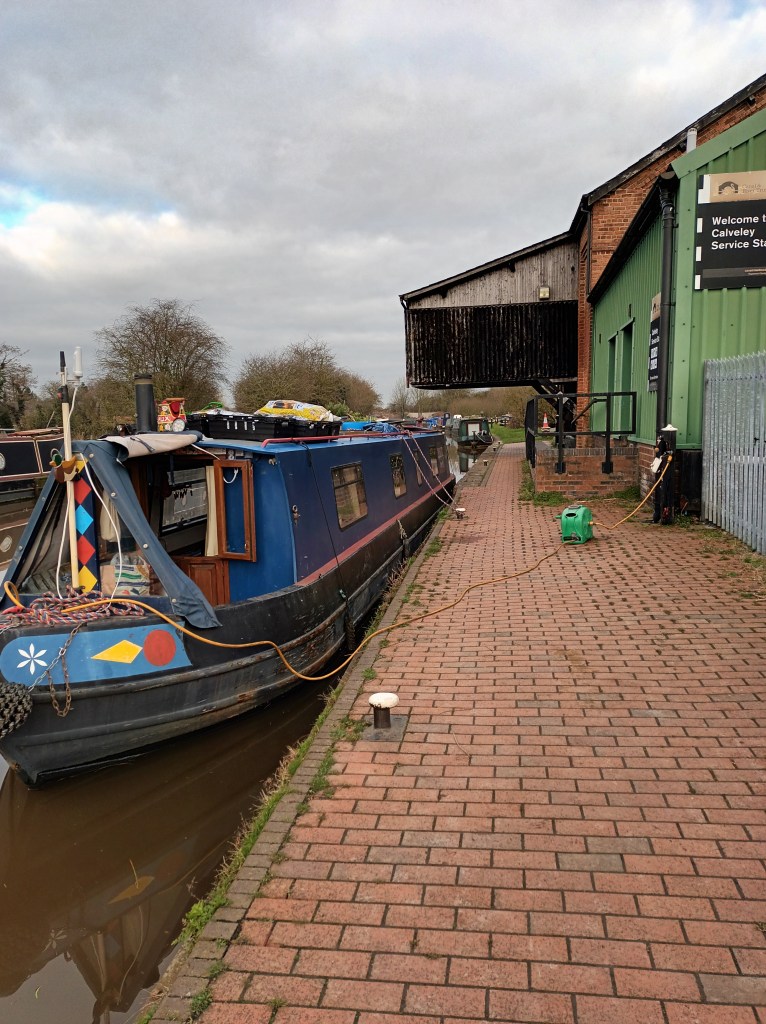
From Calveley Services it was down to Nantwich to find a laundrette from which I returned laden with damp washing while Steve headed for a supermarket to stock up on necessities. Then while the stove rapidly dried the washing for us, we set off for the Llangollen Canal. It branches off the Shropshire Union just outside Nantwich alongside the Hurleston Reservoir. You enter the Llangollen through the bottom gates of the Hurleston flight of four locks which took us up 34ft. We were quickly through these – mainly because it’s muck spreading time in the fields and the maize stubble alongside the locks was getting a very whiffy covering!

The 44.5mile Llangollen canal is justifiably one of the most popular holiday cruising routes there is. It wends its way through farmland, woodland, bird-rich meres, marshes, and market towns with some real highlights along its length. The two spectacular aqueducts of Chirk and Pontycysyllte lie ahead of us. There are just 21 locks along its length but to keep you entertained en route there are lift bridges, tunnels and some eye-catching architecture. We did wonder at one point if we’d been fortunate enough to stray not only into Wales but France!

We last cruised the Llangollen in the heat of summer in July 2011, but we’ve never travelled its complete length. There are some holiday boats around but it is very peaceful at this time of the year. There are no queues for locks, which can be both frustrating and a sociable time in the summer sun when you meet new people and hear their boating experiences.

From Llantsilio near Llangollen water flows from the River Dee into the canal which carries it down to the reservoir at Hurleston providing drinking water for Cheshire towns. This creates strong flows at the locks where the bypass weirs discharge – it can prove challenging as you can see to get neatly into the locks when this combines with blustery winds!

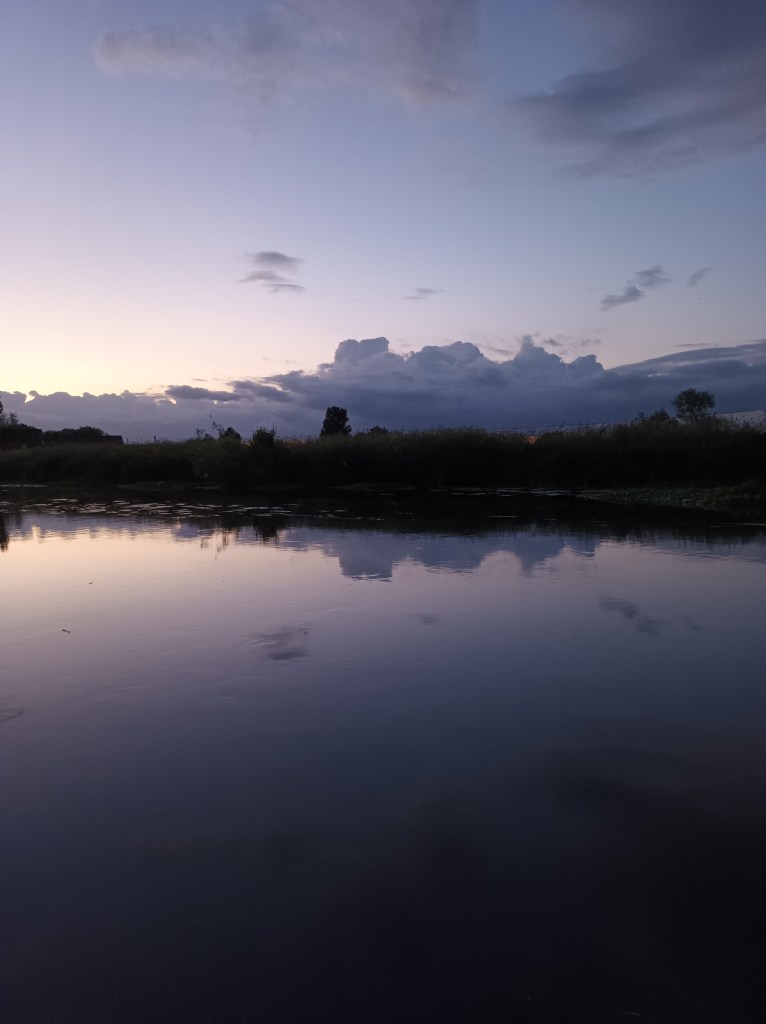
Whilst it has been chilly in the wind, we’ve enjoyed some spectacular sunrises and sunsets this week, and experienced a range of moorings. The views from our home and office have been varied and rewarding. It has been a peaceful week which makes us even more grateful for our life. That deep sense of gratitude is perhaps what has prompted the significant boaters’ responses to support the struggles of the Ukrainian people as they battle war with Russian invaders. Not only can we all contribute through our regular shopping in supermarkets which offer chances to add donations to the final bill, but we can also donate to food collections, knitting, crochet and clothing projects all coordinated via social media.

We know the value of canals as peaceful places for leisure mainly, for boating and fishing, walking and cycling and on the Llangollen for the practicality of moving drinking water. In Ukraine and Russia canals are mainly for irrigation for food production of crops and to ensure drinking water. The 250-mile-long Northern Crimean Canal lies at the heart of the Ukraine/Russian War. The canal links the Crimea which was annexed in 2014 by Putin with the Ukrainian Dnieper River and its water. It is the main source of water for Crimea. Last summer the Ukrainians rapidly and secretly built a dam at Kalanchak to block the flow of water to Russia. Kalanchak was occupied by the Russians, and just a week ago Ukrainians bravely took to its streets singing their national anthem in defiance, and demanding the Soviet withdrawal. As the protests happened, Russian media reported that soldiers had removed the Ukrainian dam.

Being moored in Ellesmere as we are now seems particularly poignant. It was here that Eglantyne Jebb was born – she went on to found Save the Children – a key aid agency working to alleviate the current conflict. Jebb also drafted the Declaration of the Rights of the Child in 1924 – so relevant today. In memory of her work the Ellesmere Sculpture Trail includes this moving work by John Merrill called Refuge. It represents a child displaced by conflict supporting its own shelter as it seeks refuge.

This bitter bloody conflict over water, land and rights is directly threatening millions of children, their safety, security and basic human rights. Like so many in the UK we are supporting Ukranian people as best we can. We are fortunate not to be facing the horrors Ukrainians are experiencing daily. It is a somber lesson for us all to be grateful for what we have, to support those who face conflict and seek refuge, and to fight continuously to protect peace.

Giving up

Scouring the news for glimmers of positivity seems an exhausting process – but we all need these to give us hope, not just about the current situation, but for our own wellbeing.

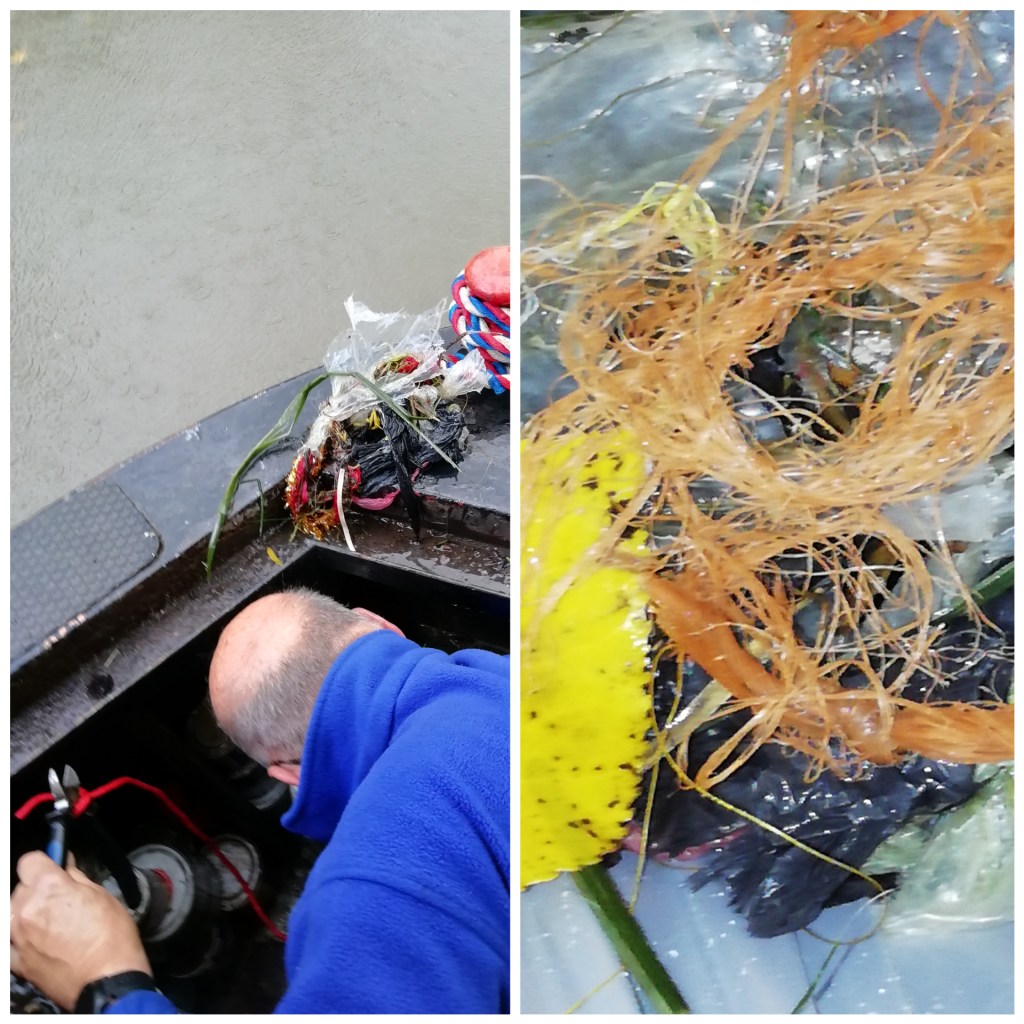
Looking around us and making our contribution to improving the world around us can be one way to help us get through bleak times. It’s a way that works for me, and has always worked, whether the tough times fall at home, at work, or in the wider world. I’ve been doing what I can – fishing out rubbish as we travel, baking so we have fresh tasty bread (pummelling dough as way to vent my fury at politicians), distracting myself with work, and learning about the world on my ever-changing doorstep. All activities guaranteed to generate positivity. What do you do?

This week the world around us has offered us a tantalising glimpse of Spring with sunshine that warms, plus a series of miserable downpours but we’ve moved on, finally tackling the last wide locks we shall face for months.

Wide locks are great if you have others to share them with – we were lucky to have a family on holiday to share the huge Chester Northgate triple Staircase locks (32ft), and subsequent Hoole Lane (8ft 3) Chemistry (8ft 9), Tarvin (8ft 4), Greenfield (9ft) and Christleton (9ft) locks with us. It makes the mechanics easier. Two boats in a lock fit snugly, they don’t need tying up to stop them crashing about as the water flows and swirls. Opening and closing paddles and gates is much easier with another pair of hands or two, and conversation whilst waiting for locks to fill or empty makes time fly.

We are seeing holiday boats appearing on the cut now, so company won’t be in short supply for long but the final wide locks on this stretch of the Shropshire Union have been lone affairs for us. These last 6 locks are approached through stunning scenery with wide reaching views across to the Peckforton Hills and the turrets of the castle there, and moorings at the foot of Beeston Crag, topped by the medieval ruined keep built by Ranulph de Blundeville no less. Part of the 34-mile-long Sandstone Trail winds its way in sight of both fortresses as they guard the Cheshire Plain.

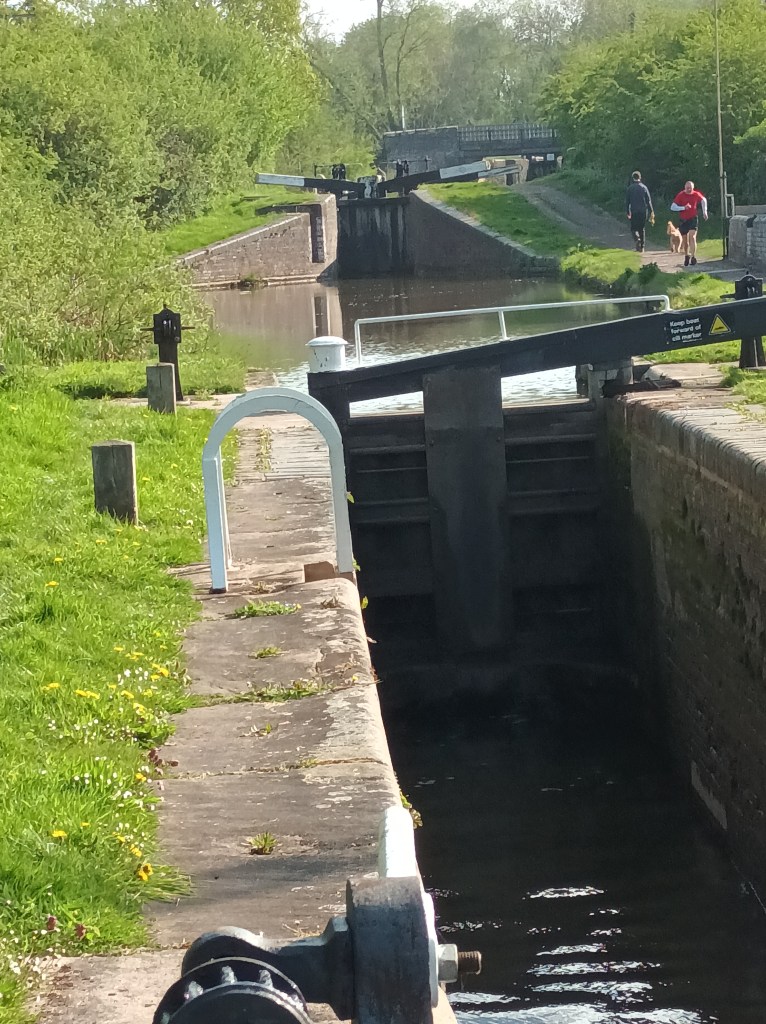
So to the final big 6 – Wharton’s (7ft 8), Beeston Iron (7ft), Beeston Stone (8ft 6), Tilstone (9ft 8) and the double Bunbury Staircase (15ft 7 in total). Each lock is unique, and each has its own stories to tell, some dramatic, some courageous, some poignant and some celebratory. Tilstone for example is surrounded not just by trees in its wooded glade but by history and memories. The lock itself was constructed out of sandstone in 1772 and is now an historic listed structure, as is the Mill, now converted into a house. It overlooks the lock, right by the listed single span bridge dating from 1767 that takes the road to Bunbury. At the other end of the lock is the circular Linkman’s Hut which is also listed. I wonder if the lengthsmen who had responsibility for set lengths of canal were also ‘linksmen’?

There are modern memories recorded here too, of people who loved this spot, remembered by plaques on a sturdy seat where loved ones can sit to remember them and watch boats navigating the lock. A well kept rose bed was created by the family of Jane Morris in her memory after she chose this peaceful spot to end her suffering from illness and depression in 2014.

These wide locks are on what was originally the Chester Canal, linking Nantwich to the River Dee at Chester. It is now part of the Shropshire Union Canal.

Bunbury Staircase

We’ve made it now through the Bunbury Staircase and now we shall be ferried up and down hills by narrow locks – bliss! They will take us along the Llangollen Canal, the Montgomery Canal and then back to the Shroppie to the Staffordshire and Worcestershire Canal where we have an appointment at Kinver at the end of March or beginning of April (canal time you see).

By the time we get to Kinver we will be nearing the end of Lent which started on Tuesday with pancakes for us on board. So it appears I’ve given up alcohol, chocolate and wide locks for Lent! Two of those will fuel my contribution to the aid efforts for Ukraine.

Nature can lift our spirits in a moment

So lar, so very good

Storms, winter chills plus threats from war and sanctions to fuel supplies and costs are challenging individuals and businesses right now. The lessons we’ve learned may help everyone.

For us living in our 50ft home/office/workshop staying comfortably warm is something people feel we struggle with. If I had £1 for every time someone says “Is it cold on the boat?” or “Stay warm” – I might be able to fund much of our energy bills!

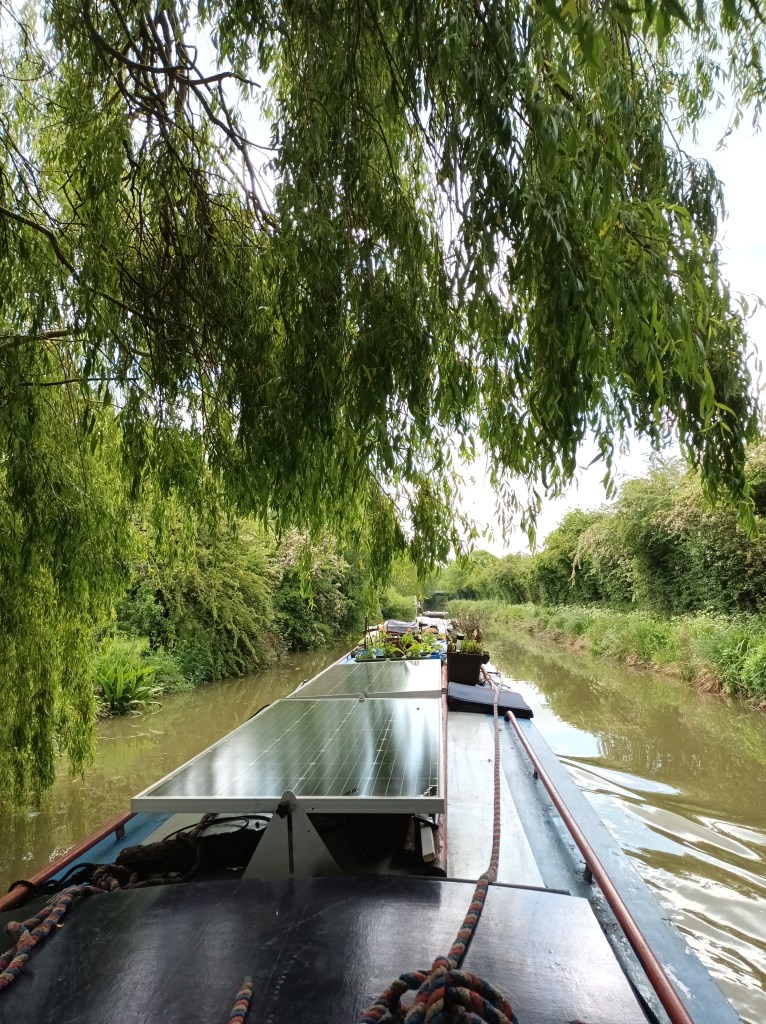
One area of our energy usage is actually nudging not into deficit but into profit! It’s exactly 11 months ago that we invested in 2 x 175 watt (peak) solar panels. Steve installed them himself, and the cost of the panels plus cables, controller, and ancillary parts like drill bits, screws etc was £530.01.

Our panels hard at work

The panels support our electric needs – powering this computer that I use for work (and writing our weekly blogs), running our lighting, charging phones, as well as operating pumps for bilges and water. Without solar input we would have to run the engine (using diesel).

In 11 months what we’ve saved in engine running hours resulting on reduced spending on diesel, servicing, replacement oil and oil filters etc. has come to £559.26 to date, so the solar panels have paid for themselves in less than a year, and generated even during Storms Dudley, Eunice and Franklin.

We are hugely lucky on the canal network. Because we are constantly on the move, if we moor sensibly (not under overhanging walls or high buildings) and angle our panels most effectively, we can maximise every possible ray of sun to reduce our costs. We forage wood for kindling and sometimes also find bigger logs for burning. Gas for cooking, coal for heating and diesel to move, provide power and water heating, float their way to our door thanks to the hugely efficient and reliable coal boats that operate the length and breadth of the inland waterways network. We are grateful to many of them!
These boats – manned by men, women, and often boatdogs – operate whatever the weather, whatever the season, getting through despite storms and closures. They offer a range of services, and wherever we are on the network we can harness their services. It’s not just fuel from diesel, gas, and various smokeless coals to kindling and logs but they often offer pump out services for those that have toilet tanks, and sell other essentials like fenders. For boaters who are continuous cruisers, those in marinas, and those on permanent moorings – these boats are literal, essential lifesavers.

Jay, Kat and Lulu the Boatdog on Bargus

We are always grateful to see them – coming through rain, through gales, through the dark, in the sunshine – they always tie up with a smile and efficient service. They are fascinating people – former engineers, university students, music production experts, mechanics etc. and many are additionally very talented photographers whose enjoyment and knowledge of the waterways comes from unique perspectives. Many coal boats provide the community around them not only essential fuels but a shared passion for the canals, countryside, walking and local pubs through social media, resulting in some seriously excellent recommendations.

I’m grateful to Brian on Alton for coal and first class recommendations for a good read, a good walk and a good pub.

We are fortunate – we are heating a 50ft by 6ft 10inch boat, and whilst we’ve come across a 65ft holiday boat this half term with gas central heating which took on four 13kg gas canisters in a week – we are just heated by the multifuel stove burning coal and wood. We are toasty warm – in fact often down to t-shirts inside! Our space heating runs 24/7 in the cold months and in winter we expect to use about 50kg a week. We’ve just loaded another 240 kgs today – all transferred to us by Jayson from Bargus and put in the containers we placed ready on our roof.

Looking ahead whilst refuelling our diesel tank

Kat filled our tank with diesel as they moored alongside us, Jayson chatted and together they kept track of which customer wanted what, who was next, what the ever changing load was on their boat, with diesel off, coal off and in some cases but not ours, poo on! It’s essential for them to know the weight and distribution of that weight to keep their Bargus safe. Their job isn’t just about steering a boat, lock wheeling, and serious cardio workouts with gas bottles and sacks of coal – it’s a mental workout too!

Together this fleet of hard working individuals keep us and the other boats out there moving, warm and fed. Our costs for heating, cooking, lighting and transport amounted to £1489.00 last year for home and office. This year we expect them to drop thanks to the solar, even with the rising costs of gas and threat to oil prices.

The lessons we’ve learned are clear – investing in solar has paid off; delivering essential services with committed customer service never fails; and neither does the beauty of living afloat.

We all need a fresh, positive perspective to our lives right now. If you want to share the highs and occasional lows of coal boat life you don’t even need a boat – just follow @fuelboatBargus and Brian McGuigan @coalboat_alton and Andrew_Haysom on Instagram. They’ll transport you into a whole new world, wherever you are – and that’s always a good thing.

How was it for you?

Were this week’s storms horrendous, stressful, expensive, devastating or over-hyped events for you? Storms are not something floating home owners take lightly.

Storm Eunice was of course only the latest storm of this winter. In the past 4 months we’ve floated our way through 6 named storms each affecting our narrowboat home/office/and work in different ways. For each though we prepare in similar ways – preparing the boat, ourselves, the dog and, if we have it with us, the car.

Boat… if we know there are storms coming and we have a choice, we would choose a canal rather than river. Flooding from rising water levels is more easily managed on a canal, and on a river you can find yourself unable to get off the boat if levels rise around you.

If we can we would rather moor with rings or bollards set into mooring sites or via chains attached to metal piling alongside the towpath rather than mooring hooks or mooring pins. The pins need to be hammered into the ground and if rain makes the ground very soft as often happens in storms the pins and the attached ropes can come loose or at worst completely detach, leaving the boat drifting free. We’ve rescued too many drifting boats in the past year from soggy pin moorings to risk this with our home. We’ve also brought a couple to the side that have been drifting with ropes trailing mooring hooks which have wiggled free from the metal piling as boats or winds create movement, so although we have them onboard we prefer to use chains. Whatever we have moored to, before a storm we check our ropes and the knots that connect the boat to the mooring point.

So we’ve opted for a canal over a river, fixed mooring points and then no overhanging trees or rickety looking buildings too close by. We take most things off our roof so we don’t lose things, or cause problems for others nearby with missiles hurtling off our boat.

Back in late November Storm Arwen came upon us when we were moored at Fradley Junction near Lichfield in Staffordshire. It brought chilling winds and snow during the early hours. In preparation we had brought in enough fuel for a day or two, put a torch at both exits from the boat and also kept a thermos of hot water ready in case we had to thaw ropes or zips to exit the boat! As it happened the rear metal hatch which we normally use to leave the boat froze solid so we needed to leave via the front cratch.

In early December Storm Barra arrived whilst we were moored at Acton Trussell. The only thing we noticed was an increased number of sticks for the fire conveniently lying on the towpath for us as we walked the dog!

Dog – his activities are curtailed during storms being always walked on a lead just in case a gust blows him into the canal. He does have a habit of walking on the very edge of the towpath so we don’t take any chances. As he’s getting older now he’s going out in a coat and harness with a handle – the coat to keep him warm and the harness to allow me to hoick him out if he goes for an impromptu swim.

Car – we seek somewhere to park away from overhanging trees – Eunice has forced it into a multi-storey car park nowhere near the top and not in the basement in case that floods!

Storm Malik named in late January by our Danish friends began whilst we were moored on the Macclesfield Canal at Bollington. Barely had it whimpered away from Cheshire than Storm Corrie took its place. This was a storm I was most aware of. Corrie appeared during the day whilst we were out walking up to the exposed viewpoint of White Nancy and the gusts were such at they were capable of knocking walkers off balance. It was that night in the dark that I really became aware of Storm Corrie.

The tawny owl who had called the night before fell totally silent and the ever-vocal Canada geese were quiet too. Maybe they moved into the fields to seek shelter in grassy hollows whilst the owl sought a non-swaying shelter.

The calm before Storm Corrie

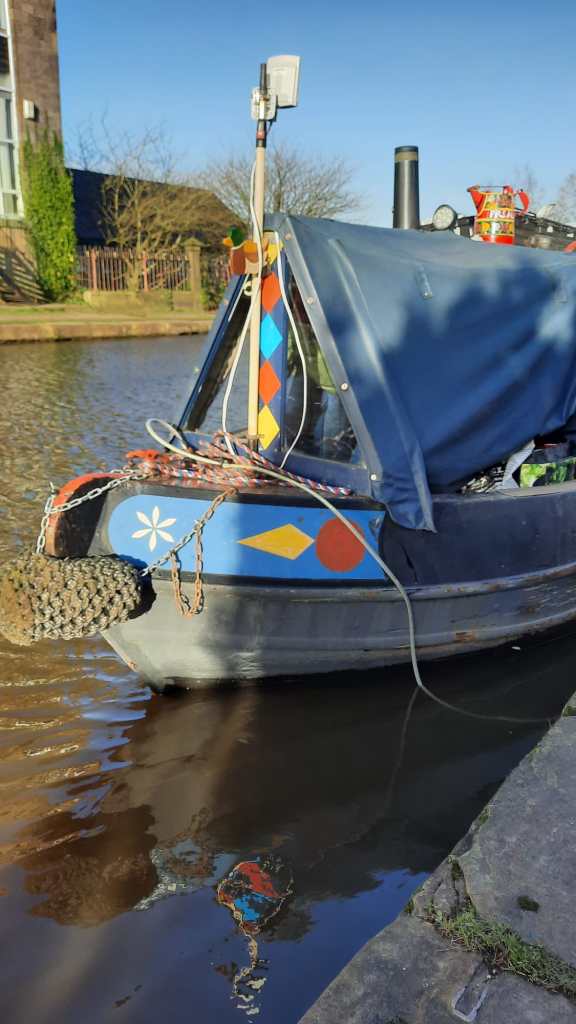
The long and the short of it was that we survived Corrie…and Dudley so fast forward to Storm Eunice. When she started we were on the Shropshire Union Canal in Chester not far from the famous Cathedral and walls. We were moored to rings and with everything we had space for moved off the roof. Some sacks of coal remained on the roof and so did some plants. I had to hope that the latter would be heavy with the regular recent downpours not to be hurled into the canal. If they disappear and they float, I will fish them out if I can. Anything loose on the roof has been put into the cratch (the space at the front of the boat) and the cratch cover securely zipped and fastened. It is old and doesn’t fit as well as it did because it has stretched in some places and shrunk in others (we’re heading towards a replacement in late spring) but hopefully it will hold.

I managed to complete meetings and work assignments before the worst of Eunice arrived. Like anyone in a bricks and mortar house or office, we could lose internet or phone signals if nearby masts are affected but it didn’t happen.

Around 1pm (Friday) the wind started picking up. The gusts caused the canvas cratch cover at the front of the boat to start tugging and pulling against its zips and fixings. If it rips it rips…and everything underneath it will be at risk of being hurled into the canal. The storm brought moment of calm and then sudden squalls of noisy violence which left my heart in my mouth as the cover thumped and the boat swung on what slack the wind created in the ropes as they strained tight before hitting the side once more. There is nothing to do at these times but sit tight, hope and distract ourselves. I put on music to cover the sound of the gasps and groans from me and the boat!

White horses gallop past on waves moving rapidly down the canal past the Cathedral and past the boat. Water slaps against the metal hull making huge gulping sounds as it is squeezed into the gap between the stone canal bank and the boat. The boat lurches in the big gusts and rocks gently afterwards as if recovering ready for the next onslaught. Inside everything that is hanging, plants, coats, swings and sways. The water is choppy in the dog’s water bowl to his surprise. Although he’s now deaf and can’t hear the chorus of thumps and bangs he can feel the agitation. Normally he sleeps through the afternoons as we work but the storm unsettles him so he sleeps with one eye open…just in case.

We are lucky – we can’t be affected by power cuts – we generate power from the engine and solar panels on the roof (surprisingly the morning of Eunice brought us 200 watt hours).

Eunice in Greek means a joyous victory and I think our preparations have helped us to a victory over the strength of the storm. We have had one loss – but a doormat seems minor.

Storm Eunice abating

These storms provide a life lesson for us all not only of the imperative to reduce global warming but of managing risk – preparing well, practicing, planning for every eventuality and hoping.

I hope you survived Eunice as unscathed as we have, and as we all move forward to Storm Franklin whenever that arrives, that we can all prepare effectively and survive through a combination of planning and luck.

Work-life collision

Just when we thought we’d got that work-life-balance thing spot on – but we’ve been discovering how confusing it can be when work and life collide.

It’s more of a linguistic shunt than a literal crash… so to explain…

One side of our business is property letting – bricks and mortar, rather than floating homes.

nb Preaux, our office, workshop and home, turning onto the Wardle Canal from the Trent & Mersey

Our own home and office is a 50ft narrowboat – this week navigating the Trent and Mersey, Wardle and Shropshire Union Canals. The latter is positively busy – more moving boats than we’ve seen for weeks! It’s also very beautiful.

We’ve got used to dealing with leaks on the water – leaking locks, leaking water tanks and leaking windows come to mind.

We’ve been tackling leaks of a different kind for some tenants – leaking radiators. That demanded a call to draw on a well established relationship with a plumber local to the radiators. Given that our properties are in different places we keep up good relations with plumbers, electricians and carpenters in several locations. Networking remotely you might say!

Another facet of the business is journalism with some PR (public relations). The journalist welcomes leaks but PR is somewhere you generally prefer NOT to have them. Fortunately there weren’t any this week although we did pass a reminder of a political leak which has resulted in a positive flood of bad news for the Government over the past year or so.

Anyone for an eye test?

Then, as we were heading into another lock (and we’ve tackled a fair few in recent days), we had a crisis call from another tenant – about a different kind of lock. He was locked in his bathroom! As we tackled one kind of lock we were simultaneously sorting a solution to a different kind of lock for him and by the time we were heading into the next lock for us, he was free and a repair was underway.


Managing work and life whilst floating through the British countryside demands multi-tasking but we don’t duck that – in fact we revel in it, and we picked up another delightful duck this week – meet (early) Valentine!

Happy Valentines’s Day and have a good week – at work and in life!