
If we had any doubts about why we live afloat this week has surely banished them.
We started our week in Braunston, the Northamptonshire junction which has been a focus of the waterways for writers, artists and photographers for generations. It used to be buzzing with working boats, but now houses a flourishing marina, the invaluable Tradline rope and fenders, a chandlery, art business and for those drawn these days by good cakes and breakfasts – the floating attraction of Gongoozlers Café.

An added attraction there was a grass snake swimming across the canal – everyone thought it was a stick at first, and I failed to get pictures although they aren’t uncommon swimmers at this time of year.
Braunston was where we picked up our 5-year-old lock labourer and apprentice skipper. With him aboard, we moved on, through the triangular junction with twin Horseley Iron Works towpath bridges that forms the meeting point of the Oxford and Grand Union Canals.

Through 10 miles we chugged on in the sunshine, passing squawking moorhens chiding their bobbing black pompom chicks, swans calmly marshaling new cygnets and avidly counted ducklings trailing their mallard mums trying to see who had the largest family to cope with – 12 being the record.


After the three double locks at Hillmorton, the crew required a well-earned ice-cream halt even with the help of volunteer lockies. Double locks were introduced to canals to cut down delays and enable faster cargo carrying.
At Hillmorton we fished out plastics with our nets as we headed down the locks, so that meant a trip to the waste bins before we moved on to Newbold and a mooring before the tunnel near a pub that promised a playground. It didn’t look brilliant but entertained happily for several hours.
Sunny Sunday took us through the little Newbold tunnel, and on for another 12 miles until we passed through the smallest lock our young labourer has ever moved and with the help of a volunteer too – the stop lock at Hawkesbury Junction. Stop locks are a matter of a few inches only – they were originally used as a way of water companies controlling use of their waters – in this instance marking the move from the North Oxford onto the Coventry Canal.

We tied up on the Engine House moorings and had just settled for a meal when we met new boaters on their first week out in their new boat – they hit us which is always a good way to make sure you get attention! We were glad to help them sort out mooring for the water and provide a water connector – someone did that for us when we mislaid ours, so we are always glad to pay a favour forward.
After a quick trip to the fudge boat, it was time for our crew to reduce in numbers and for us to dispose of the car to enable us to travel more rapidly. When leapfrogging a car, we have a choice. One of us can move the boat and the other the car, or we can both move the boat and then one of us or both of us walk or cycle back to get the car. It slows us down and interrupts the flow of cruising.
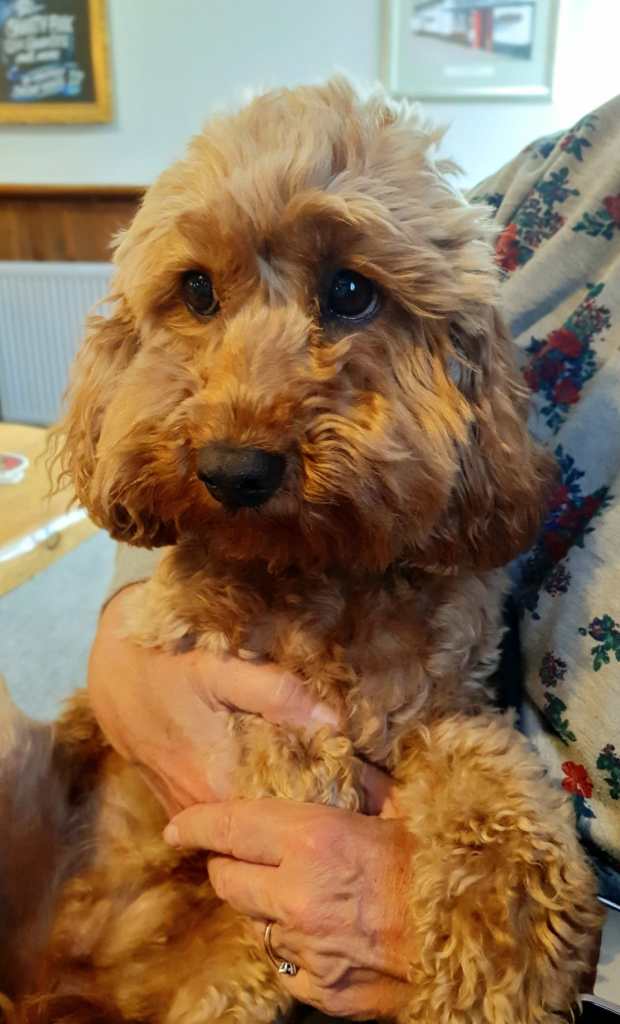
For our new furry crew member this was obviously another series of new experiences, making it back to the boat from leaving the car by bus, two trains and a taxi. She managed it all and jumped back on board with alacrity when we finally made it home.
Monday took us from Hawkesbury to Polesworth, moving on in more sunshine through 16 miles and 11 locks. These locks came in a single block or flight at Atherstone. Before we tackled them, we took the chance to nip into Atherstone for some shopping to refill the fresh food stocks although we are self-sufficient at the moment with lettuce, spinach and radishes growing well on the roof. With the help of voluntary lock keepers, boaters taking show boats up to Crick for the Bank Holiday weekend boat show and with holiday boaters as well as some kind walkers eager to help with closing gates, we made it down the entire flight in 2 hours 3 minutes.
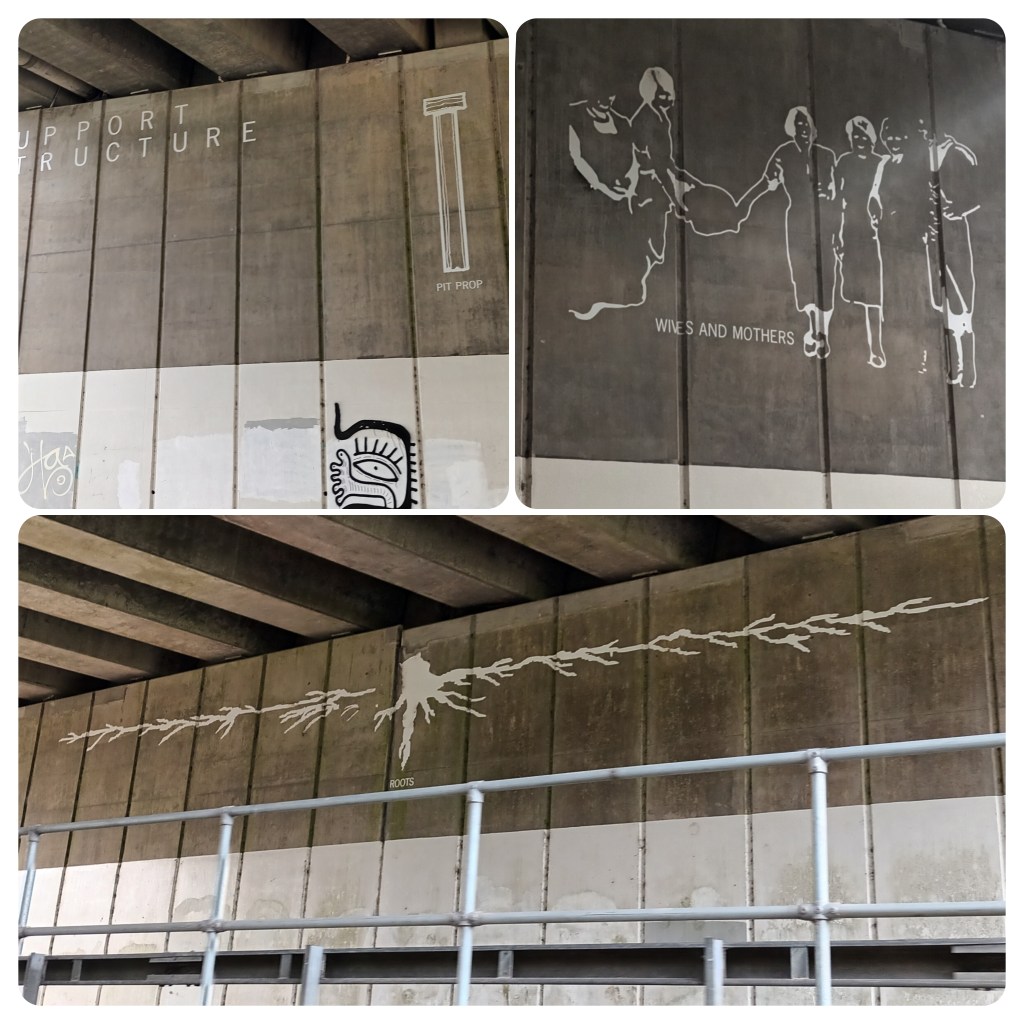
Polesworth is a Warwickshire village that once provided coal and clay, and food for thought via the Polesworth Circle which attracted literary greats like Ben Jonson, John Donne and others. Its art remains thought-provoking.
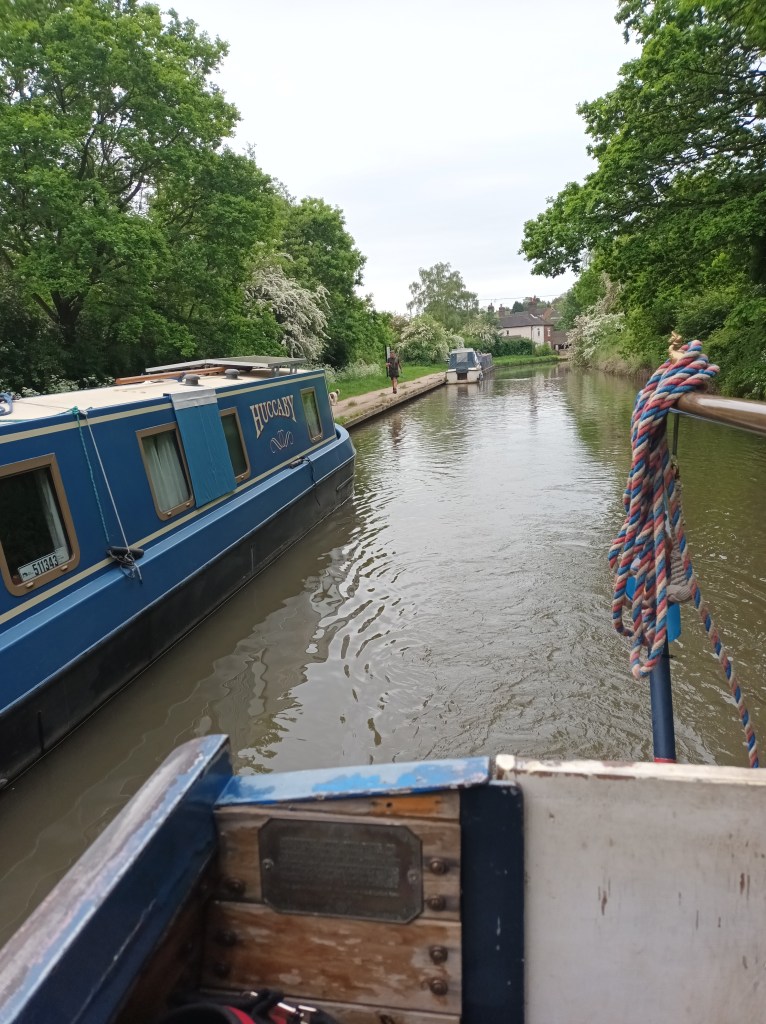
We headed through Tamworth to Fazeley Junction, dropping down the two locks at Glascote, and moving onto the Birmingham and Fazeley Canal. Such is the nature of the floating community that we waved in passing to boaters we haven’t seen for years, enjoying a shouted catch up as we moved north and they south. Good to see them, and see them looking well.
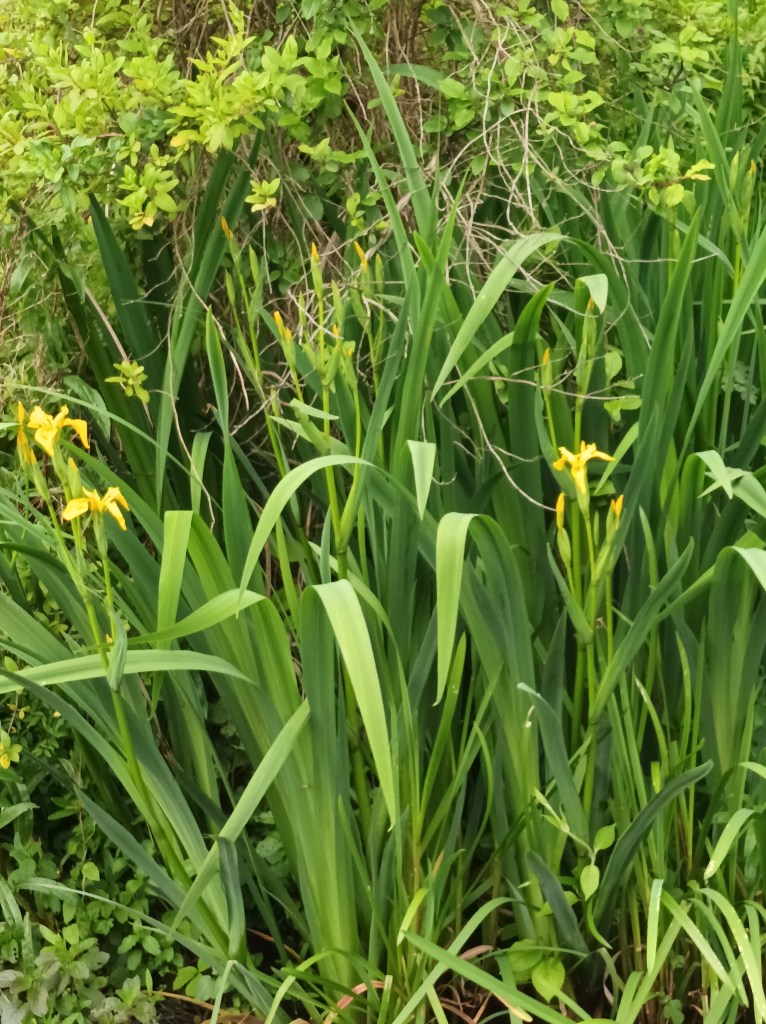
It’s a glorious time to travel the canals – the hedgerows look as if they’ve been iced – thickly laden with white may blossom. The air is thick with scents, from may and from rapeseed growing in vivid yellow swathes across the countryside. Alongside the water nature is putting out the flags for us, bright splashes of colour amid vibrant and varied greens of reeds, the frothing white of cow parsley and swaying curtains of willow.
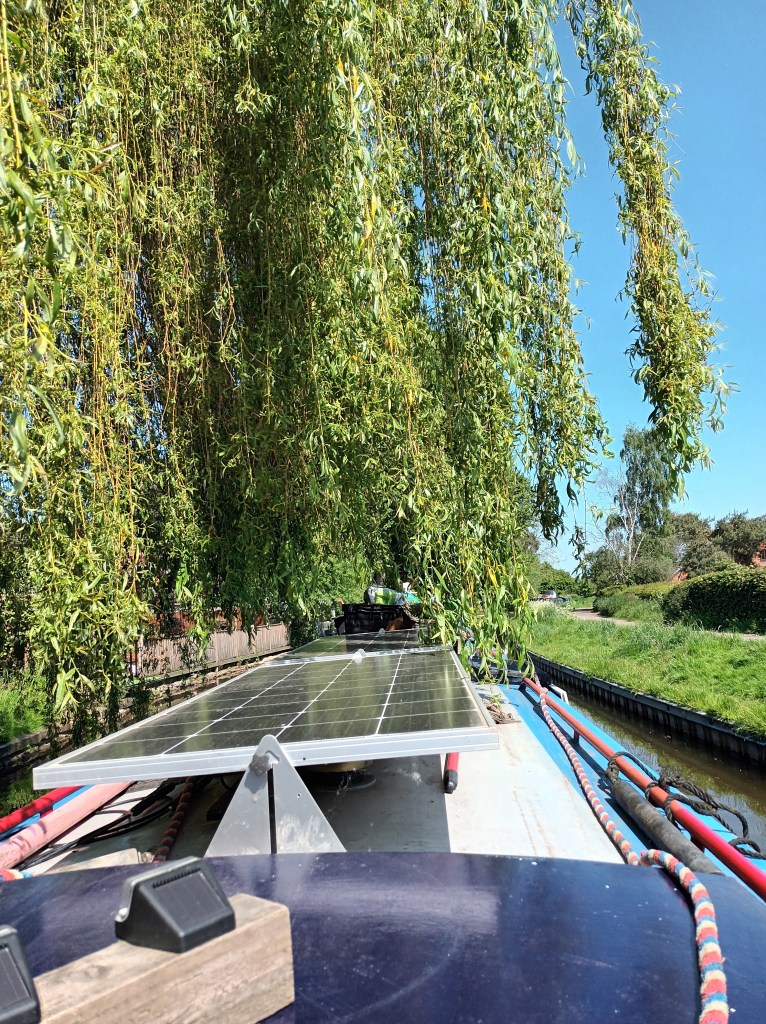
On New Year’s Eve as 2023 began we were moored before the small swing bridge in Staffordshire at Fradley Junction, handy for celebrating in The Mucky Duck aka The Swan. We moored up there once more, walked through the growing and popular nature reserve surrounding Fradley Pool; checked the pub hadn’t changed in the intervening months; enjoyed limitless hot water showers at the services (our equivalent of a spa); and watched the bats feeding overhead in the early dusk.
Early the next morning we turned onto the Trent and Mersey Canal, seeing yet again the changes HS2 is bringing to the area. Metal barriers have sprouted where once there were trees.

Moorings have gone, cottages are empty. Significant towpath work is underway too, perhaps linked to HS2, and its good to see that workboats are being used to transport ballast and planted coir rolls which create bank protection. As always – we met two of them on a blind bridge!
Twelve miles and 4 locks on Wednesday took us to Great Haywood, a favourite spot of ours with glorious walks around the grounds of Shugborough Hall, and a chance for furry crew to swim (nope, madam preferred to paddle) in the River Trent.

We managed to moor next to another friend and found an onboard garden to swoon over.
Thursday then was our final long day of travelling, and it turned out longer and contained more surprises than we expected. We aimed on 13 miles and 13 locks to get us to the Staffordshire village of Barlaston midway between the “canal town” of Stone and the heart of the Potteries, Stoke-on-Trent.
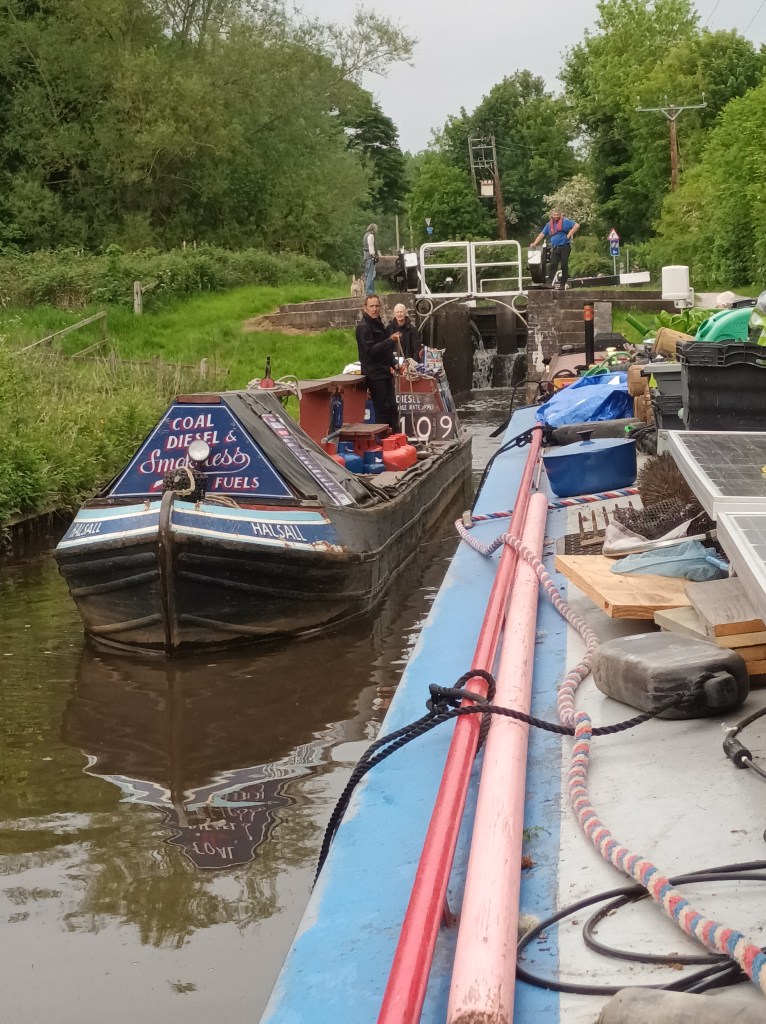
We were doing so well. Manoeuvring round boats searching for their spaces to set up the Bank Holiday Weekend floating market and up through the four deep, cool and dripping locks at Stone.

All was going so well, and we moved on then to the days final 4 locks at Meaford (pron Mefford). Through the first lock and it looked like someone was coming down the second lock, giving us a helping hand through – but that’s when we realised the man opening the paddles of the lock to let the water flow out didn’t have a boat. He turned out to be a Canal and River Trust employee emptying the pound (the section between locks) and lock 33 ahead of us.
The issue was with the cill of Lock 33. The cill is a large, raised ledge against which the top gates of a lock close, containing the water. The issue in this case was that something had come loose and when the gates shut, and water levels were lowered water from the pound above was about to escape through a narrow gap into the lock. Pushing water at force through a small space resulted in a powerful jet of water being directed at the back of the boats going down – dangerous for the person on the back at the tiller, and potentially sinking boats as the water could get straight into the back of the boat. Boats going up the lock could face flooding at their bows. So repair work was essential.

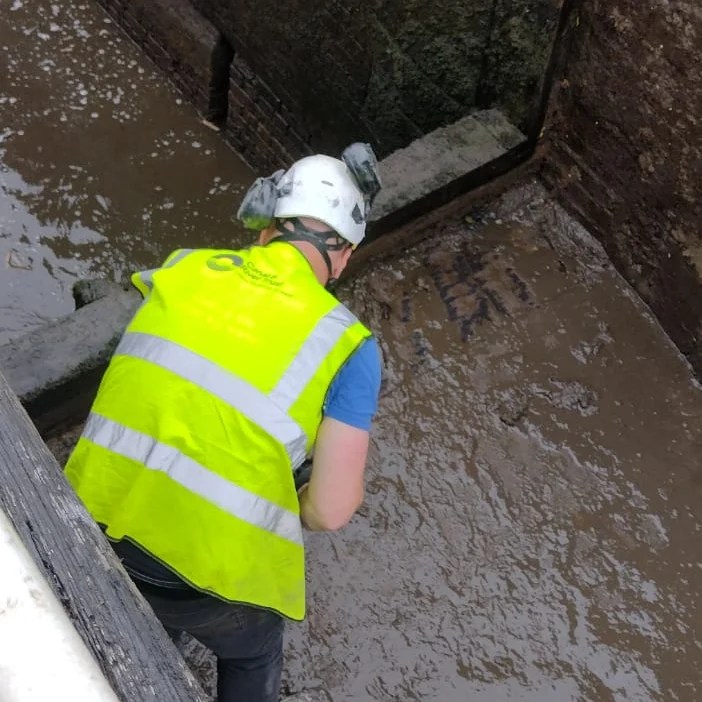
Three staff from CRT emptied the lock. We moored up after the first lock and stayed put until allowed to move. It was about a four-hour delay in the end, but we were able to support the work by letting other boaters behind us know so they didn’t try to get through the first lock. I got some crafting done, had a chance to talk to local people and other boaters, and Steve along with other boaters helped CRT at the site of the lock at issue. Rapid evaluation once the water level dropped combined with repairs involving quick setting cement followed by clay and the lock was ready to work again. Working coalboat Hassall was the first to be let through to try the lock, and once they were safely through then the rest of us queuing could head through in turn.
That brought us to Barlaston later than we had expected, as dusk was falling, but we are here, where we wanted and aimed to be. It has been a wonderful, invigorating and uplifting 6 days of travel. We have felt bathed in nature, and sunshine. We are an incredible 79 miles and 24 locks nearer to our next destination and the chance we really hope, to experience yet another of the Seven Wonders of the Waterways.
 Pickingupducks