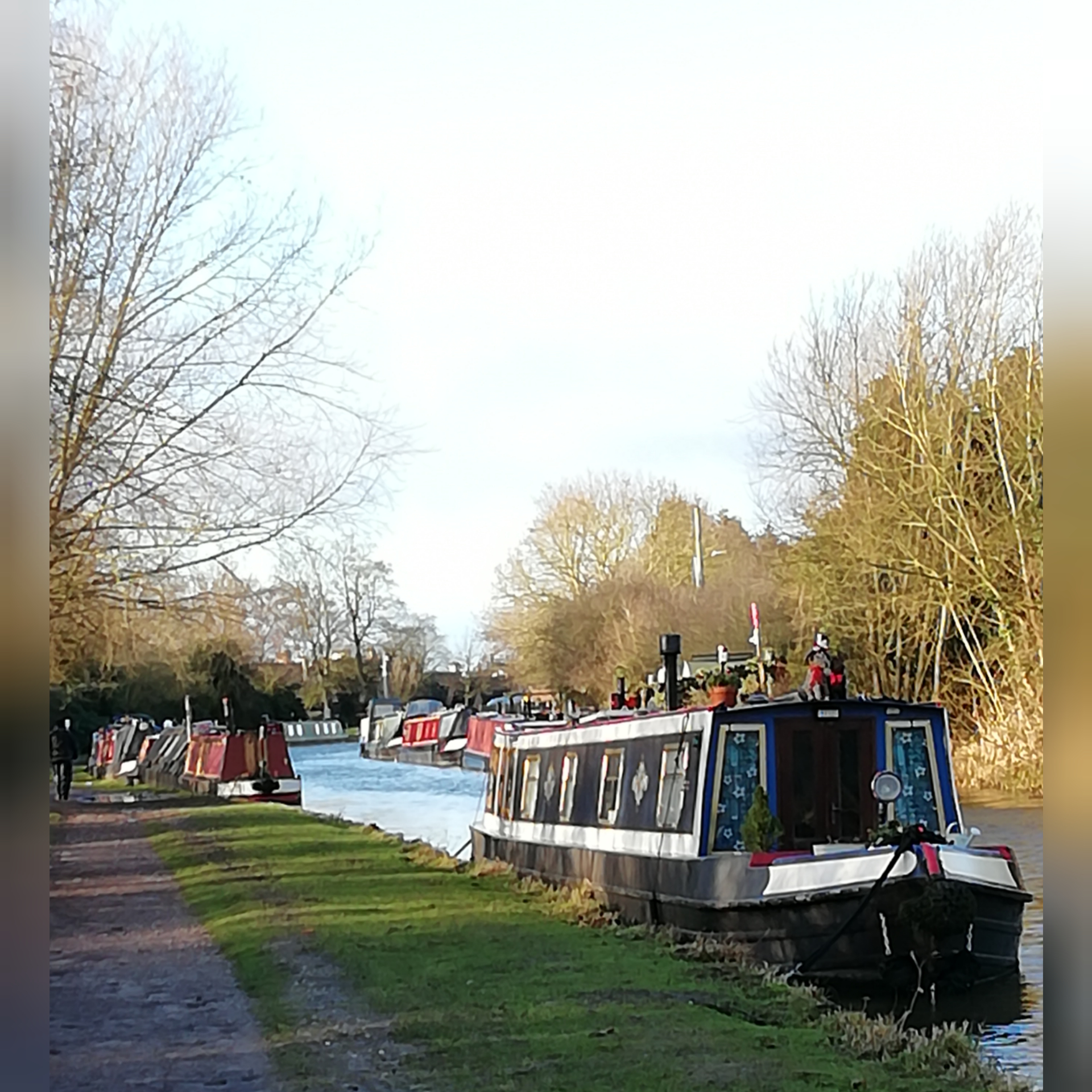
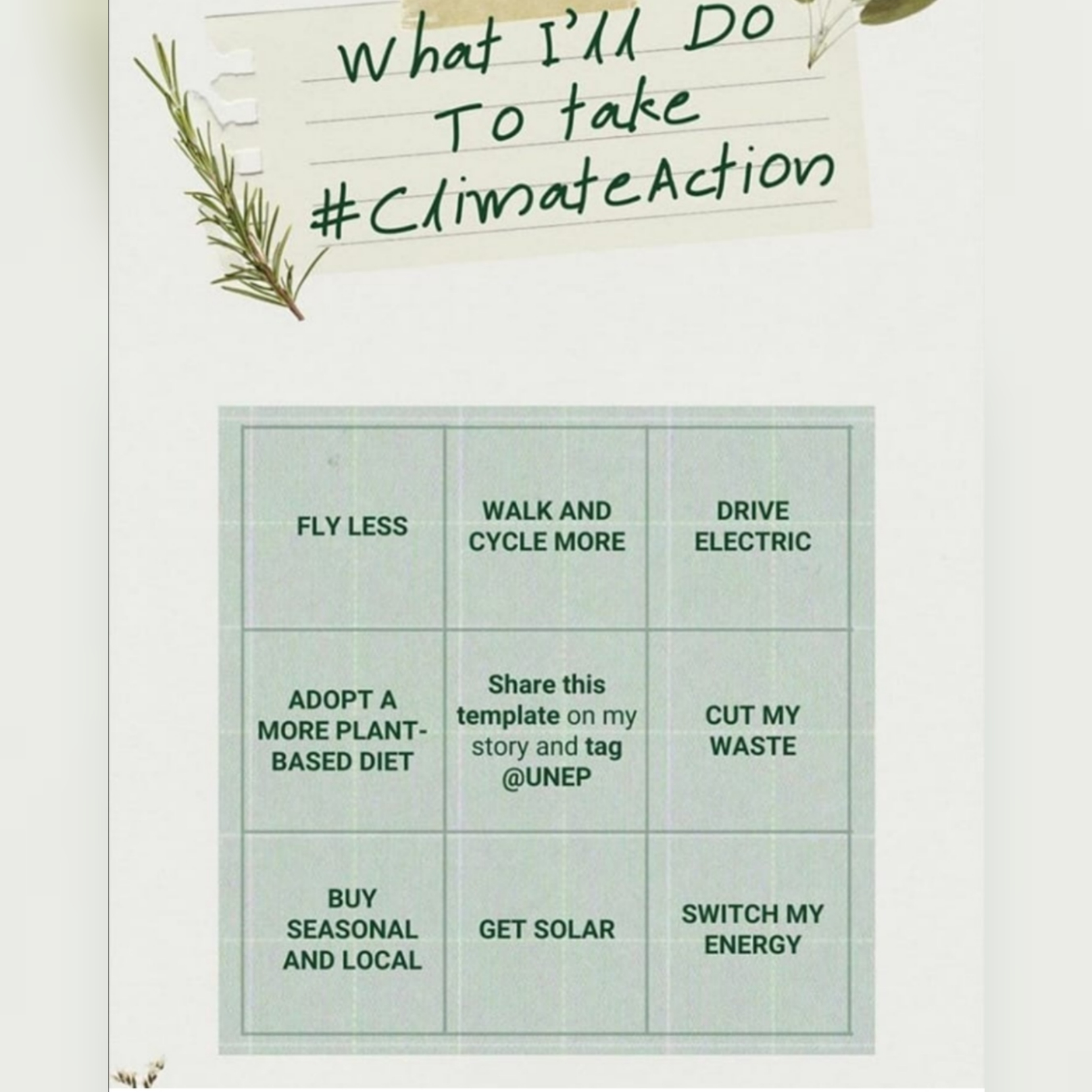
One way to break free in 2021 – resolution or revolution!

Welcome 2021 – may it be happy and healthy for you and those you love.

It’s a new year! That time when we aim to exercise more, lose weight, stop doing things that are bad for us, and think of how we might change our lives for the better. I wonder if we will be making resolutions this year, after 9 months that have rocked our world and created more changes than most of us have experienced in our entire lifetimes. If nothing else this pandemic has shown us just how adaptable we are when we need to be.

Living and working from home has given many of us new perspectives – of home, of work, of ourselves and of those we live with. The pandemic has also made us more appreciative of the importance of teachers, health care workers, research scientists, our communities, friends and families. I hope we cling to the good things we have learned. We can achieve our dreams, if we are prepared to make short-term sacrifices.

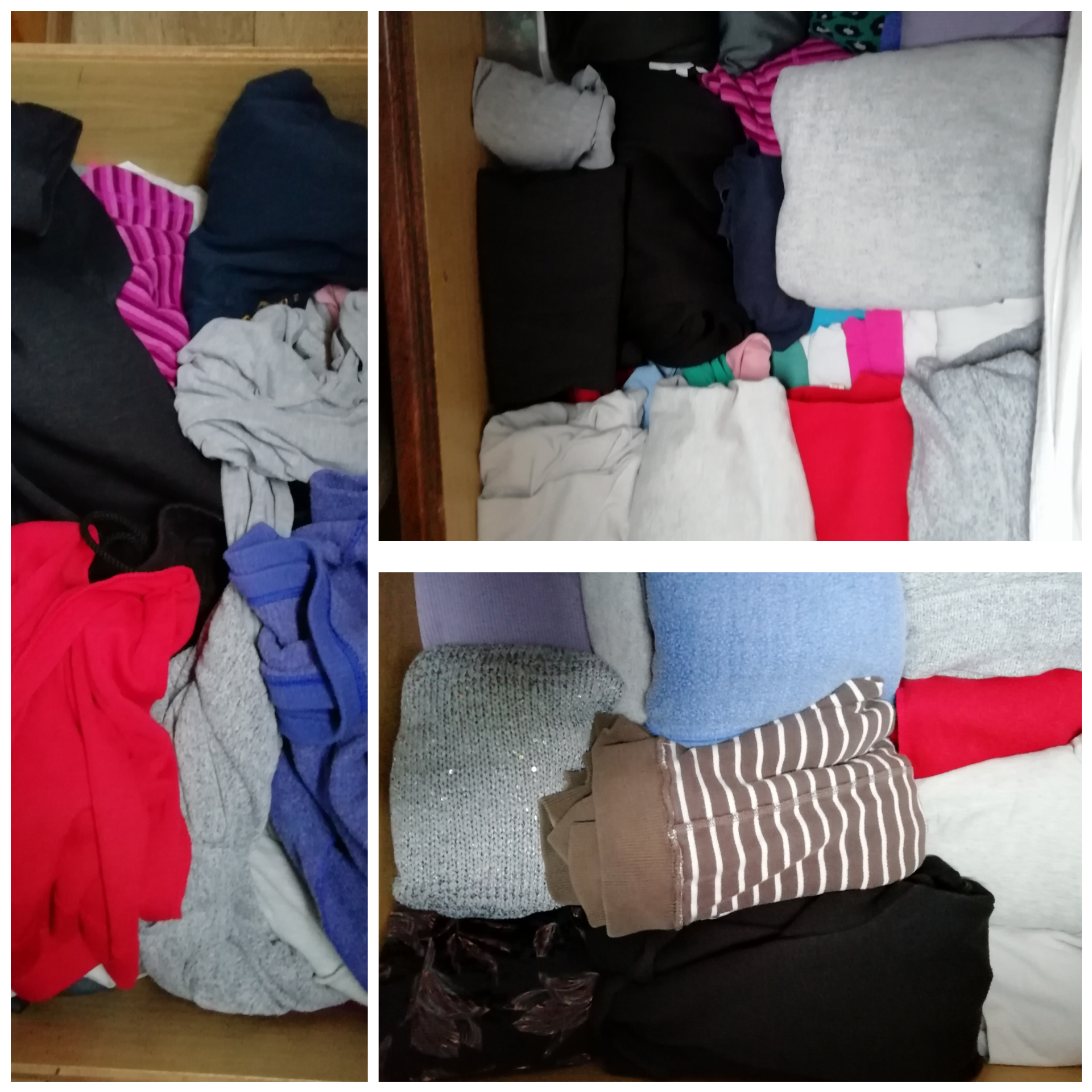
In the past 6 months we have personally stripped away what isn’t important, particularly with material possessions. We have found this adds significantly to the freedom of living on a narrowboat (to be honest if we hadn’t we’d never be able to move on the boat, and the boat would probably have sunk under the weight of stuff!). Decluttering is an extreme activity but one which we’ve found surprisingly liberating. I wish I had done it when we were living in houses, I know it would have given me more space and freedom.
It has revitalised the way we both live, and work. Bringing a fresh, reinvigorated perspective to all aspects of your life is profitable in many ways.

Creative musician, writer and friend Dave Wakely once wrote William Morris’s advice in beautiful calligraphic script on our dining room wall (on request I hasten to add):

“Have nothing in your house that you do not know to be useful, or believe to beautiful.”

It’s a wonderful maxim and the great thing is that it recognises personal individual choice. It applauds what you like to use or love, not someone else’s taste or decisions. Of course unless you live on your own that is likely to mean compromises – in our case these centred mainly on books and tools!

We have met young people turning to boats as a way of escaping pa-renting, now enjoying accumulating their first home possessions onboard… We know older boaters with brick and mortar homes whose boats are holiday or weekend homes, equipped as an extra. For us it has been completely different. Giving up our 4-bedroomed family home in 2020 and moving to live on a 50ft narrowboat for good came directly from the pandemic restrictions and the way Covid had forced us to change our way of living. In our 31 years of marriage we have combined lifetimes of collecting things, inheriting things, squirreling things away, saved memories of our two daughters from their first teeth (yuk, why have you kept these?!) to every concert, performance, play or sporting event programme they have been involved with and those have been many. Our move demanded drastic downsizing and decluttering, so here is our learned experience if you fancy creating a clean sheet in 2021.

During the first lockdown we realised that if we no longer needed to be in a set location to work, it didn’t matter where we were as long as we had internet access. So – internet access was a requirement and something we could achieve on the boat. We just have to check for connectivity when we moor. We looked at the kit we had and worked out that between us we could live and work with a single laptop, an ipad and our two phones. These all require cables (several share so that reduces things). We both use a Garmin daily so we needed those and their chargers.

Our decluttering began with 4 maxims: need. want. keep. go.

We started by considering the minimum things needed, for us and the dog. That divided up into what we needed to live – cooking equipment (a hob, a casserole dish, a steamer and 2 pans) clothing (layers are the trick for all seasons, you add or subtract as required, and waterproof outers are essential), heating/cooking in the form of a multi-fuel stove and furniture (more follows on this). For the dog – a bed (we may give this away as he spends most of his time on the sofa), towels, food and water bowls and leads. To that we added the things we wanted such as personal mementos that add meaning to life.
We worked round the house room by room, not forgetting the glory hole under the stairs, the attic and garage working out what need and want items were in each room. We asked our children and friends whether there was anything they wanted and which we could give them, or looked to see what we could give to charities who would find them useful. (Not sure the girls were hugely impressed with boxes of their school books, annual reports, first teeth, programmes, and Guiding makes!).

Anything which didn’t fall within those two initial categories was put into keep or go piles (recognising that if it’s kept but can’t go on the boat then we have to pay or beg favours to store it). I ended up with a single notebook with 5 headed columns for each room to keep track of decisions1

Go items subdivided into sell and tip – with an intention to only tip the minimum possible, anything that couldn’t be given or sold. Sale items had photos taken (we soon discovered they sold better after our youngest daughter gave up time to come and take photos. Her eye for detail and staging was an evident winner!). We used ebay or Facebook market place. I made a policy of only putting up a maximum of 12 items a week so I could manage the queries, questions, and collections/postage whilst also working flat out in lockdown one! We met some delightful people and made a significant amount of money in the process. There were occasional frustrations – buyers changing their minds, some items going for a song which felt hard to let them go, but we recognised our need for them was over. Hiccups happened too – with the sale of one pair of pictures I saw they had sold to a buyer in Bradford. Only at the last minute did I realise I had forgotten to tick the UK-only selling box so they had to be parcelled up for a flight to Bradford, Pennsylvania! It has resulted in a delightful ongoing correspondence though!

There were moments of painful dithering – and if we had real doubts after talking through the future of an item, we put it in the keep pile and relegated it to the garage for a week or two so it was out of sight. After a period of time we would make a final decision on its fate. Usually the items moved into go!

I am increasingly aware that what has finally ended up in store really is minimal. I also think we will probably part company with most of it we will have lived for a significant time without it, and probably won’t remember why we stored it! The exception for me is my kiln and stained glass equipment which I just can’t fit on the boat but somehow, one day, will find a way of returning to it!

I realised that squirreled away were things I kept because someone had given them to us. It felt as if I was being ungrateful by disposing of them. Daft really as the givers will never know and have probably forgotten over the years what they have given us. Does anyone else cling to such items? Since Covid of course we haven’t been welcoming visitors so there’s been no need to get them out and put them on display when the giver comes round – a hidden positive perhaps! To anyone to whom I have ever given anything which falls in this category for you – please dispose of it immediately if it’s cluttering your life!

Books collected over years for work and pleasure; often tattered copies of articles I had written stuffed in cuttings files from journalism days; book chapters and journal articles from academic days and delicately stitched tiny items painstakingly made when my daughters were small, together with inherited items were the hardest on the emotional decluttering. They have been lugged from place to place, country to country, over decades. The fact I have kept them for so long gave them more significance – if I kept them this long they must be important but I hadn’t looked at, used or even thought about most of them for years.

Work books, collected and curated over time have gone to colleagues and university libraries for others to use. What I need I have in my head or can find via the internet.

Cuttings files remain for now in storage but will perhaps depart or find new homes in coming years. Baby items were very gratefully received by local charities.

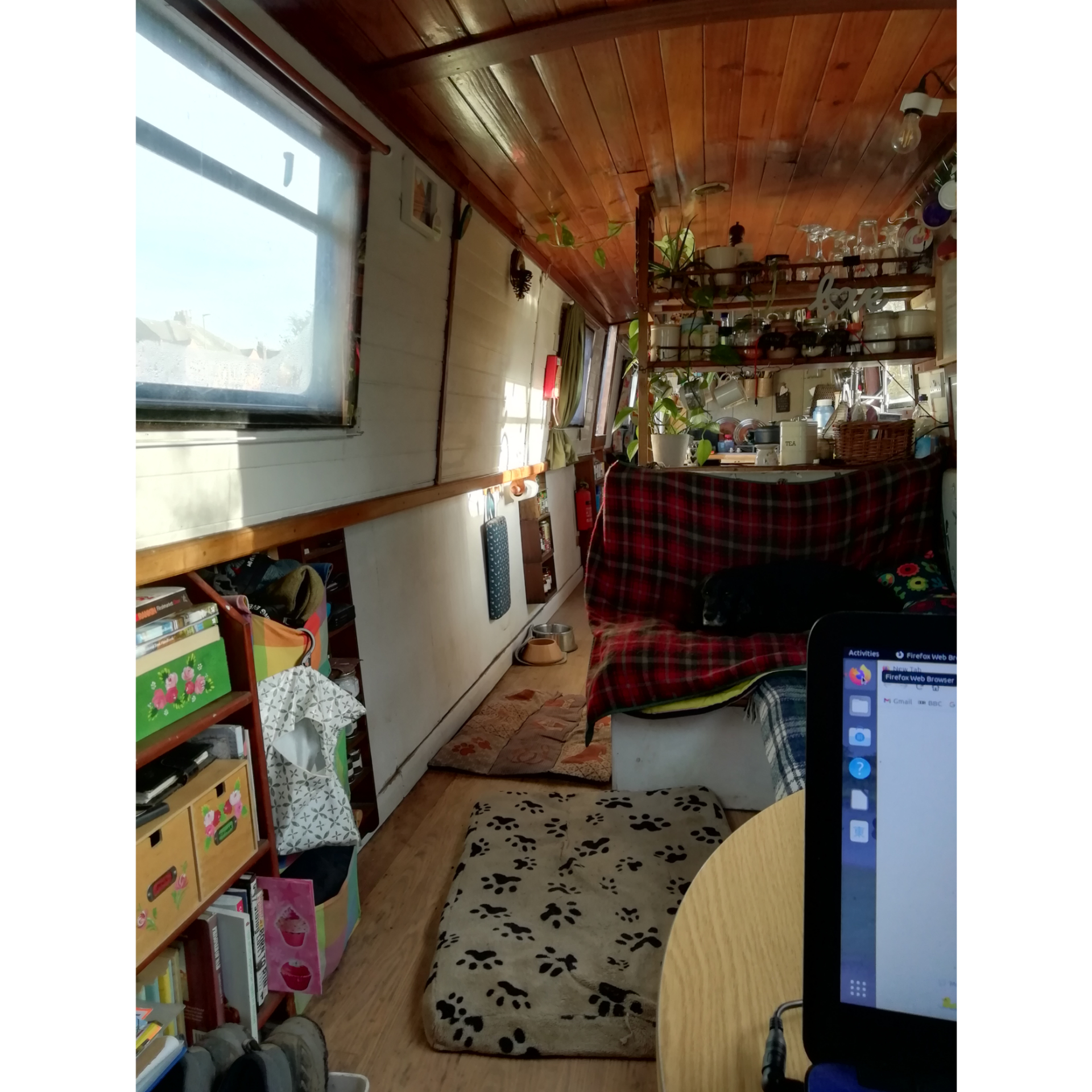
We, of course, had another requirement for our decluttering – what will fit into a 50ft narrowboat? Furniture from our house was going to be too big. Our much loved family dining table bearing the scars of red wine rings from long lazy dinners, scratches and doodles from numerous homework sessions. It was made for us in France from forest oak by a hugely talented friend and local postmaster, and is over 9ft long and over 3ft wide. It would take up almost three quarters of our entire current onboard living space! It has of course gone into storage. However we like to eat, work, and play board games at a table so we needed and wanted one on the boat. We ended up buying a cheap gateleg table with 4 folding chairs that fit between its legs. It does the job it needs to do and when the weather’s good, when we are allowed visitors, and are moored alongside green space, I look forward to taking it ashore to dine outside.

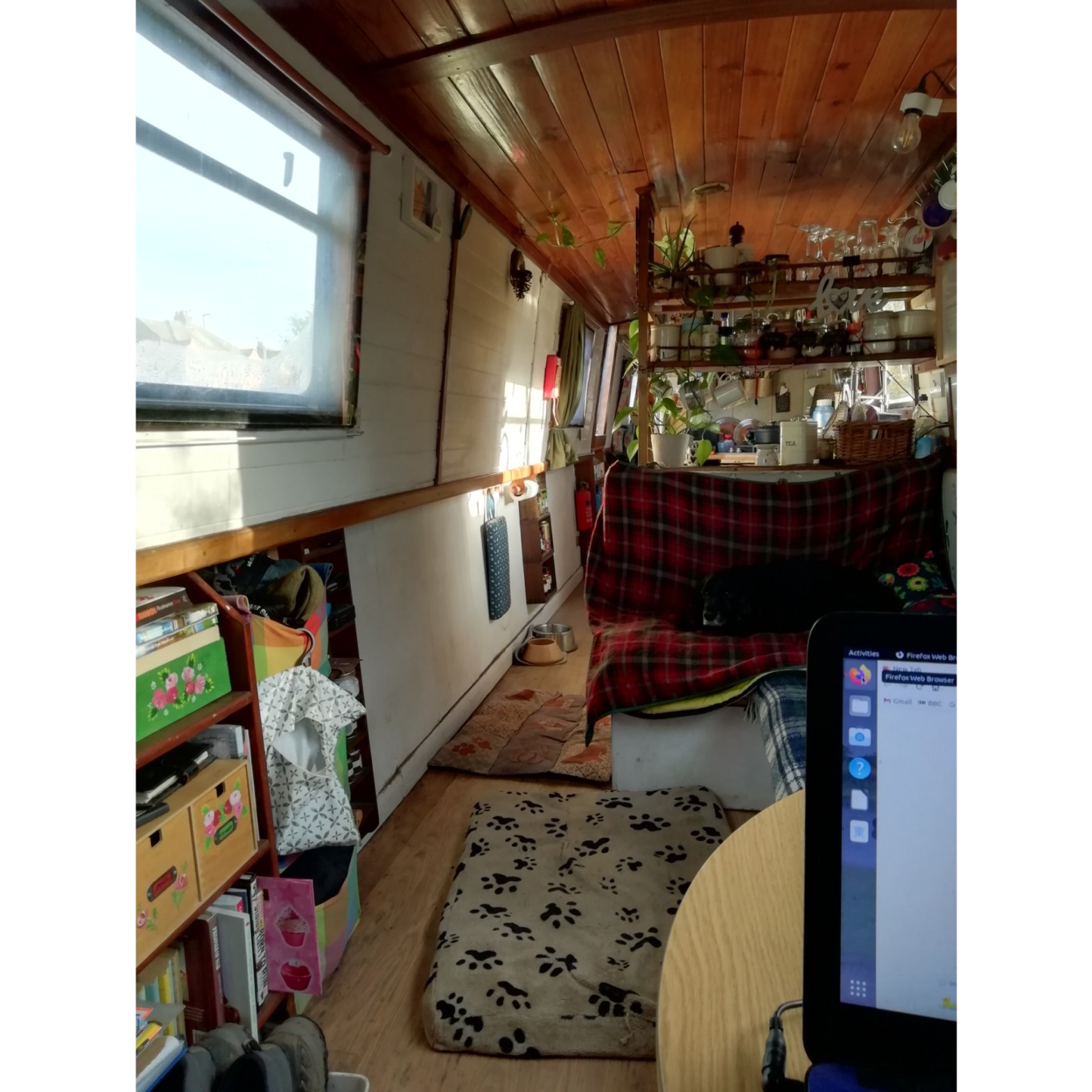
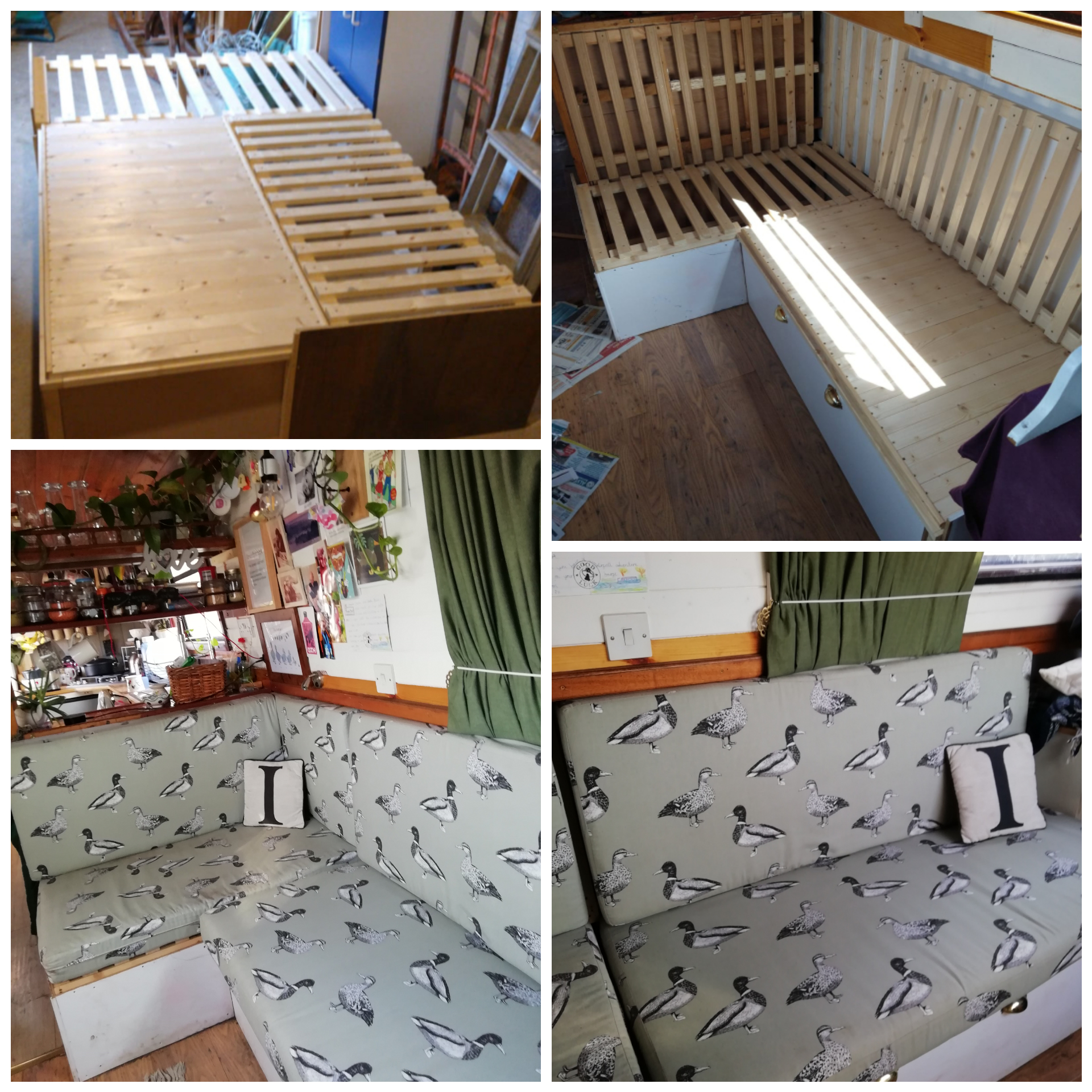
Chairs and sofas found new homes as Steve build in a fantastic sofa bed which seats 6 and makes a comfortable double. It provides loads of essential storage underneath, a box that pulls out to create a coffee table and its comfy cushions which were covered (in an appropriate duck fabric of course) by a skilled upholsterer friend.

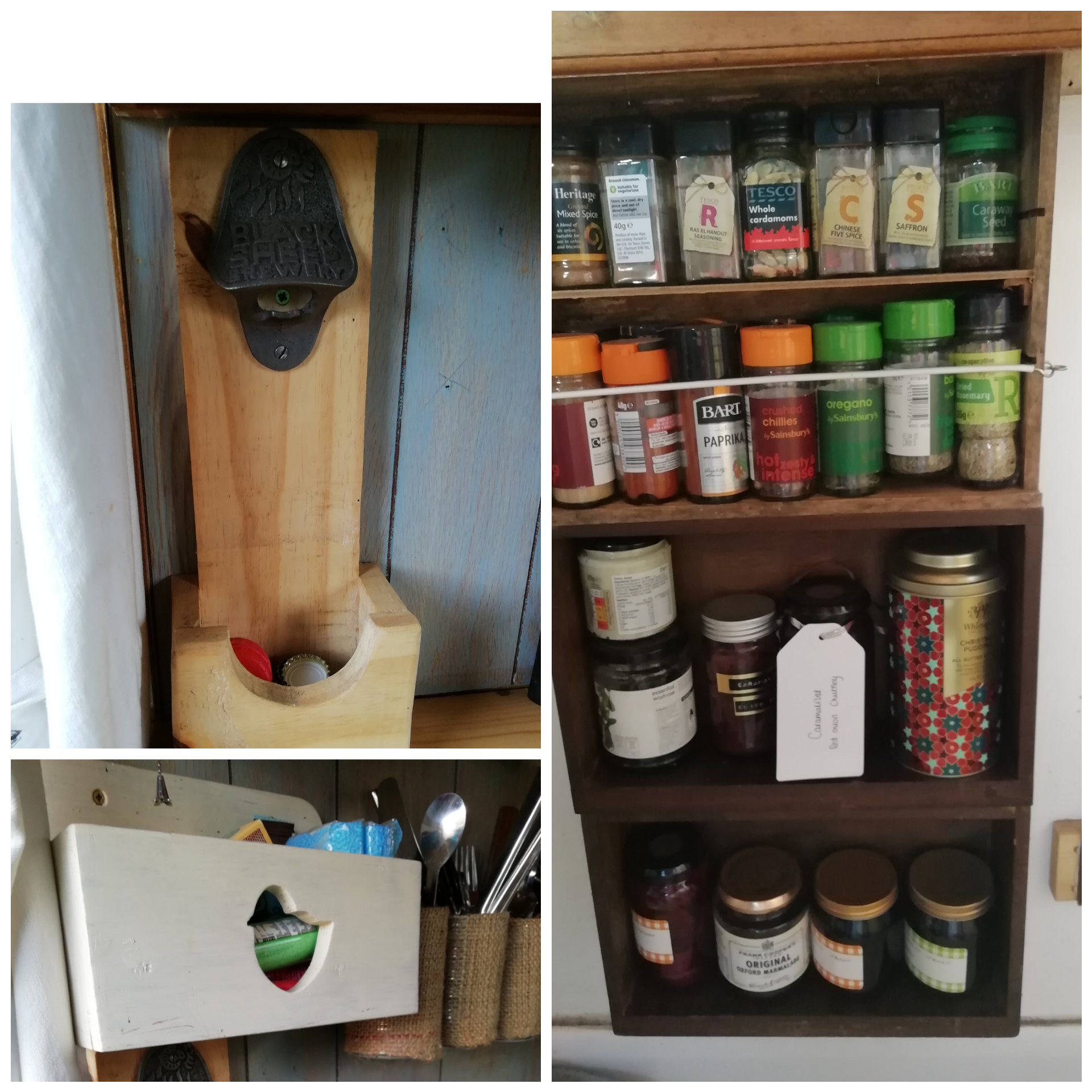
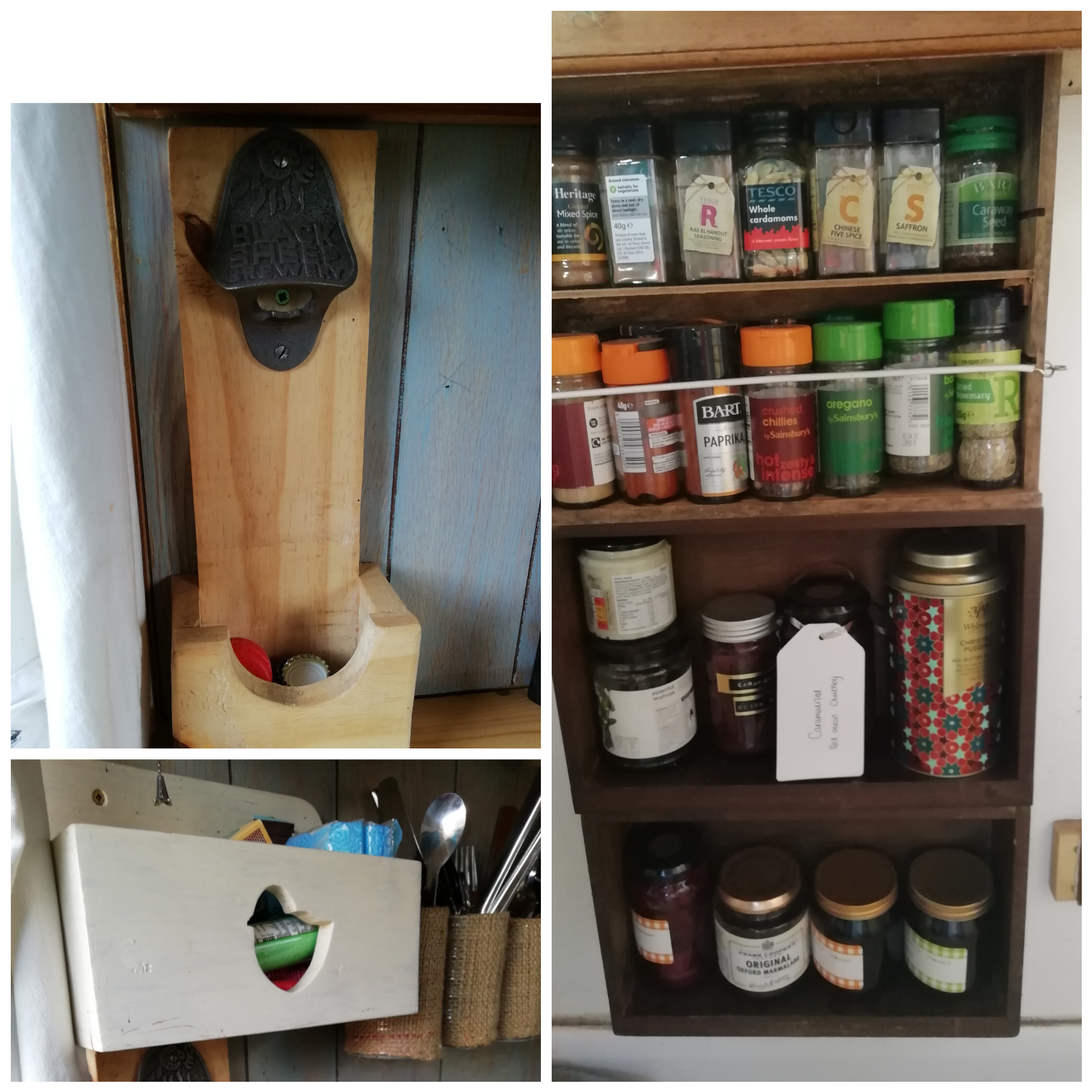
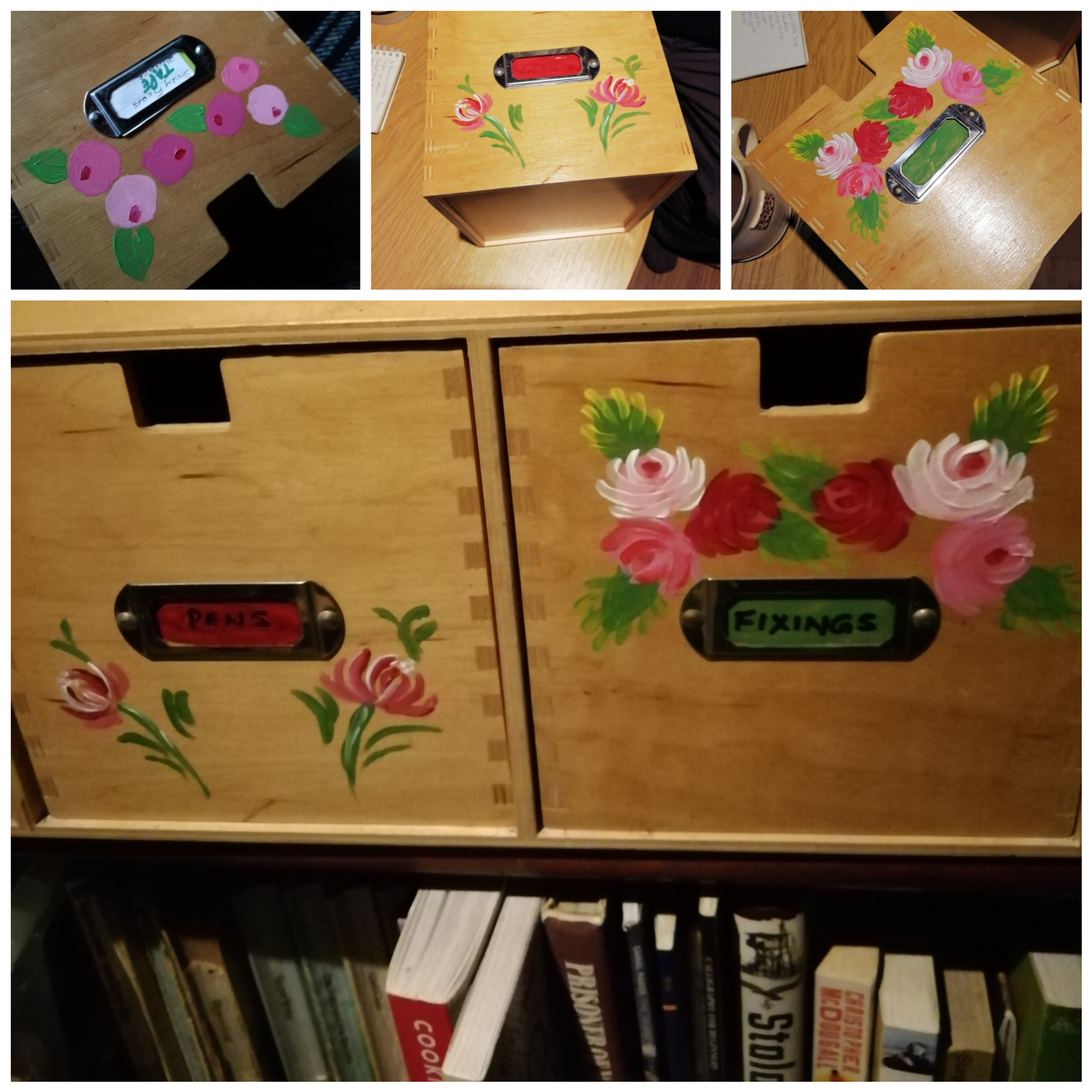
A chest of drawers I particularly liked and which came from another friend was way too big to fit on board – but storage is vital so two of its drawers have been repurposed as shelves. It’s with us in a different, smaller but really useful form. A wooden bird-carved box from the maker of our dining table has become an essential kitchen holder, and a wooden bottle opener made by another special family friend is a necessity!

Delicious homemade goodies from fabulous friends and family were wonderful Christmas gifts on our drawer-shelves

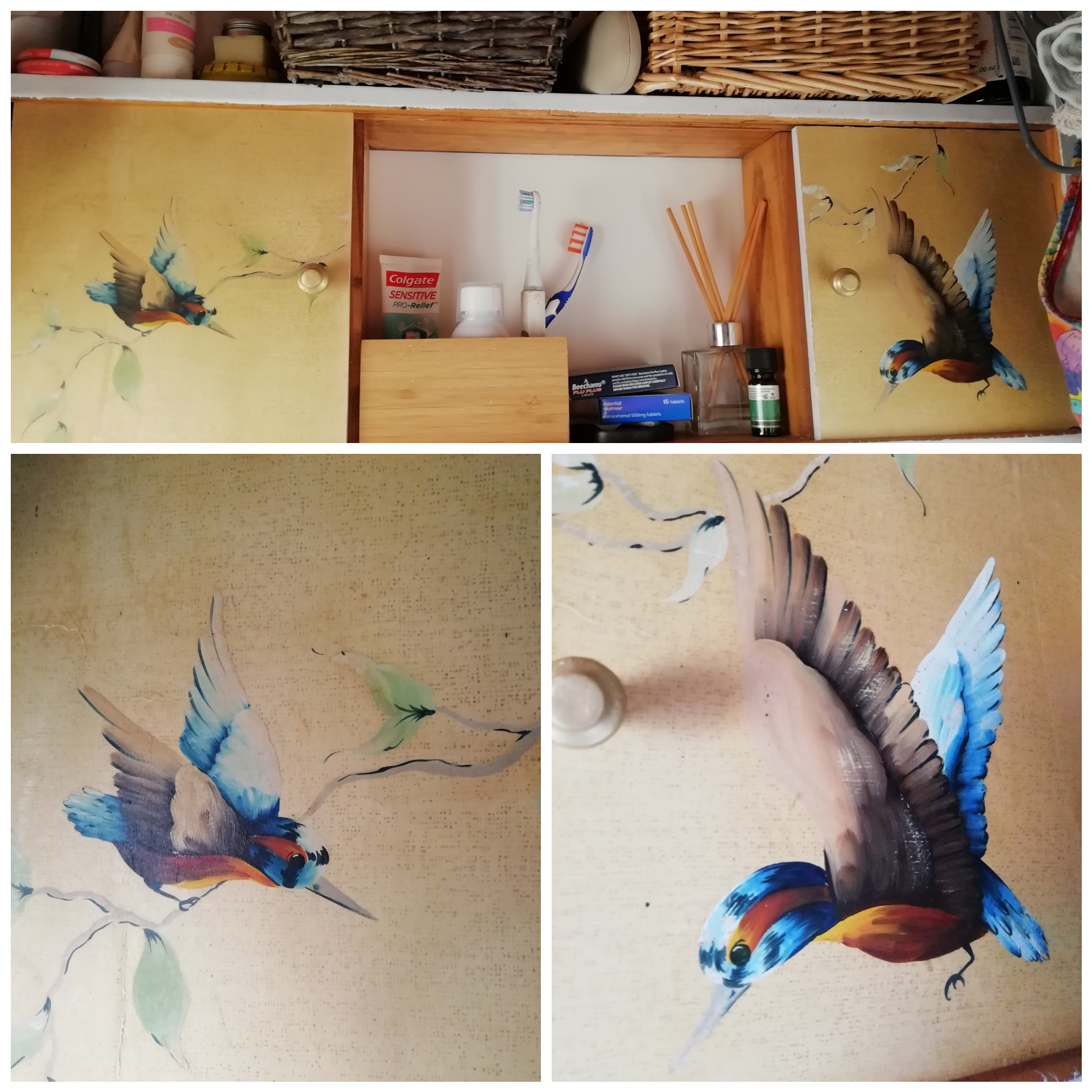
Our decluttering doesn’t mean we don’t have clutter – but we do try and keep the boat clear of too much (Steve might disagree but I honestly feel I’ve done remarkably and the boat is still afloat!). The bathroom cabinet is recycled because it would fit the space, and the beautiful kingfishers on each door were painted on a lampshade for a standard lamp by my late mother. I’ve no idea where I would put a standard lamp on the boat, and haven’t used the shade for decades, so I fixed them onto the cabinet and now enjoy them as a daily reminder of her.

We now have a one-in one-out rule for anything that isn’t consumable, to try and keep the status quo. It means that what we do have is valued and appreciated – something William Morris would, I am sure, applaud.

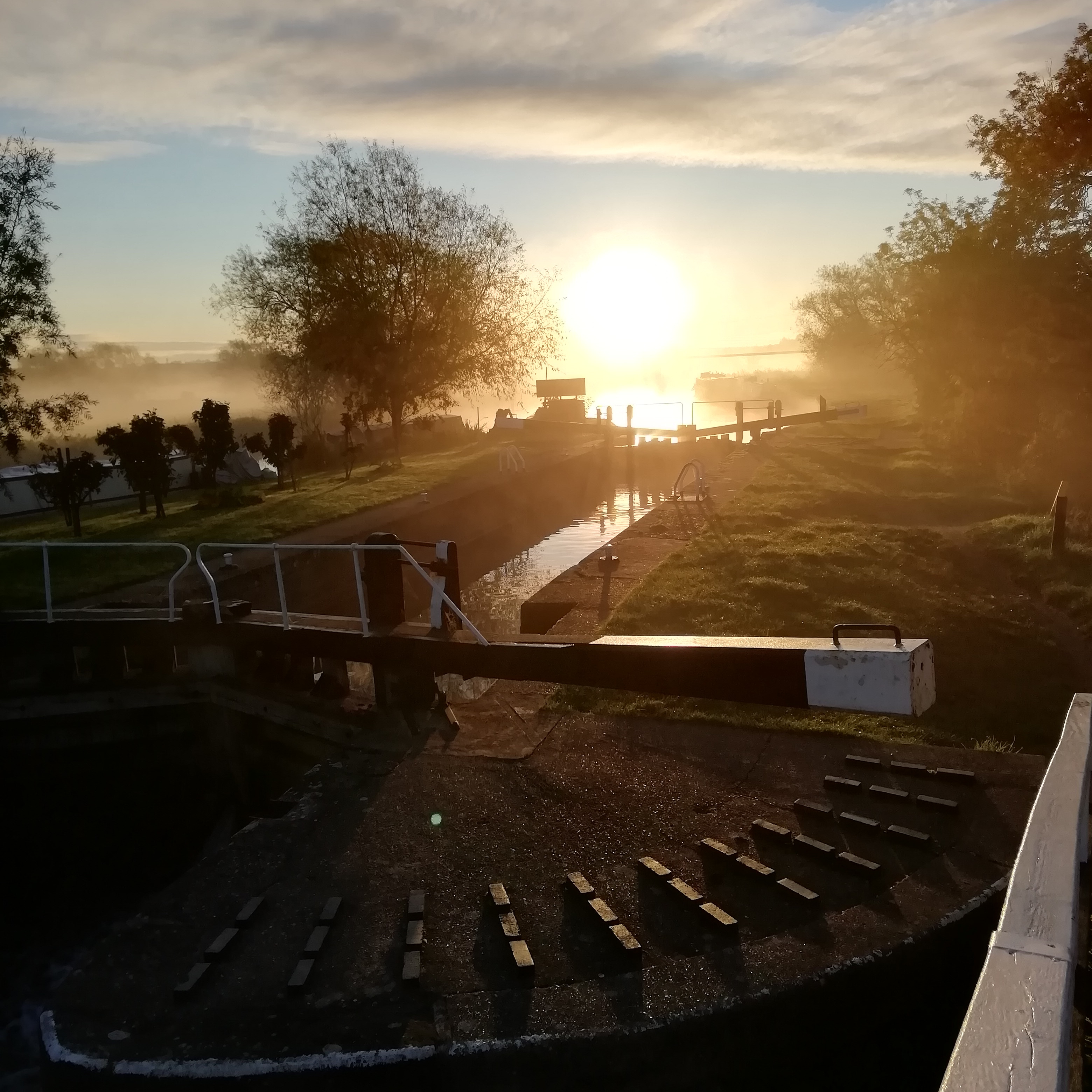
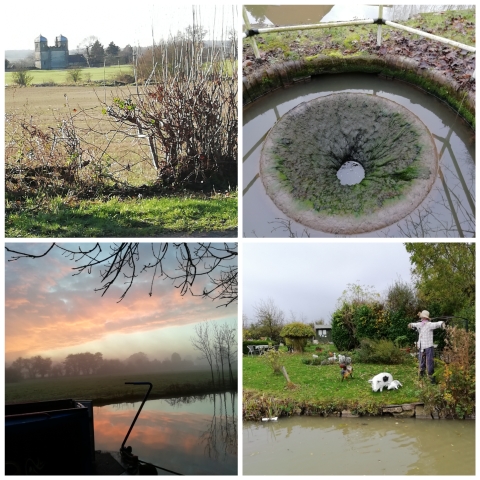
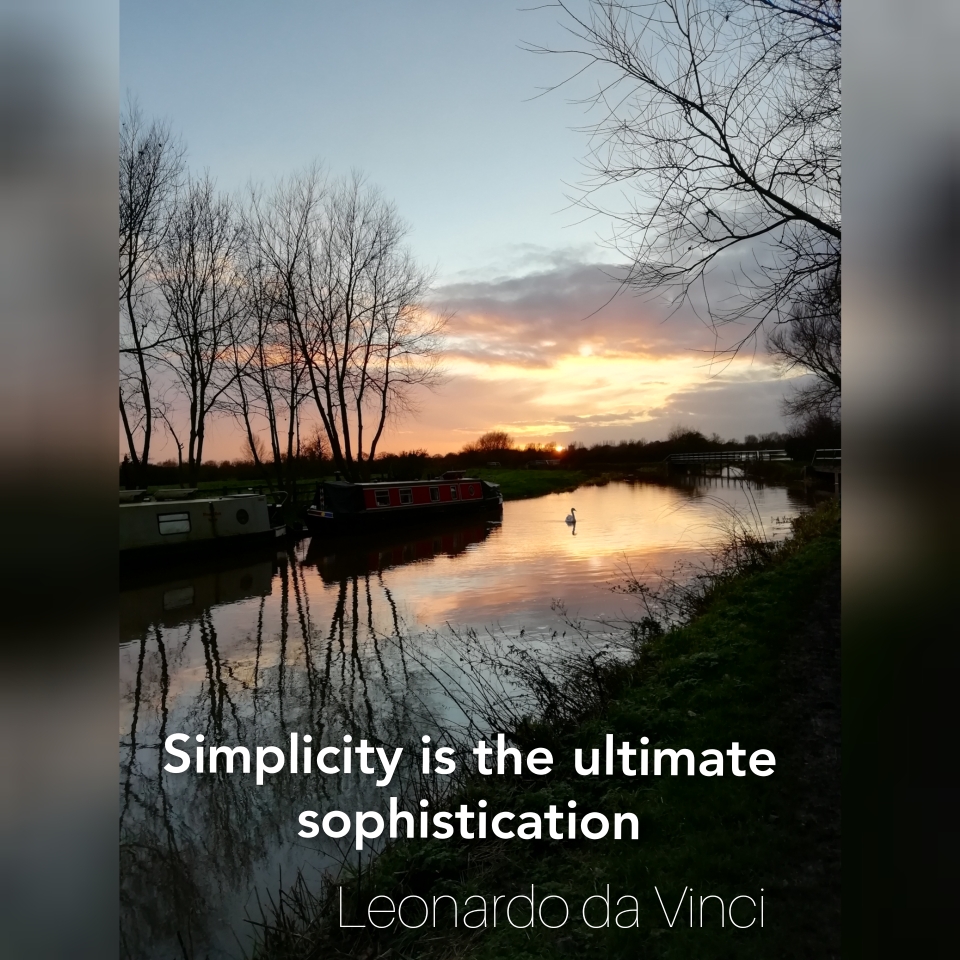
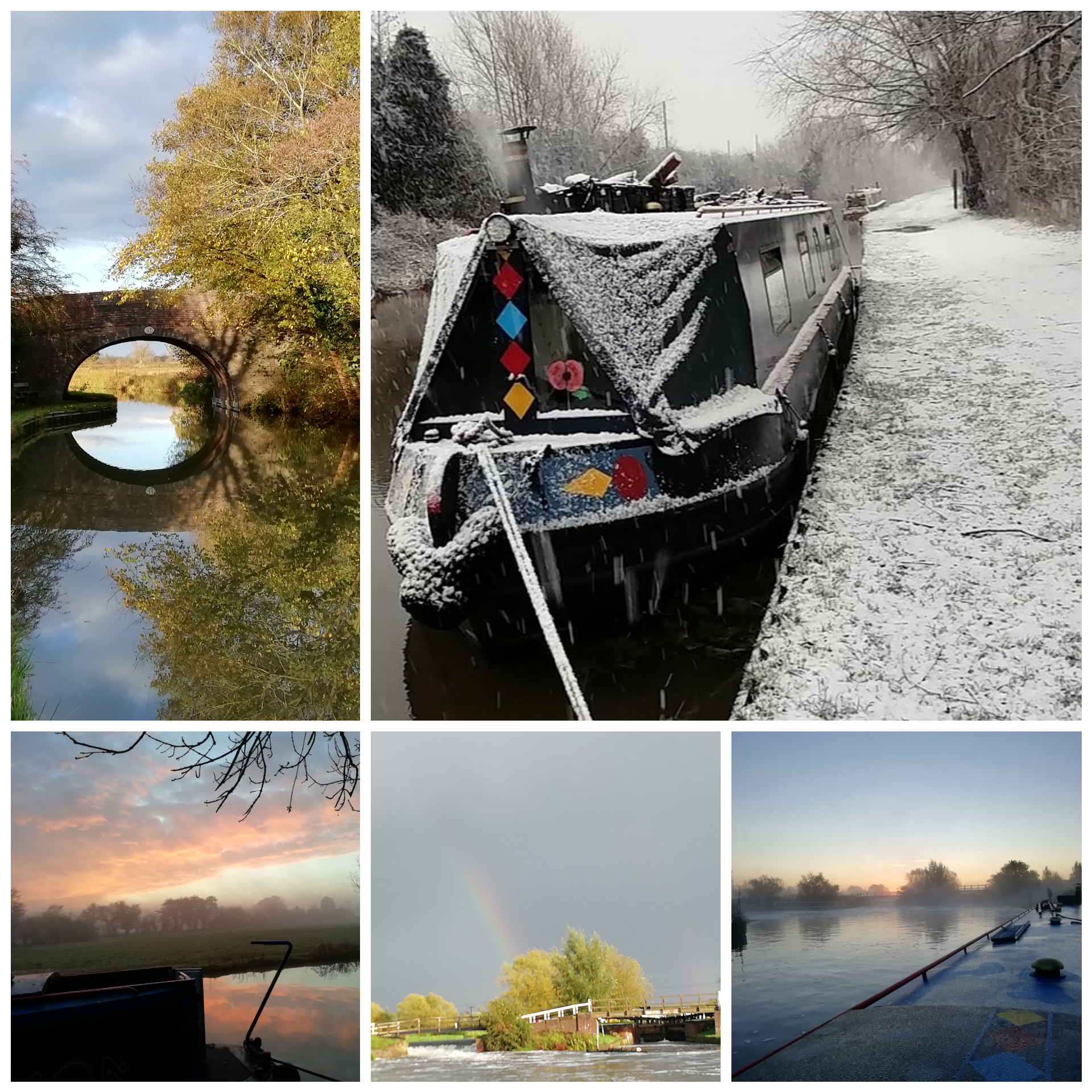
Decluttering has enabled us to look outwards rather than inwards. Not dwelling on material possessions means we are free to explore and not miss unique moments like these we’ve experienced. We wish you all a healthy, happy and liberatingly uncluttered 2021 packed with many moments that lift your spirits.

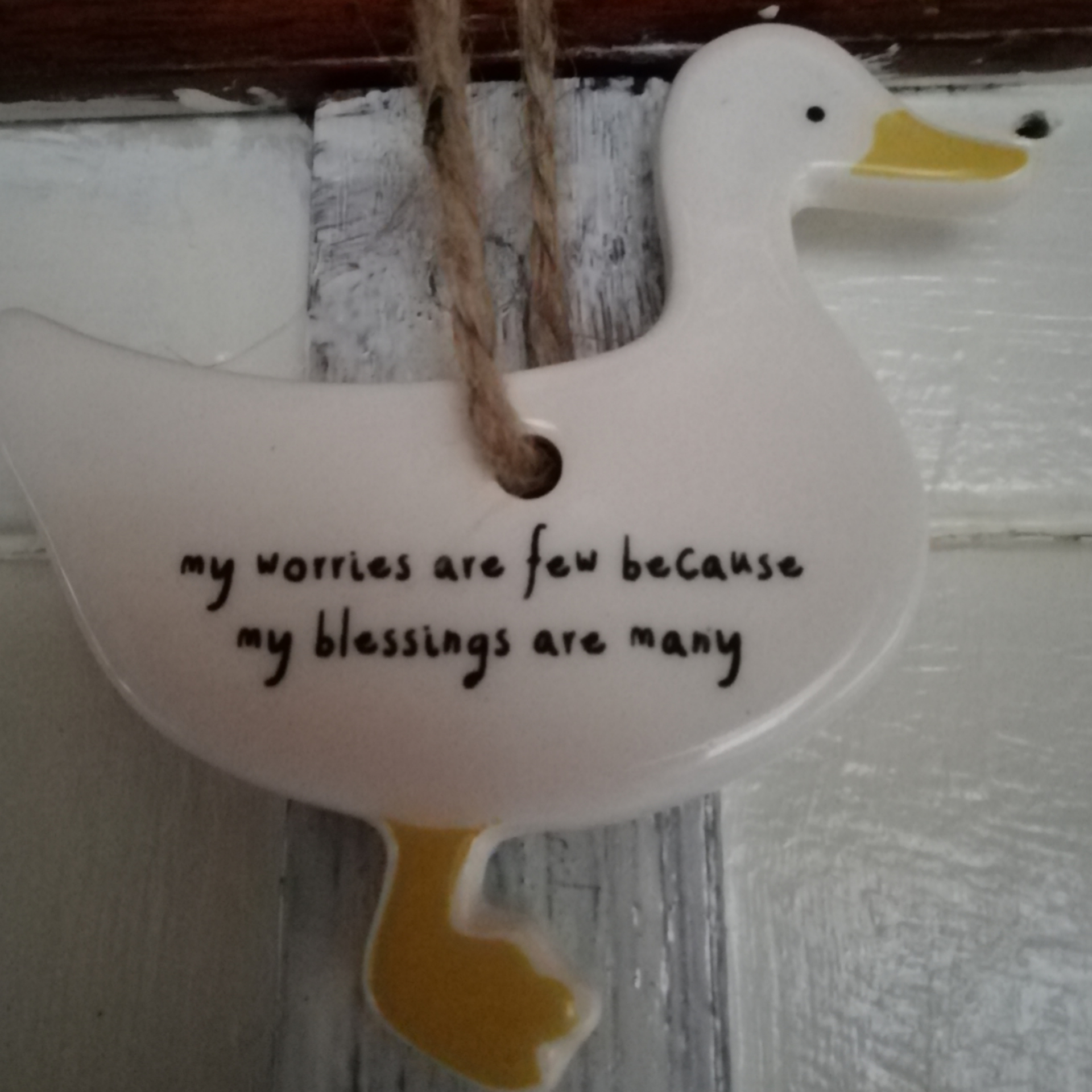
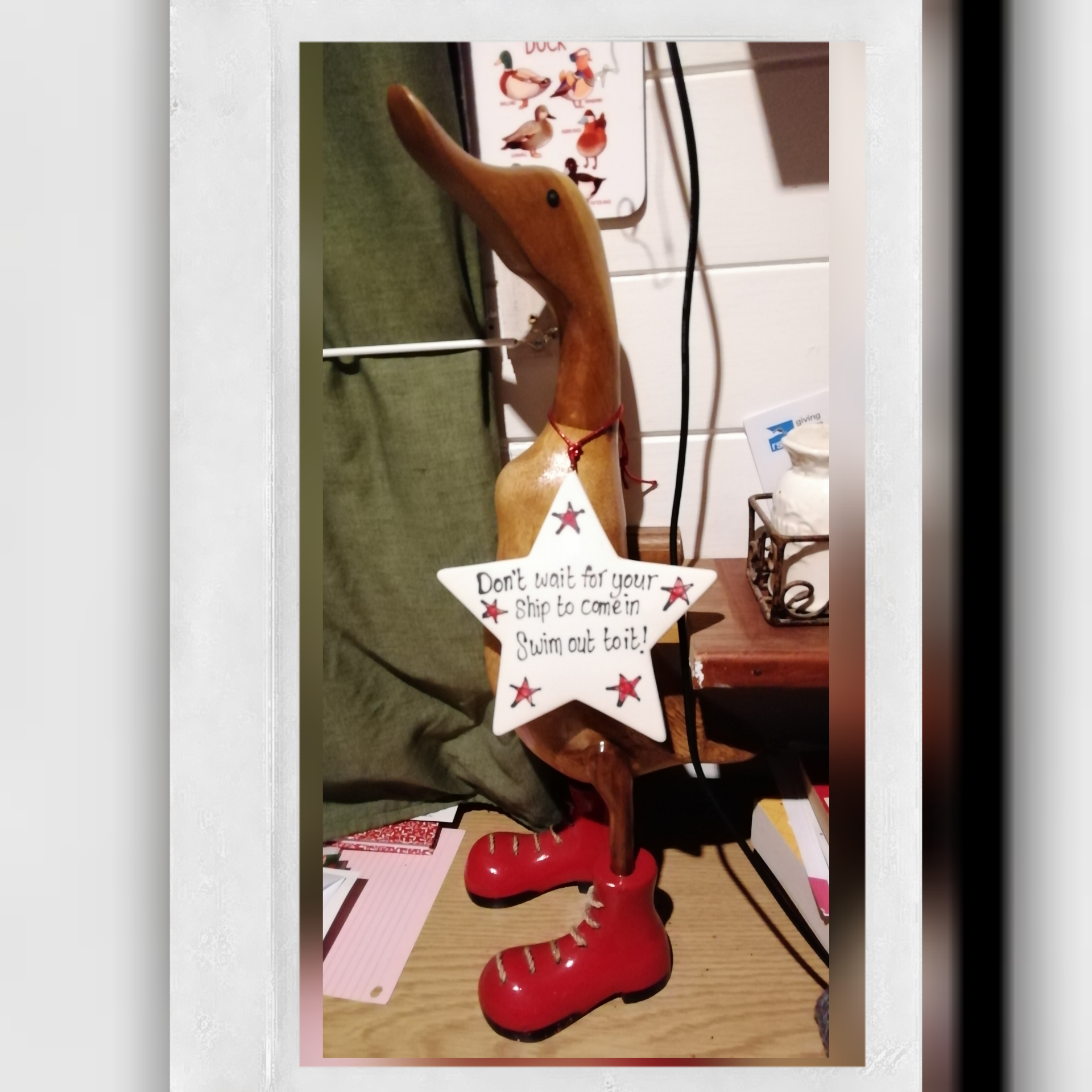
Our own aim for 2021 – to be more duck and to take no-one and nothing for granted.

Wise words from a total star – the fabulously talented Lisa at The Handmade Mug Company

Coming up from us in 2021 – we’re not ducking the big issues:

  • Making mini spaces work like a mansion
  • How to try to live more sustainably
  • Hilarity in the unexpected
  • Evaluating our aim to live a low-impact life
  • Can we really live well for £30 a week all in?
  • Tales of life afloat from boaters new and old
  • Eating and drinking from the wild – will we survive?
  • …and anything else you’d like to hear about – just let us know via the comments.

Wishing you health and whatever floats your boat at Christmastime

Whatever your Christmas looks like, whether it is going to happen now or in the summer, we wish you well at this time of year. Thank you for joining us on the adventures our new life is bringing us – we look forward to more unexpected moments with you in 2021, and to welcoming you on board as soon as we are allowed to do so!

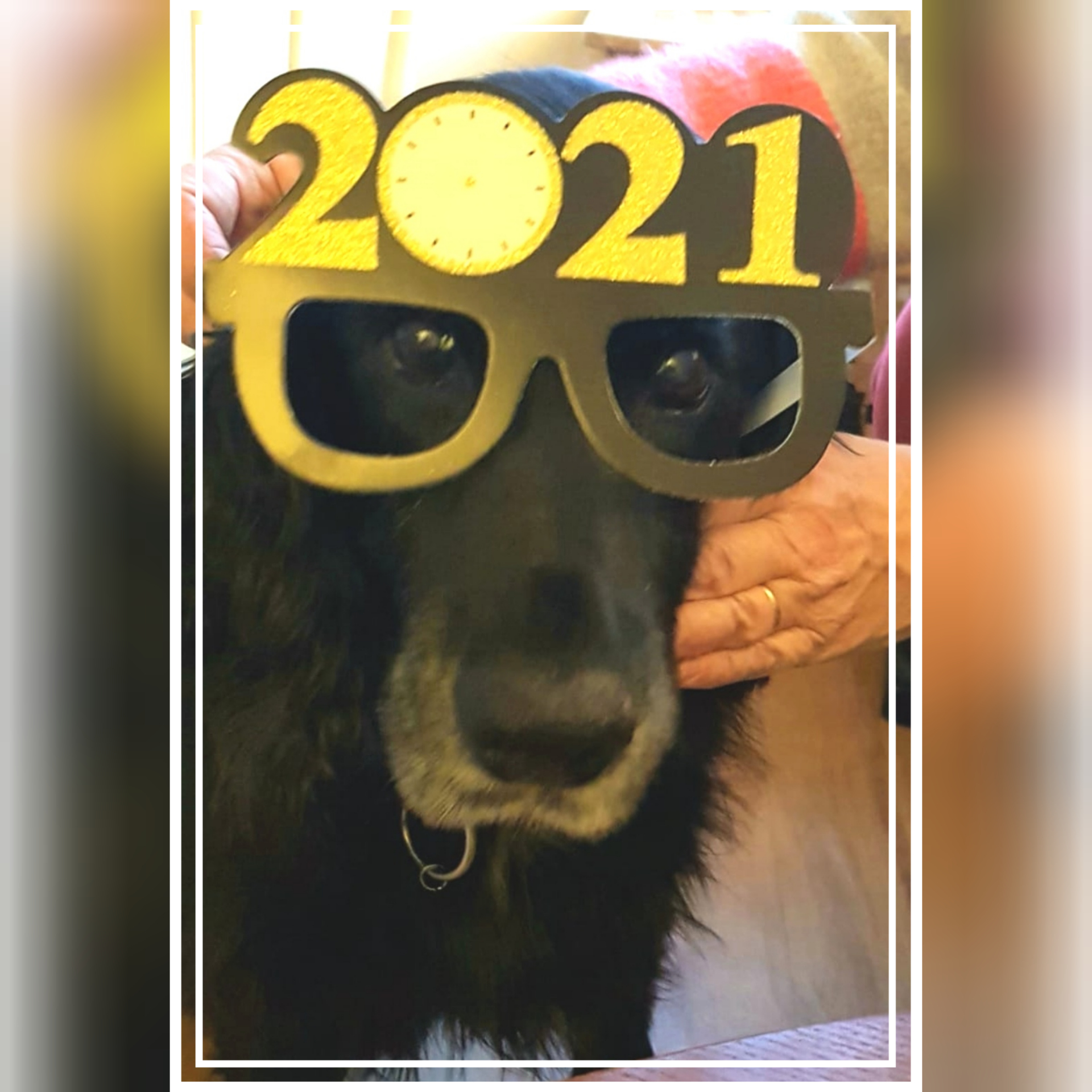
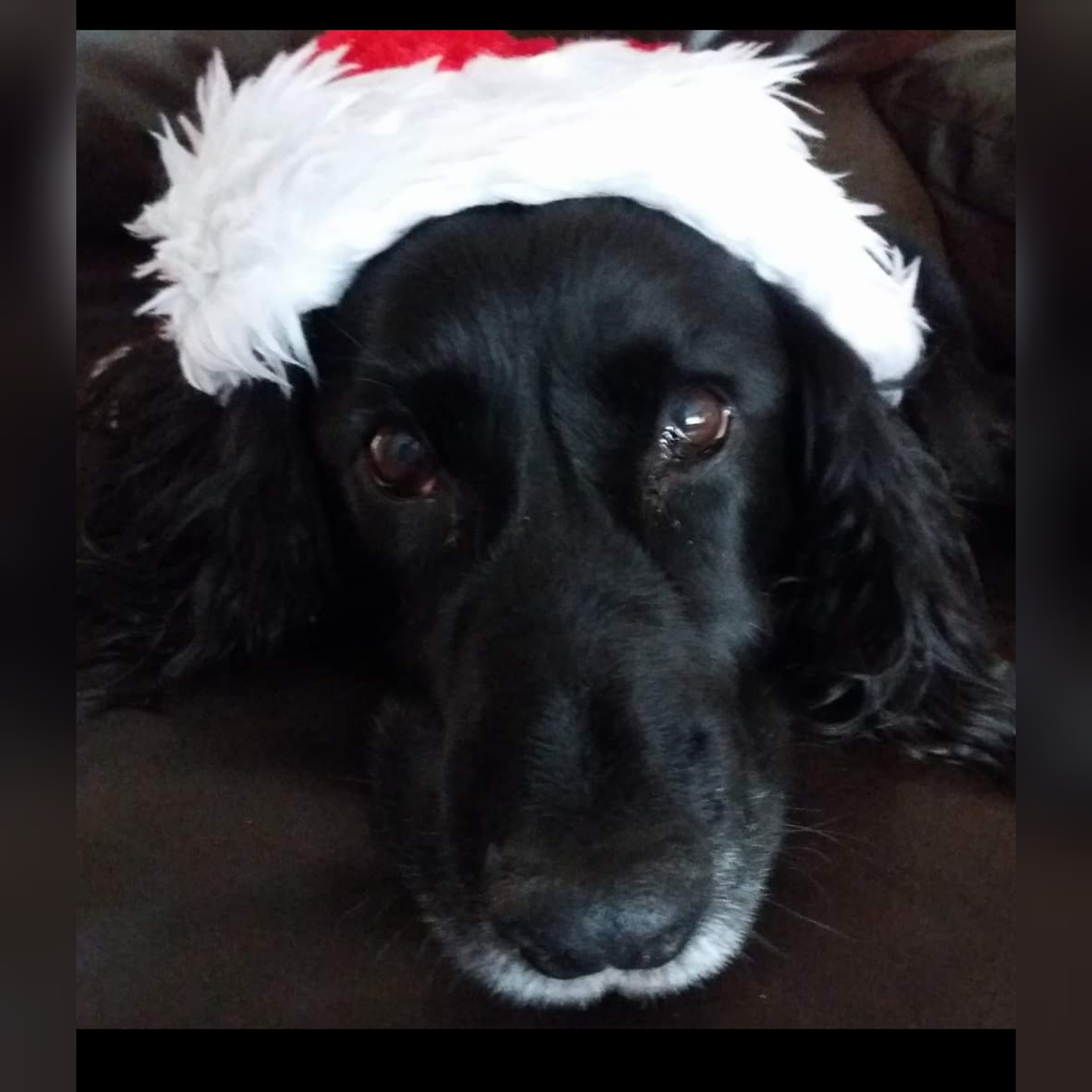
Festive dog
The boss wishes you all a Happy Christmas….this is his happy-but-waiting-for-a-biscuit face!
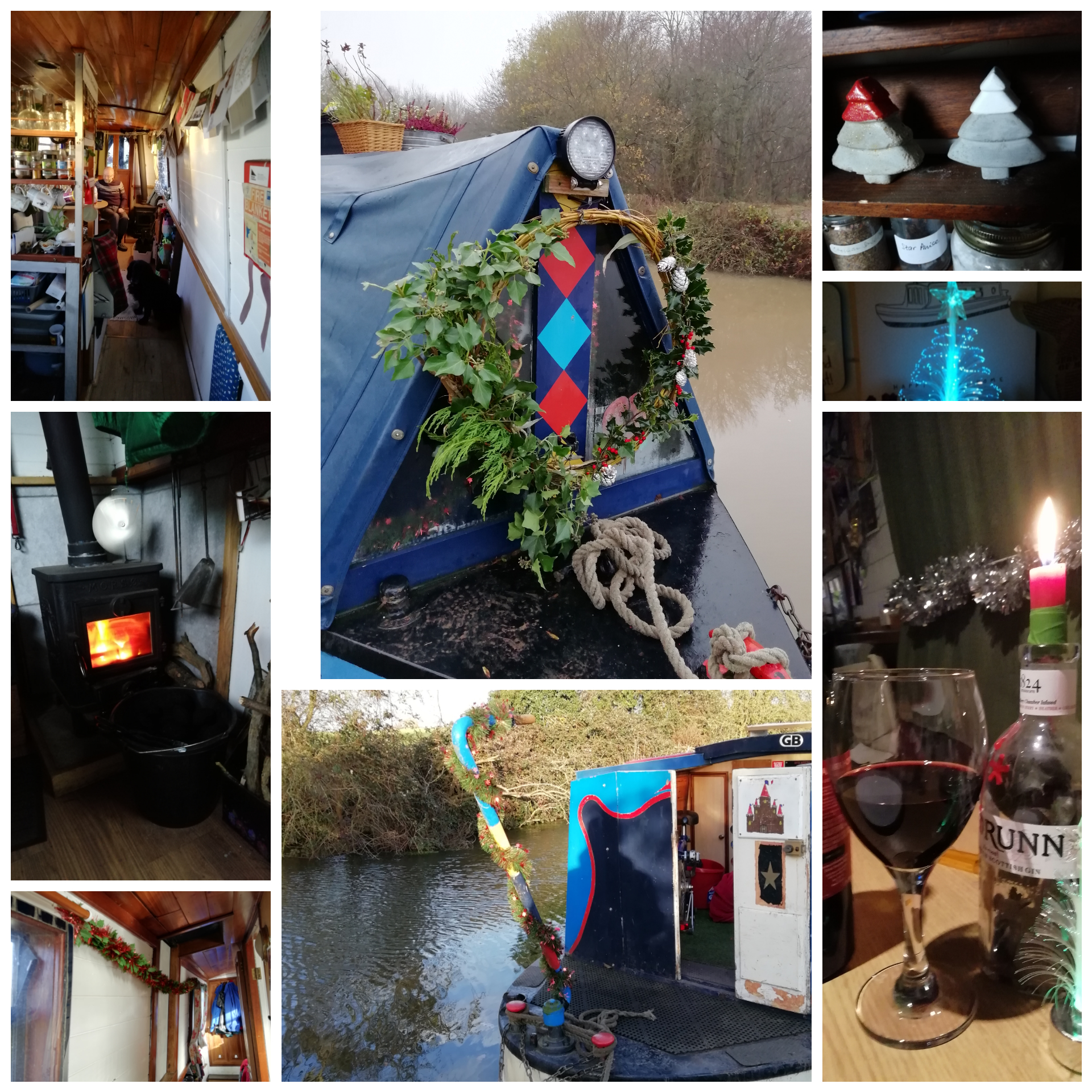
Festive look on NB Preaux
This is our adopted maxim for life, recognising those in narrowboats, rafts or clinging to flotsam…
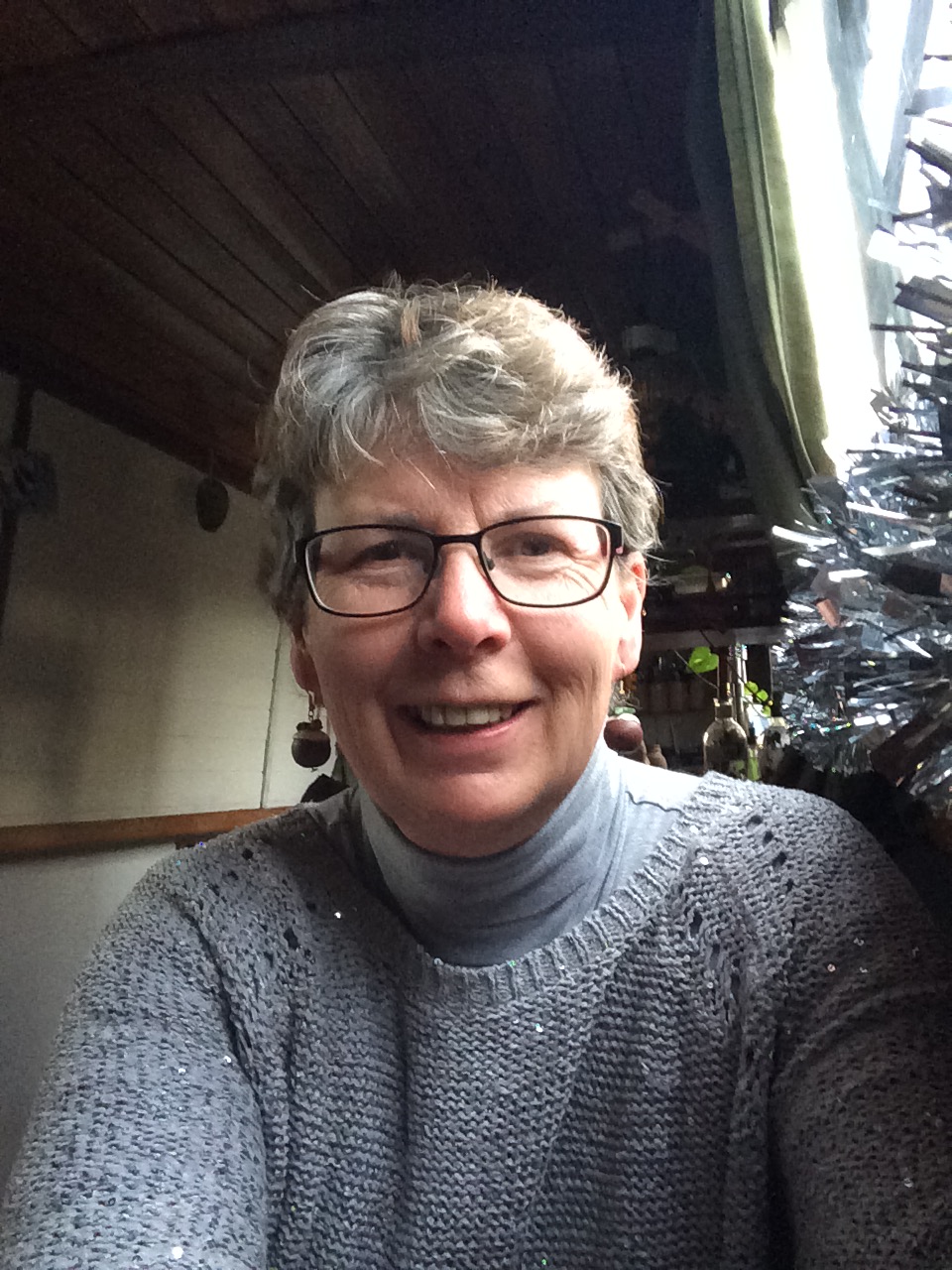
it must be Christmas – the pudding earrings are out!
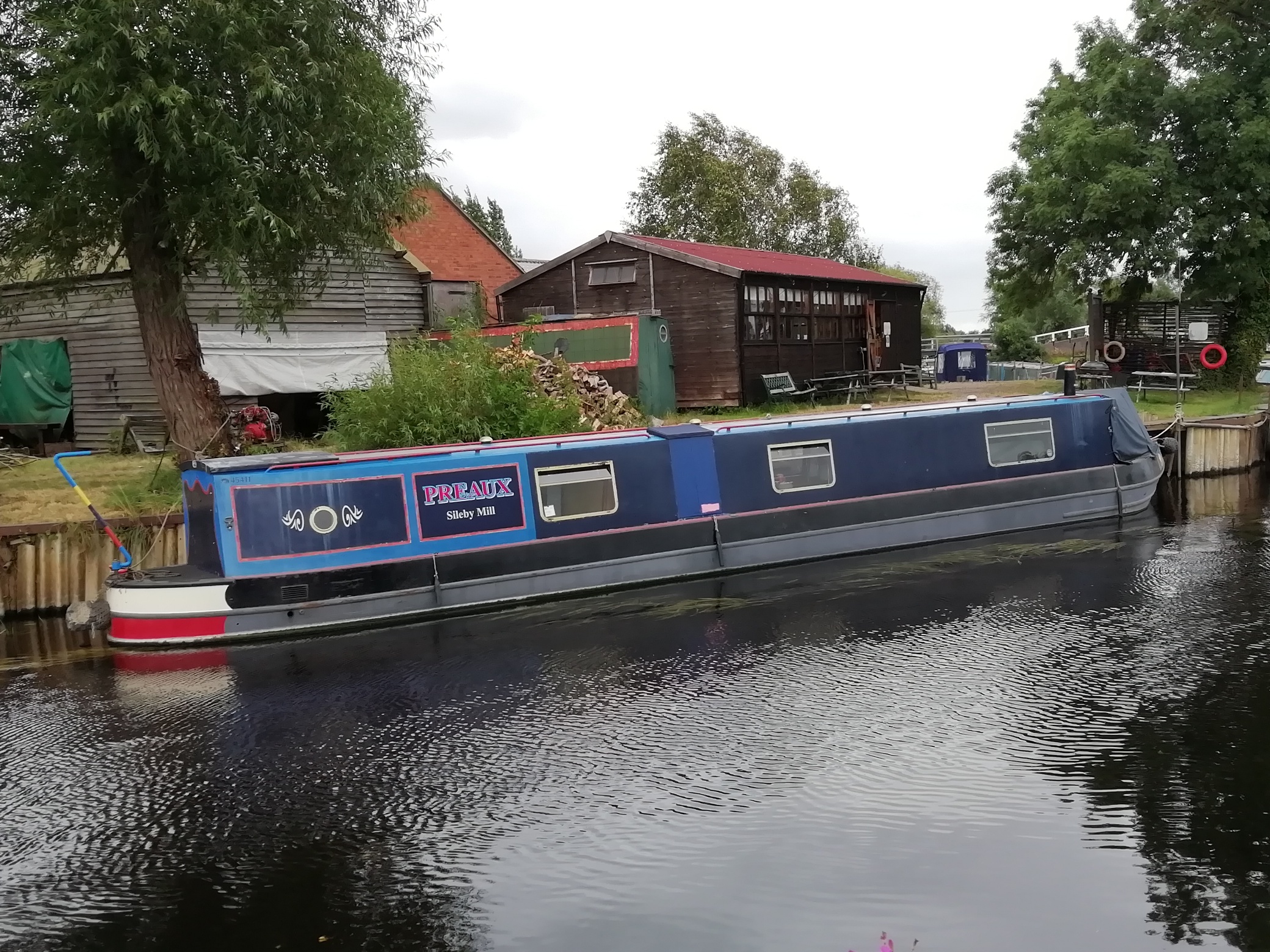
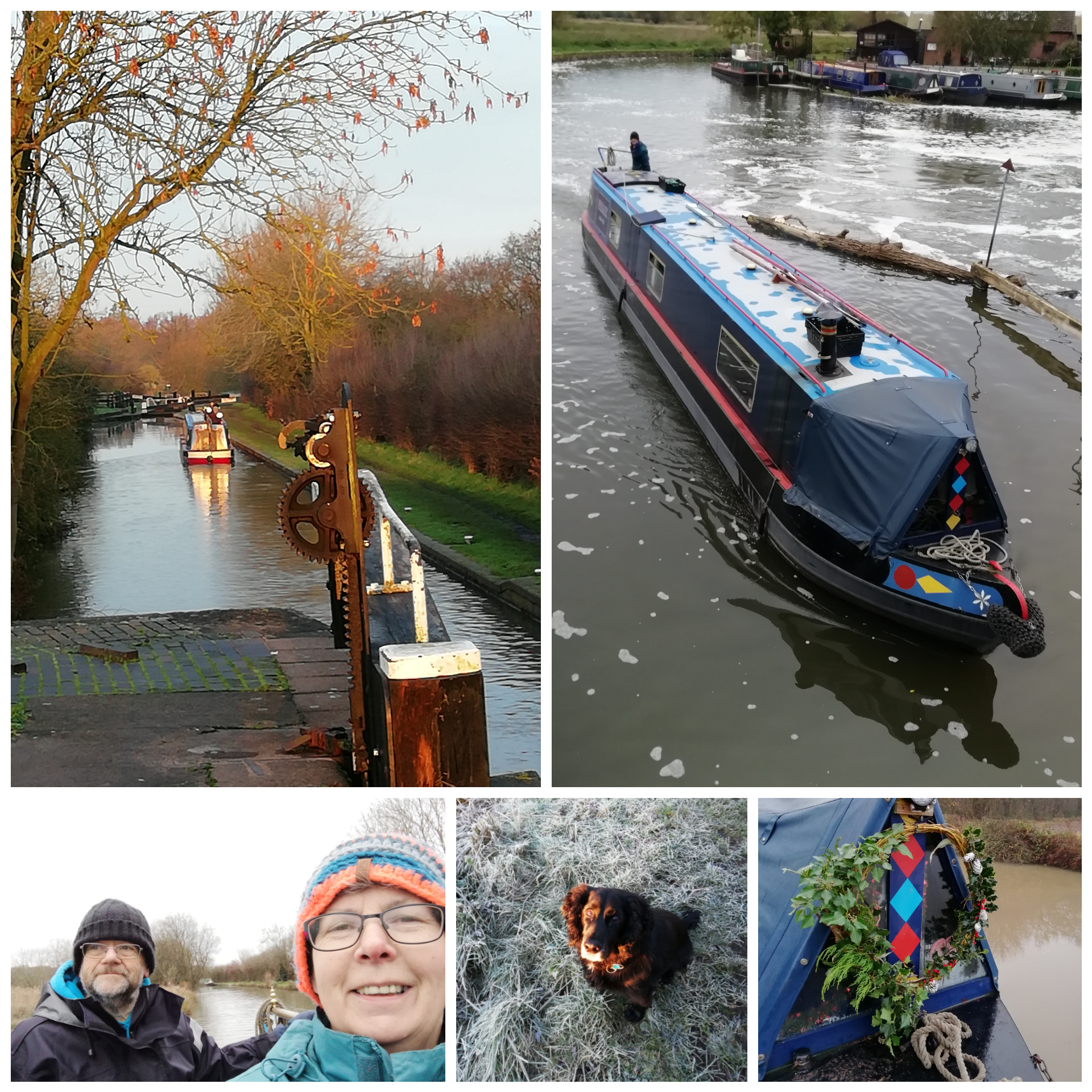
Setting off on our new life from Sileby Mill – September 2020
Still living our dreams – December 2020. Happy place and happy faces – honestly!

Quarterly dividends and life lessons

In the final quarter of this year we have travelled more continuously (despite the global pandemic) than ever. At 3-4mph it’s been slow going, but we have happily cruised 143 miles, six and a half furlongs (no, I honestly have no idea how long they are) and worked 77 locks. We have taken in one river (the Soar), two arms (Market Harborough and Welford), a line (Leicester), and six canals (Grand Union, Oxford, Ashby, Coventry, Birmingham & Fazeley and the Trent & Mersey).

The move to a 50ft narrowboat was the direct result of Covid-19. We realised with internet access we could work from anywhere, and were aware our frenetic work life seemed to be taking more and more of our precious time. As Ernest Hemingway put it in The Sun Also Rises: “I can’t stand it, to think life is going so fast and I’m not really living it.” I quit my job and went freelance. Steve moved his work onto the boat, we let our home and as a result have enjoyed three whole months, a quarter of 2020 having irreplaceable experiences and learning invaluable lessons – including (a) how to live in very close proximity with your other half, (b) how to survive living in a small space, and how to enjoy life given (a) and (b).

Here, in no particular order, are our top 30 observations from the past 3 months which we hope you’ll appreciate and which are a partial response to the many questions we’ve received. We’ve learned a lot, about ourselves and the world around us, the world which is on our doorstep!

  1. Living with a spaniel on a boat you never have enough dog towels or cheese.
  2. It is easier than you think to have no food waste. In 3 months I have thrown away only onion and garlic peel. Using leftovers is easy with websites that allow you to type in the ingredients you have left.
  3. Winter provides additional free fridge space if you move carefully. All sorts of groceries keep well on outside ledges if you don’t rock the boat too much and knock them into the water!
  4. You are bound to meet the only moving boat of the day at the one bridge on a blind bend.
  5. Put things back where you got them from – ideally where they live. If you don’t you will waste time trying to find them again… Losing things through carelessness or laziness can create friction that no one needs. I have now lost a total of 6 gloves and heaven knows where they can have gone in a space this small!
  6. Don’t panic – all sorts of things will happen and 99% work out fine. We are still imagining there might be that 1% but haven’t found it yet…
  7. Life’s richness exists in the little positives: the kingfisher with his flash of vivid blue in a fleeting moment of flight alongside the boat; shared amusement over a greedy cob swan tapping away as he nibbles weed off the boat…
  8. Ditch the little irritations – realise their unimportance. In the moment it takes to draw a deep breath recall instead the reasons you appreciate your partner, and remember honestly the irritating things you do which they generously don’t remind you about… In my case those take so long to list I forget the original irritant.
  9. Going slow isn’t something to be ashamed of or to avoid. It saves time and accidents. A whirling dervish imitation (particularly on a boat) isn’t going to win prizes and can lead to a cold dip or worse. We have passed too many poignant waterside memorials to people to know how dangerous boating can be.
  10. Ropes freeze on metal and can skin your hands if you (a) lose your gloves and (b) are in too much of a hurry.
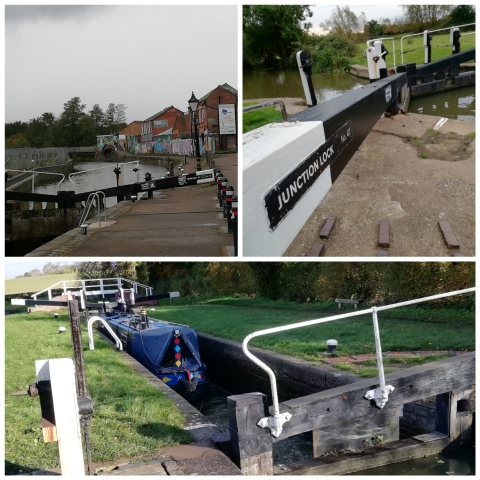
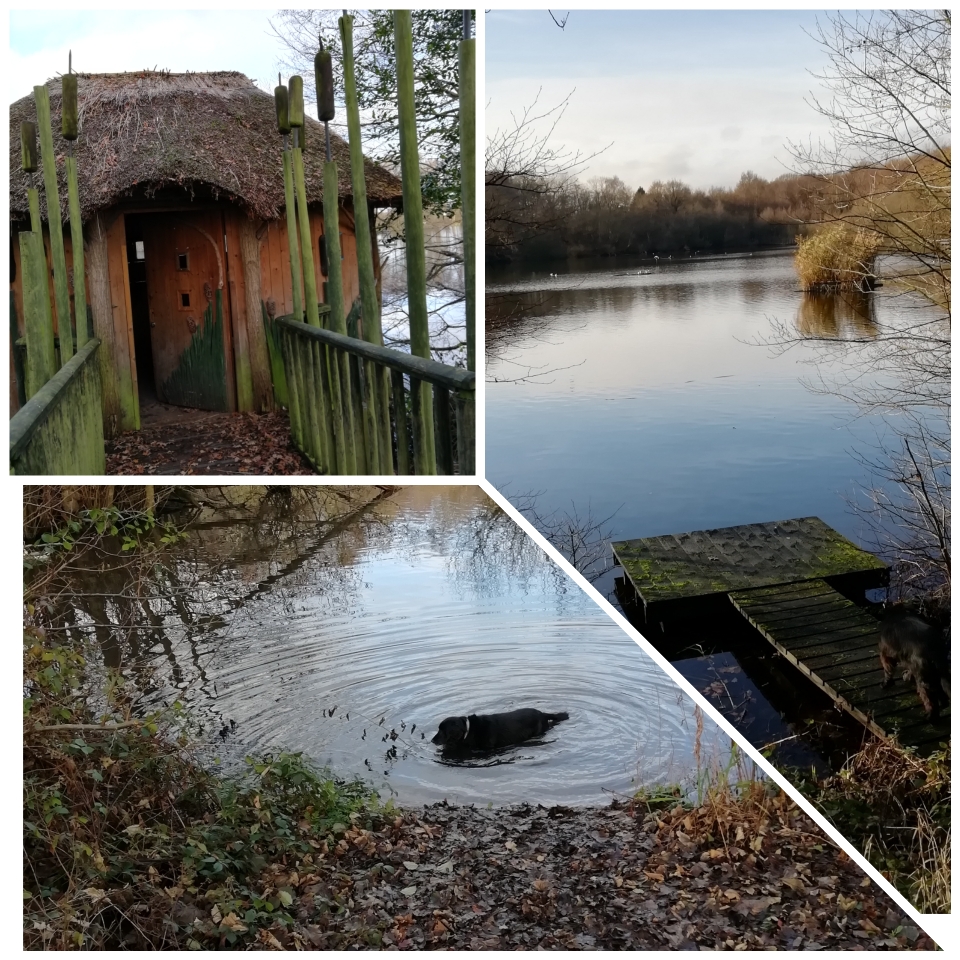
  11. If things don’t go according to plan they can lead to better things – a sticking gear cable led to a moment of worry at one of the locks at Fradley Junction. I had the lock ready thanks to the support of a 3-year-old in sparkly unicorn wellies, and wondered why Steve wasn’t bringing the boat in. We ended up walking the boat like a large blue dog, back to a mooring on a rope! There was nothing I could usefully do (apart from get out of the way) so the dog and I had a delightful unexpected walk/swim round the nature reserve (see later pictures for proof). It was something we might never have discovered otherwise. When we got back, all was resolved and we carried on where we left off.
  12. Leave each other space and peace to do what you do best (related to the last point – had I been hovering asking questions and adding to the stress of the situation the repair could have taken so much longer and built irritation in us both…).
  13. Even when things are going well, we all need time to ourselves.
  14. Learn from everything – particular highlights have been the discovery of Mabel Stark (a diminutive nurse turned tiger trainer of the 1920s), reed mace (the real name for what I have called bulrushes for years), that tempus vernum means Springtime as well as being an Enya number, and ducks do morning Pilates (leg stretches one after the other, wing stretches, and neck extensions too…)
  15. If you have the chance to do something today – do it. Emptying bins and toilets or filling up with water comes in this lesson. If you leave it the next available places may be frozen, shut or out of order.
  16. Being distant doesn’t mean being remote. I love the fact we have technology for the important things. We may be physically away from family because of the pandemic or travel but we can stay in touch with them and share moments without interfering with their day but whatsapp messages or a photo letthem know we are thinking of them. Daily December video calls enable a helpful 3-year old to practice his numbers and show Cola the right window to open on his doggy advent calendar!
  17. As a boater you can manage a thorough shower, including washing and conditioning your hair, treading your underwear clean in a bucket in the shower tray at the same time all in four minutes and and four litres of water.
  18. Upon hearing ‘man overboard!’ you reach for the camera first, and the life ring second.
  19. Your ability to navigate a lock smoothly is inversely proportional to the number of spectators.
  20. Walkers on the towpath believe you hate each other without realising you are actually yelling at Alexa… though this may indicate her to be a 21st century marriage-guidance device enabling the venting of frustrations…
  21. Don’t be so wrapped up in your journey that you miss things on the way. This week we took time to visit the National Memorial Arboretum. It’s a 150-acre site of 30,000 maturing trees in tribute to those who have served our nation, servicemen, civilians, emergency services, animals and also a poignant woodland dedicated to children lost too soon. The torrential rain for our first visit masked our tears. So much death, sacrifice and suffering is recorded here. Why have we not learned the lessons wrought at such cost? There was humour too and it was often that which brought tears. There is so much to see and it will be so different at every season, we both look forward to going back.
  22. One of you has obsessed about water in the bilges and has to keep checking.
  23. You both get paranoid about the loo indicator at bedtime just in case nocturnal trips turn the bathroom into a red light district (red= full cassette) necessitating a cassette change at 2am.
  24. One of you can reel off to anyone whether listening or not, details for how much diesel and coal you get through and how long a toilet cassette lasts (it’s all on a spread sheet – 100 litres in 3 months, a bag a week, and 2 days if there are only 2 of you, in case you wanted to know!).
  25. You take it in turns to do the fun things – steering a 10-15 ton boat, and foraging, as well as the less fun things – emptying said toilet cassette.
  26. Recognising there is always a real need for a small treat on deck – a biscuit, a mince pie, with a hot cuppa when its wet, windy, or cold.
  27. Look for the good things that make you feel good. Nit picking and finding fault will only make you feel mean and nasty.
  28. Daily exercise is essential and fun.
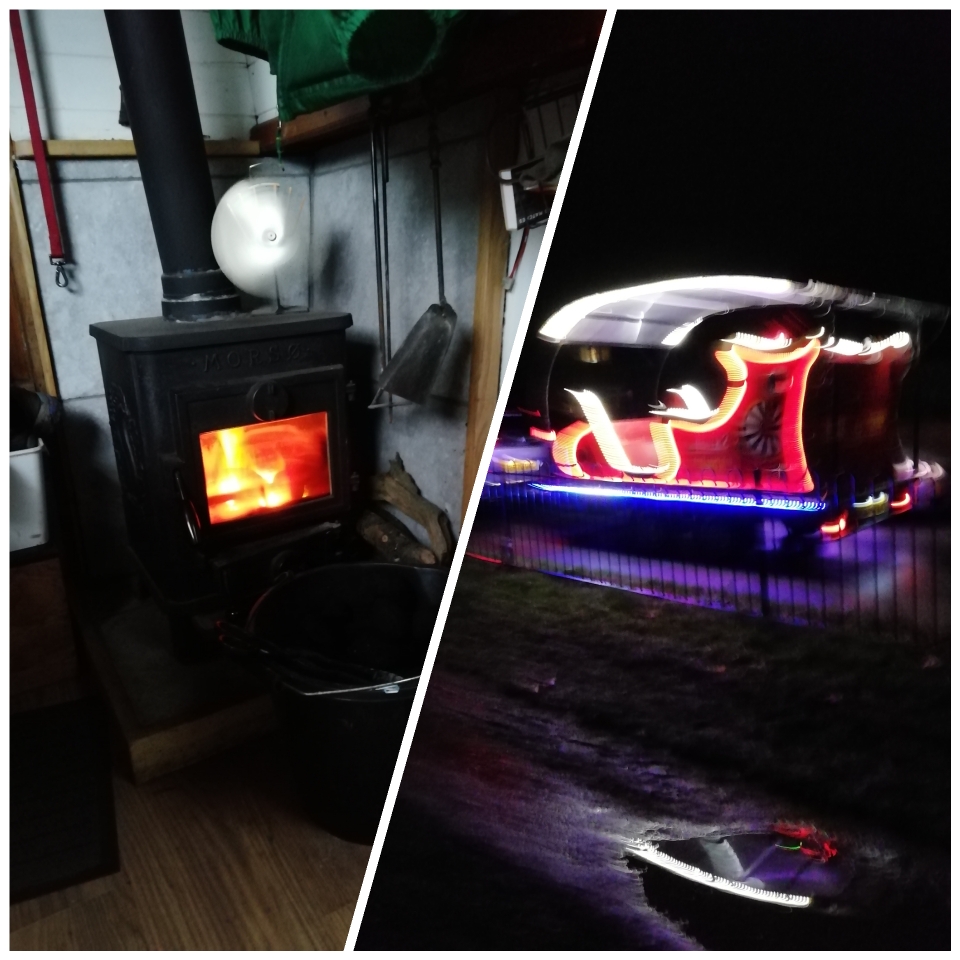
  29. You are never too old to be excited by a visit from Santa on his sleigh – well done Round Tables across the country!
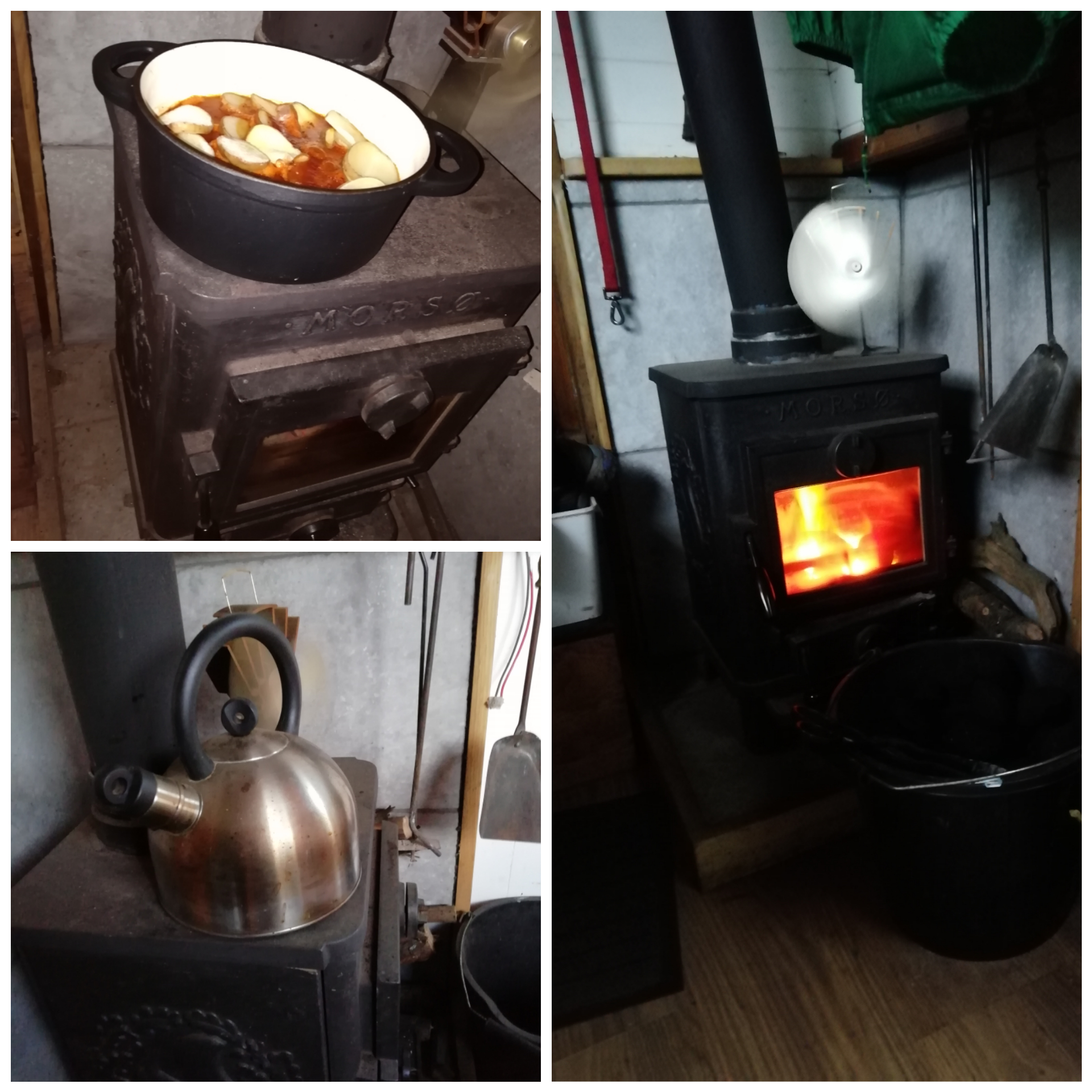
  30. Warmth is vital – internal, and external. Care, hugs, layers of clothing and a roaring fire along with a steaming bowl of soup or a cup of coffee are essentials as well as treats.
Fradley Junction Nature Reserve – an unexpected pleasure accompanied by a lovely latte from the Laughing Duck.
Blazing fire and visit from Santa on his sleigh – what more can one ask in December?
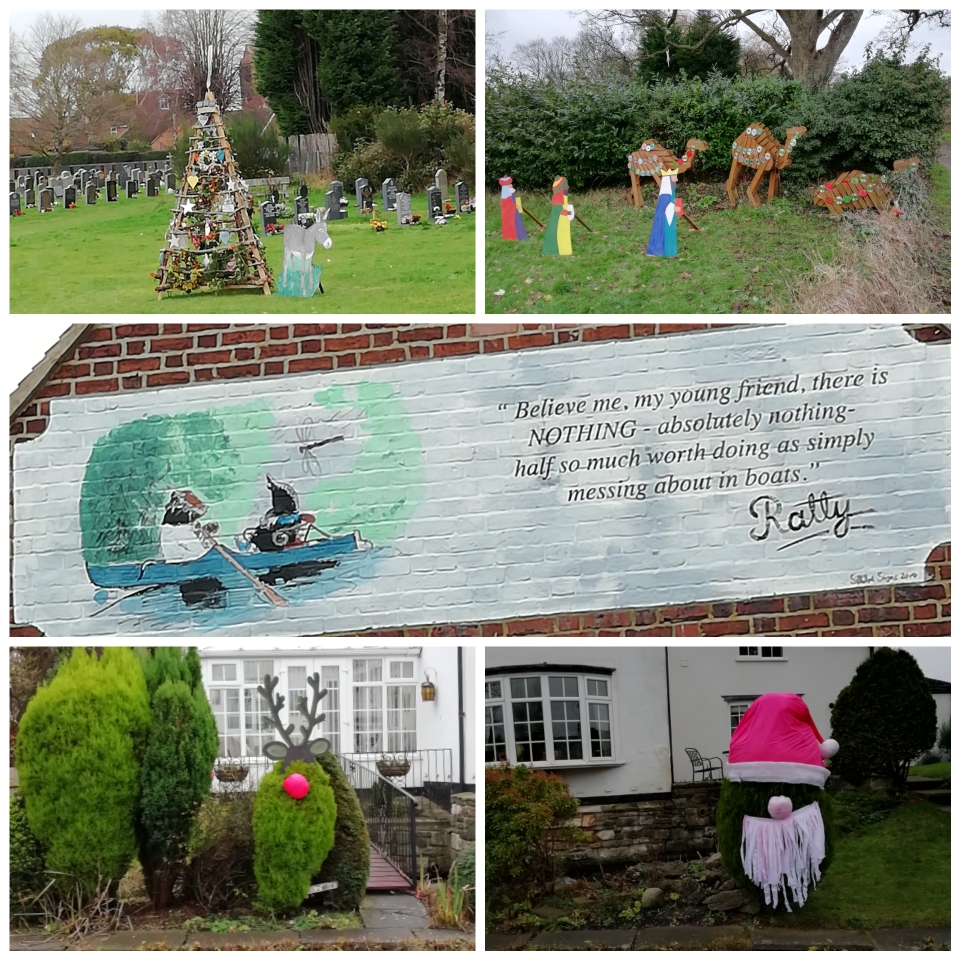
The humour and ingenuity of residents at Alrewas in Staffordshire
Beauty at all times of the day

Coming up in the next few weeks to take us all into a new and hopeful year we’ll take a look at some requested topics. If you’ve any to add, just let us know via the comments:

  • Downsizing without pain
  • Stress-less living in a small space
  • Something for nothing – foraging for fun
  • The tools of journey planning with a narrowboat
  • Stories from others about why and how they live on England’s inland waterways
  • More living for less outgoing

Locked down in an active firing range, flights and foraging for Christmas

In less than a week we have managed to travel through 3 counties and 4 canals (good going at a maximum speed of 3mph; got locked into a military firing range on a live firing day (our lockdown 3); and begun preparing for Christmas with permitted flights and foraging .

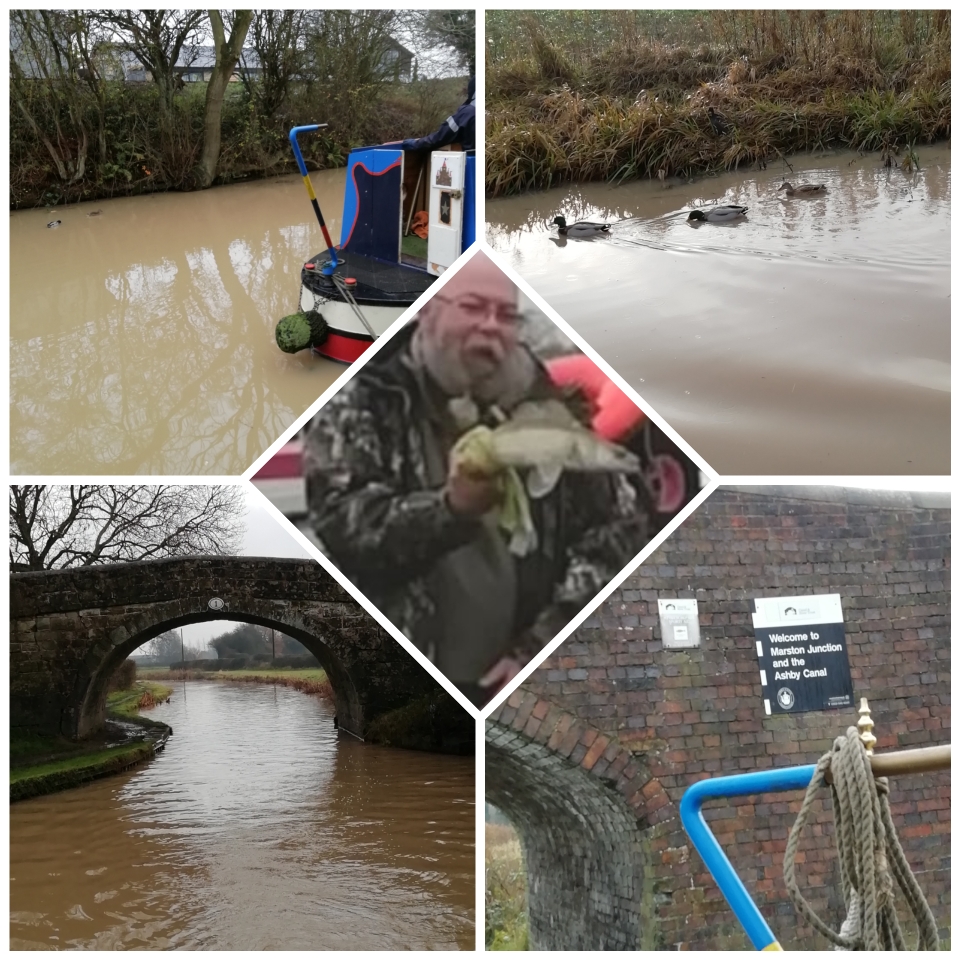
We left the Ashby Canal, enjoying its gentle meander through undulating, mainly arable farmland and left with a victory – sight of a real live zander. For more about this fearsome fish, predators wiping out native species see previous blog.

The Ashby Canal in Leicestershire was hit by a disaster whilst we were there (see breach blog) so it was with some relief that we moved on. Each canal has its own character, brought about by the industry that spawned it, the land through which it flowed and in part by whatever the boats using it were carrying. Each Canal still maintains its unique character in part born from its geography but also now by its usage. The Ashby Canal for example doesn’t actually go to the exotically named Ashby-de-la-Zouch and never did. It served the coal fields of Moira, taking its high quality coal to warm the students and academics in the Oxford colleges. In time it also carried iron and steel from the Moira Furnace and the barges came in laden with goods for the area. Its gentle contours and lack of locks (until Moira which is not connected now to the main canal) made it popular with commercial fleets and today those very reasons make it popular with leisure boaters too. It is a leisure and holiday canal now.

As we left the Ashby canal at Marston Junction, turning hard right onto the Coventry , we left its milky coffee coloured waters, stained by the run-off from heavy rain seeping through ploughed clay fields, and a mallard paradise. The Ashby is heavily populated by handsome males with their iridescent blue green heads, accompanied by their duller brown spouses. The latter make sure everyone knows they are there, not by their plumage but by their voices – you always knew when a female mallard was seeking attention!

Equally noisy flocks of Canada Geese love the fields around the Ashby and the water park at Market Bosworth, but we only saw two families of swans on the canal. Towards Marston Junction skinny-legged moorhens scuttled across the surface of the canal warning of our arrival with their harsh “krekk krekk” call.

The Coventry Canal (Warwickshire) was a different story – moorhens and mallards remain but not in such numbers and they swim amid plastics and litter around Nuneaton. Our fishing net came handy to hoick out a variety of floating debris from deodorant cans to beer cans, plastic drinks bottles to takeaway cartons.

On the wooded stretches beyond Nuneaton the canal opens to mixed woodland which is clearly the playground of jays. We watched them burying and eating acorns before flying up into the tree tops, disappearing as flashes of bright blue, salmon pink and white searing though the sky.

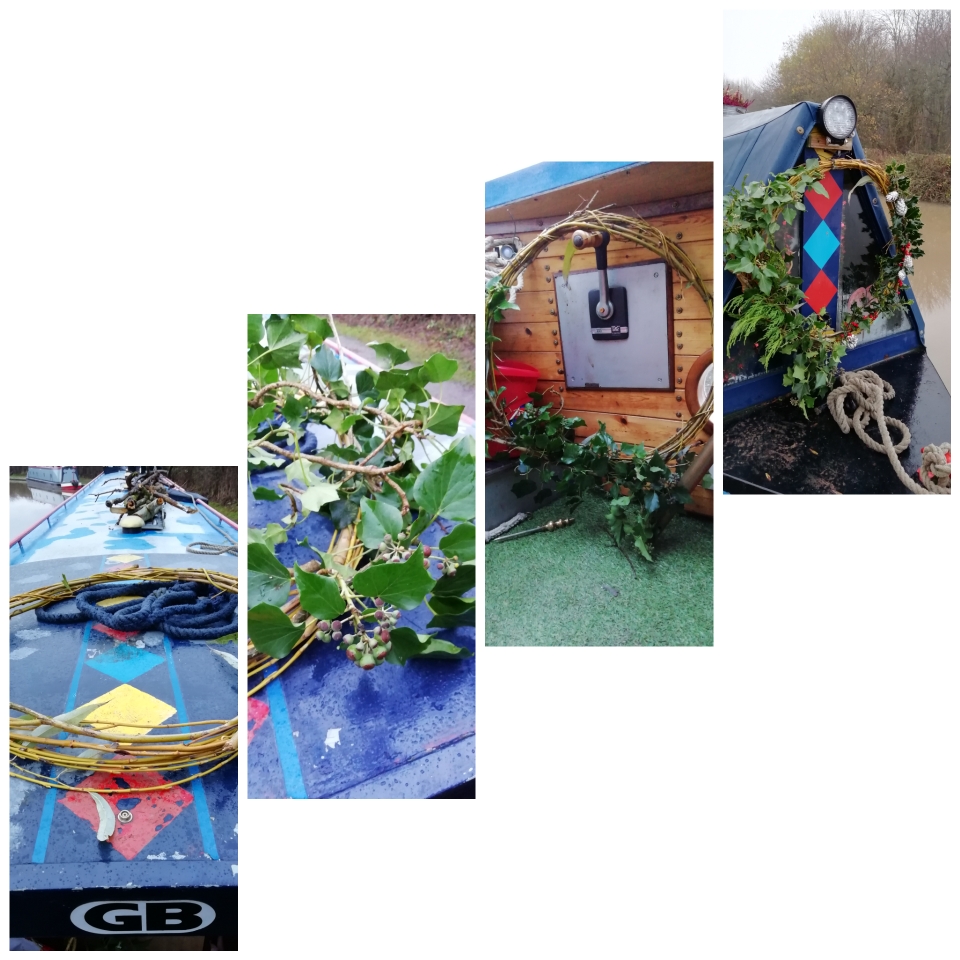
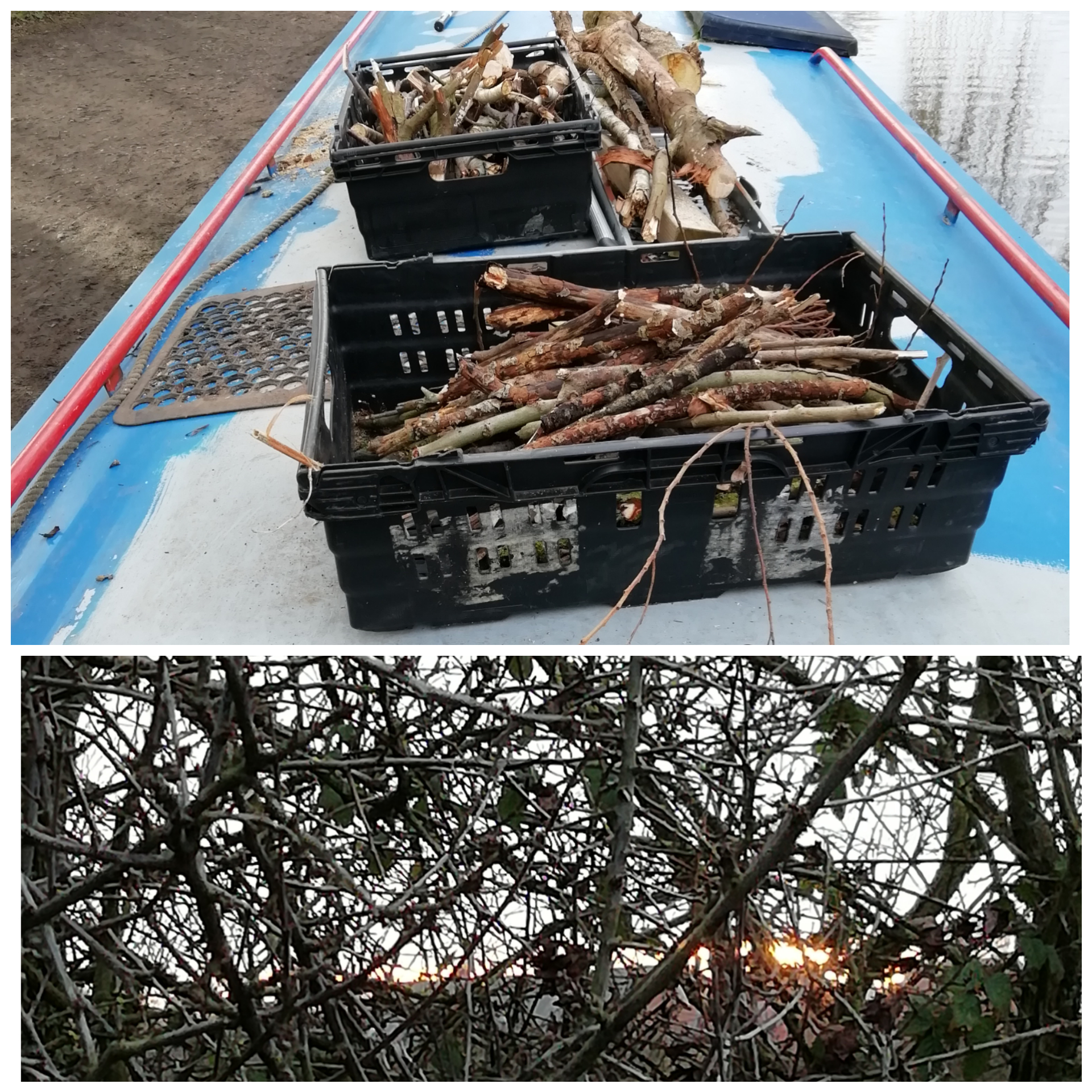
Foraging has been a delight during the Autumn although because I am still cautious the haul has tended to be reduced to mushrooms (edible) and wood (for the fire). Now as we approach Christmas, I feel the urge to celebrate, to deck the halls… or hulls… Canals are ideal places to find flexible willow withies so easy to bind into wreaths. Ivy with its seedhead stars, and holly with vivid red berries are easily found in hedgerows and a bit of discarded lleylandi dumped by a disgruntled gardener added to the greenery. Some pine cones, sourced and dried earlier in the autumn and given a splash of white to make them stand out produced our 2020 festive wreath – no cost and totally sustainable.

After cruising all week it’s still there, and it is delightful to have it complimented by boaters and walkers alike. Some boats are putting Christmas trees up and lights are appearing in unexpected locations to brighten towpaths and moorings.

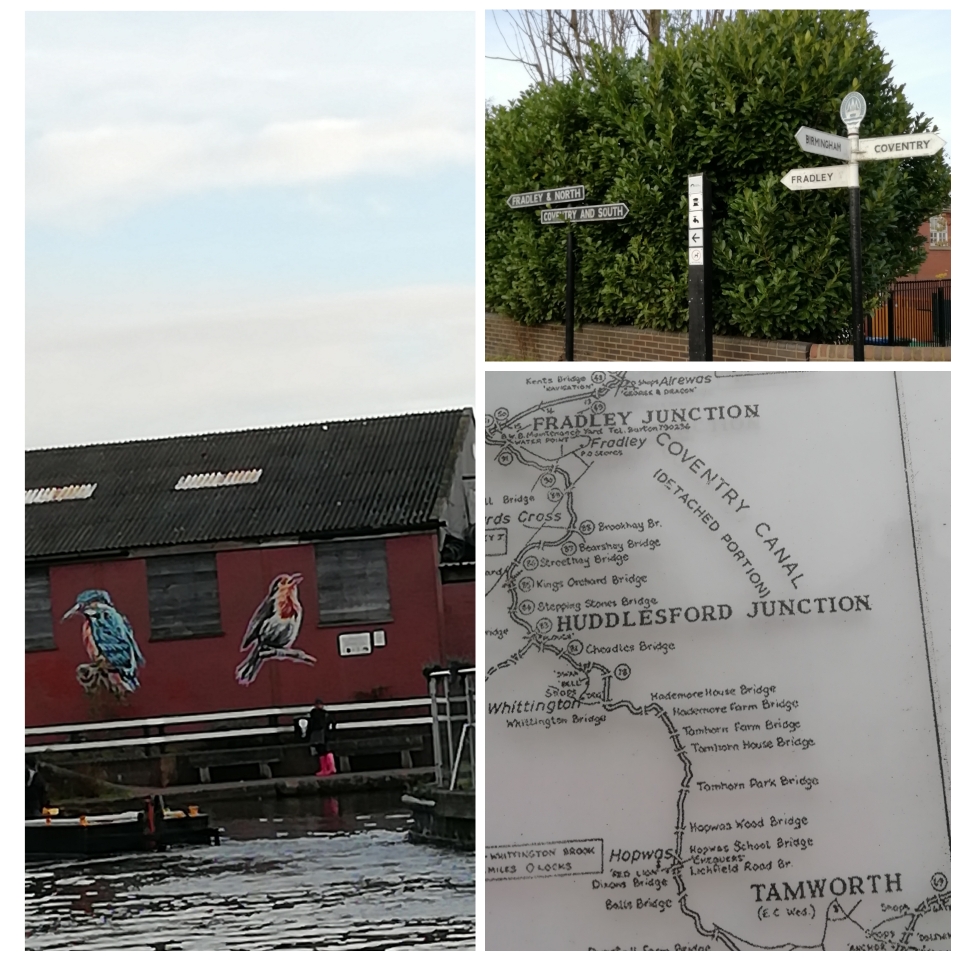
Maps appear to indicate a simple route up to the Trent and Mersey from the Ashby involving the Coventry Canal as the intermediary. At Fazeley (Tamworth) with its sensational artwork on the old warehouse buildings, we suddenly found ourselves joining the Birmingham and Fazeley Canal, and stayed on that all the way to just passed Whittington where we rejoined what is called the Coventry Canal (detached)!

There are various stories about what happened to create this peculiar state of affairs but they all involve companies running out of money, others stepping in to build a bit, and then running out of money too. Sounds like certain current transport projects…

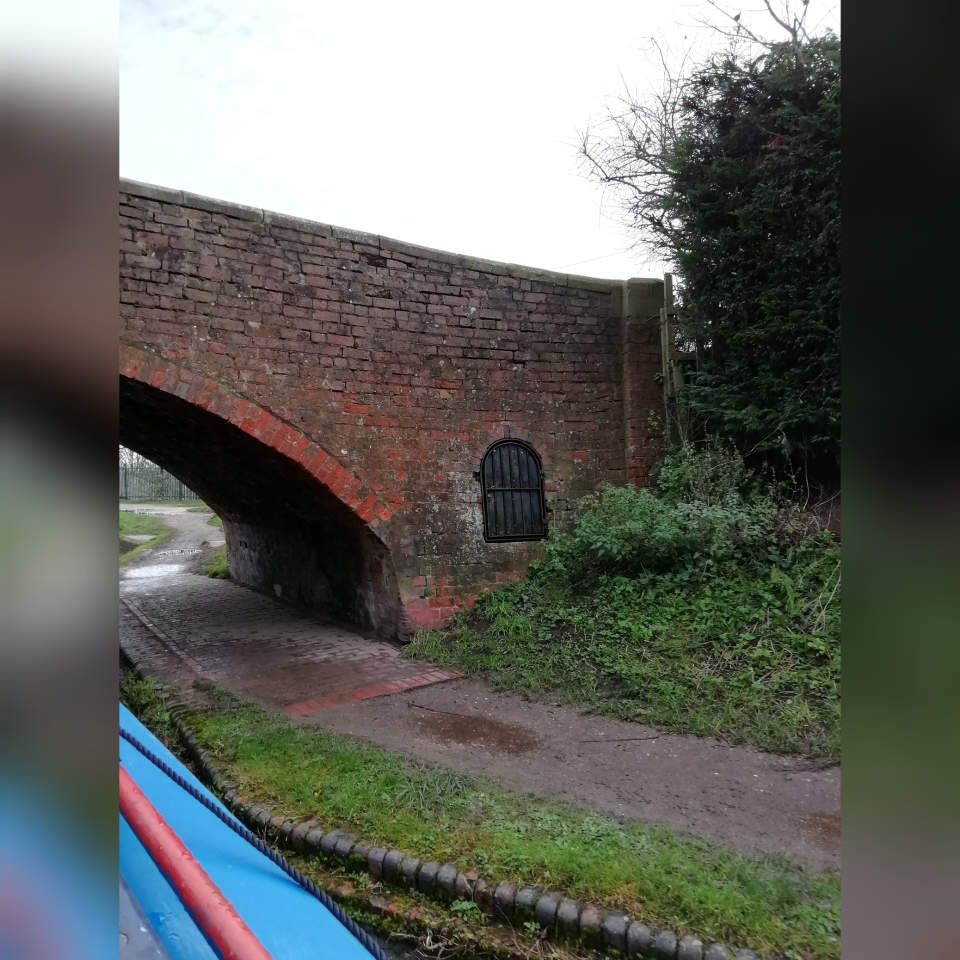
The Birmingham and Fazeley (Staffordshire) is very different in character – its 15 existing bridges are named, like Dixon’s Bridge and Bull’s Bridge, whilst the Coventry uses numbers. Having left the Coventry after Bridge 77 we found ourselves picking up the detached section with Bridge 78 miles further on! Both canals though in places have bridges with doors in the side of them. Could these be for Santa’s elves? Or to store no longer needed politicians? Slots cut into the bridge ends below give clues to their more mundane but useful purpose. The door is the entrance to a storage area for stop planks, the wooden planks slotted in to block off a section of canal to drain it for maintenance work or to conserve water in the event of a major leak (as happened on the Ashby in November).

The Coventry Canal and the Birmingham and Fazeley brought the pandemic into stark focus once again. On the Coventry we tackled the Atherstone Flight, a series of 11 locks which took us down 70ft from the lofty heights at the start of the town all the way through, past the ALDI UK headquarters and out into the rural countryside beyond. We need to press on to get to see family at Christmas so we are making early starts which brings utter beauty to each day (as well as the odd frozen rope to contend with!).

The Warwickshire town of Atherstone is famed for its Ball Game “the most brutal game on earth” according to the New Zealand Herald! It takes place every Shrove Tuesday and this year was the 821st event. Snowstorms, foot and mouth, Word Wars have not stopped it, but just this week the Coventry Evening Telegraph reported that the Covid pandemic is threatening the 2021 event.

Further on the Birmingham and Fazeley, the delightful Staffordshire village of Hopwas embraces both sides of the canal, underlining what a difference cruising in this pandemic has meant to boaters like us. The Red Lion and the Tame Otter are on either side of the visitor moorings and in normal days we would have welcomed the opportunity to join their firesides for an hour or two to enjoy a fragrant mulled wine, or a cask ale and given our custom to both out of fairness of course. Both are now lying silent and dark, a 2020 unlike any other. ..

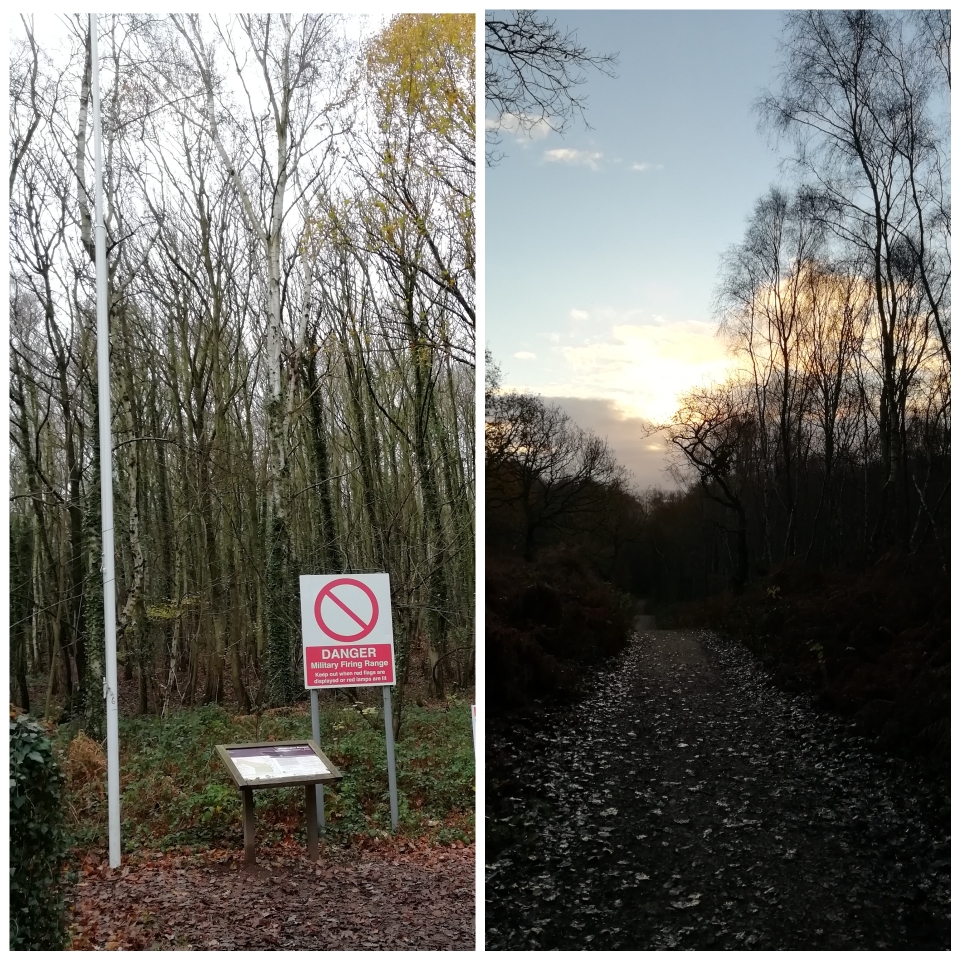
So this year we will remember Hopwas not for its pubs but for its woods. Hopwas Hayes Wood is a stunning 385 acre area of ancient woodland, heaven for walking, running and cycling. We headed into it from the canal where we were greeted with a flagpole and an official Ministry of Defence sign saying that this is the Whittington Firing Range and on a day when a red flag is flying and the gates are locked you shouldn’t enter. We walked through the gates around 8am and there was no flag so we enjoyed a good hour or so walking through the woods.

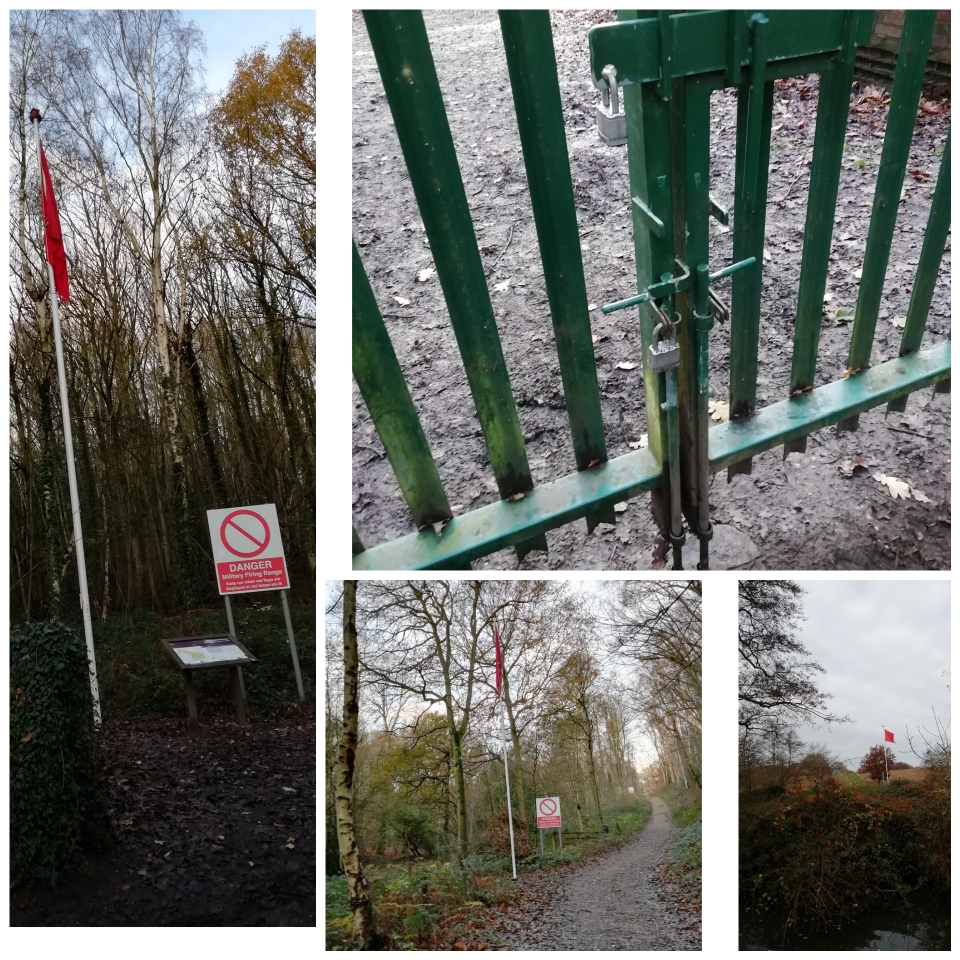
We started to walk back down the hill towards the canal just before 9am and found ourselves faced with – a red flag… and further on another red flag, and another – the damn things were now proliferating and accompanied by some seriously padlocked gates where we had entered earlier…

Local runners heading along the towpath realised our plight and came to our rescue with details of an alternative route out of the woods which would take us away from the firing zone and back to safely. Needless to say the journey back was done a lot faster and as ever we were delighted to meet local runners!

If you find yourself in this area – do go down to the woods but take a look at the MOD website first – might have saved us being locked in!

What excitement will next week hold?!

Disastrous leak cancels our plans and ends in tiers

Sunday was a lockdown day with a difference for anyone boating on the Ashby Canal and for towpath walkers near Snarestone close to the current end of navigation on this restored canal. Thousands of gallons of water drained from the canal into surrounding fields as part of the towpath fell away resulting in a breach of the canal. Boats were left stranded, fish (small and large, some up to 20lbs in weight) were left dead or gasping and although we were around 6 miles away we were affected.

The breach and its resulting damage

The restored section of the Ashby Canal is 22 navigable miles…or rather it was that long on Saturday until Sunday’s drama cut it short. Originally built to service collieries (at which point it was 31 miles long), it was designed without a single lock. That means if there is a need to halt water, stop planks are essential. These huge wooden planks, like railways sleepers, are lowered across the canal to stop the water literally flowing away. The concern was that the canal and the marina where we were could drain out through creating problems for boats, the canal structure, and surrounding farmland.

Boats on linear (towpath) moorings were shepherded into the Market Bosworth marina and stop planks placed across the entrance, sealing boats and water in. Emergency tape fluttered warning to any boats trying to turn in. Once secure, we all sat and waited whilst higher up the canal according to the local news, frantic and frenetic activity by an amazing group of volunteers halted the drama. 

Fishermen said they were alerted by a sudden flow appearing on the canal where water is normally totally still. The first we knew of the drama up the cut was the activity at the marina once they had received the alarm.

Stop planks in place across the mouth of the marina with warning tape. You can see how far the team had to move them to get them into place.

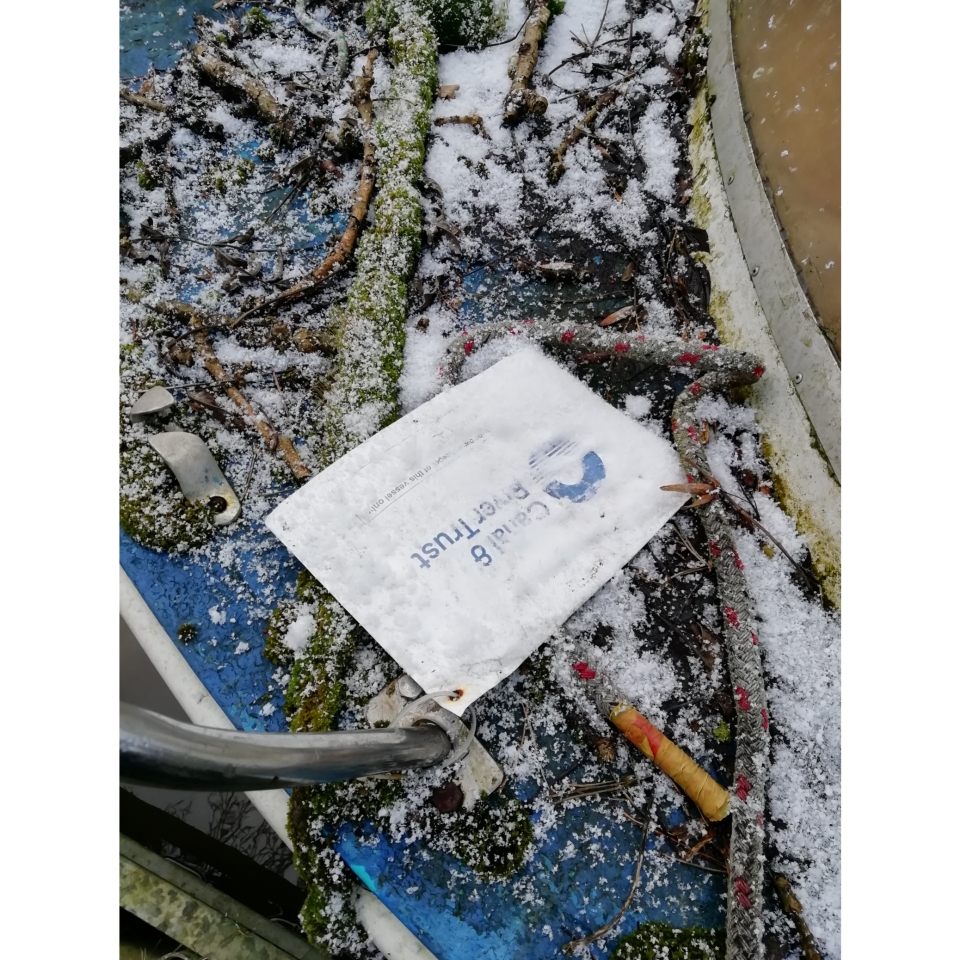
The early activity was followed by a boaters’ stoppages email warning. From Canal and Rivers Trust (CRT).

CRT warning – I have no idea how after seeing the pictures I have shared that they thought the towpath was still open!

So our plan of exploring to the end of the Ashby current navigation is on hold for another year or so. It just proves that we never know what’s round the corner. The best laid plans etc… so we will head out of the Ashby Canal and at Marston Junction head north west, turning back onto the Coventry Canal. Challenges ahead on the 38 miles of the Coventry we need travel to Fradley Junction include the 11 locks of the Atherstone Flight. The last time we did these it was blisteringly hot – something tells me that won’t be the case this time. The forecast warns of rain, sleet, and more rain! We will be going slowly and carefully – locks are too dangerous to take lightly in any weather but particularly in winter.

With the end of lockdown 2.0 and the introduction of tiers we find ourselves in Tier 3 here in the Midlands.  CRT have reinstated the 14-day maximum mooring in unlimited areas so we are pleased to be getting back to some normality of movement. Their guidance has been extended to advise not travelling between tiers. We have our map books and gov.uk out to view our amended route alongside the restrictions. As we are in a huge area of tier 3 it appears we can move as we wish for a very long distance. We have restocked with fuel and food to stay warm and enjoy soups and stews as we travel. New views on a regular basis will also keep our spirits up. 

Keeping observant and sharing a daily picture from our life or the natural life around us during lockdown on @pickingupducks on Instagram has been hugely enjoyable and it’s great knowing that others look forward to these too.  Seeing the changes of nature, as well as the ways that all of us as individuals have the capacity to lift the spirits of others is just wonderful. Posts that created the most interest recently include the changing nature of what I had called bulrushes for decades but now know are reed mace; a beautifully decorated road sign at the end of a tiny country lane; Cola exploring his pawfect very own doggy advent calendar (huge thanks Lesley) and hazel catkins bringing the cheerful hope of new beginnings.

It’s a delight to be asked to continue these daily posts. Small moments of enjoyment are always important in winter. They seem more necessary this year than ever. Finding my thermal socks was one of those moments! The glee of seeing it’s started raining minutes before the dog and I set off for a walk means I can get full waterproofs on (that’s opposed the misery of setting off without waterproofs in bright sunshine and getting soaked 20 minutes out!). Being on a boat has resulted in a different kind of rain check too. I realise I used to look up to evaluate rain, but now I look down. Heavy rain produces far agitating ripples on the canal surface. These ripples change in frequency and dimension depending on the type of rain and prove a very good indicator of whether it’s welly or walking boot weather.

As we get back on the move we still have some leaks on board – from the fresh water tank – but we can now manage them. To help stay warm and reduce draughts, we have put up our Perspex double glazing. Being rather old and a bit scratched it gives us a hazy view of the world – no bad thing in 2020 some may think! With the demand for Perspex thanks to Covid, now is not the moment to seek replacements, and those we have will certainly work for this winter. Spring 2021 will look even brighter for us when we take them down and see clearly again!

A new mystery emerged with the discovery of a loaf of bread in our store in the covered cratch area with huge chunks removed – mice? rats? greedy swans or ducks helping themselves? None of these seemed possible – how could they get through the closed tarpaulin cover, undoing zips and elasticated ties? The culprit inadvertently gave himself away by nuzzling my hand with a crumb-covered muzzle! Cola the boat dog had been snatching a mouthful behind my back whilst I was busy undoing zips and ties to let us out. Bread is now in a closed, dog-proof container!

Bread damage and the thief – really looks guilty doesn’t he?!

My lockdown 2.0 goals are rolling into a running-up-to-Christmas set of goals – has anyone else done the same ? The lockdown return to running didn’t quite work due a chest infection (not Covid), but I averaged 14,000+steps a day which has done a great job strengthening my knee around the meniscus tear. The promised jeans are on and a bit more effort should make them comfy! 

We are looking ahead to Christmas. We hope we can spend it with 4 wonderful family members to make our squad of 6. Our aim is to moor somewhere nearer them for that to happen. That demands keeping an eye on planned repair stoppages which could restrict where we go, reviewing river flooding risks, canal freezing risks and planning our route accordingly factoring in water fill up and waste disposal points. En route we aim to minimise contact with others prior to the festivities to try and protect the family, and to use dry days to forage greenery and decorate the boat ready for the festivities. If you are creating foraged decorations it would be great to see your creations to give me inspiration!

Finally, I just have to share this with you – yesterday afternoon’s walk resulted in us both standing on the muddy towpath in a steady downpour howling with laughter.

Floating in the reeds we found the latest (undramatic this time)Ashby Canal leek! Let me assure you although it’s a plant, it honestly wasn’t a plant by us! Wayne and Emma Jackson you’ll know why we instantly thought of you two!

So whatever tier or restrictions you are under – we hope you too can find something to smile about.

Fishy goings-on in a murky underworld

As on land, problems never seem to come singly on water. We’ve wrestled with onboard flooding and finally identified the source (our fresh water tank) so continue a now monotonous cycle of sealing, filling, evaluating, mopping and resolving.

We have reduced the severity and number of leaks, identified and hopefully sorted them but working away this week and bubble support means we won’t be able to do much more testing until next week.

This week’s added concern has come from unidentified electronic alarms. What do they mean? Where are they coming from? Are they indicating something dire or expensive has gone wrong? Are they related to the boat or the marina connections? Can we sort whatever it is before we need to move on (if allowed) on 3 December as England’s second lockdown ends? Most crucially – is it serious, so serious it could result in us having to evacuate our floating home?

The noise is intermittent and irregular. Sometimes short sharp beeps, at others a rising series of notes, so is it emitted by one or more items? It appears we have only heard it at night, but is that because often during the day we are out, or because Alexa (yes, we have her onboard) is playing us music or the radio has drowned it out?

It is clearly an alarm and electronic. To be honest we don’t have that much on board that is electronic! We have done the rounds of the carbon monoxide monitor, the smoke alarm, mobile phones and the battery charger. The dog must have wondered what on earth we were doing, running up and down the boat stopping at intervals and listening – is it coming from here, from there, from inside, or out? The answer came, as these things often do, by chance. Steve went out to fetch fuel for the stove from the roof and came back laughing. The beeps are fishing alarms – and there are three fishermen on boats around us, each with a different make of alarm and each makes a different sound.

Spot the fishermen on the pontoons in the sunset

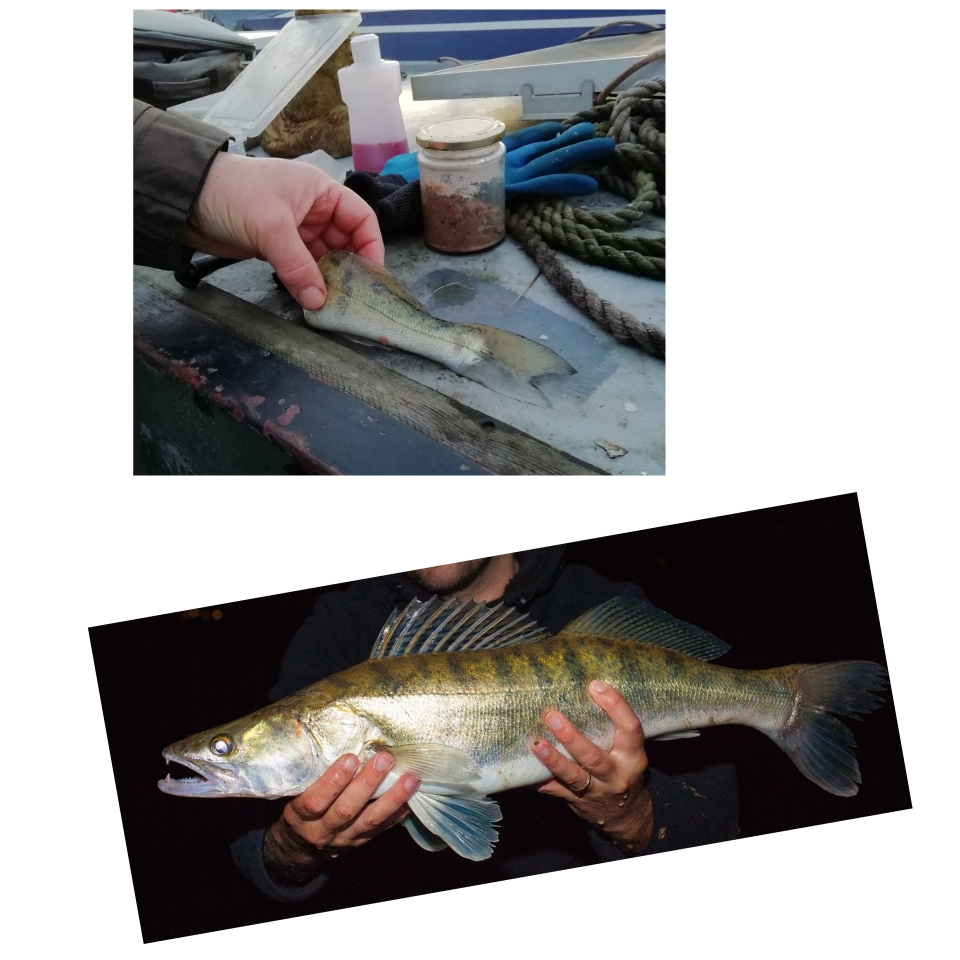
Having discovered the cause of the noise we can now relax. But it made me curious about what fishing from a marina pontoon might yield. The answer was unexpected but fascinating – they are seeking Zander, an invasive non-native fish which it is actually against the law to throw back. This fish is so tasty that it is commercially farmed in some countries like Denmark. It appears amazingly versatile, for everything from sushi to grilled or baked fillets. I don’t think I have ever eaten it (knowingly at least). Frozen fillets are on sale for £16 for 240g and the catch record in the UK for the species appears to be 9.7kgs.

Zander (aka Stizostedion or Sander lucioperca) is also known as the European pike-perch. It is now prevalent on several of our canals including the Ashby where it appreciates the dark shade created by boats, making a full marina zander heaven. Its predatory behaviour has led to it being regarded as a threat to native species like sticklebacks and gudgeon. It’s become such a problem since it was introduced to the UK in 1878 in lakes at Woburn Park in Bedfordshire, that many canals are now managed by electrofishing in sections to try and reduce its numbers.

Modern technology comes into play if you want to succeed in zander fishing apparently, not only using multiple rods with bite alarms but also employing bluetooth sonar to identify packs of zander. From the frantic and regular beeping we’ve heard, I imagined it would be really easy to get a picture of one, to nip across to a boat and peer at the catch but since I learned about them they appear to have become elusive… being caught only when I haven’t been around apparently unless that’s just a fishermans’ tale. This mini fillet was the total result of the past 24 hours so I was grateful for a Pixabay copyright free image to see this evil floating Dracula in its entirety!

The falling temperatures make me realise why anglers fishing from narrowboats buy alarms to tell them when a fish is biting so they can respond from the warm! The cold is something we’ve really noticed, particularly with this week’s work schedule. Imagine returning to a large metal box which which has been shut up all day with no heating as temperatures drop and you’ll realise why we’re becoming adept at laying the stove early in the morning before we leave so we can have it lit within seconds of returning at night. Soups, stews and hot drinks are coming into their own as vital means to raise temperatures and spirits alike.

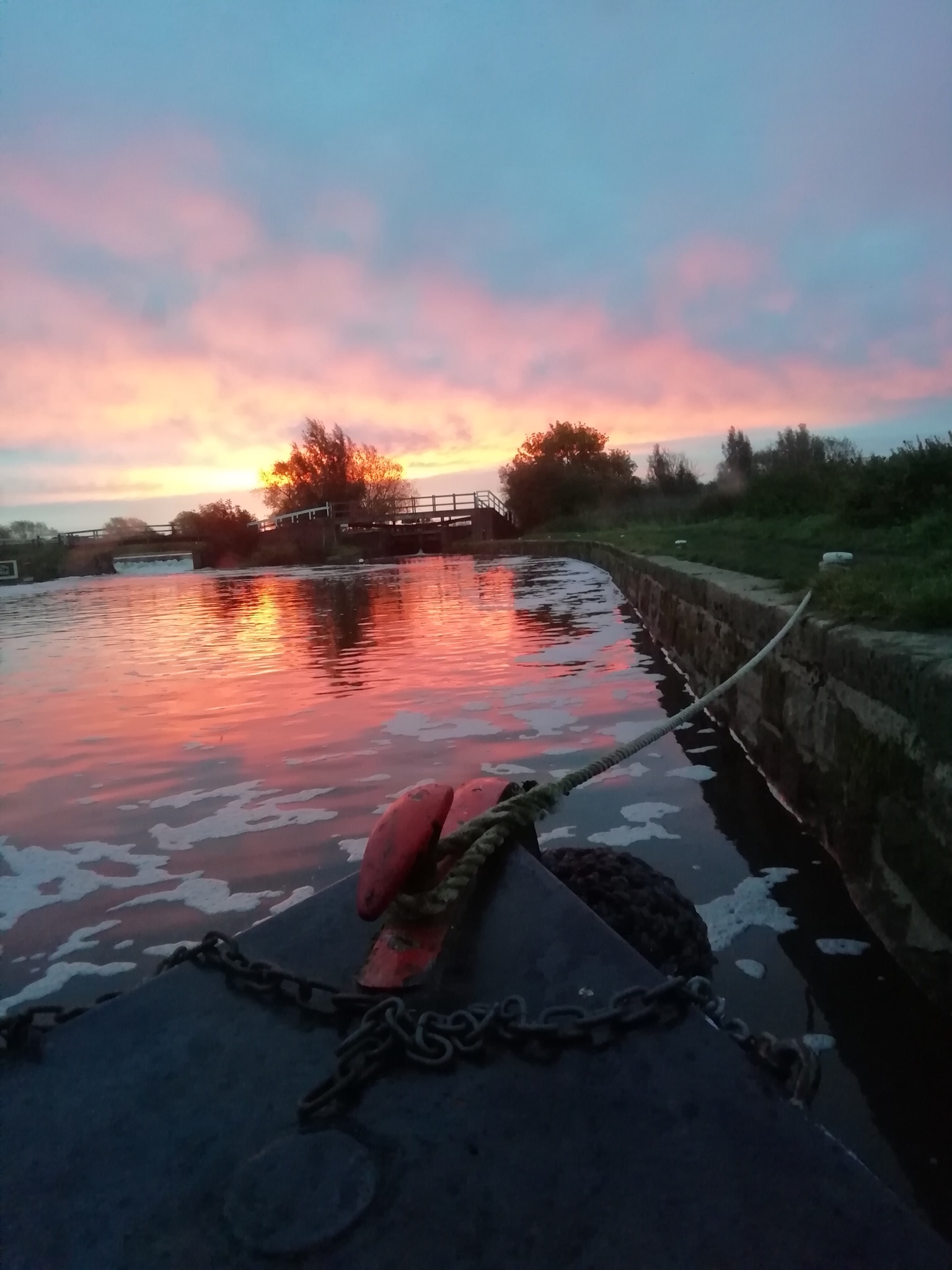
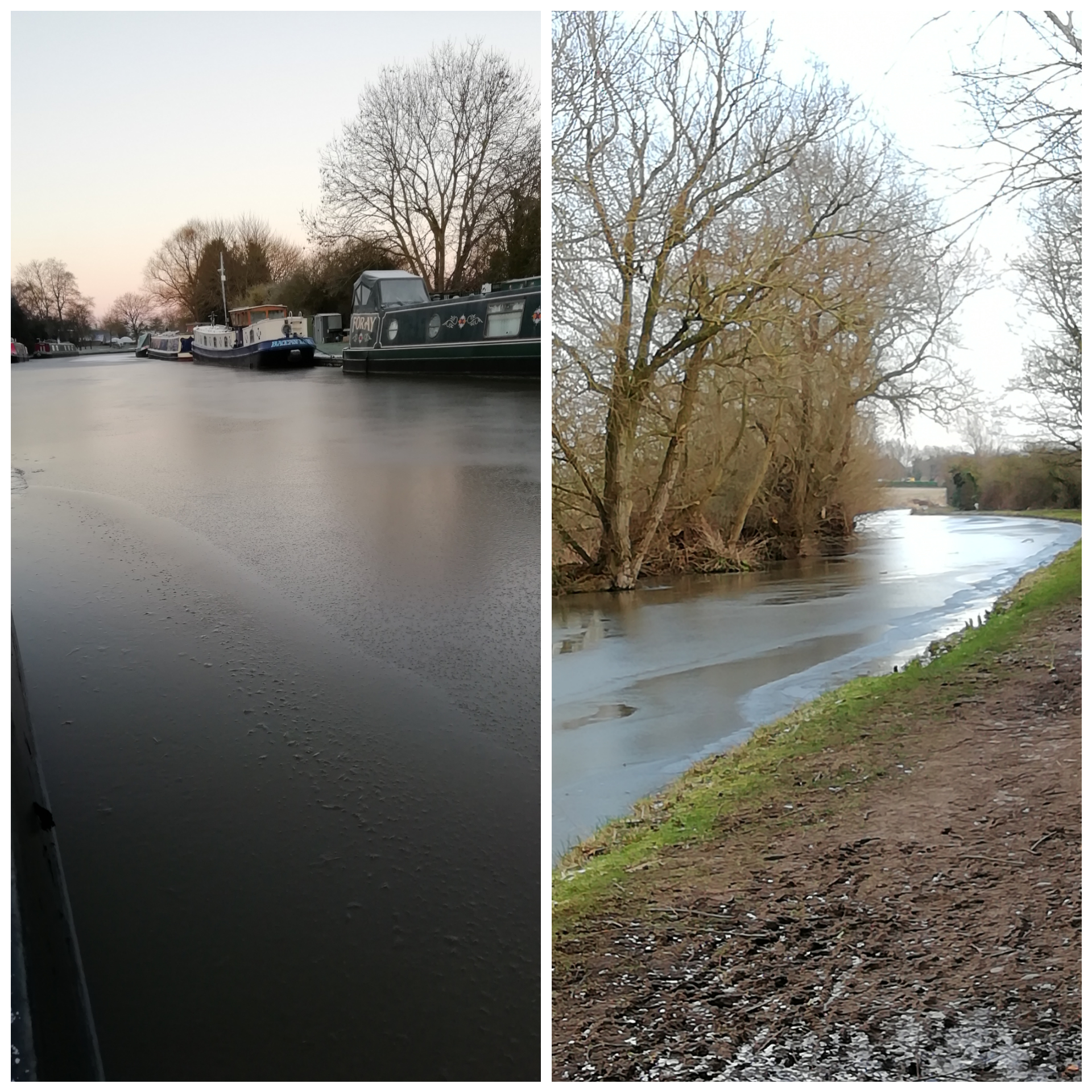
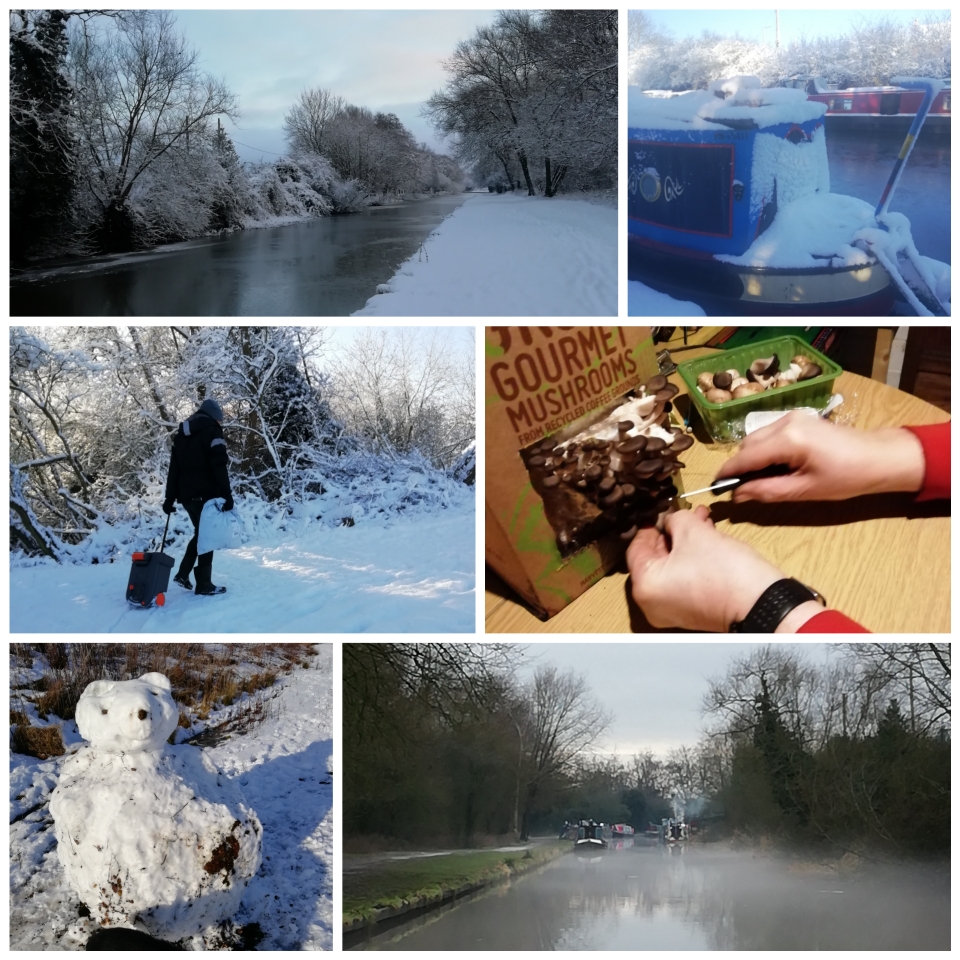
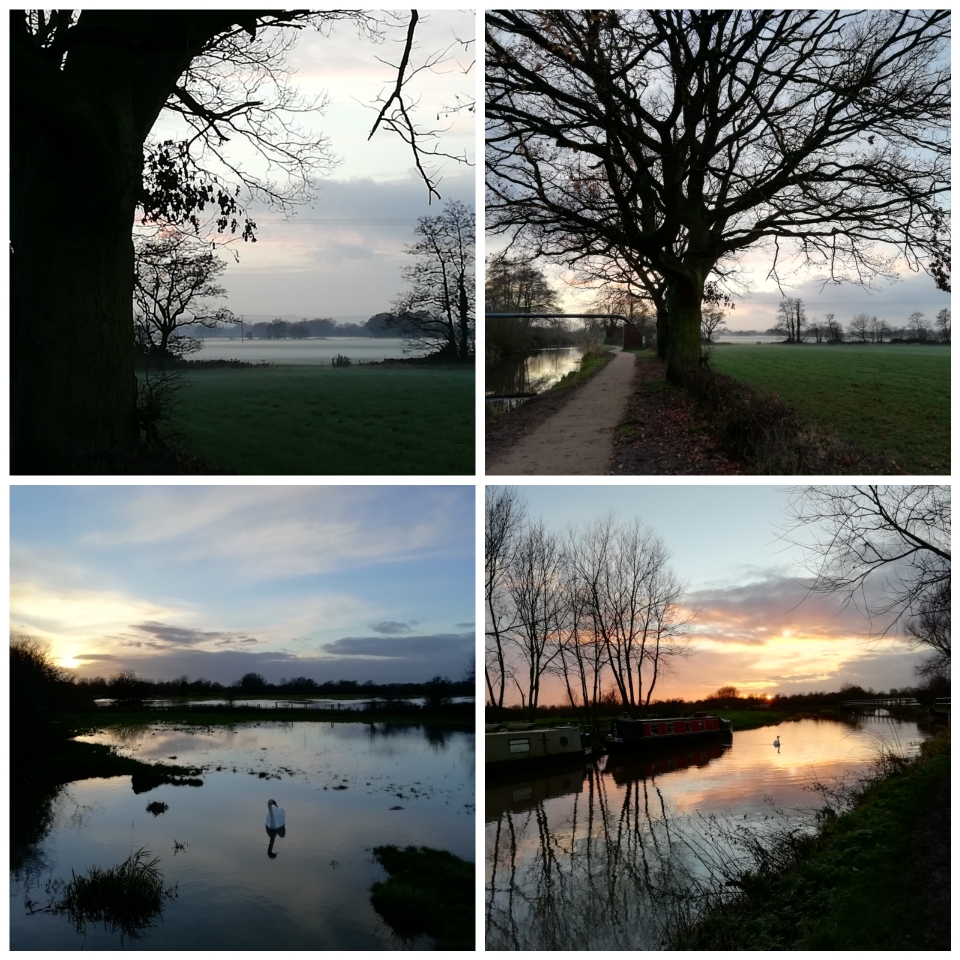
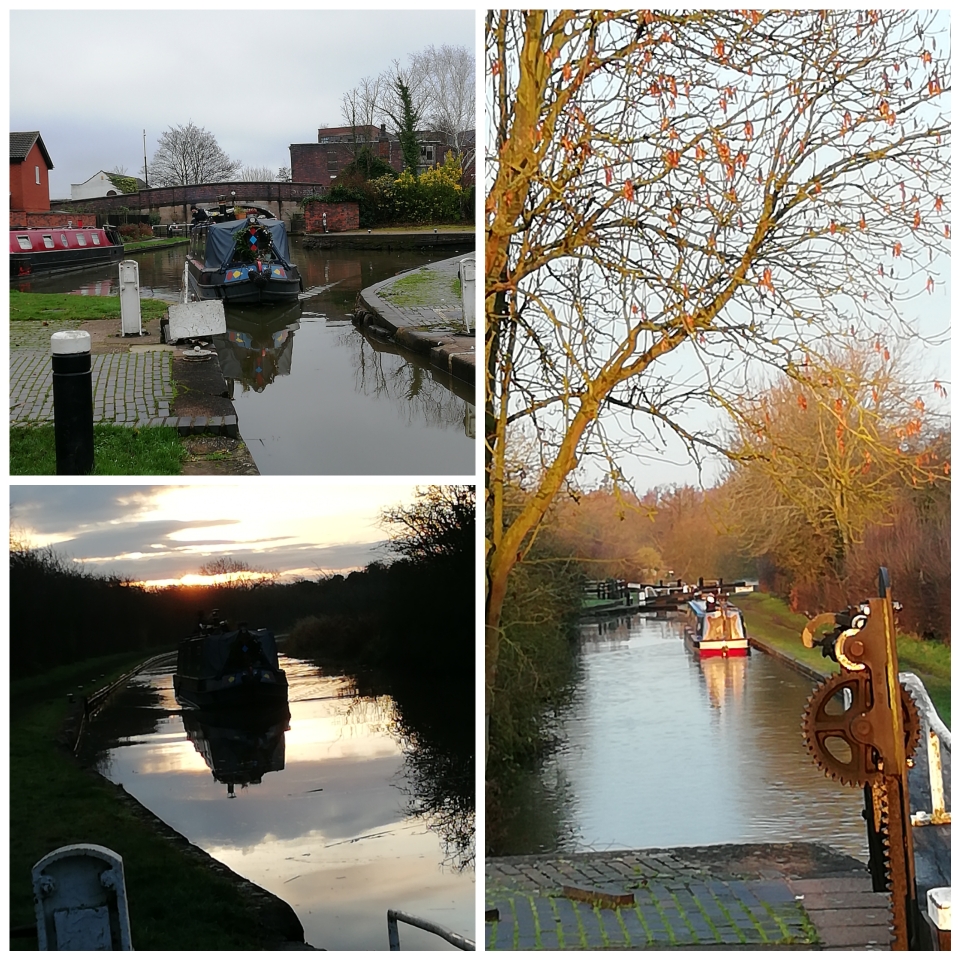
The cold though does bring unique benefits we can’t enjoy at any other time of the year and which are even more apparent living on our non-centrally heated narrowboat….the chance to cuddle hot water bottles, to snuggle up on the sofa swathed in blankets, silvery white walks, the crisp crunch of the towpath as the slushy mud has set hard under foot, and we’ve enjoyed the most stunning sunsets reflected in the water which seems like a double treat. Coming back into the warmth after being out to appreciate the sights around us feels a real bonus – it’s worth nipping out into the cold just to get that chance to come back inside! Maybe this is the Scandinavian hygge but whatever it is, it is special.

As the temperatures take us towards Christmas we wonder like everyone else how we are going to be able spend it because of tiers and regulations, travel restrictions between tiers may hit us, and of course there is always the dilemma of should we morally mingle with those we love, particularly those with underlying health issues. My lockdown 2.0 return to running has been struck down too by a tight chest and runny nose which thanks to the C-19 by ZOE app necessitated a Covid-19 test for us both. Fortunately we have use of a car this month but I wonder how I will manage if in the future I fall ill and have to cycle the distance to some car park to stick a swab down my throat and up my nose!

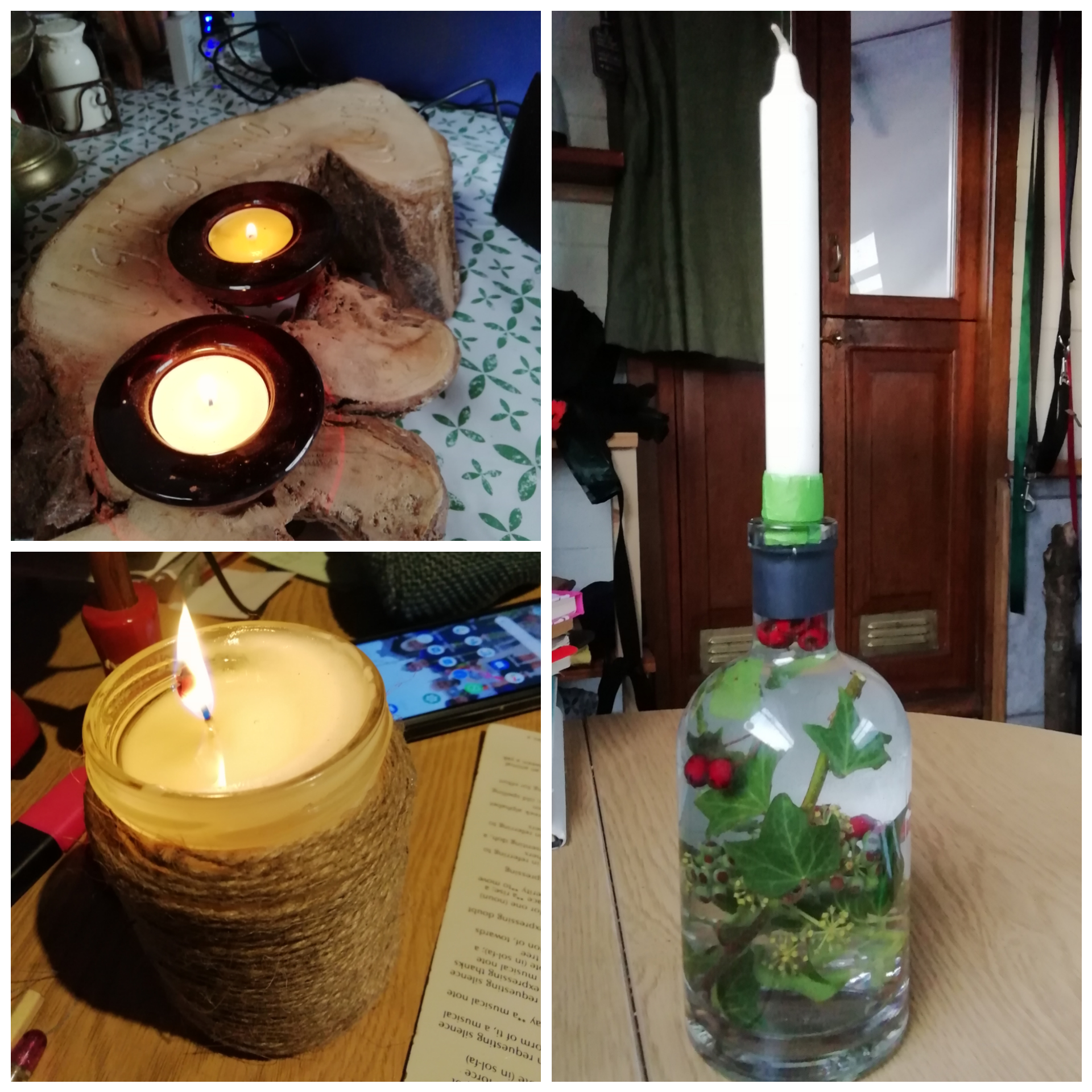
Seeing lights and festive decorations lifts the spirits and it’s a delight to see them going up so much earlier this year, giving the chance to spot new ones every day. Narrowboat owners are doing their bit, and we’re starting to see decorations appearing. Some are going all out with the lights. I’ve made a start on natural and upcycled decorations with enjoyably emptied gin bottles doing duty as candlesticks. Once we leave the marina we will return to a lot of candlelit evenings as we return happily to our off grid lifestyle. I am also finding a surprising amount of satisfaction recycling toilet rolls into snowflakes – a highly recommended creative way to pass a winter evening!

A casualty of our time here has been our centre line which has frayed badly because of movement during the recent winds. By chance this seems a bit of a bonus as we do have a replacement, and if I can forage enough greenery I intend to use the old rope as the base for some natural festive swags along the side of the boat.

Incidentally our Covid tests were negative and we were texted the results remarkably within 12 hours. My chest infection must have been some winter bug, but I imagine I was not alone in jumping to instant conclusions that Covid was to blame. I’m lucky, it seems to have beat a retreat and the only thing that suffered was my return to running although I have managed to walk an average of 8+ miles daily.

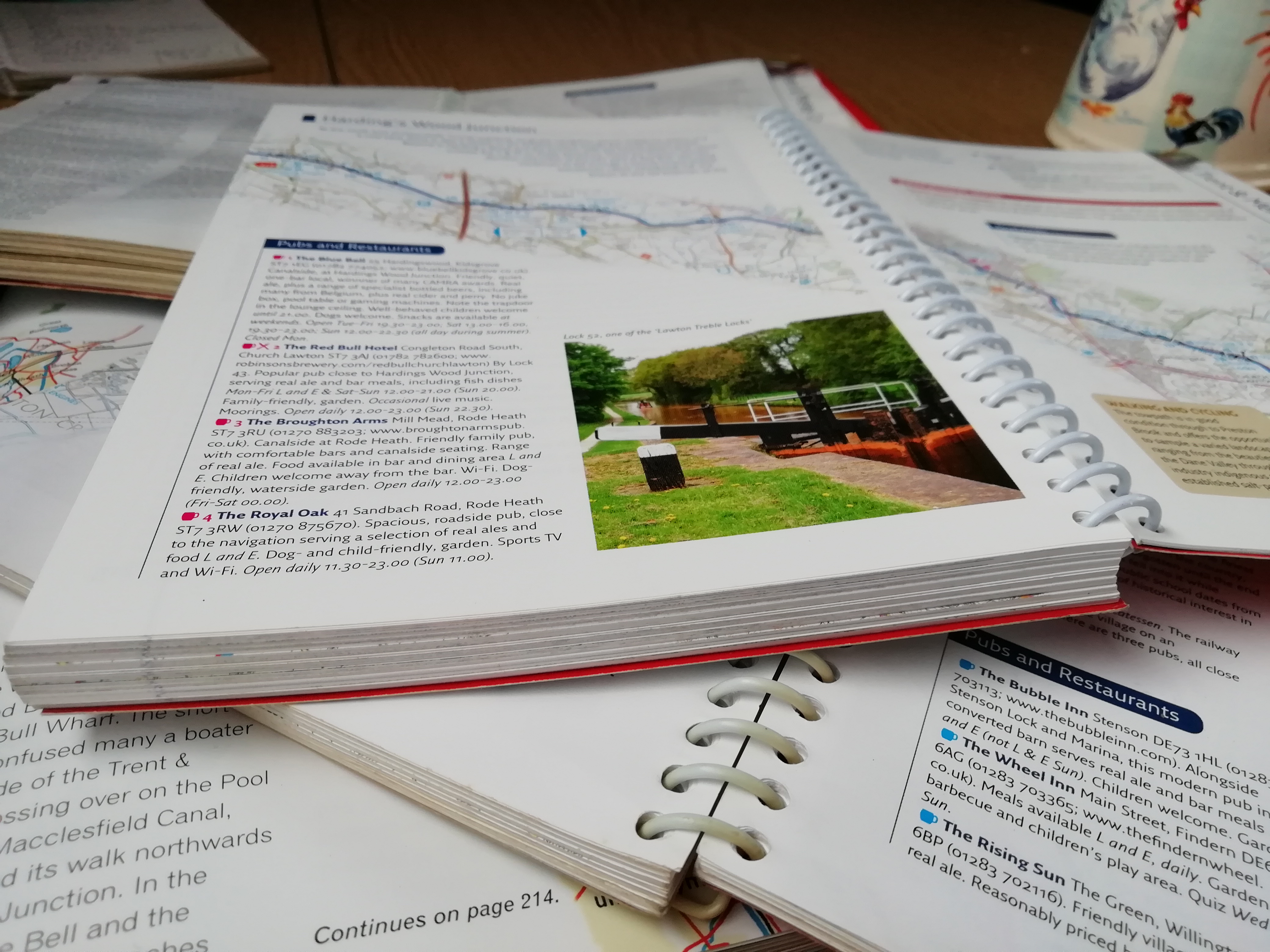
We are going to head the boat in the direction of our family in the hope we can meet up somehow, somewhere for some of Christmas. We are going to self isolate on board for the two weeks beforehand to try and protect our family, but there is still confusion and no clarity yet from Canal and Rivers Trust about whether we will be able to travel through tiers to meet up. If we can, we will, if not we will load up with fuel, food and sit tight when we’ve found somewhere we want to moor. By my next blog next week we will be on the move to somewhere and we’re looking forward to it, wherever that may be to, and hoping for no more dramas en route!

Sinking feelings are bad news when you live on a boat

Water is generally regarded as a necessity for life afloat, but as we now know, in the wrong place it is both worrying and threatening.

You only have to look at the news or cruise England’s canals to see that narrowboats do sink sometimes. New bulletins also bring us the heartbreaking destruction created by flooding and to lose possessions with sentimental value would be hard. For us now flooding leading to sinking would result in the loss of our entire home. It would be devastating. It would spell the end of enjoyment of this new life afloat after only a short while, the end of our reduced impact alternative living , and create immense stress working out what we would or could do next. The fear for me is that this could become a reality if we don’t find and sort the leak/s we have discovered.

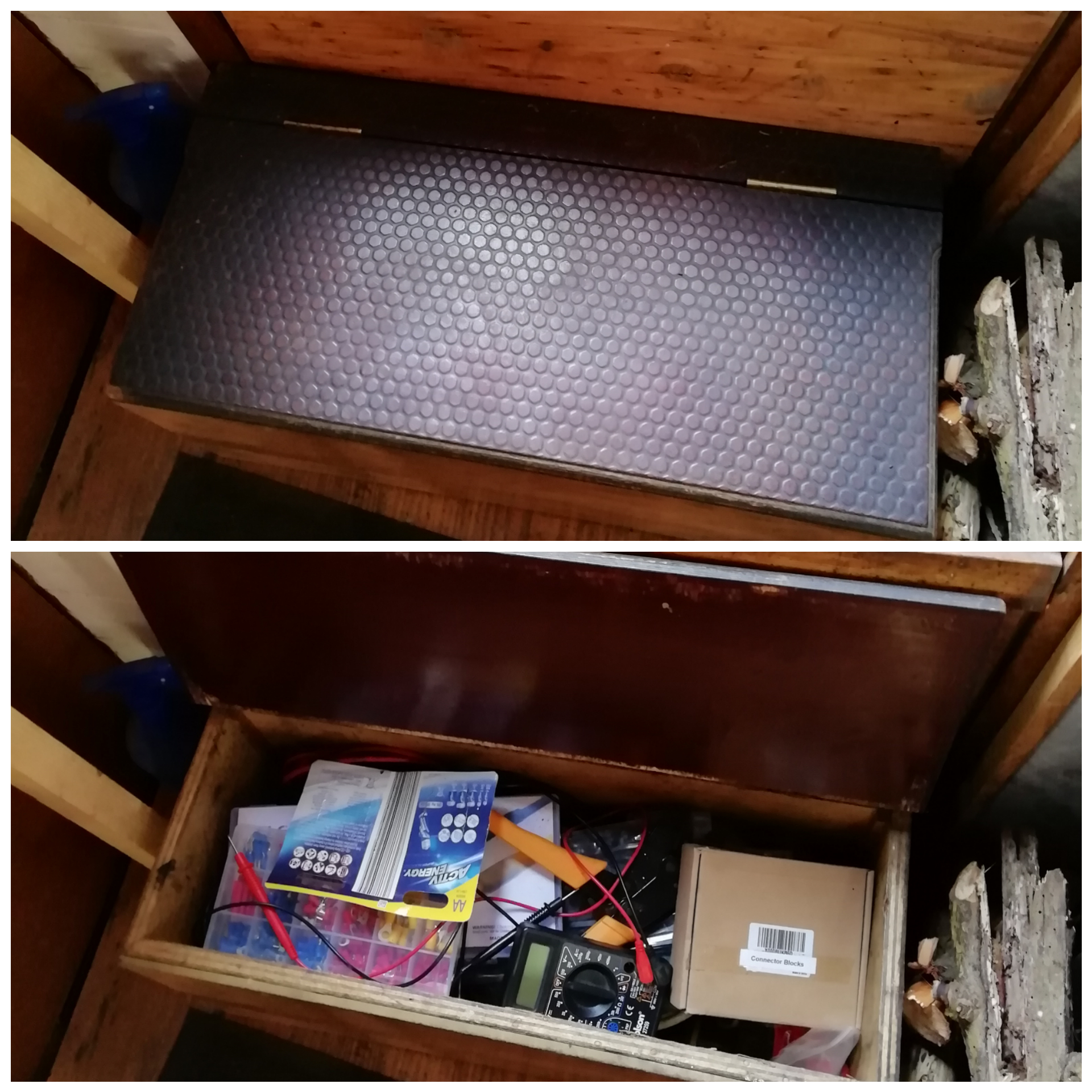
For some time we have been mopping out the bilges (the underwater internal part of a boat between the bottom in the water and the floor within the boat) regularly. This narrowboat doesn’t have the luxury of a cabin bilge pump so it’s a manual process. That’s a good thing otherwise we might have missed the drama going on beneath our feet, our sleep and daily life… The access slot for mopping out the bilges is under the step into the bedroom cabin at the back of the boat. Black, dirty water comes out in bucketfuls…

Cabin bilge mopping… under the step access to the hidden depths.

Water has been gathering inside the boat under the floor in some quantities. We get several 10 litre buckets out at a time. We need to stop it but to do that we need to understand what type of water it is and where it’s coming from. If enough water comes in – we could sink.

According to this handy article from Whilton Marina there are alarmingly multiple ways of sinking your narrowboat!

Whilton Marina vital guidance available online
  • Water in the engine hole – we don’t seem to have any quantities of water there
  • Leaking stern gland – our stern gland was repacked only a few weeks ago [believe me, that’s an excitement for another blog]
  • Failing to pump bilges – we are mopping madly!
  • Weedhatch faults – our weed hatch is clear and clean
  • Locks – we can rule out this leak is nothing to do with them

So we have identified that there’s water in the bilges and we need to work out how it got there and stop it increasing.

Three potential sources could be culprits:

canal water – that would indicate that we’ve sprung a leak in the part of the boat accessible to the canal. This is pretty unlikely given that we can mop out and it appears dry and then only gradually returns. If it was even a small hole in the hull it would be a constant refilling. We paid £4,000 to have the hull replated with steel and blacked when we bought the boat a couple of years ago and haven’t had any collisions, accidents since then that could create a hole. That’s the logical eliminaton explanation but at night when it’s windy and I can hear water lapping against the hull, I still imagine that water is being forced into the bilges somehow! Ridiculous ideas always seem to take hold in the night!

rain water – this can come in from poor fitting covers, windows, etc. Generally it doesn’t appear in the multiple bucket quantities we’ve been seeing but could be adding to the bilges somehow. We have a covered ‘cratch’ at the front of our boat over the well deck which makes a usable space. In the summer it creates our ‘conservatory’ – an ideal place to sit on specially made cushions with a drink with the cover folded back to let a gentle breeze.

The versatile cratch, created into a multi purpose, multi season space with its long-lasting aging cover from AJ Canopies

In winter with the cover zipped shut it is a utility room and porch, somewhere to shed muddy boots, wet weather gear, towel down the dog and store fuel. It also serves as a place to dry wet clothes.

The sides provide steps which form an easy route into the boat but as with every step on our boat, they double up as storage for garden chairs, sacks of dog food, the water hose, the anchor, the barbecue, the next lot of fuel for the fire etc…

We know our cratch cover is leaking a bit. One area has come away and there are problems with the closures, probably because we think the cover is as old as the boat and we all give and stretch a bit after 30+ years. But – if incoming rain could be part of the issue, how would rain getting into the well deck of the bow get all the way to the back of the boat?

More investigations required removing the sealed, non slip flooring board (oddly called buffalo board) which covers this area and which we walk on. This revealed a rusted hole in the bulkhead between the well deck and the main cabin of the boat, not a big hole but water can enter through tiny gaps. So Steve filled the hole with metal filler and we waited. The weather obliged and rain raged for us a couple of nights later, but there’s no way that alone would have resulted in the buckets we have been mopping out. The rain water that collected near the now-blocked hole was easily dealt with by kitchen towel, so rain certainly wasn’t not the culprit of the bilge buckets.

There had been drain holes in the boat which allowed rain water to exit the bow deck. On advice when we bought the boat we had them plated over. Steve decided to restore the holes but much smaller to deal with one potential ingress of water. He duly drilled the first hole and instead of rain going out, we ended up with canal coming in – it appears with all our stuff on board the boat is sitting much lower in the water than it was! Hasty finger in hole moment and urgent recourse to metal filler. More mopping required – this time of the well deck. Fortunately that’s now sorted and we won’t restore those drain holes until we have removed significant amounts of ballast raising the boat in the water!

drinking water – we actively put this with a hose into a tank at the bow [front] of the boat. A hole in the water tank below the level of the floor would mean a bilge with more water than we are finding given that the tank appears (and we can’t be totally sure with an old boat and no level gauge) to hold at least 250 litres of fresh water. The tank lid sits below the buffalo board we walk on, and is filled with a hose via a filler cap outside the boat.

Well deck mopping – rust creates fascinating patterns which shimmer under water!

So with two options down – not rain or canal- it looks like it must be a leak from the fresh water tank but high enough that it only leaks when the tank is full or near full. Having cleared and uncovered the well deck to check the rain situation, we began the process of looking for obvious holes… not easy in a 30+ year boat which has been well used. We have been using more water recently because we are now living on the boat. We do keep a record of when we fill up, and we’ve filled up 3 times in the past 2 months. So we topped up again to check. When you are low it can take an hour to fill up but we only had to wait half an hour, watching nervously before water began spurting out in so many places we couldn’t mark them all!

X marks the spot of one leak and the blue arrow shows the direction that particular leak was spurting out

Hastily we turned off the hose to the mains and turned on cold taps in the boat to reduce the level and pressure of water in the tank to stop it spurting out! More mopping followed and buckets later we realised that every time we have filled up we have been pouring about 40 litres into the boat! The water was insinuating its way through rust gaps and tiny spaces in the bulk head and trickling down along the bilges to reach the point at the stern where we mop it out.

So we at least know where the water’s coming from. Ironic that we’re effectively trying to sink our own boat by actively pouring water into it!

Hasty recourse to experts and canal boat online forums for advice led to finding the sealant which is safe for such a job, followed by an emergency click-and-collect order to Screwfix and a dash to fetch it. The top of the tank has been wire brushed, cleaned and has now had two layers of sealant, and the whole bulkhead has also been sealed with metal filler.

Now we wait to see if the sealant and metal filler have done the job. We continue to mop but the amount of water in the bilges is reducing, not increasing. It is damp now not sopping but we have reduced the water in the water tank to make sure there won’t be additional leaks in the meantime…

Three days later we attached the hosepipe to the main supply pipe, crossed our fingers and with bated breath and chalk at the ready, we watched the top of the water tank for 18 anxious minutes which felt like a lifetime!

Insert hosepipe…cross fingers, have chalk to hand and wait…

Sure enough, the leaks began again but (and it seems strange to say this), we only identified eight leaks and they were small, contained dribbles rather than gushing, spurting fountains. We managed to mark each one with a chalk arrow to allow us to target repairs this time.

Success – now only 8 leaks!!!!

Lots more mopping in the well deck but we think the leaks were contained and the metal filler held back the water from flooding down the boat.

More sealant and more waiting is where we are now. Taking the lid off the tank would be a major task and create major problems (we can’t live aboard without water) as well as generating a major bill and we are actively trying to avoid all these.

We haven’t completely solved the problem yet but hope we’ve identified the cause of the leak and are well on the way to sorting it. We will try another tank fill tomorrow. If it still leaks then, we will keep going with sealing and testing – perhaps trying waterproof tape and sprays as well. We know that if we don’t fill the tank right up, we can avoid flooding the boat. That will have to be guesswork with no level gauge. If and when we can or have to replace the tank, or fit a new liner in the future we will install a gauge and a new lid.

For now the Autumn winds are building up. They have to blow hard to create waves on a canal but they are managing it. Already now when I wake at night hearing the waves slapping against the hull I just enjoy feeling snug and warm and happily let the waves rock me back to sleep.

Coming up next – the slippery A-Z of making a profit from your boat day and night… Covid tests… and have we solved the leaks?

Getting back on an even keel and learning to live positively in lockdown

We are having a very different living experience for this lockdown, and one I hope will make us much more appreciative of our floating lifestyle. It was a head over heart compromise and one which led to a lot of discussion. One of us was head…and one heart – I am sure you can work out who was which!

We are spending lockdown moored in a marina, and it has brought some benefits:

  • WiFi is working well enabling easy access for family and work (note the order!)
  • Unlimited access to hot showers with…wait for it – heated floors
  • Fresh water whenever we need/want it and waste disposal for the loo just a short walk away on a non-muddy path
  • Access to a washing machine and tumble driers
  • The walk to town with food shops is only a mile or so, and it’s downhill on the way back when laden. If we feel lazy a small shop on site opens 2 hours a day
  • Electricity which means we can keep our batteries fully charged (after investing in a new charger to replace the definitely faulty old one) and get diy pre-winter jobs done with power tools
  • Secure car parking so we’ve been able to collect and charge the car ready to respond to support/work needs

It is a very different way of living. Our views are constrained and for the first time living on this boat I feel a sense of claustrophobia. We have neighbours at arms’ length on one side and a pontoon width away on the other. The freedom to moor where we choose and often in isolation amid ever changing views will be wonderful when we return to it.

There are nearly 200 boats moored here. Some are locked up for the winter. Some are people who always choose to spend their winters in a marina. Some are permanently moored here, and this is their home.

NB Preaux marked with the arrow looks tiny – even though she isn’t moored at the shore end of the pontoon

We have been here less than a week as I write this, and it’s already easy to identify those personalities who make up any community. There is the expert-at-everything – from boating to Covid risks or political predictions; the organiser keen to tell you what you need to do and how; the introvert who avoids all eye contact; dog lovers; cat lovers, and the sharers, who without any expectation of return, give to the community. In this last category came the thoughtful teenage Niamh who arrived at our boat the other evening with her Dad and a painstakingly beautiful coloured and cut-out poppy as an Remembrance offering for us. They took one to every occupied boat.

We proudly display her poppy on our boat and in its small way it formed part of some poignant moments of remembrance evident around Market Bosworth.

We joined the two minute silence standing on the pontoon overlooking the water, heads bowed and at a time when we are giving up very small freedoms, we remembered all who gave the ultimate sacrifice of their lives but also the sacrifices and freedoms that so many give up for the duration of war. My father was a Fleet Air Arm fighter pilot who gave up 2 years in a prisoner of war camp having been shot down and handed over by collaborators to the occupying troops. My mother, a cipher officer continued to work daily contending with blackouts, air raids and rationing, not knowing whether her future would be as a widow or a wife.

Lockdown 2.0 meant we couldn’t celebrate together the birthday of one of our daughters and the 3rd birthday of our grandson, but if we can collectively stall Covid-19’s increasing march across our nation there will be more birthdays together. In reality we are being asked to give up very little to protect ourselves and others for just 4 weeks.

 I am trying to take lessons from what has seemed valuable in our first months of a slower life on our narrowboat to support me, and perhaps others through lockdown:

  1. Forget the mania of multi-tasking. Actively relish taking time to focus on each task, however small and reap the enjoyment of doing it well. A day of multiple small achievements brings remarkable satisfaction and that is something we all need, for our self esteem, sanity and sense of well being.
  2. Ditch the dishwasher if you have one. If you have a lockdown companion or a family make washing up at least once a day a shared task. It is easier to have meaningful conversations about feelings and concerns over a shared often mindless task which needs to be done and which allows you to work together without eye contact that can seem invasive. (Is there always an I’ll wash, I’ll dry, I’ll put away and the person who vanishes to the loo the moment washing up is mentioned?).
  3. Put technology on hold – go for a walk without it.
  4. Make something – create or cook something from scratch.
  5. Take time every day to appreciate the surprises and spectacular beauty of nature around us – something which has endured for centuries and will endure long beyond this pandemic.

Taking control at a time when things can feel out of control is important. Put yourself in charge of how your tasks are done and how long you take on them.

It was inspiring and intimidating to see how people used the last lockdown, but we can all make this one count in our own way. It is another chance to build or strengthen ourselves and our communities, to offer help to others and to use the internet to access new insights. Being interested in something and someone other than our own worries alleviates stresses and pressures for a bit. It helps to think of someone and something other than ourselves and means we often return to our own worries with a new perspective.

Feeling that your whole life is at the mercy of someone else’s control be that economic or political, circumstantial or emotional is debilitating…. Every journey starts with a single step… what’s your step to control of something going to be?

What has helped you through lockdown whenever it has been for you? What have you learned, resumed, or found solace in? What ideas do you have which will inspire us?

I did set some lockdown 2.0 goals just to have a way of trying to motivate me through it, so here’s the update of how they are going:

  • To achieve something, however small, every day
The foraged early sloe gin is bottled (tastes good too – one has to try – hic!), the rag rug is taking shape (grows a bit every day) and a new battery charger has been fitted to maximise the electricity we currently have and protect our vital battery life.
  • To see if I can start gradually running again and hope my meniscus tear has healed enough to let me carry on... well, the knee is holding up and I am taking slow but sure runs most days increasing by minute increments.
  • To leave lockdown 2.0 lighter in spirit and looser in jeans knowing I have made compromises and decisions that are right. I have so far completed my daily step quota, made relatively healthy food/drink choices (sloe gin’s ok isn’t it?) and walked another stretch of the glorious 100-mile Leicestershire Round
The fabulously signposted Leicestershire Round, with glimpses across Looking Glass Pond, 4-paw drive avoids the mud on the towpath and is this the Bosworth Boar, symbol of Richard III’s household?

We are now approaching two months living this new pandemic-inspired life. We are still talking, still frugally solvent, still in good health and still afloat – so that’s good! We have faced hurdles but heated discussion and compromise have got us through. We are enjoying this life, and expecting to enjoy it even more once we are able to resume our travelling again but we know there will be more challenges ahead – particularly when winter strikes. Can we avoid being frozen in? As everyone is wondering, can we all get together for Christmas? For us, how many weeks will it take us to travel to be near them? The news of a potential vaccine and more effective testing makes me feel much more positive about our collective futures and the lifting of lockdown 2.0 on 2 December.

In the immediate future we need urgently to find this really worrying leak which is resulting in water continually gathering inside the boat’s hull. I am also going to explore further this delightful, historically-infused area whilst we are here… looking back to 1485, the Battle of Bosworth and King Richard III.

It seems that December 2020 won’t herald a repeat of Richard III’s “…winter of our discontent…” which has to be a huge relief.

Lockdown 2.0 is rocking our boat

It’s a different lockdown this time – for us in more ways than one. This time we are afloat, living on a 50ft narrowboat which we are renovating as we cruise. Preparing for a lockdown on a narrowboat is different, and wondering as we do so what we might have forgotten!

Canal and Rivers Trust have lifted the 14-day maximum stay in one place for continuous cruisers like us. Leisure boaters who don’t live on their boats can’t go to them until 2 December as was the case for us in Lockdown 1.0. For us now it just means we don’t have to move as often to keep to the terms of our licence. 

We are currently cruising the restored Ashby Canal, a 22-mile, no lock route in rural countryside. It doesn’t connect to anywhere. Boats go up the length passing through Warwickshire and Leicestershire ending at the moment past the delightfully tiny Snarestone Tunnel (250 yards). At that point you turn, heading back through the tunnel and travel the 22 miles back to the junction with the Coventry Canal from where you can head in multiple directions. It was built for commercial canal traffic with shallow sides not easy for mooring because the commercial boats unloaded only at the set wharf points (now pretty full of leisure boats)…

The beautiful Ashby canal and its often challenging shallow sides!

We have walked much of the Ashby towpaths over the years but never cruised its length so this seemed like an excellent route – not too far from the family at a time when there were 2 birthdays to celebrate in November and Christmas on the horizon. Now with lockdown 2.0 it is giving us different food for thought.

Like anyone on dry land we need to shop occasionally ideally for fresh milk and bread once a week though we can do without those if needs be. But on a narrowboat there are certain key things we have to consider which you won’t be thinking of if you live in a house or a flat… namely water and waste!

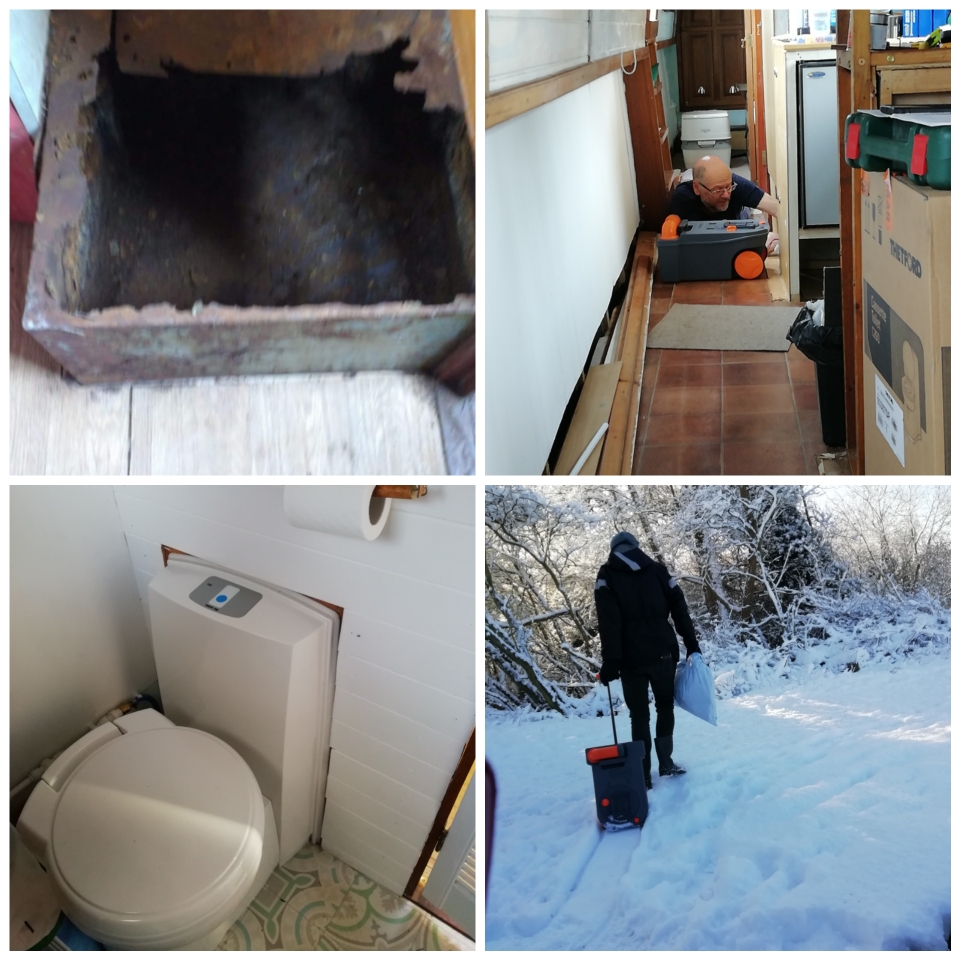
We need to fill up with fresh water every few weeks for drinking, cooking and washing. We need to dispose of general household rubbish and…this is where we need to talk about every small child’s giggle factor…poo! In our case with just two of us on board and obviously no visitors during lockdown, two toilet cassettes last for around 6 days. Although sealed, wheeled containers, they are heavy when full and trying to drag one of those along a towpath in the mud is problematic to say the least.

Our funky orange and grey loo cassette plus rubbish bags and the seasonally increasing quantities of mud, mud, glorious mud

We have a few other particular requirements we need to consider for a month’s lockdown.

  • WiFi with a decent bandwidth – not the case where we are currently moored
  • Reliable phone signal for us both – not the case for me where we are currently moored
  • The ability to have our remaining (electric) car safely nearby, in case we have to respond to urgent issues with work or the highly independent members of the family for whom we provide when necessary caring support.
  • a bus route in case one of us has to go one way in the car and the other of us is needed in another direction
  • A place that’s suitable for mooring the boat without needing a gangplank which we need to continually lift and raise to avoid impeding the towpath
  • and if possible with two of us and a dog coming and going a mooring where the towpath isn’t totally churned up with mud

Sounds easy? If we were on another canal we would just keep moving from water and waste disposal point when we needed to. We would be able to find shops on the way if we needed them, and there would be diesel too to help us keep the engine running for either cruising or topping up the batteries for lights and heating water. In other words our lockdown would look no different from our normal life.

On the Ashby Canal it is a bit different. There are a lot of boats here already, some liveaboards, others leisure moorers. Many have found moorings that suit them and are staying put. The nearest water, waste and diesel point is less than half a mile ahead of our current mooring but we would then need to cruise quite a distance to the next available turning point if we wanted to return to this spot, and the WiFi is not ideal for working…we could keep cruising but once we get to Market Bosworth that’s the last of shops on the Ashby…

We are divided – we disagree – we have different views over what to do. 

Option 1 – move to better WiFi and fill up with fuel, empty bins and waste on the way and hope we can find a good mooring with safe parking nearby. We have walked a lot of the towpath hunting for a suitable site and not found one which ticks all the boxes yet – maybe we are just being too fussy…maybe we have to compromise more after all, we chose this life…

Option 2 – turn our lockdown into another new experience and find out how the other half live in a marina complete with WiFi, in a good phone signal area, electricity (reducing diesel use and enabling the use of power tools which we need to resolve certain issues including an internal leak before the real winter begins) secure car parking, water, waste disposal, walkways around the boat so no mud immediately outside, a shop and… wait for it…a laundrette on site! Other shops are in walking distance. 

Option 2 is the one we have plumped for after much discussion and debate. The deciding factor was the need to support our key working children with child care and support, get to independent but elderly parent ASAP if needed and respond to work emergencies which require attendance in person. We have chosen our new life but no one else should suffer because of it.

To me it feels like a bit of a cheat, a cop out if you will but I know it makes sense. We will still be living on the boat, we have to it’s our home, but living on her in a different way. Life is a compromise and the tough stuff is yet to come – winter whilst we can and will have to be moving, will come with all its challenges. 

There is also the moral element – if everyone is trying to reduce the amount they move about, shouldn’t we be doing the same if we can? I have already come to value immensely our nomadic life – new views when we choose, seeing new countryside and communities, watching the wildlife at close quarters every day and the liberating sense of freedom living like this brings.

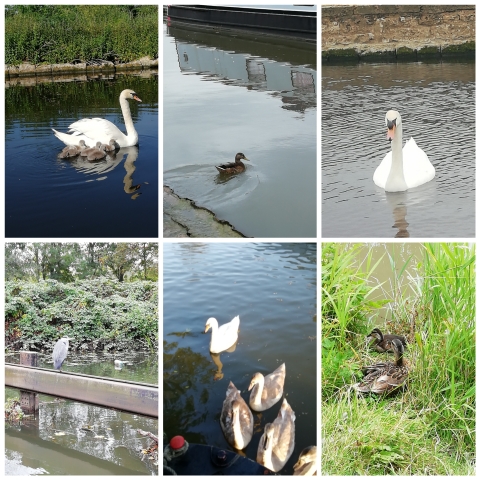
picking up ducks of various kinds, plus Canada geese and a persistent swan

But could I really feel comfortable knowing that we were living our unchanged life whilst our family and friends, those we know and those we don’t, are being asked to give up some freedoms for the greater good and health of our country? 

We have chosen this lifestyle and are being asked to compromise it for a month, just one little month, which in the scheme of things is a fraction of time. If this compromise enables me to be available for those that rely on us if they need us to help them through lockdown 2.0, if this month means more of us will be together with our families intact then it’s a compromise that makes total sense and one I need to take (and stop whingeing!).

I’ve been lying awake at night enjoying listening to the owls calling but worrying that we, no let’s be honest, selfishly I, will feel claustrophobic in this self-imposed static lockdown. I also know the only way I will feel like that is if I let myself.

I have already learned so much that has helped me to live better and reduce stress during our first months living afloat on a narrowboat. I need to use and share those lessons via my lockdown blogs in the hope that some will support me and maybe you too. We are all going to be constrained to try and stay safe and healthy. If we can make it as positive an experience as possible then when it’s over we can once more appreciate what we have missed.

Nature’s beauty can sustain us through tough times, lockdowns, pandemics and life’s challenges as it has for the generations before us

My goals then for this lockdown:

  1. To achieve something, however small, every day
  2. To see if I can start gradually running again and hope my meniscus tear has healed enough to let me carry on
  3. To leave this lockdown lighter in spirit and looser in jeans knowing I have made compromises and decisions that are right..

4 small weeks – let’s see just what we can achieve.

Life reflected in boats, an introduction and preparing to be stuck…

It’s been a week of many miles across the waterways of four counties as we need to reach a set place in the coming weeks for a family celebration (outside in groups not exceeding 6). This has given time for thought as we chug our meandering way at nearly 4mph along the waterways.

Boats, houses, and cars mean different things to different people. Bought, rented, or borrowed, they can be viewed as status symbols, personal security, harbingers of debt, realisers of dreams, steps or statements.

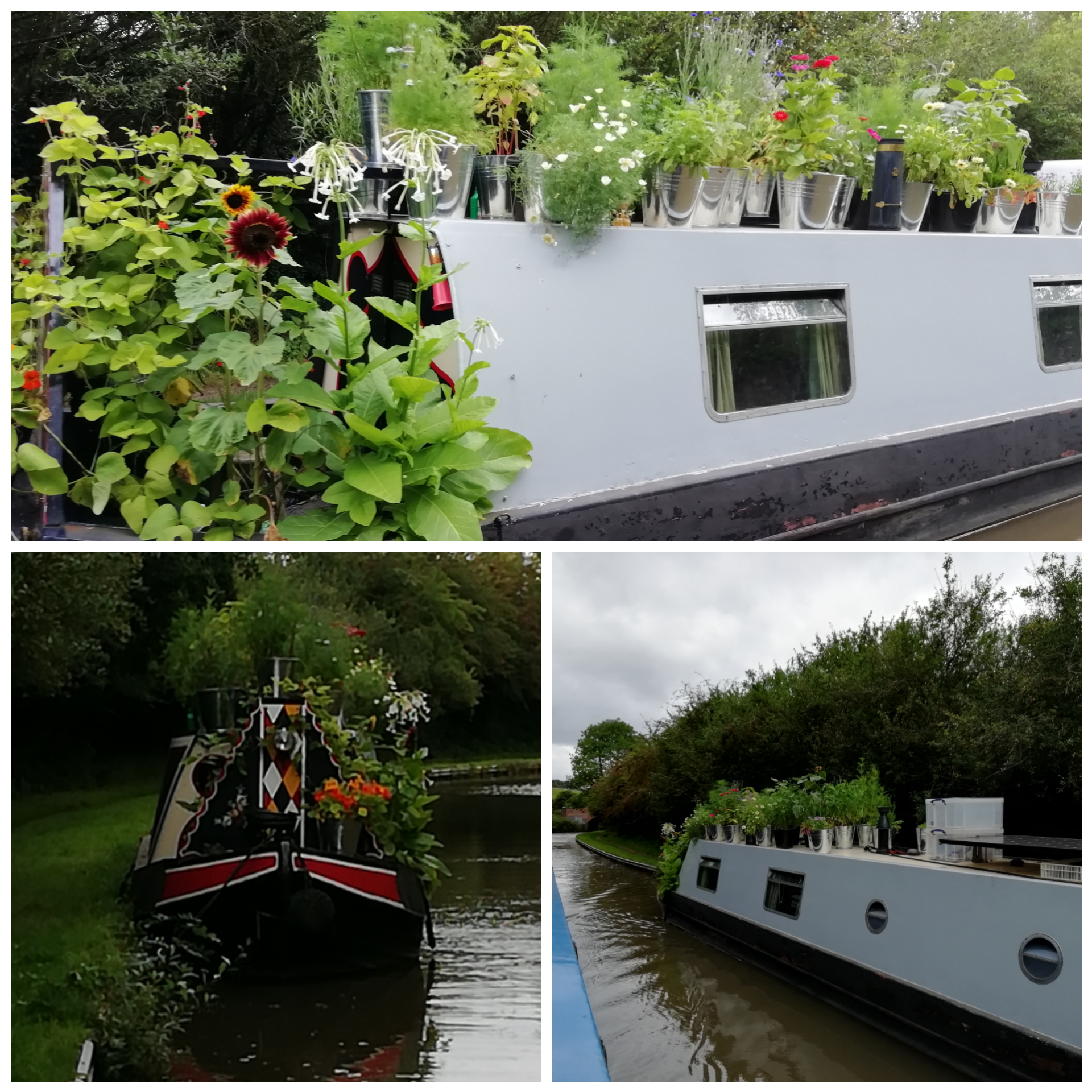
Just as cars and houses often tell about their owners’ aims, aspirations, and priorities – boats and from my perspective, narrowboats particularly, are fascinating in this respect. For some their boats reflect who they want to be, for others they show who they perceive they are. Some care about the outside over the inside; others care more about the inside, and some just don’t care what anyone else thinks. Every journey there’s a boat that makes us smile – humour is evident everywhere.

Floating personalities from lawns to garden sheds, L plates, sleek perfection and a desire to bring a smile

Some spend hundreds of thousands of pounds having a boat built from scratch to be a floating home-from-home with all mod cons they feel essential (yes, that can mean a washing machine and tumble drier, several fridges, a freezer, central heating and several TVs depending on the size of the boat); others invest in restoration of heritage boats, painstakingly returning them to their totally original specification, or giving them contemporary interiors; some scrape together enough to buy a boat that just floats and are glad of it as a place of escape or a home; some sink themselves into debt to achieve their dreams and some, like us, are determined to achieve their boat reality without loans. It means thinking twice or thrice about what we need and what we want, and whether they really equate. For all boat owners their boats are projects – whether realised by a boat builder or by themselves.

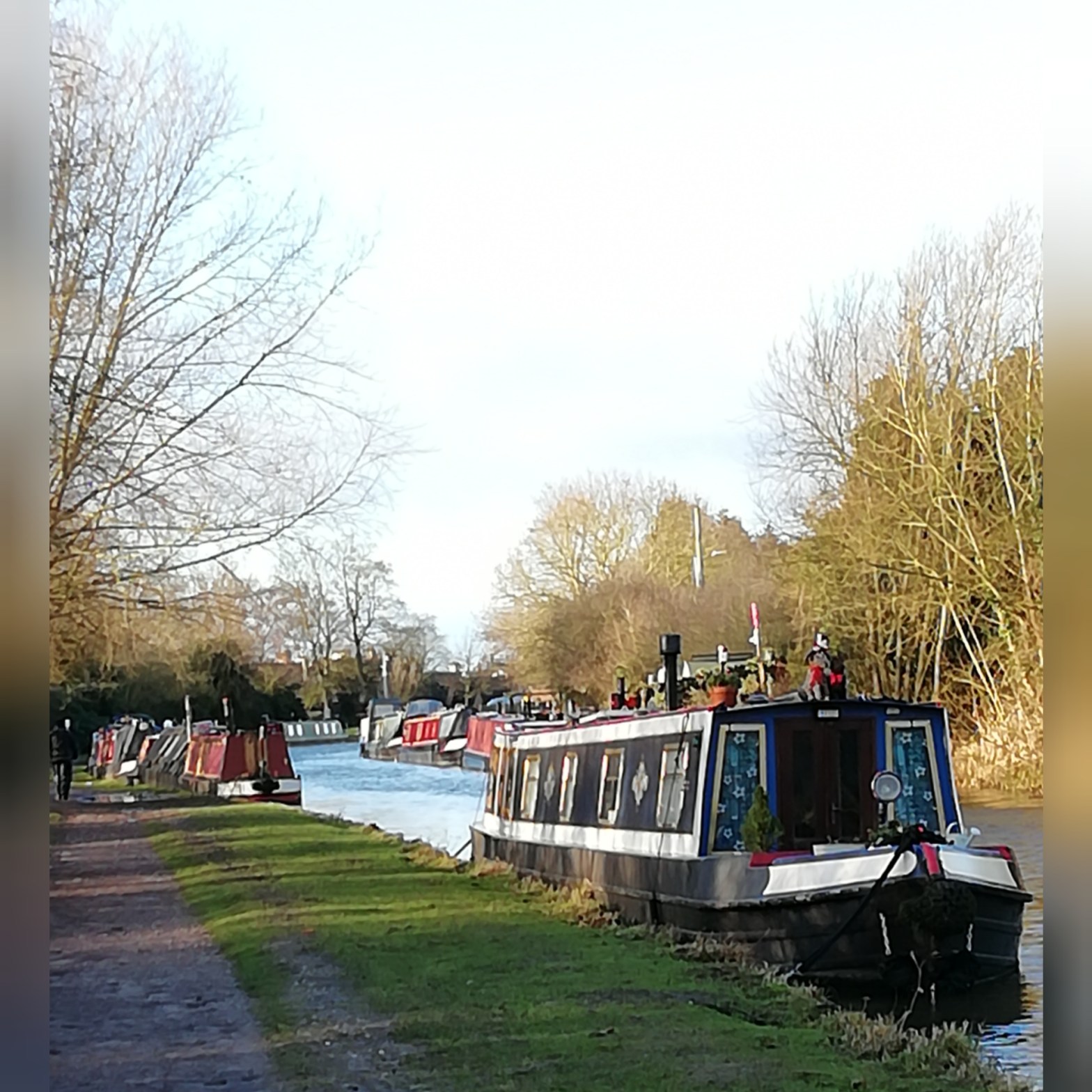
Live-aboard boaters also come in multiple formats. Some have home moorings. They may live on smart purpose-built marinas with Moorers’ lounges hosting regular social events with many facilities (including laundrettes). Others inhabit smaller marinas with few facilities but often a strong community feel. Some rent or own land and mooring alongside the towpath or on the offside. Some live-aboard owners we have met never move their boats – they are floating, not travelling homes. And then there are the continuous cruisers (CC) like us, who by the terms of their Canal and Rivers Trust licence have to keep moving:

“Boats without a home mooring must be engaged in genuine navigation throughout the period of the licence.” (CRT)

If we find a 14-day spot we can stop if we wish for that length of time. We don’t have a permanent ‘home’. Walk along any towpath and at some point you are likely to see mooring signs, 48 hours, 14 days, no mooring etc. 

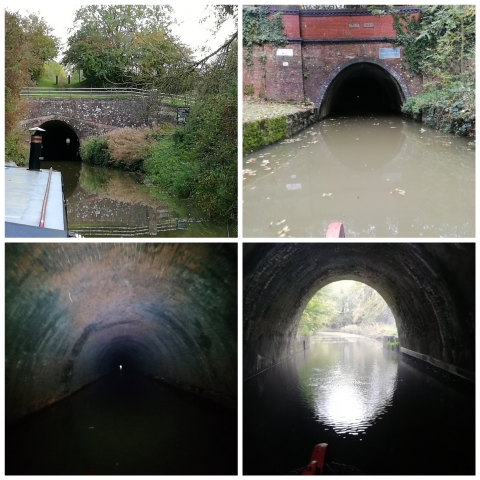
As I start writing this we are travelling in Northamptonshire, through the dripping wet Braunston tunnel, 2042 yards of it, which opened in 1796. Quicksands caused problems in construction and although you can see the light at the end from the start, it was built with a slight S bend in it. Steve’s at the tiller in the damp darkness and I am with the dog by the blazing stove in the lit, warm cabin. No question who has the better deal in my mind! I will pull (and push) my weight shortly for the 6 locks at the end of the tunnel taking us down into Braunston where we need to stop to fill up with water and empty our bins.

It may take longer through this tunnel if we meet a nervous holiday boater coming the other way. We have had boaters bouncing from one side of the tunnel to the other in panic, but the single tunnel light we can see now coming the other way seems to be steering a straight route. It is easy to hit the sides of these long tunnels because it is so mesmeric steering in the dark. If there are boats with children out on half term holidays I can guarantee that we will hear ghoulish shrieks and screams in the darkness.

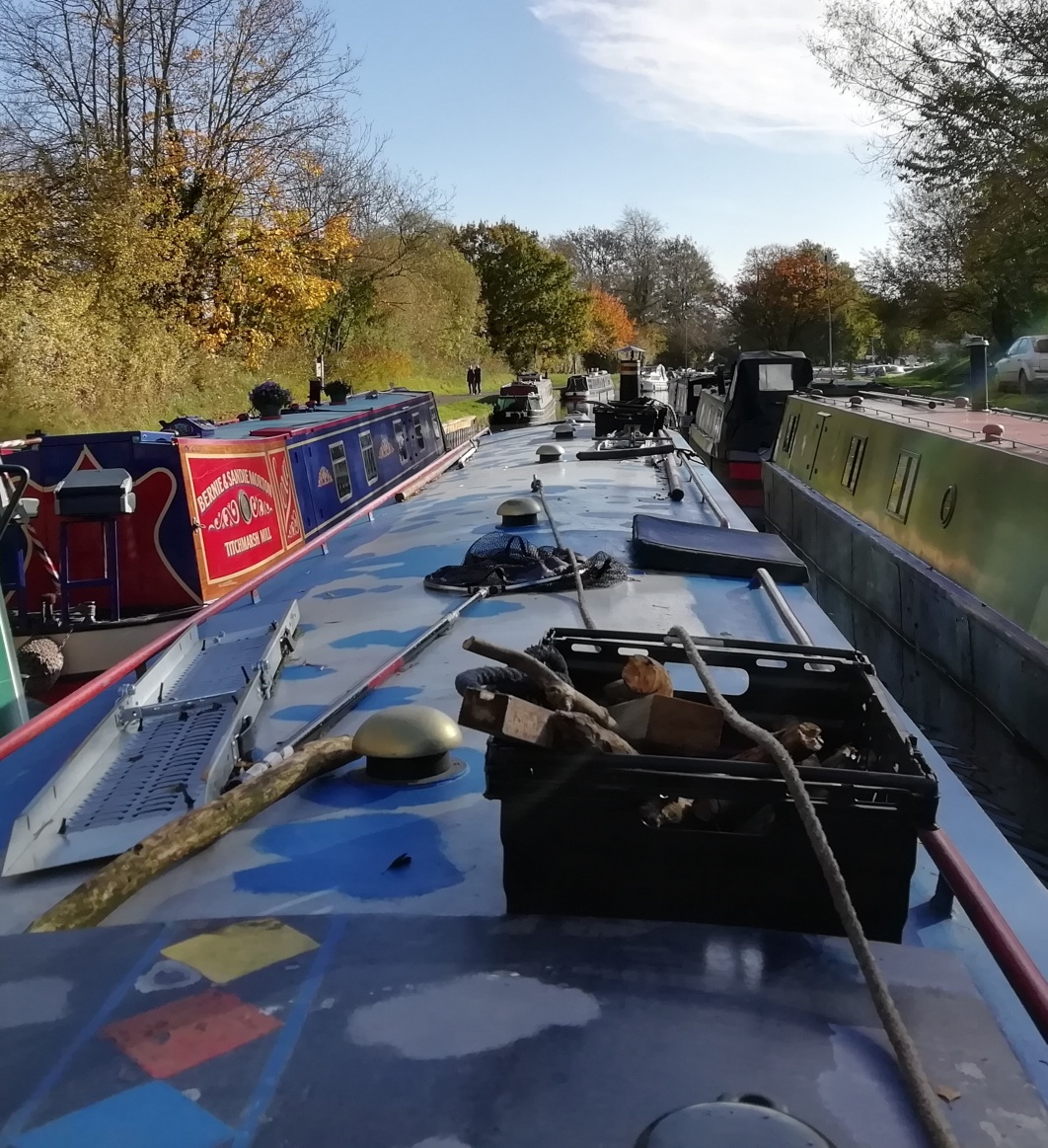
Tunnel vision : Braunston in the rain, Crick in its autumn colours and Newbold with its walkways

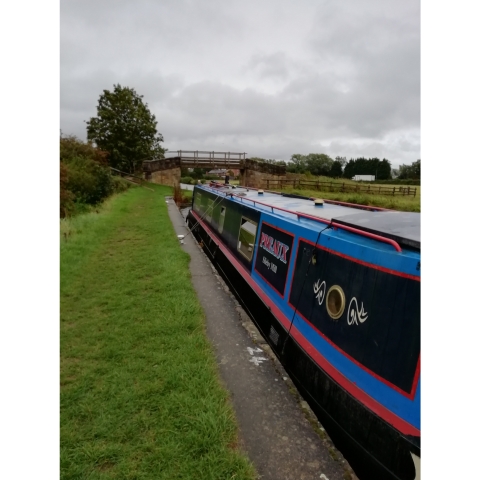
So it is time I introduced you to our key partner in this Covid new normal lifestyle of ours, our 50ft long, semi traditional (semi trad) NB (Narrowboat) Preaux.

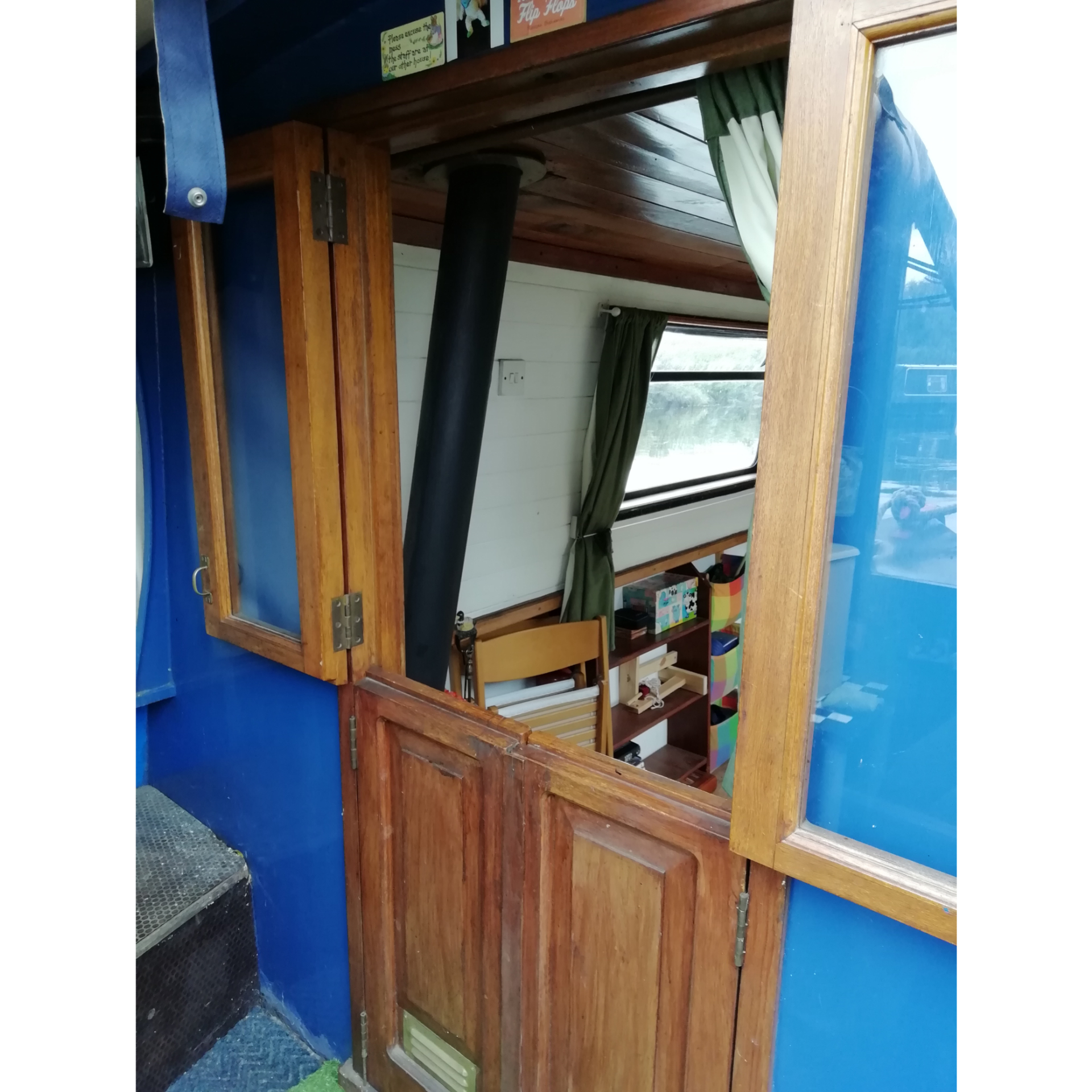
Being semi trad means we have an engine under the floor at the back which we stand above to steer in a small contained space which happily fits two of us and the dog. Cruiser sterns have big spaces at the back where a whole boatload can congregate and a traditional (trad) stern has a much smaller space at the back, an engine exposed in a cabin area beyond the boatman’s tiller, but giving warmth and protection to the boatman.

Our boat was built by Brummagem Boats in 1989, an auspicious year for us, the one when we were married and when our current (very modern by our standards) house was built. Preaux’s vital statistics are: Length 15.24 metres ( 50 feet) – Beam : 2.07 metres ( 6 feet 9 inches ) – Draft : 0.64 metres ( 2 feet 1 inch ). She has a steel hull and was originally called Isis. We renamed her after the village where we lived in France and where our daughters were born, a place that is very special to us. Preaux is French for playgrounds – appropriate for a boat which takes us to so many wonderful places to explore and enjoy. 

Our philosophy for this Covid inspired new normal ilife is to reduce our impact on the planet. To live more simply in multiple ways – in what we eat, how we travel, shop, cook and to see whether that makes us happier and healthier in the process. We aim to recycle, reuse and repurpose. Our cutlery is housed a series of burlap-covered tin cans; our hand towel hangs in an old stirrup from my riding days; and our shelves are made from recycled wood to name but a few. They all do the job and give us pleasure when we look at them.

Our boat is cosy, haphazard in design, has a lived in look both inside and out, and I (no doubt like every boat owner) like to think she has her own unique style. By living more sustainability and frugally, we aim to create more time for the things we enjoy and in turn reduce the time we need to spend earning. Put simply – if we reduce our consumption then we should reduce our outgoings, giving more time to spend with each other enjoying life. Will this result in happiness? Time will tell.

Our make do and mend approach has been harnessed to resolve the issue of our shoes. Regular blog readers will remember they were being singly carried around by the dog, and often taken alarmingly close to the water. Even in such a confined space, we were forever hunting the missing shoe or trying to fish its partner from the canal with our plastic-catching net. Using what we had on board we now have a shoe rail which takes shoes out of the dog’s interest zone if not his height. It fits neatly under the gunwale so is using currently wasted space. The next project is to sort something similar to protect crucial wellies and walking boots from our retriever!

Shoes in pairs – for the first time in 6 weeks!

The other project of the week was lighting. The kitchen (galley if you prefer) had existing lights on the ceiling and wall behind the person cooking or washing up. Made a good excuse for not washing up the evening meal debris until it was daylight so you could see what you were doing…but wasn’t ideal when chopping vegetables. Injuries are something we need to avoid. Steve’s solution has imbued the kitchen with a touch of Hollywood glamour with a strip of glitzy LEDs above the hob and sink area – so no more injured fingers or morning piles of washing up!

Washing too is getting easier – thanks to the historic French wine making technique. Trampling clothes during my shower and rinsing them off afterwards is proving very effective for many items. Economical with water too which is always important. They dry well above the stove but are now left to drip into the shower tray for a while as my pathetic first attempts at wringing out resulted in buckets and bowls catching the cascading drips to stop the boat flooding from the inside! Maybe I need a mangle? Has anyone one they don’t want any more?

A key requirement has been a rug for the wood floor, so I have made a start. T-shirts from the days we could run and race together (and donations – thanks Emma) are reduced to long strips which I plait before sewing together into a rag rug. Should keep me entertained in the now dark evenings and one chair is getting a comfier back whilst I wind the ever-increasing plait round it to stop it from tangling up or becoming a dog toy! If any of you crafty people out there have any idea how long the plait needs to be for a 2m x 1m rug please let me know – it seems never-ending right now!

Several people have been contacting us saying they’d like to visit which is lovely (although after my description of our boat you may change your minds) but Covid has us confused again. If people come and visit us and they are in a Tier 3 or 2 area do they need to stay outside the boat or does a boat with all doors and windows open count as inside? We are currently heading back into Leicestershire having travelled via the Grand Union, Oxford, Coventry and Ashby Canals.

I have begun planning a 2-week store cupboard in case we get frozen in when winter hits but now I am thinking of it as a Covid-lockdown store. One thing we should be alright for a while is fuel for the essential stove – Mark on Callisto, one of the working boats, delivered to us whilst we were moored on the Welford Arm so we have enough fuel for warmth and cooking for a while.

In France we know friends are back in lockdown – if it happens to us again, where will we be if we are forced to stop travelling? We will have to wait and see. The one thing we know for sure – it will certainly be a very different lockdown for us from the last if it happens.