More than 50 years ago Robert Aickman, co-founder of the Inland Waterways Association compiled the original list of the ‘Seven Wonders of the Waterways.’ With our descent of the Caen Hill a flight last Saturday we have now travelled through or along each of these, and we would take issue with Aickman on several of his list.
1. The river in the sky is his first. The awesome Pontycyllte Aqueduct carries the Llangollen Canal a towering 125 feet high above the River Dee for 1,000 feet.
Gulp! It’s a knees-knocking long way down…
Thomas Telford and William Jessop’s astonishing feat of engineering is, like the Great Barrier Reef, a World Heritage site. Walk across it, and you have railings between you and the drop to the river. Boat across as we last did in March 2022, and you realise that the aqueduct is a mere trough, and you have no guarding railings between you and that plunging view.
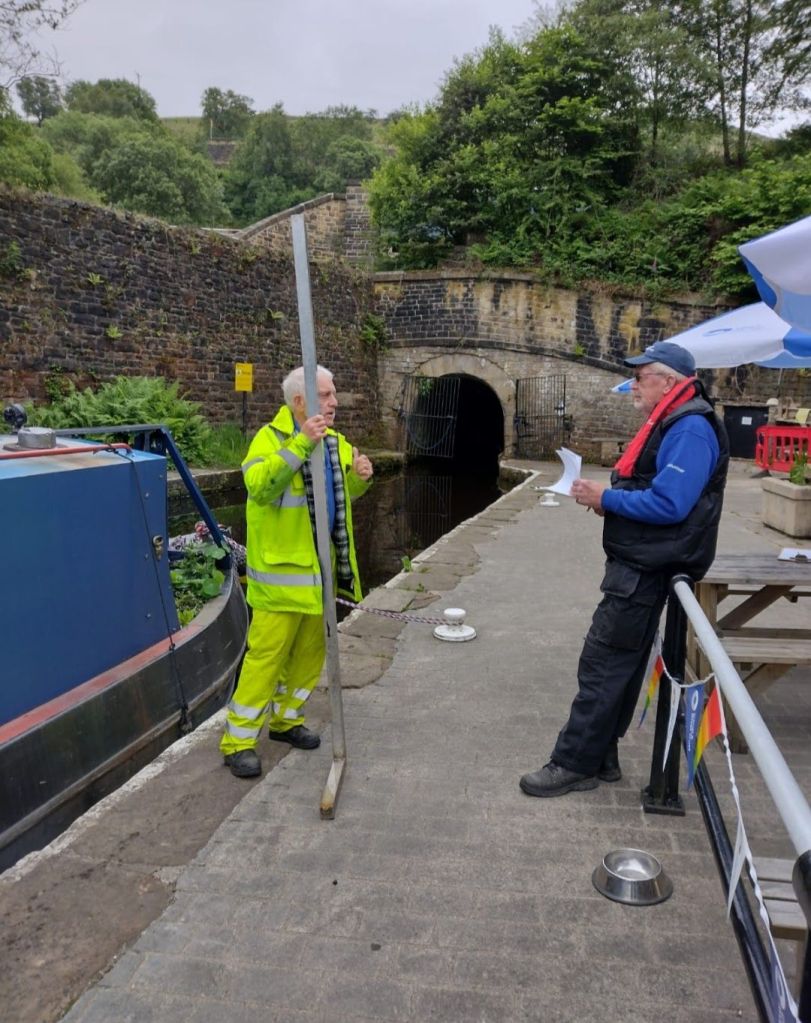
2. The longest, deepest, and highest canal tunnel in the country, is the Standedge Tunnel on the Huddersfield Narrow Canal. At nearly three and a half miles long, 645 feet above sea and 638 feet below the Pennines, it is remarkable. Being accompanied through by Trevor Ellis, who documented the Tunnel’s history, was a highlight of our boating life.
Getting the boat measured for Standedge – Trevor on the left
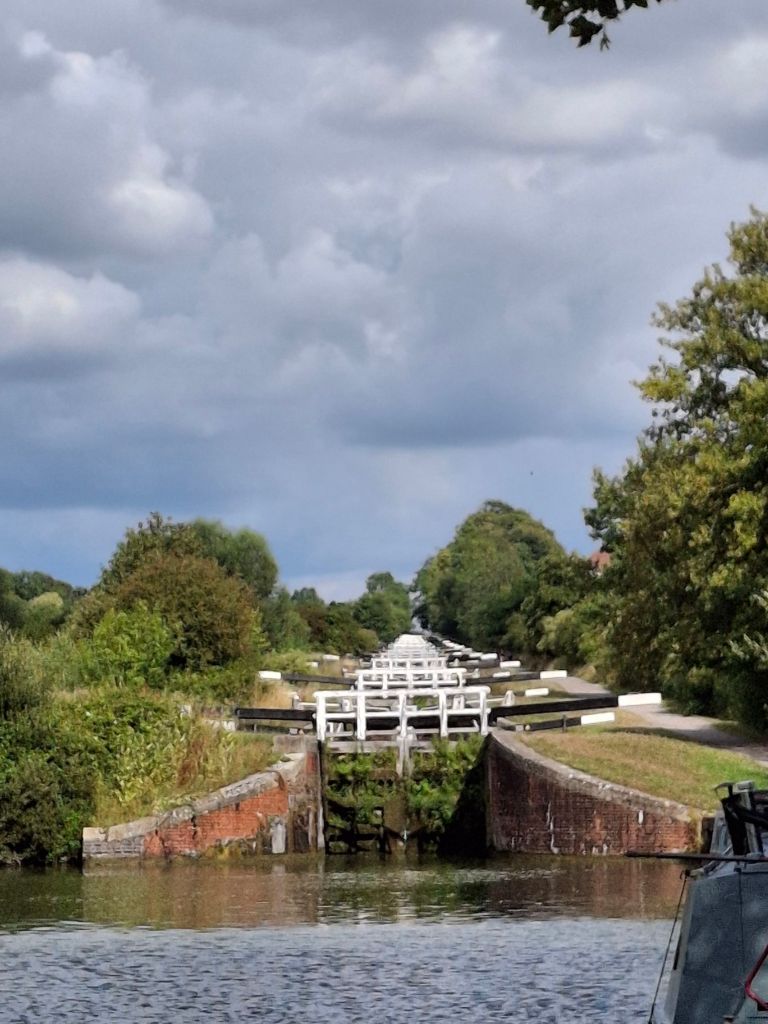
3. On then to our most recent wonder whose place in the list we would dispute. The Caen Hill Flight is a 16-lock wide flight that forms part of the longer 29-lock flight at Devizes to climb 237 feet over 2 miles.
The locks and their side ponds are designated as a Scheduled Ancient Monument – the same level of heritage protection given to Stonehenge.
I’d argue about them – look at the longest 30-lock flight, the Tardebigge, which we completed in September 2022 with the help of wonderful lock wheeler Kat James. Currently closed because of brickwork collapse we hope it reopens soon for others to enjoy.
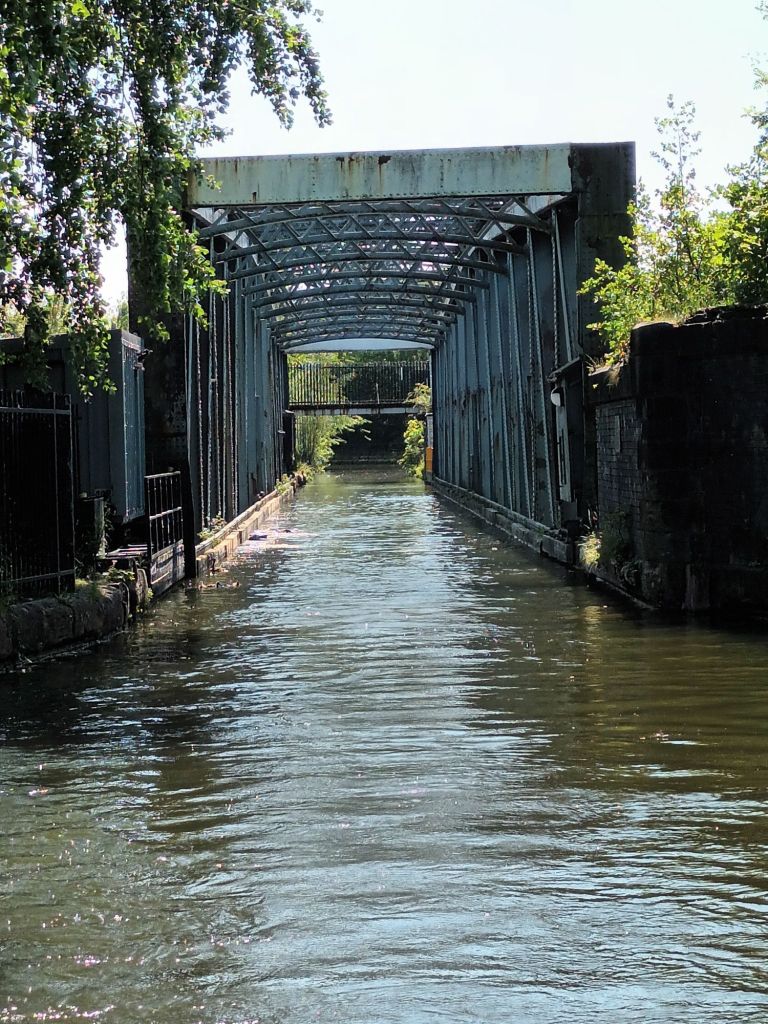
4. Over then to the wonder on a private canal – the Barton Swing Aqueduct over the Manchester Ship Canal. It pivots to allow larger boats to pass underneath. The aqueduct is a trough that seals at either end and moves with 800 tons of water on board. It is a feat of engineering but sadly always seems to be a highlight for litterpicking whenever we have travelled along it.
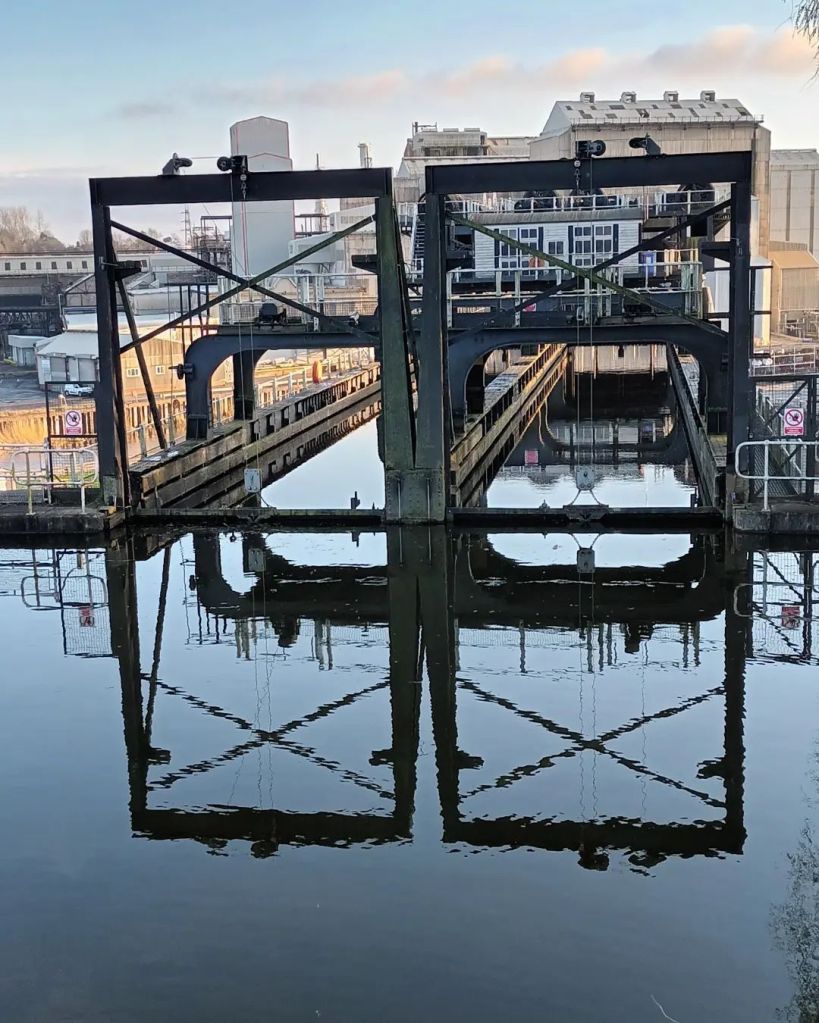
5. The Anderton Boat Lift is undeniably astounding. It was built in 1875 to carry cargo boats 50 feet up and down from the River Weaver to the Trent and Mersey Canal and back. It has two water filled caissons, which transport boats up and down on a remarkable journey, one we took in June 2023.
6. Bingley Five Rise Locks in Yorkshire is another which I would dispute should be included in such a wonders list. They are a staircase flight of 60 feet where one leads into the next without a pound in between. They were completed in 1774, but I would argue their place should go to Foxton instead, a staircase flight we know so well with 10 locks opened in 1805.
7. Burnley aqueduct. This mile-long stretch of embankment carries the Leeds and Liverpool Canal 60 feet above the centre of this industrial mill town. Perhaps the constant drizzle that accompanied us along its length in May 2021 led us to not being as suitably impressed as we should have been!
So now I find myself wondering what we would say are the wonders of the waterways today. There are so many contenders, so many beautiful and breathtaking places and sights, impressive feats of engineering and restoration available today that compiling a new list is certainly something we need to get on with! What would you want to include?
People, scenery, nature, and weather can all be feelgood (or depressing) factors, but this week they’ve been positives.
As the countryside unfurled from flat fields to rolling hills ahead of us, and white horses cut in chalk have appeared alongside the boat, we have continued to make our way west on the Kennet and Avon Canal. Not brilliant for work as the wifi and phone signals have been patchy, but it has been good to have evenings without streamed TV, or radio. Having to talk to each other, plus days of less challenging locks (ground paddles aplenty allow for more controlled operation and we are now on the descent) have healed some of the earlier raw emotion generated by this waterway.
We have also met some incredibly interesting and genuinely nice people in the past week, had a close encounter with Jim Lloyd (aka the Prof) from The Archers in a village shop, and been soothed by wildlife surrounding our floating home.
But first to a Very Special Bear who gained Royal Approval. In 23 destinations across the UK prior to the Paddington in Peru film being released last year, Paddington Bear statues on benches were installed to the delight of fans young and old. In Newbury, home of Michael Bond, creator of the delightful bear, there was an outcry when two drunken RAF engineers destroyed Paddington. In true Paddington fashion good prevailed – they were prosecuted and Paddington was restored to everyone’s delight, but particularly local man 64-year old Anthony George.
He happily let me photograph his leg in a Hungerford coffee shop when we met last week. His very own Paddington was tattooed ahead of the re-unveiling of the Newbury bear. He wants people to be “more Paddington. If we all look after each other like Paddington’s label says we should, we can make the world a better place.”
Billy who I met while we sheltered from a sudden downpour under a tree alongside Froxfield Middle Lock felt the same. His travel voucher from London had got him to Newbury and he decided to walk from there to Bristol. He said going along the canal made him feel safer. He told me he had found people to be friendlier and kinder alongside the water, but he still declined a hot mug of tea (obviously my tea making abilities have become public knowledge), saying he needed to press on with his 61 mile walk. He was very pleased to have picked up a discarded camping chair with carry bag from a fisherman who said the back had broken. Billy reckoned there was no need to have a chair back if you sit upright!
I think he’s right – people on the waterways come from so many diverse backgrounds, but we all enjoy the peace and the calm of surrounding nature, maybe we are more accepting, more aware that everyone is different. We are sharing the same environment, and sometimes we live in close quarters not just with nature but with nearby boaters, and in some situations we have people walking past our windows on towpaths gongoozling in at our cosy home. People are generally taken at face value, and often maybe because we may only encounter each other fleetingly, people often confide in total strangers in a way I have not found in bricks and mortar living.
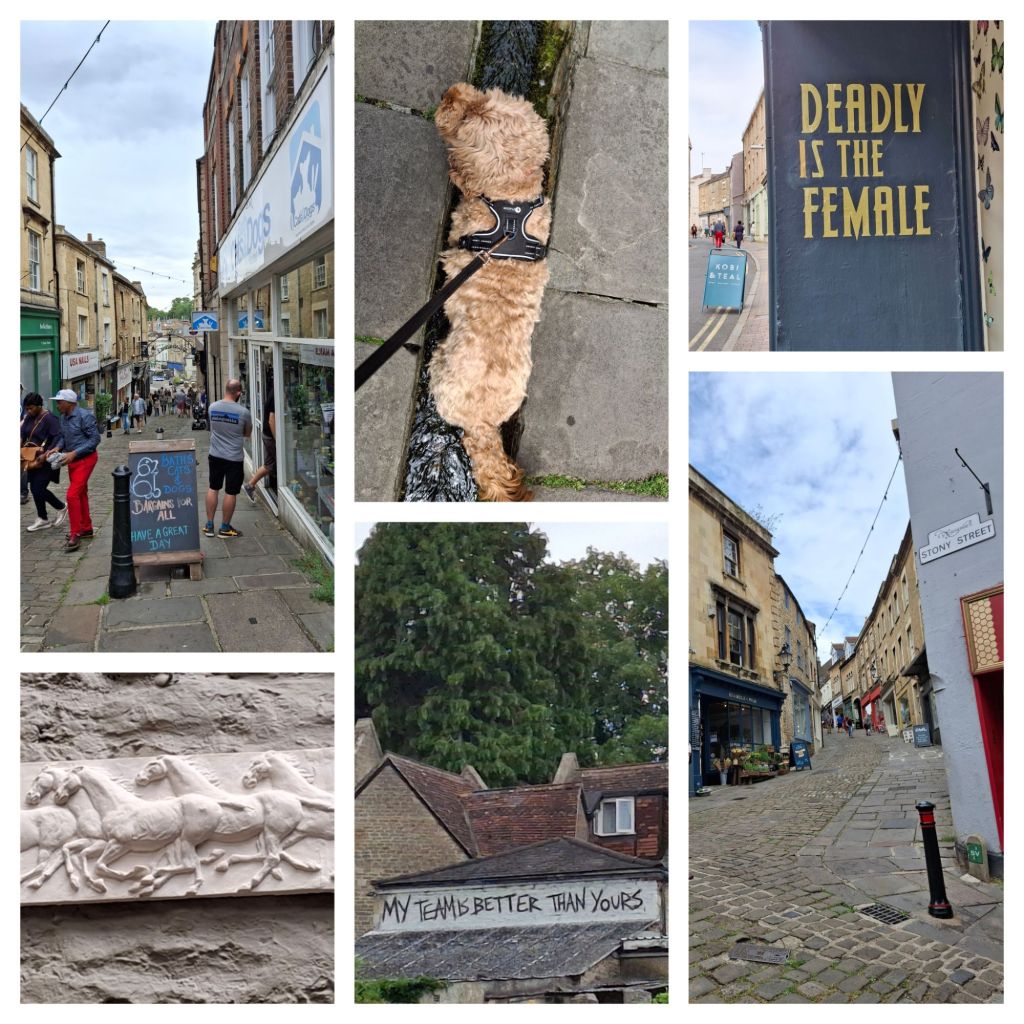
Boaters even when they end up back in bricks and mortar homes continue to be accommodating and supportive of those still on the water. Catherine at Torrent Duck Cover Repairs did a short notice awesome job for us in repairing our cratch cover which was beginning to have issues thanks to wear and tear. Not only did she make herself available to complete incredibly efficient and effective repairs including perfectly colour matched reinforcing patches, she did it whilst we took time to explore her local town of Frome, after giving us an invaluable insider’s guide as to what we should see and do. Her repair work was rapid, and excellent quality so we highly recommend her if you need boat, tent, caravan or trampoline cover repairs, or a guide to Frome!
Frome
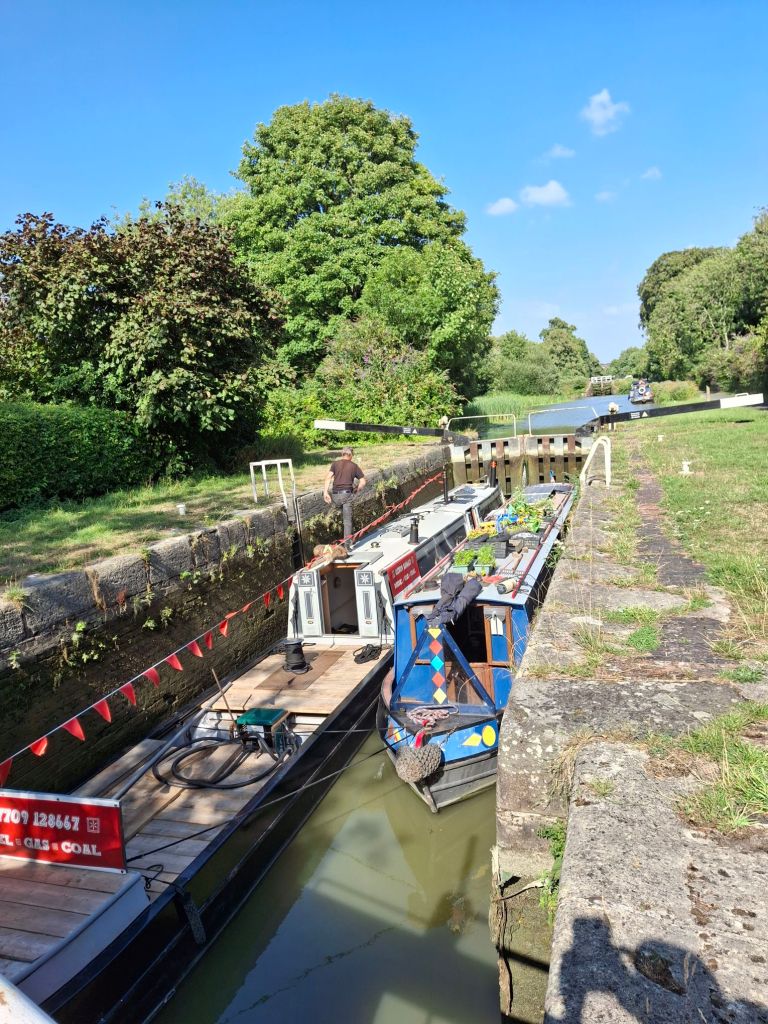
Back on the water we had the fun of sharing locks with Tarn the coal boat and her crew of Mike and Myrtle. We also shared a few beers and an impromptu meal aboard Preaux as the heavens opened. Another night the roof garden was automatically watered! The courgettes are loving the downpours.
Further on we encountered the delightful owner of a private wharf who let us moor up so we could do some visiting as the visitor mooring was full. He bought the place 10 years ago and was busy rebuilding and expanding it. The main wharf house was surrounded by a beautiful established garden with espaliered pears and towering hollyhocks – I do appreciate seeing them because there’s no way I can grow them on the boat!
Tree envy!
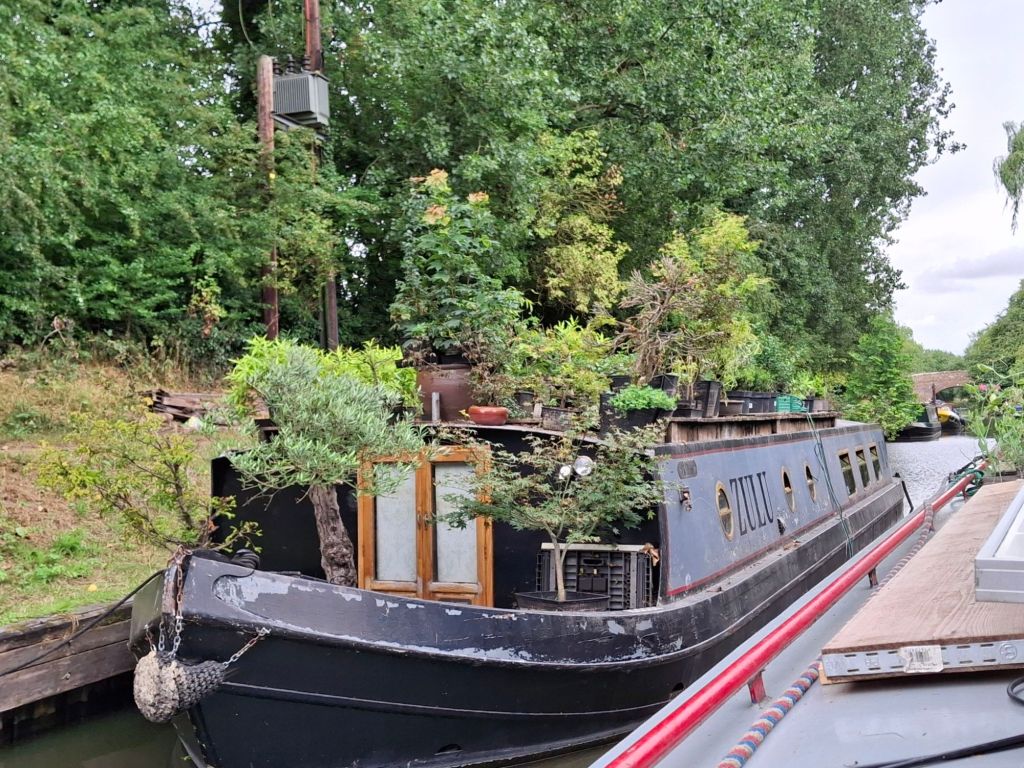
We have though seen trees on boats this week – on widebeams and growing from rear button fenders. I also saw a handcrafted wooden arch on the bow of a boat for sweet peas. I thought that was a fabulous idea. Armed with buckets of soil for depth and the spectacular seeds produced by gardening guru and boater Higgledy Garden I’m sure it would become a fragrant paradise. If I didn’t have a cratch cover, or travel so much, I know that would make a spectacular display.
On then to All Cannings with its wonderfully well stocked Community Village Shop. I was quite taken aback to find the gentleman behind the counter was not wearing a name badge declaring him to be Jim Lloyd. This though is a shop which is as valuable to the community as it is to the boaters. It made me think – Ambridge has only one boat on the River Am it appears, that of Rex Fairbrother. Perhaps after the Kennet and Avon we should go and hunt down a mooring on the Am, from where we could enjoy the hospitality of The Bull and the expansive range of products at the Village Shop. Rex, as a boater is, of course, one of the nicest most accepting people in Ambridge. Well done Archers scriptwriters.
As this blog goes live we are preparing to descend the Caen Hill flight – the last of the Seven Wonders of the Waterways we’ve yet to experience. We are buddying up with Tarn and once we are down we aim to enjoy some much needed family time.
We turned onto the Kennet and Avon, aiming to head through Berkshire, Wiltshire, and then to Avon. We have now been on the canal for two weeks, and only now are we feeling we might survive it.
Never have we shouted at each other so much or argued like this. The early stretches of this canal from Reading to Newbury are definitely NOT designed to foster marital harmony!
We did stick with it though and found, as some had advised, that the Kennet and Avon changes its character as it goes along (thank heavens).
The Reading to Newbury stretch is a challenge, a struggle heading uphill through locks with only gate paddles that need to be opened with great care to avoid out home and office being thrown about in turbulence similar to a powerful washing machine spin. Throw into the mix constant swing or lift bridges, river flows coming at you from unexpected angles bringing gravel banks, weirs, heat – unrelenting heat – and horseflies, maybe it wasn’t just the K&A but a combination of circumstances and situation. Remembering that we had some Avon Skin so Soft on board disposed of biting bugs, plus Germolene (and its soothing smell redolent of childhood) to anoint the persistently itching bites incurred before we unearthed the Skin so Soft, has made life much more pleasant.
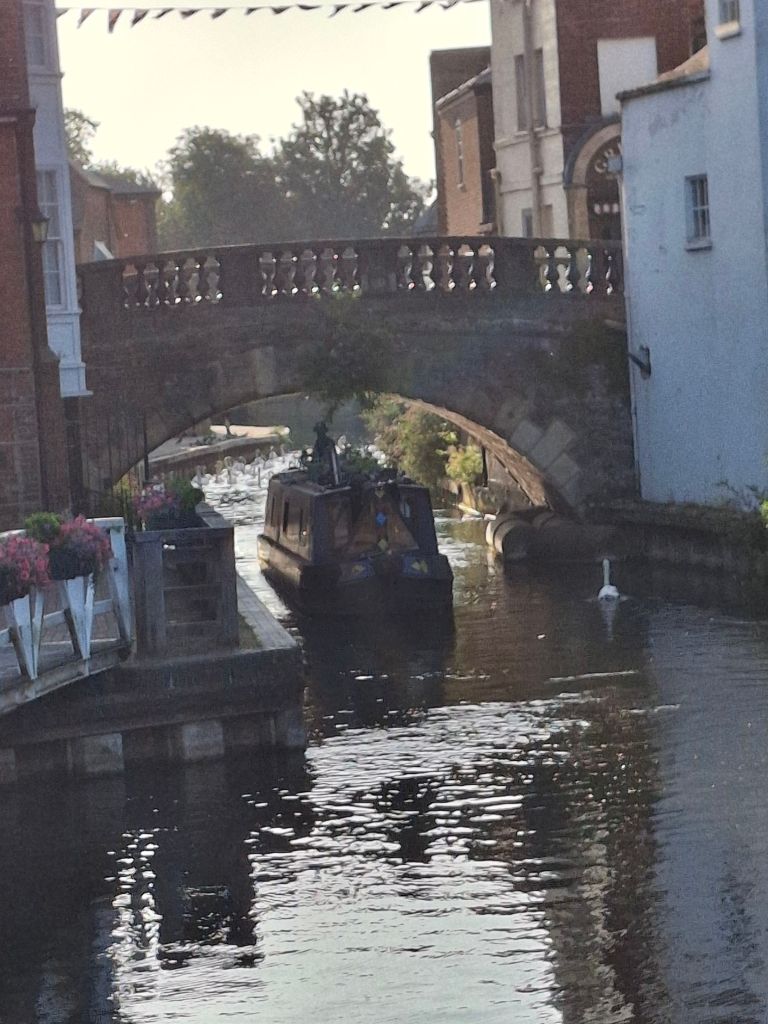
Coming through Newbury
The stretch of canal from Newbury to Hungerford has been a delight with some peaceful mooring spots, friendly village shops with remarkable produce and good pubs. We have had the real delight of being able to catch up with old friends and colleagues from nearly 25 years ago when we lived and worked in the area. From Newbury we have also been astonished by the efficiency of buses and trains serving little villages and market towns.
So as with most boating – challenges fade in the memory replaced by current delights. Kingfishers, villages resplendent with thatched cottages, remarkable topiary, and wonderful walks on the Downs are making the frustration and fears of the past week something of the distant past.
We have refuelled (for the first time since June in Northamptonshire) thanks to a new fuel boat called Tarn operated by Mike Mann and his four-legged boss Myrtle. It is so important for us to support commercial boats, particularly new ones so we were glad to give them our business.
Maybe we haven’t gone as far or as fast as we thought we might, but we are hugely grateful for the chance to explore areas and also share hospitality with old friends. It has also allowed us time to explore and find fascinating insights in areas which we would have missed had we not walked and wandered our way. We have found tombstones to the Newbury Martyrs which sent us finding ghastly inhumanities of Tudor times in the name of religion. It seems devastating and unthinkable that inhumanities continue to be committed today in the name of religion. Will the human race never learn and live in tolerant peace? We also discovered the tombstone of James Dean – not that James Dean but an unfortunate carriage driver who died in 1827 after a collision with a hearse laden with a coffin that came off in the accident and killed poor James.
In Hungerford we also experienced a clatter gate also called a clapper gate or tumble stile. One of the most unusual gates we’ve ever seen which totally bemused both me and Boatdog until it was demonstrated.
Next week, we won’t have as many chances to pause but will get a move on (in narrowboat fashion). We aim to tackle 27 miles, 1 tunnel, 5 swing bridges (one in the middle of a lock), and 52 locks before next weekend! We climb to Crofton, head through the Savernake Tunnel, and then after Pewsey, we start to descend the famous Caen Hill via one of the longest continuous flights of locks in England. Pronounced Cane, this flight has 29 locks stretching over 2 miles, which will carry us down 237 feet (and when we come back this way after turning at Bath, it will carry us up that distance too!).
The locks come in three sections –the first set will take us through Devizes. The next 16 are a steep descent and with their spectacular side ponds are now a scheduled ancient monument. The final seven cover just three quarters of a mile.
The famed engineer John Rennie designed the locks to tackle the steep Caen Hill, so it’s Rennie we have to thank or blame – next week we shall know which!
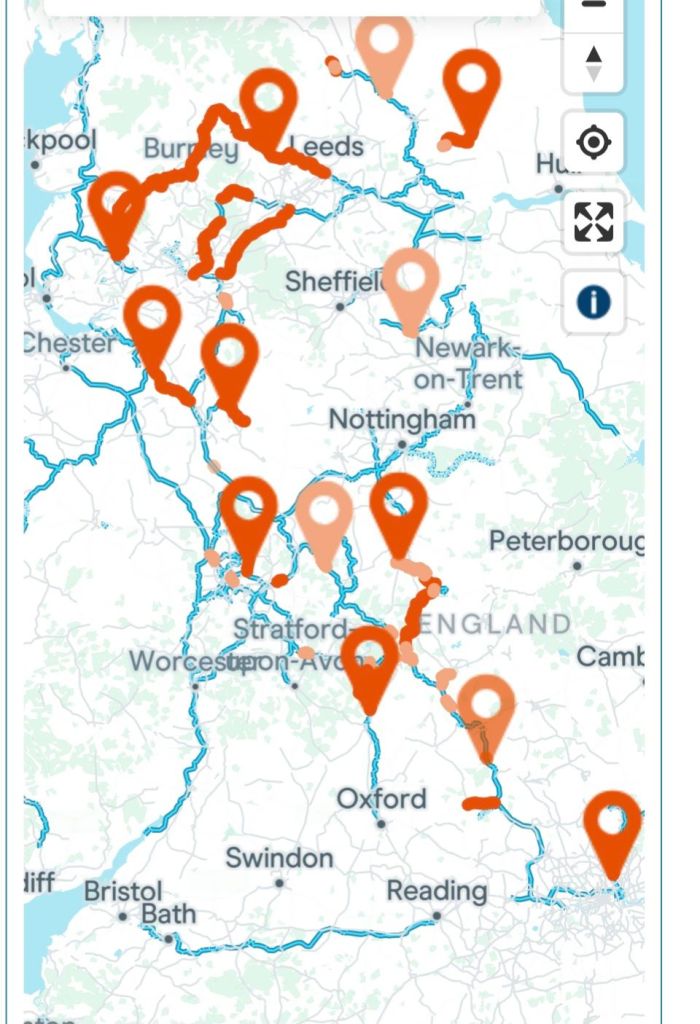
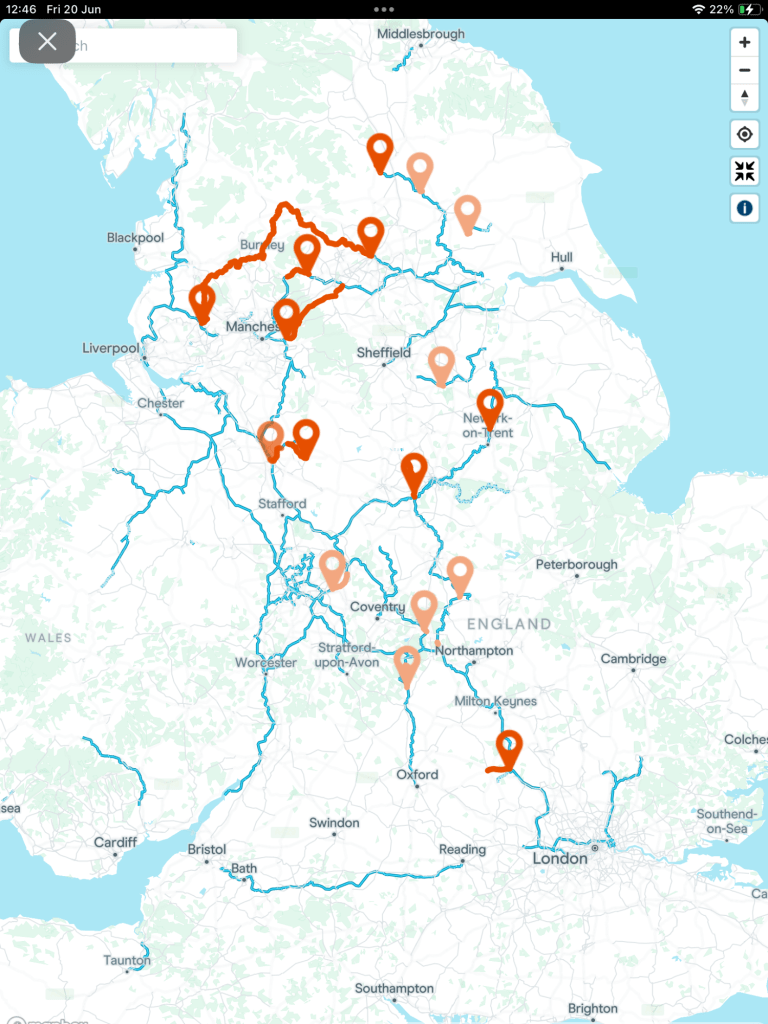
One of the main pluses at the moment is that we have water to travel on, to allow us to keep on the move, unlike so many people across the country at the moment. This is the situation this week of stoppages (red) and restrictions (beige) resulting from low water levels.
We are on the clear section between Reading and Bath
I’m pretty sure that we need some sustained torrential rain and if we’re aiming on moving every day next week the chances are we might just be encouraging the skies to open – let’s see if they do! We may be squelching down the Caen Hill Flight!
So this canal is challenging us and shaking us out of complacency. If we thought we were getting the hang of this boating lark after all these years, it’s proved to us we still have a lot to learn and we are grateful for that tough reminder.
It doesn’t matter how many times you launch yourself into new ventures, there is always a frisson of fear, an nagging anxiety, concern over what might happen (even when you know you have prepared, even over-prepared for every eventuality).
There are those nights of unsettled sleep, butterflies in the stomach, irritability, and edginess. It’s the fear of the unknown, and the more you do, the more experiences you have, the more aware you are of what just could, just might, go wrong. I am glad to know the hugely experienced boater Jo from nb Minimal List feels the same. Maybe she, like me, believes ignorance of what might happen can be bliss.
Anxiety like this applies to many circumstances of life and work, and once more, boatlife appears a perfect foil for articulating the trials, tribulations, and triumphs we all face wherever and however we live. The fear as we left the South Oxford (which we’ve travelled before) for the unknown waters of the River Thames, and then leaving the River Thames for the Kennet and Avon. Both waterways come with reputations. The K&A, as it’s abbreviated, is known by many as ‘a canal you only do once’. The mighty Thames, on the other hand, can be capricious, with tidal sections, wide expanses and narrows, shallows and depth.
Like all inland waterways in Britain, these two we’ve encountered for the first time for us in the past week have their own individual characters and practical requirements. The Thames demands an anchor – requiring us to scrabble about in lockers to haul it out with its heavy chain and rope. It’s been buried there since our foray up the tidal Trent some years ago.
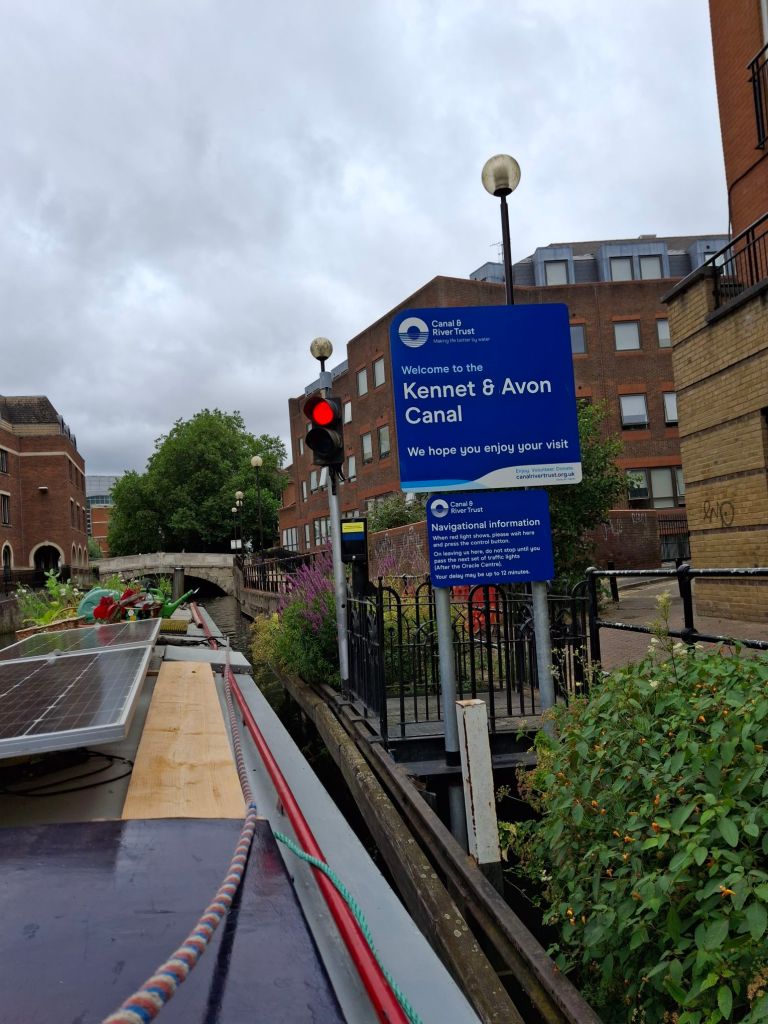
The Kennet and Avon resulted in a scrabble for a windlass, which we hadn’t needed all the way along the 96 miles of the Thames from Dukes Cut up to Lechlade and then down to Reading. Having found the windlass, I found I didn’t need it for the first lock on the Thames, and I then got left behind the boat before I could use it in earnest thanks to a bizarre set of traffic lights… as anyone around Reading’s Oracle Shopping Centre last weekend might have been able to testify. I was the puzzled looking woman purposefully striding alongside the waterway railings, looking plaintively at the blue narrowboat passing below being ably skippered by The Skipper looking anxiously for a place to reunite with me. It is a little odd when circumstances mean you really do miss the boat… and it’s your boat, your home, your office, your everything!
That was an anxiety inducing moment I never expected! But then I had seen a note in the navigation guide about a traffic light system in operation on a narrow bridged section, but hadn’t realised it required a push button operation from a boat battling a strong wind and where there was no opportunity to moor or even stand to push anything etc alone a tiny button a few feet above the bow of the boat!
Push button? How this is the nearest the wind allowed us to get!
After 3 tries we ended up moored on the opposite side of the navigation and I legged it over a bridge and down the far side to balance on a metal bar to push the button only to find it immediately went green. By the time I legged it back the Skipper had had to move the boat through leaving me to trail in his wake on the shore – right through The Oracle Shopping Centre where bizarrely there is nowhere to moor – not encouraging custom from passing boaters! As you emerge with the boat from this area, you pass under another road bridge and round a bend where your line of sight indicates alarmingly that you are heading straight for a weir. Not until you get a fair way towards it do you see a lock to your left.
On foot, you emerge onto the road above that bridge, and there is a car park area ahead on the left and a towpath on the right. Taking the right leads you to the weir with no access to the lock. Guess which one I took first time? Eventually , we reunited. A start on the K&A that made it seem anything after that would be a doddle.
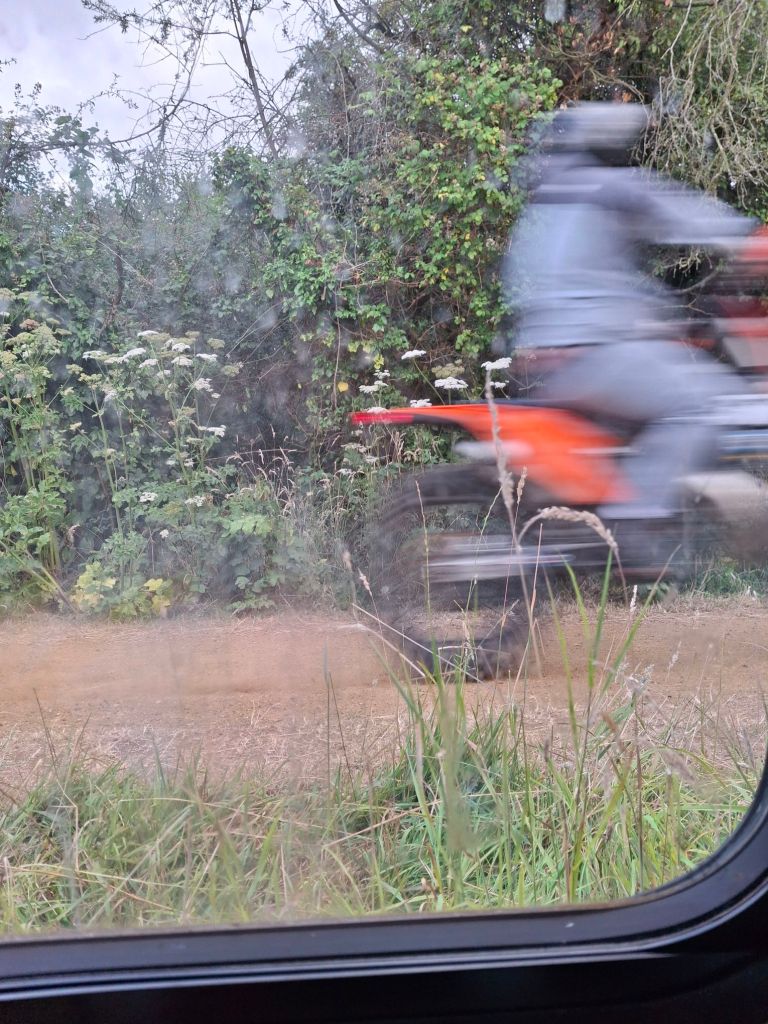
First night motorbikes on the towpath beside us made letting the dog out or watering the roof garden dangerous
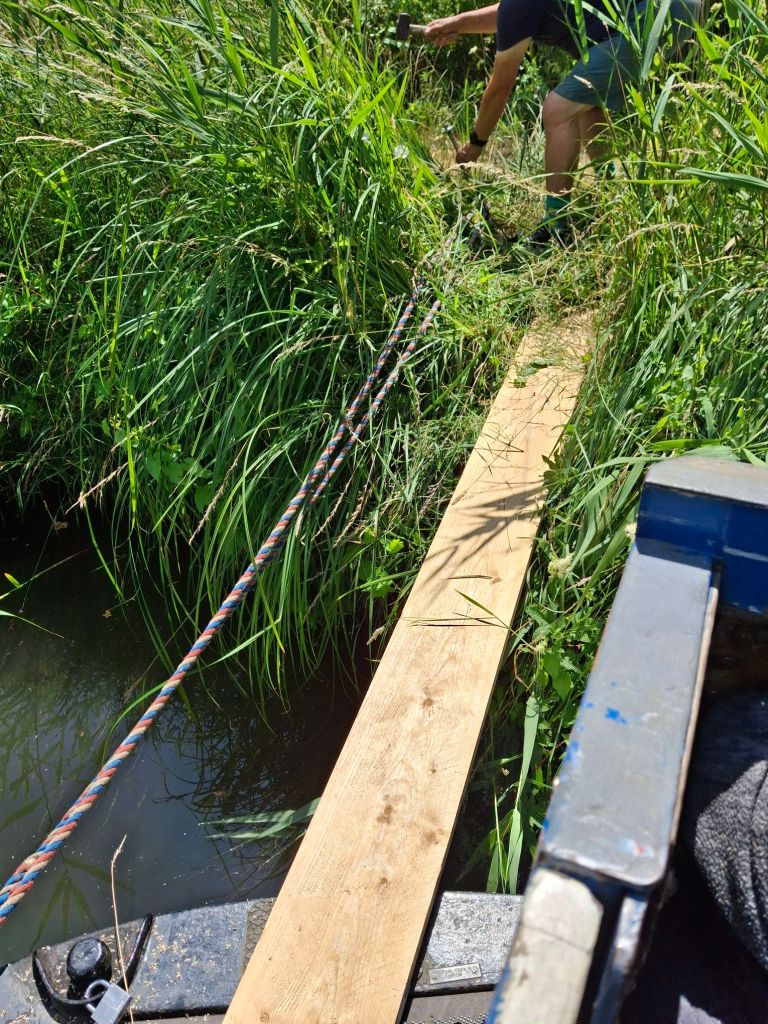
The K&A certainly is unique in very many ways. Like some river/canalised stretches, it alternates with sudden river flows in areas making concentration when navigating a necessity. Mooring on visitor moorings is 24/48 hours in the main so longer moorings are wild and shallow edges make an 8ft gangplank essential. Luckily we are equipped, (sadly acquired without the hilarious Eric Sykes and Arthur Lowe slapstick comedy of The Plank – if you haven’t seen it then head to YouTube for some sheer delight), so this was the start of my commute one day this week – how does it compare with yours?
The K&A harnesses two river navigations – the Kennet and the Avon. The resulting broad waterway with canalisation runs for 88 miles through 106 locks (including a flight at Devizes that forms one of the Wonders of the Waterways). It runs from the Bristol Channel through the historic city of Bath to the River Thames at the modern office blocks of Reading.
Reading
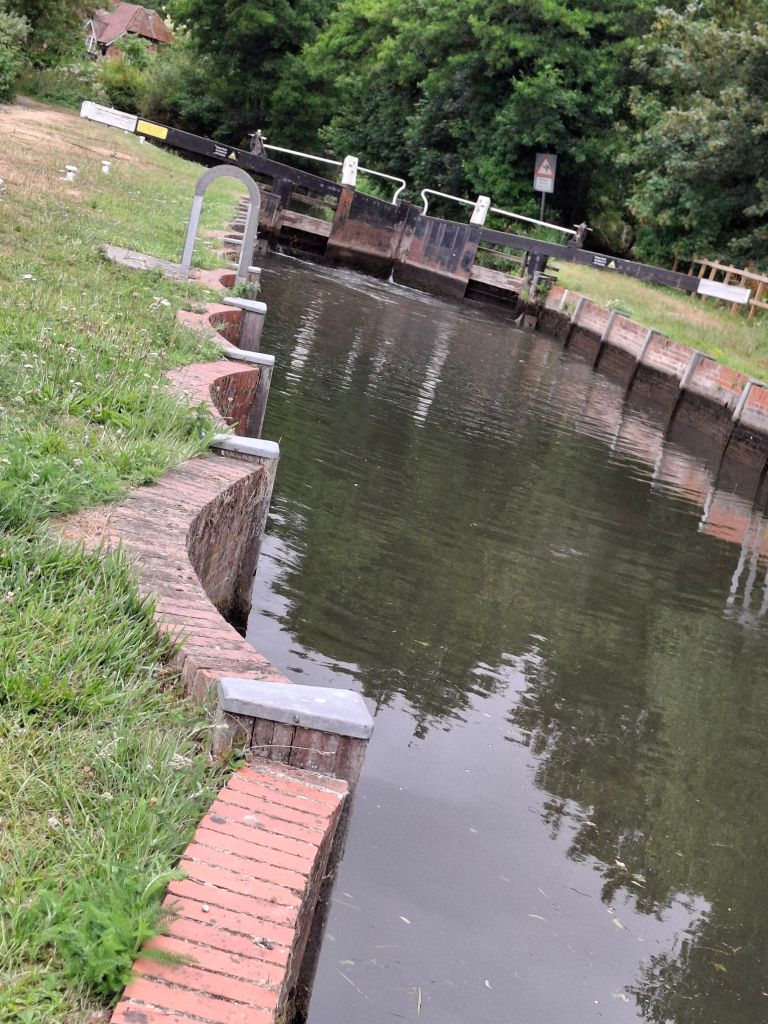
After decades of dereliction the waterway reopened in 1990. It originally featured turf-sided locks, and now scalloped edged locks that replaced some of the original turf sided locks. All the locks were built to take barges that were 13ft 10inches wide so two narrowboats fit with ease.
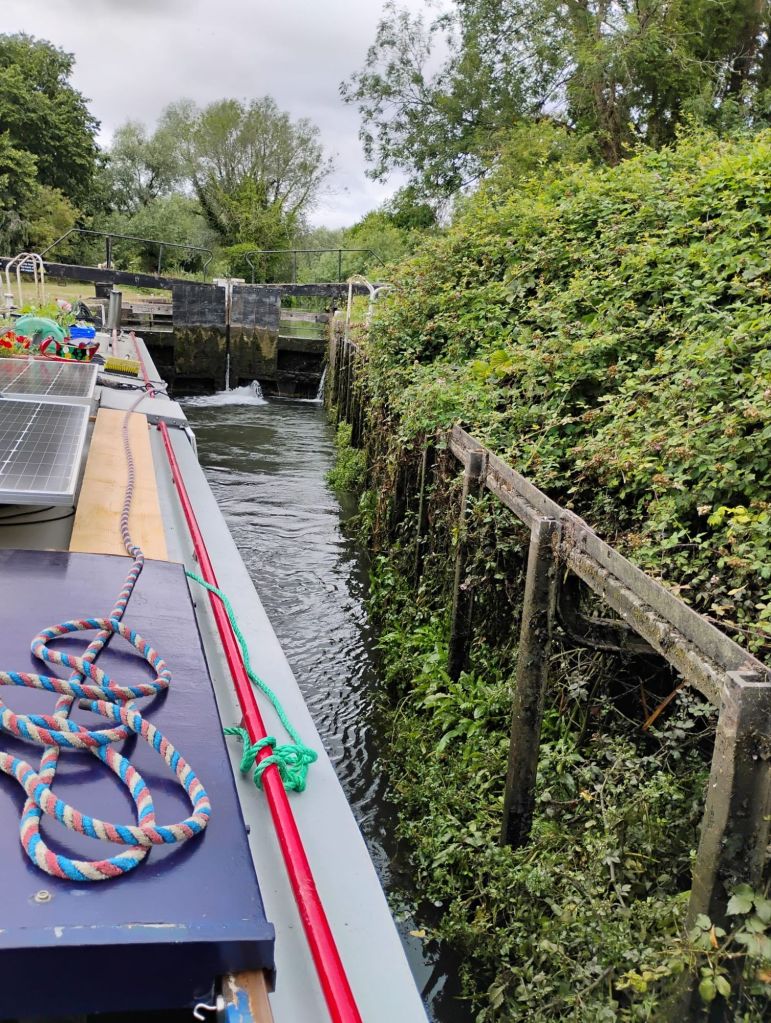
Now a bramble-sided turf lock
Turf sides were often seen on river locks in the day – they made it cheaper because brick, stone or wooden locks walls were only needed to support the lock gates, and the roots of the grass would hold the sloping earth sides together. The locks took more water and were more prone to leaks but that wasn’t an issue then as it is now. The wider working boats weren’t able to get caught on the sides as the locks emptied.
This was common on river navigations at the time: it was cheaper and easier to just build short lengths of full height masonry (or timber) vertical walls to support the lock gates at the top and bottom ends of the lock, and leave the rest as a sloping earth bank (supported by a low brick or timber wall at the bottom), where grass and other plants would bind the soil together. Sure, it increased the amount of water it took to fill the lock, and it would be more prone to leakage, but on a river navigation there was far less likely to be any issue with water shortage than on a canal.
The biggest issue was the amount of maintenance turf locks took, and that is why there are only two remaining on the K&A with a few others scattered on other waterways on the south and east. Two have been replaces with scalloped edged brickwork. Makes you feel a mite discombobulated, wondering if they’ve warped in the current heat!
Do not adjust your eyesight!
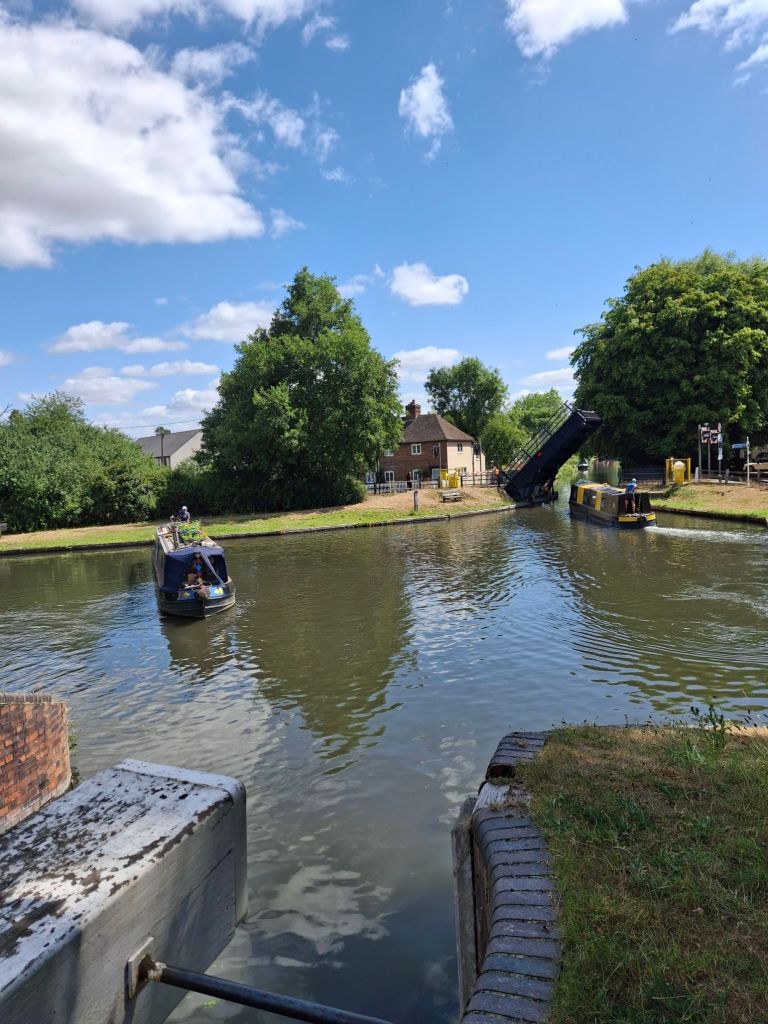
Another feature we are discovering is in swing and lift bridges – some really close to locks which need to be opened before operating the associated bridge. So far bridges have swung and lifted with sheer brute force, the requirement of a British Waterways key to operate electronics and I seem to remember using a windlass too! I can’t think of any other way of raising or swivelling a bridge but I feel the K&A might yet surprise me.
We are taking time to enjoy the environs of the K&A in parts because it runs through an area we came to live close to some 30 years ago when we returned to the UK from Swizerland. We have the sheer delight of staying in touch with many friends from those days and so we have taken the journey from Reading to Hungerford at a suitably sociable pace, allowing plenty of time for leisurely catch ups. We will eventually accelerate but it gives us time to watch the kingfishers and share moments with frogs and fish as well as good friends.
So far we’ve only actually completed 12 miles, 12 locks and 5 moveable bridges, each of which has brought its own unique character to bear on our journey. There’s no sameness about the K&A, no expectation that each bridge or lock will behave as the one before! Anxiety is abating, to be replaced with some excited anticipation of just what lies ahead and what challenges we could face.
Lock and swing bridge in operation at Aldermaston
Maybe that’s what anxiety is really for – to prepare you for the challenge, and prevent complacency. It needs to be managed so it doesn’t become paralysing but it has its place, like everything in moderation. Perhaps we should welcome it more than we do.
The K&A wends its way close to Highclere Castle where Downton Abbey was filmed. Lady Mary Crawley in the series told her groom at the altar when he expressed concern she might have jilted him: “I should hate to be predictable.” She could have been speaking for Downton’s nearby waterway.
And as I write the whole of the K&A has been issued with a low water warning from Lock 1 ro Lock 106 – so we could be here for a VERY long time!
Let your boat of life be light, packed with only what you need – a homely home and simple pleasures, one or two friends, worth the name, someone to love and someone to love you, a cat, a dog, and a pipe or two, enough to eat and enough to wear, and a little more than enough to drink; for thirst is a dangerous thing. ”
Jerome K. Jerome Three Men in a Boat
We may be missing the cat (and pipes) but our journey on the River Thames has everything else we could ask for, and we have learned a huge amount this week – our first on the mighty waterway.
So far we’ve travelled 92 miles and 33 locks in a week, something which seems astonishing given our normal pace.
We joined at the Dukes Cut from the south Oxford Canal, wending our way through blanket weed encouraged by sunshine and a lack of boat traffic to congeal the waters to a thick green slime. Cutting the engine and gliding through saved entanglement and we emerged onto the river turning right towards the Cotswolds.
A narrowboat feels different with this depth of water and even going against the flow we travelled more rapidly than normal on a canal. It is very different cruising on a wide river too, there are the big long boring lengths and locks are more widely interspersed. Many are manned by lock keepers particularly at weekends, but even if you find them on self service they make canal locks look like very hard work. The manual ones heading north on the Thames require opening and closing of paddles (now termed sluices) by spinning a large metal “ships wheel” on each gate before manually pushing and pulling gates open and shut. Opening requires spinning outwards and closing goes inwards. Further south on the Thames, locks have been converted to the electric push button variety such as one finds on some northern rivers. Again – a real doddle if you’re used to canal locks – requiring the exercise of a thumb alone!
Environment Agency locks all seem well maintained, and those we’ve encountered have worked well. It is important to put this in context. The Environment Agency only has 45 locks to deal with on the 215 miles of the Thames while Canal and River Trust have more than 1500 locks to maintain across 2,000 miles of network. Both have faced significant budget cuts in recent years.
River locks took us some getting use to, and we nearly came to grief at our first (a self-service affair) when a rope became jammed on a bollard tipping rhe boat. Staying alert, reversing the opening of the sluices, and following instructions to cut the engine so you can hear, meant disaster was averted and a valuable lesson learned.
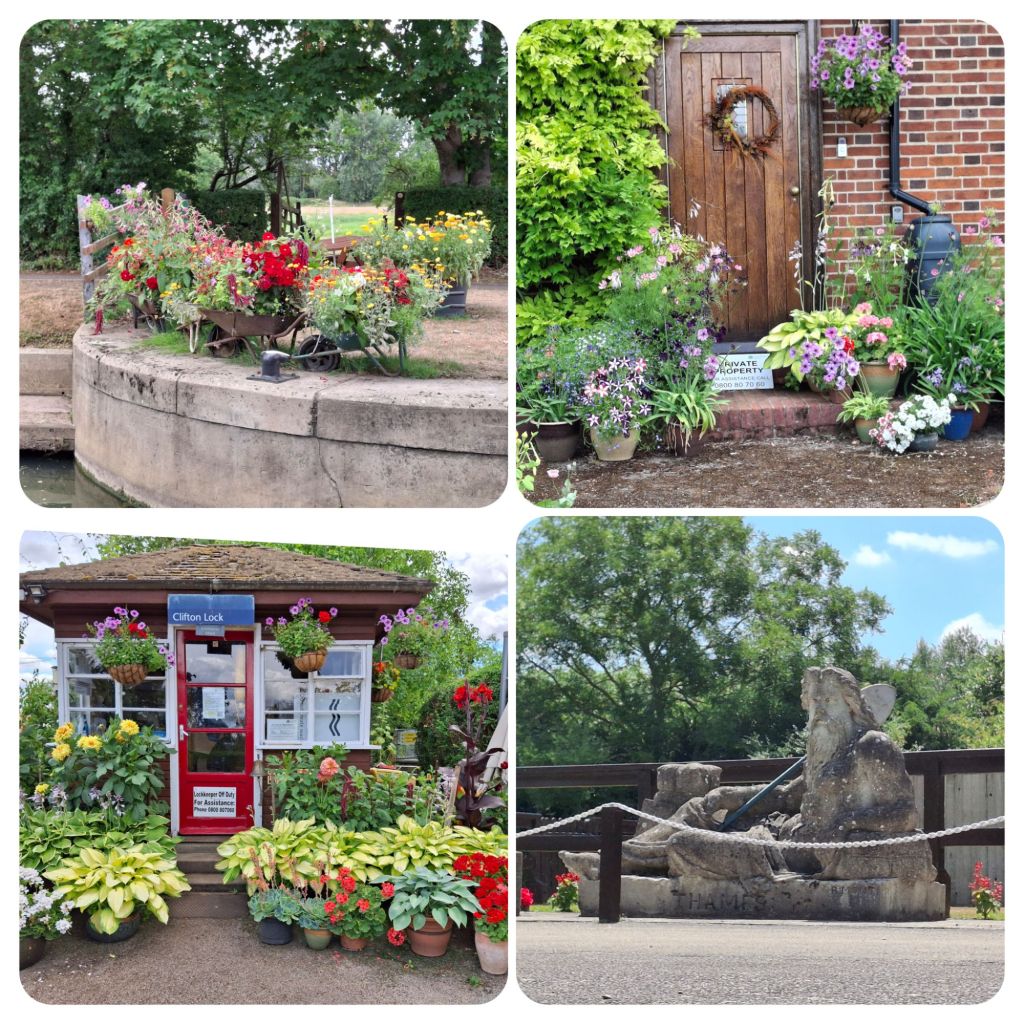
Another glory was the lock keepers’ gardens, particularly on the upper Thames – absolute highlights.
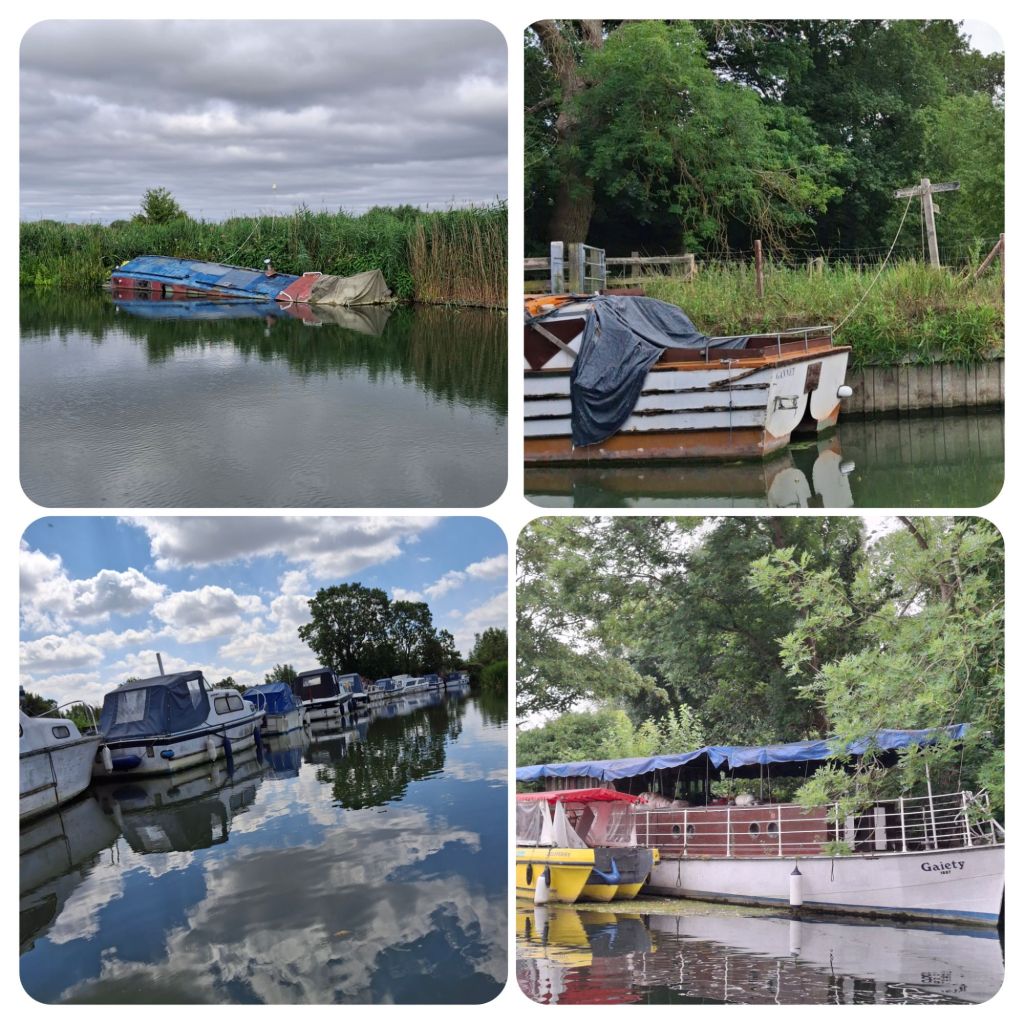
Mooring was our biggest concern – and demanded a shift of mindset. We soon realised mooring on the Thames is not as organised or obvious, or indeed anything like we had found on other rivers, let alone canals. Forget pontoons, think more about beaching the bow of your boat in a bank.
How others moor…
The identifiers for what a potential mooring might look like are different too and we’ve managed some wonderful spots. The first was a bit of a scramble, but after that we learned what to look for and as I write this we are in our first ‘tree mooring’ offering valuable shade.
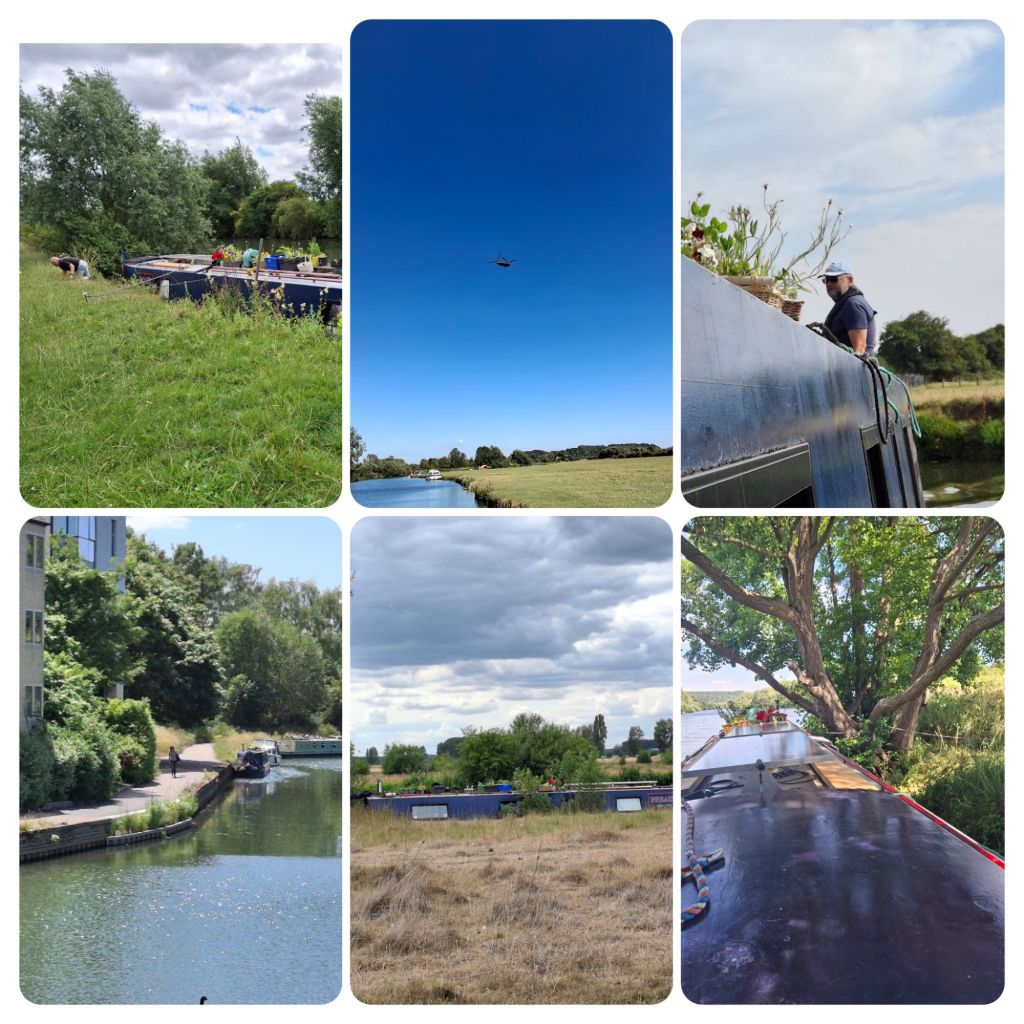
Our moorings to date
We have been fortunate with the weather, and travelling on a river where the speed limit is a rapid maximum of 5mph we’ve been able to get more of breeze coming through the boat.
There are more hazards here – so many paddle boarders, rowers, swimmers, kayakers, and canoeists. Vessels out here come in all shapes and sizes, some even carrying a spare boat!
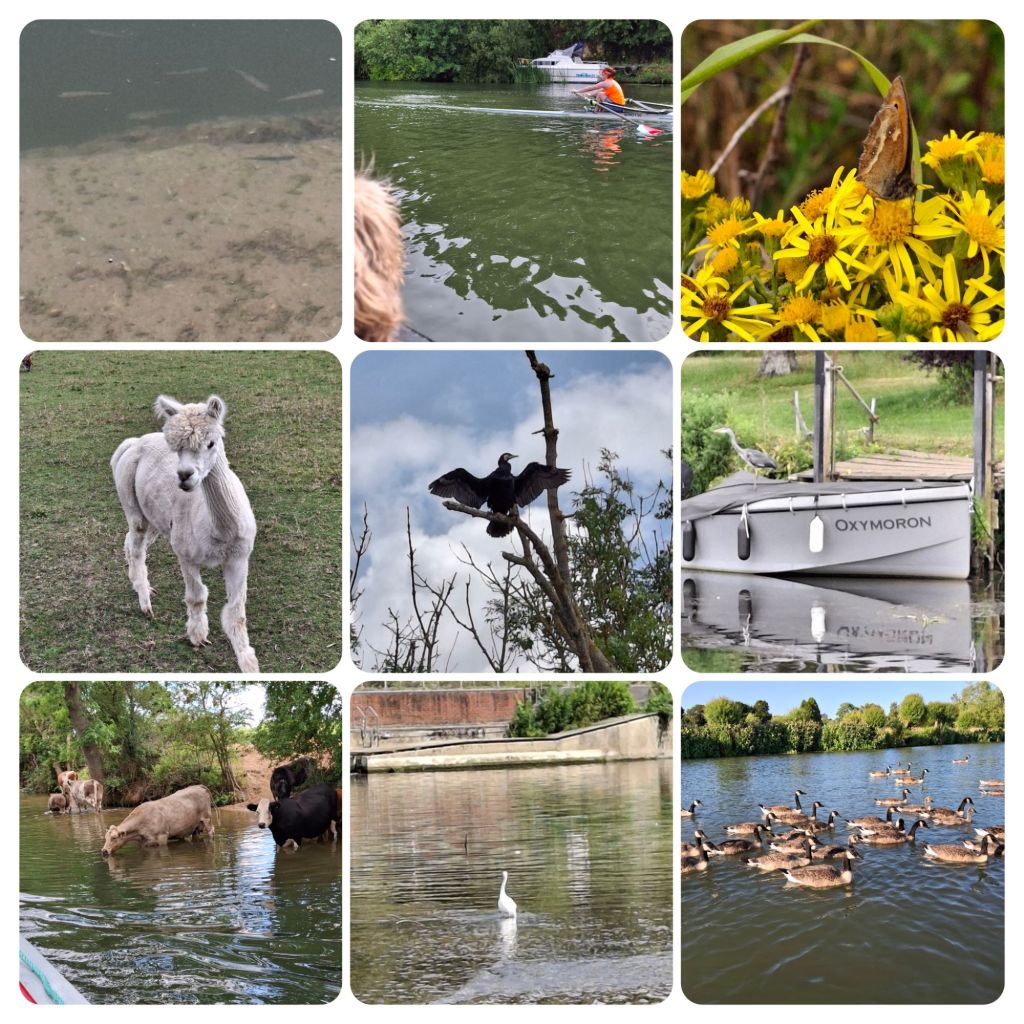
Often, nature is a bit remote compared to the canals where we all live cheek by jowl. Here, the stretches are often so wide that birds are very far away (by choice), but we have encountered some wildlife and several mink, now wild but originally escapees, have swum across our bow. Cows have also been regularly in the water alongside us!
Boatdog counts rowers as wildlife…😊
Costs so far have been – one night of paying for mooring (£7 in a farmer’s field) plus £75 for a week’s Environment Agency licence.
I write this in Pangbourne. It’s where Jerome K. Jerome’s Three Men in a Boat adjourned, as we are about to do, to The Swan Inn, and home of Kenneth Grahame, author of Wind in the Willows whose water rat delivered the best quotation about messing about in boats…
More messing about from us next week on more waterways new to us – the River Kennet and the Kennet and Avon Canal.
We’ve both spent time with family this week. Being useful in different parts of the country at different times and also separately enjoyed time alone on the boat – a rare treat for the Skipper.
Normal service will be resumed next week, and hopefully, by then, we shall be taking you with us on the mighty River Thames.
We’re in a heatwave. A time when living and working in a metal box doesn’t always seem the best idea.
It is also a time when social media and crowd intelligence/experience comes into its own. People are quick to share what’s worked for them, from draping cold wet towels over windows to setting up pumps to keep water from their mooring running over their boat roof.
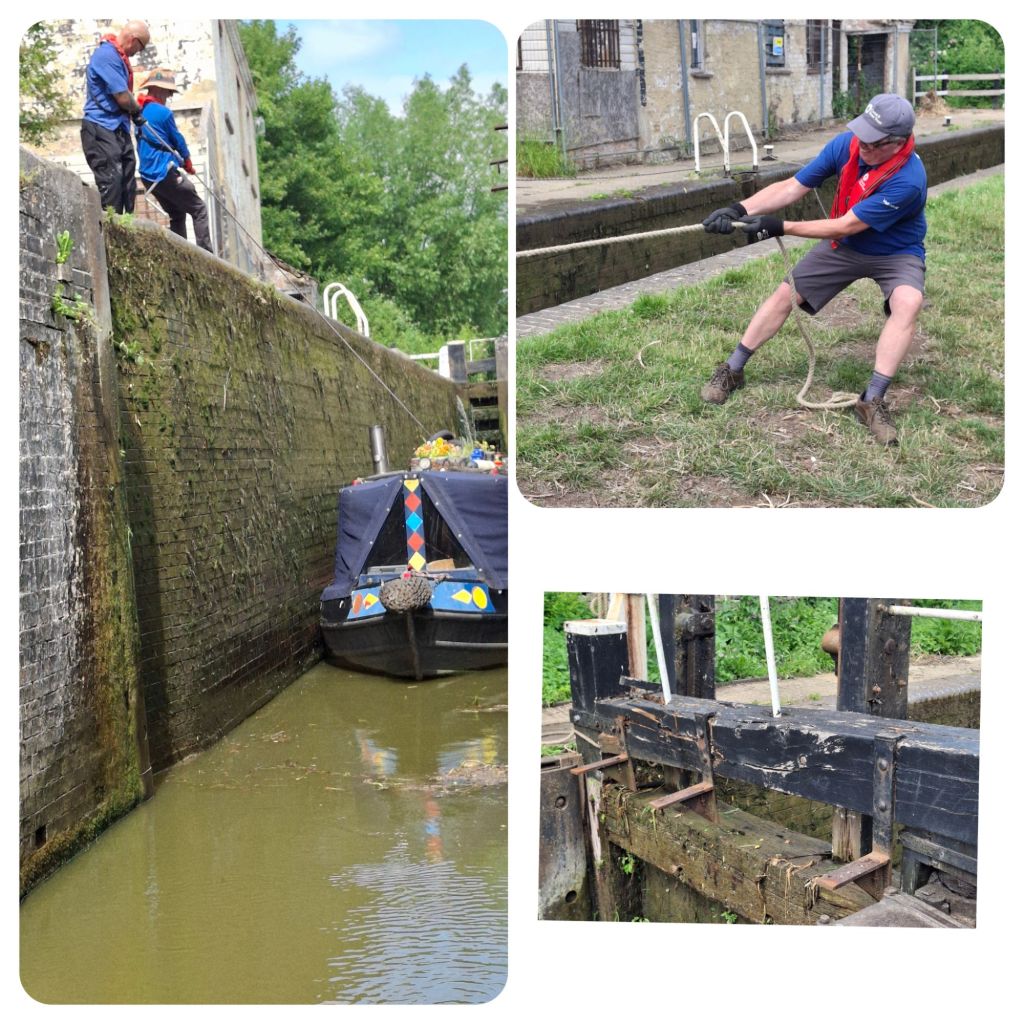
This week started with us stuck in a queue at a lock outside Banbury. We had some shade and the temperatures hadn’t begun to climb to really unpleasant heights. After 26 hours in the queue we moved from 13th place in the descending line to 1st, and were hauled through by our ropes thanks to the efforts of Canal and River Trust staff and volunteers. The roping through was to avoid the possibility of engine vibration causing more damage to the lock structure weakened by a boat strike – a boat slamming into the gate of the lock that smashed the top beam and likely caused damage elsewhere.
From there we headed on in company with boats whose crews we had got to know well during our enforced halt, and two of us found ourselves rescuing an unmanned narrowboat doing a Suez manoeuvre across the entire canal. Using our two boats to push it across I got onboard and tied a one of our ropes to the roof of the casualty, throwing the rope to one of the other boat’s crew who had managed to get into a field alongside. Together we pulled it and managed to tie it up with our donated rope. The plastic twine with which it had once been tied was frayed and useless. From strands on piling some 200 yards further up the canal on the towpath side, it seemed that is where the boat had once been moored.
We took its details and reported it to CRT. If it is licensed they should be able to contact the owner. If its one thats abanadoned then sadly it can cost £6-7,000 of the charity’s funds tk get ir removved.
It was rewarding for the four of us to find a mooring and a pub where we could toast our team efforts at the end of the day. The boat won’t stay moored for ever though – the rope although stronger than twine will also be rubbed against the metal piling by every boat that passes, and we’ve certainly seen plenty of boats on the south Oxford.
We’re now moored up for a week in one place unfortunately not somewhere with massive amounts of shade and the temperatures are rising.
Collective intelligence suggests boat dwellers are using ingenuity to keep their homes cool, and many of these will work for bricks and mortar dwellers too. I’ve collated the top 10. If you have any to add please do! These hot spells are not going to get any less frequent.
1.Mooring under motorway bridges (usually wide spaces). Tricky in bricks and mortar I grant you! 2.Opening doors and windows but keeping curtains or blinds down on the sunny side. Obviously this means swapping over as the sun moves round. 3.Working in the evening outside when it’s cool and it’s easier to think – easier for freelancers! 4 Use fans or air con units wherever possible to move air around. Solar powered fans are particularly handy. 5.If you have to move then do that early in the day when it’s cooler, stopping mid morning. 6.Make sure curtains and blinds are thermal lined 7.Make sure your home/office is well insulated – not only does this keep things warm in the winter but at times like this it helps keep it cool. Our retro fitting of insulation is definitely paying off. 8.Use wet towels as floor mats for your feet, and for any children and pets to keep cool on 9.Take the advice of those who live in hot countries and take a siesta if you can. Sleep is often disrupted on hot sticky nights so becoming tetchy through discomfort and lack of sleep can be an issue. 10.Keep cold drinks on tap – I’ve got elderflower cordial in the fridge with lashings of mint from the roof and it’s proving invaluable
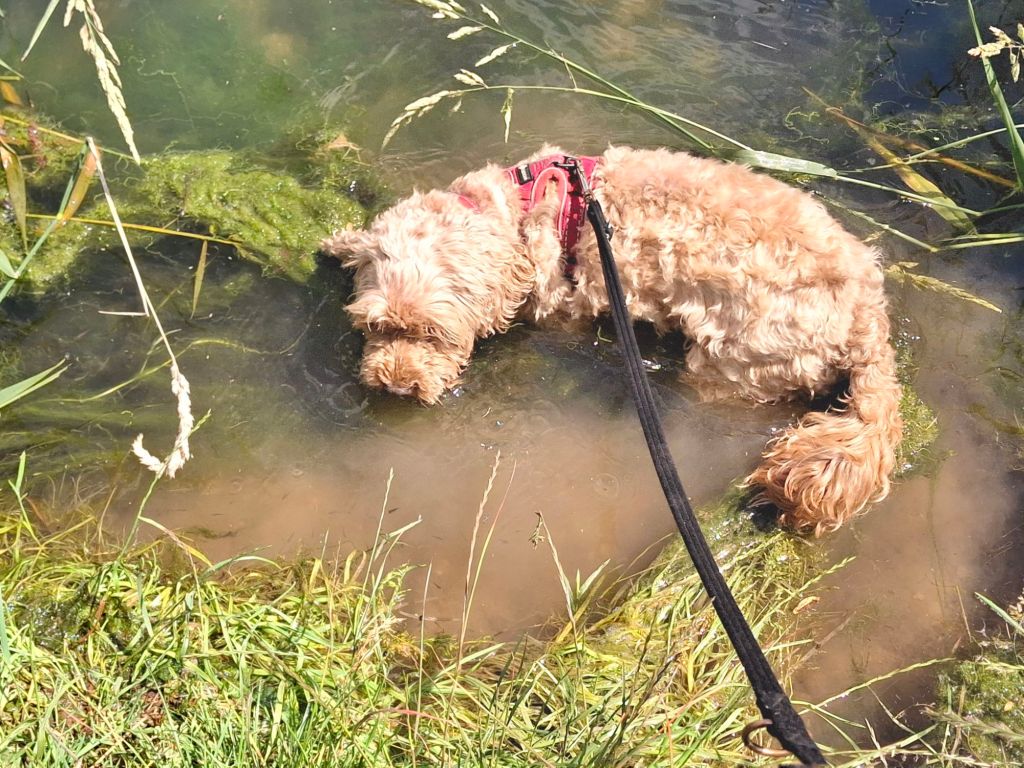
Boatdog has her own tips to share!
1.Walk early morning and late evening ideally near the river when a paddle is definitely in order 2.Keep my water bowl topped up 3.My cool mat which is activated when I sit or lie on it is very good (we even lent it to someone in the lock queue to try for their dog!) 4.Wet tea towels aren’t the best look but they help 5.Large meals are out but lots of little snacks in the day work better 6.Having a haircut has helped although being done on the boat by a far-from-professional groomer means I look more scalped than shorn in places. This approach applies to humans too – don’t wear too many clothes but enough to keep your skin safe
The weather really is causing a few problems for the roof garden. Veggies are being burnt from above and their roots sizzled from below. Some of the big baskets are doubled up to allow air to pass between the hot roof and the soil which seems to be working, and some have been given respite from the roof whilst we are stationary. The courgette seems particularly happy with this arrangement! Thanks Emma!
The courgette with its giant mussel shells from the Wendover Arm
Next week we will be on the River Thames, and whilst levels are down they aren’t suffering as much as the canal network. At the moment the red markers indicate closures, and the beige indicate areas where restrictions are in place – reducing the times boats can travel through locks particularly. The common sense approach to using locks applies at this time of the year especially- it’s not first come first served at a lock but the first to go through is the boat approaching the way the lock is set. If it’s empty then the first to go will be a boat coming up and if full then a boat going down. That way no water is unnecessarily wasted.
Maybe next week if it’s still so hot and we’re in deeper water I shall be able to take advantage of some wild swimming to cool off. Wonder what Boatdog will make of me joining her cool down times? We shall see.
You have to see it, to believe you can be it, they say, and in education and careers that is so true. It was brought home to me this week at one of the best inaugural professorial lectures I have attended (and I’ve been to a fair few).
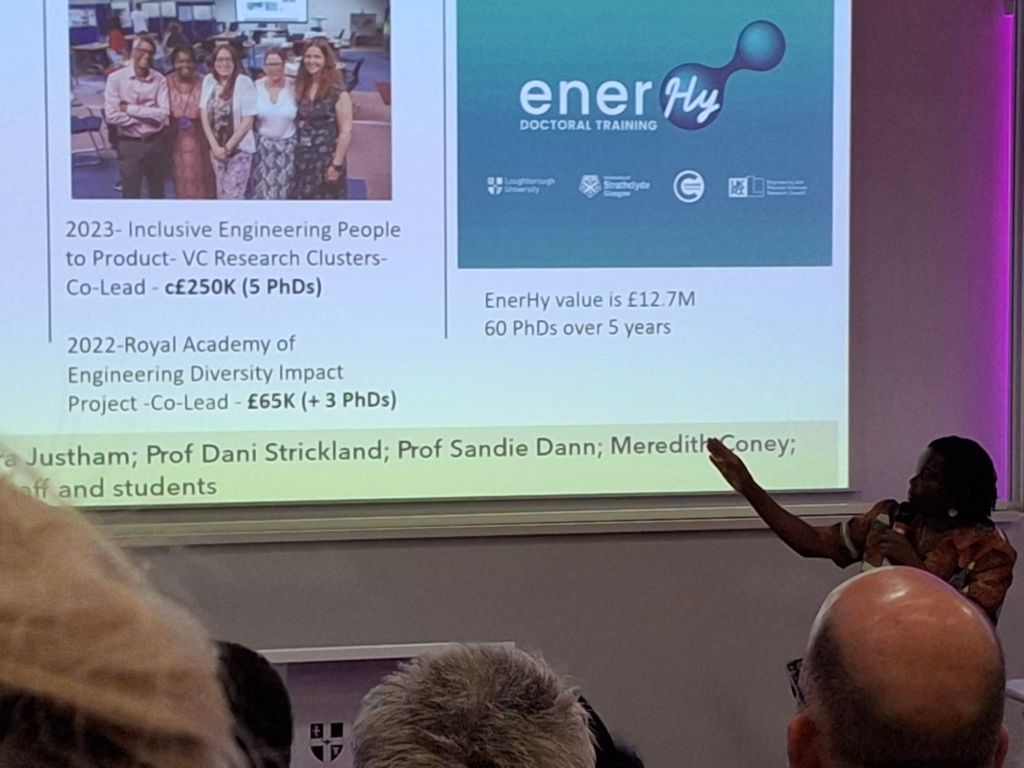
Probably one of the worst photos I’ve ever taken! Apologies Sheryl!
Professor Sheryl Williams, Professor of Engineering Education at Loughborough University in an inspiring and often emotional personal lecture, reminded us all of the importance of being able to see people like ourselves in diverse roles so that we can see the opportunities available to us, and of discovering the dreams of others.
It made me think about how often we fail to ask those who don’t look like us, those who are older, younger, from different backgrounds and cultures, what their dreams are or how we can help them achieve them. In our traditional worlds we are often hidebound by expecting everyone’s journeys to look the same as ours, to imagine our problems will be the same we encountered, but so often that is a very false assumption. Professor Williams revealed the simple truth to effective, successful education – that everyone can succeed if they have someone who will hear them, really listen to the story of their journey, someone who will believe in them and give them the right support. I would add they you can only give the right support if you know what is needed.
Bridging gaps between people and in our knowledge of each other is vital
Living and working on a boat, we may think that we know everyone’s journeys, that we’re all in the same boat.We know that boating breaks down barriers. Whoever we are, whatever our backgrounds, incomes, genders, or cultures, we are all engaged in sharing the waterways, travelling on boats whether using them for holidays or homes. We all have to navigate locks, negotiate service points and travel slowly.
We’re not all in the same boat
This week I’ve encountered holidaymakers from London, Florida, Glasgow, and New York. I’ve met boat sharers from the UK, boat owners of all ages (from 23 to 87), and permanent continuous cruisers: single women, couples of various ages and incomes and single men, one of whom has just had a heart operation and is now waiting for a cataract operation. All have narrowboats. I’ve seen some widebeam boats but not had the chance to chat to anyone on board them.
Why am I telling you all this? Well it struck me as a clear way to illustrate that while it might appear everyone is in the same boat, making the same journeys and facing the same trials…but in actual fact the only similarities are that we are all in a similar environment. As far as needs and requirements go, we are hugely diverse.
Even when we do look the same, our experiences rarely are
Discovering what individuals need is something vital to educators, but also to anyone responsible for the success of others: managers, bosses, team members, boaters etc. Watching an elderly gentleman mooring up at a water point, we asked if he needed help. No thanks, he was fine but he obviously appreciated the chance for a chat. Earlier in week I saw a holiday group at a lock and didn’t initially go to offer help because there were so many of them I couldn’t imagine they needed any. As their boat wandered away from the bollard it was (very) loosely looped over, not even tied, and the Skipper almost fell off the back of the boat trying to sort it, I grabbed the rope and reunited boat, towpath and rope. Their skipper was grateful, and glad to discover how to tie a rope so it would hold a boat.
Yet again , boating has delivered me lessons for life and reminded me once again that we should all never make assumptions [that makes an ass out of u and me (ass-u-me)]. Instead, we need to genuinely engage, ask and listen to discover how we can support, whoever it maybe in whatever situation. It’s not always easy but it needs doing.
It’s often uncomfortable at first, but you get used to making more of an effort
So as we continue chugging down the Oxford Canal I will ask if people would like a hand, I will ask what support I can offer and I have no doubt I will learn some interesting things from some fascinating people on our journey together.
If life gives you lemons they say – don’t be sour – make lemonade! Or as Monty Python would have it ‘Always look on the bright side of life’.
Got my lemon ready and this week has given me the chance to find myself an air plant which I’ve wanted for ages
This week we had every opportunity to get miserable, fed up and utterly despondent. Our goals were being thwarted every turn it appeared. We left the Aylesbury Arm, aiming to head for Brentford along the Grand Union Canal, and there to head onto the tidal River Thames. From there we would move through the sights of Windsor, Henley and onto the River Kennet, before turning onto the Kennet and Avon Canal to take us all the way to Bath.
But as I write this, we find ourselves in completely the opposite direction, back in Northamptonshire, nowhere near London, moored up on a narrow towpath as torrential rain hammers down creating pools and puddles outside.
We’re dry inside and the outdoor plants need the rain!
So what happened? Our highway is an old one, in this instance, many sections are over 200 years old. The stonework, metalwork, and woodwork of canals are subject to wear and tear of usage and weathering, to failure, and a constant need of repair and maintenance. This leads to a permanently state of juggling resources and finances to manage repairs. This has consequences, and anyone who has been following this blog over the years will have seen us diverted (around this time of year usually) because of unexpected failures or problems.
So we shouldn’t really have been surprised to find out, as we got to the top of the Aylesbury Arm celebrating having completed its length before it was announced to be closing in a few days time because of a lack of water, that we weren’t going to have an easy passage if we turned right as planned. To turn right would have meant a halt before many locks and another halt for a month or more further south. Locks needed repair because of problems which had come to light.
As you probably would have done faced with that news, we turned left instead of right, just as the weather changed. In wind and rain, we began wending our way back the route we had come a few weeks before, back through Hertfordshire, Buckinghamshire, Milton Keynes and now into Northamptonshire.
As a friend we met en route (thankfully he volunteers for Canal and River a trust as a lock keeper at Soulbury and we timed our day there to coincide with his shift- result!), put it “So you’re going in reverse!” We are indeed reversing our route – back the way we came, turning at Norton Junction to head down to Braunston and then turning onto the Oxford Canal. We shall travel almost to the city of Oxford itself before dropping onto the River Thames and follow it down to pick up our originally planned route of the River Kennet and Kennet and Avon Canal. That’s the plan but as we’ve seen this week, and in previous years, there are a lot of miles, and a lot of locks to negotiate before we reach Bath and each has the potential to throw a spanner in the works of our plan!
We’ve come up with an alternative, a solution, a through route in the face of disappointment if you will, but that isn’t fully embracing lemonading. The term appears to stem from researchers at Oregon State University when they looked at how people coped during the Covid pandemic.
It wasn’t just those who looked for alternative ways forward, solutions, or opportunities to be creative when things looked bleak who came out of the pandemic stronger – but people with a playful approach according to the scientists. If we channel our inner child, look for the fun and good things, don’t take ourselves too seriously, find humour in our days, help others and do the things we enjoy we will be more resilient, more capable of coping when we face challenges.
We’re looking for the fun things – different things, little things that we might have missed when we went this way just a few weeks ago.
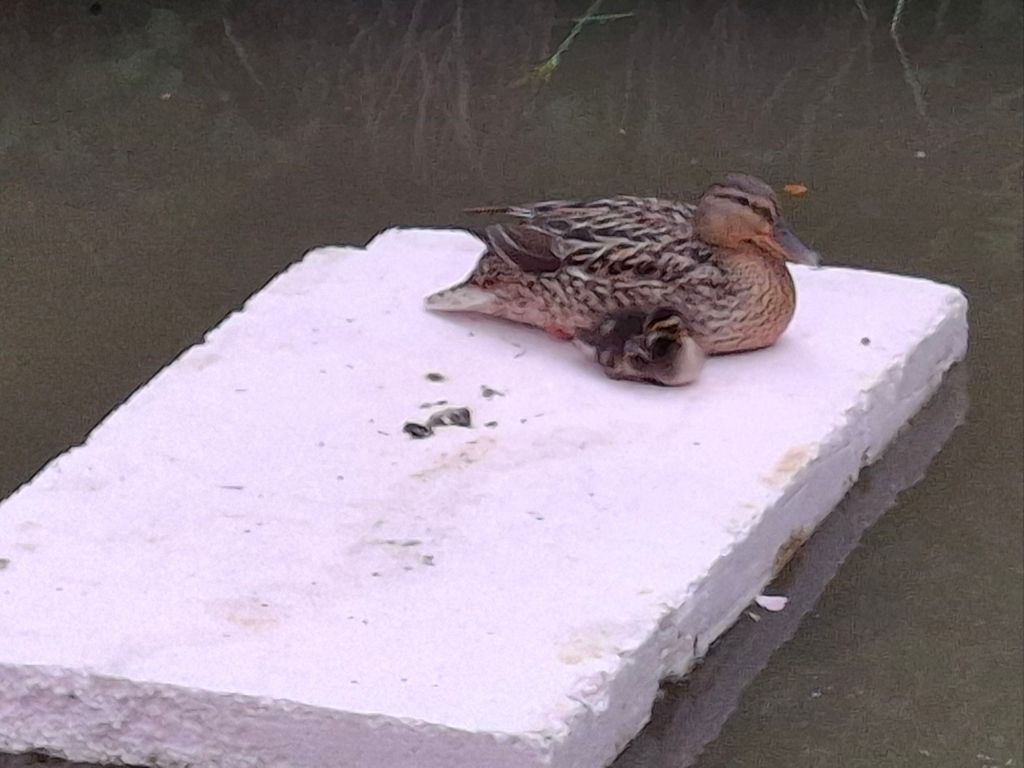
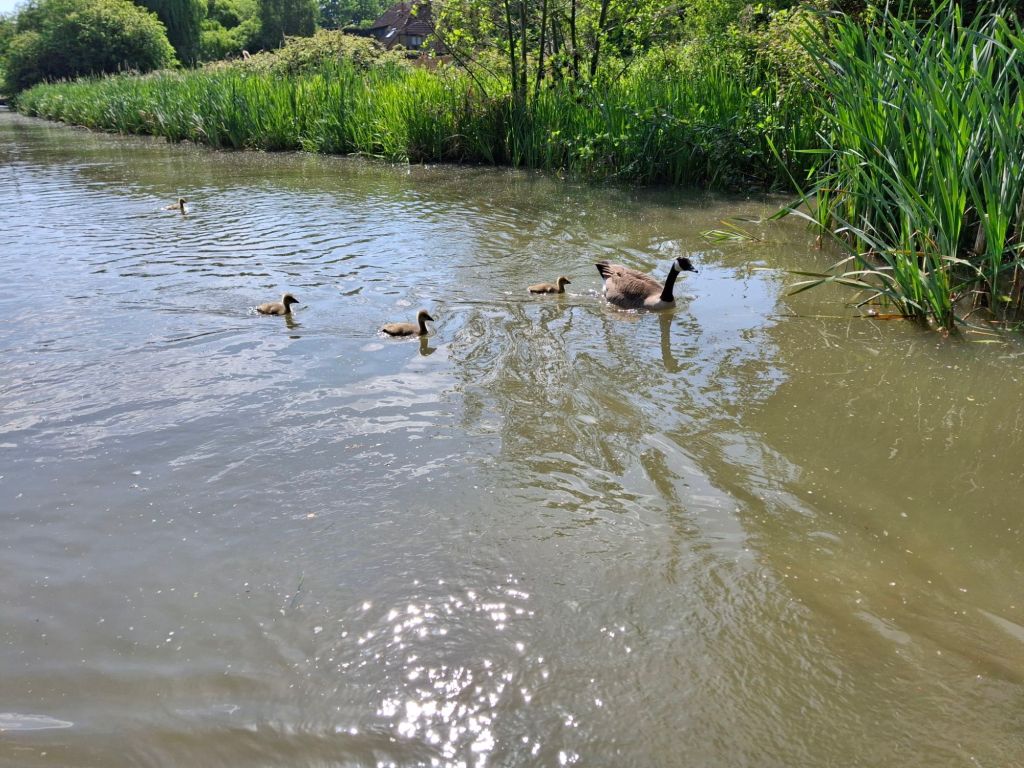
We’re picking up and fishing out rubbish as we go, trying to leave things a bit better in our wake, but at one point, searching for a net to hoick out a large piece of polystyrene, as realised a duck and her duckling had commandeered it for a raft. We smiled at their ingenuity and left them bobbing about on their perch!
Contented mother of invention
We’re welcoming the rain as a solution to the stoppages on canals all over the country.
The extra 106 miles and 24 locks on top of the original 188 miles and 198 locks of our journey also means we should arrive at Bath fitter (or exhausted!) which could be seen as a major bonus (at least in my case a necessary bonus!).
So on we go, armed with waterproofs and woolly hats, gloves and rueful grins about “Flaming June”. Will we get to our destination at all? Who knows, but we can keep trying, and if we can’t get there, we will get somewhere (with luck) and enjoy the journey with stops for plenty of lemonade (and cake?)!
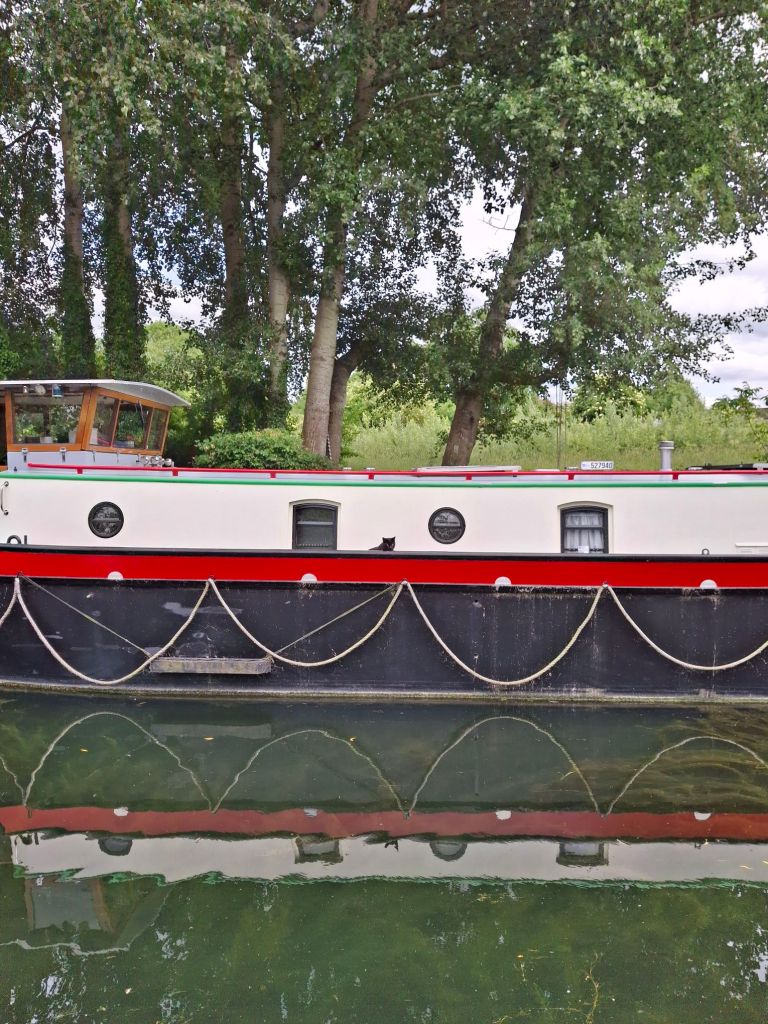
Black cats are lucky aren’t they?
Whatever life throws at you this week at home or work – get lemonading!
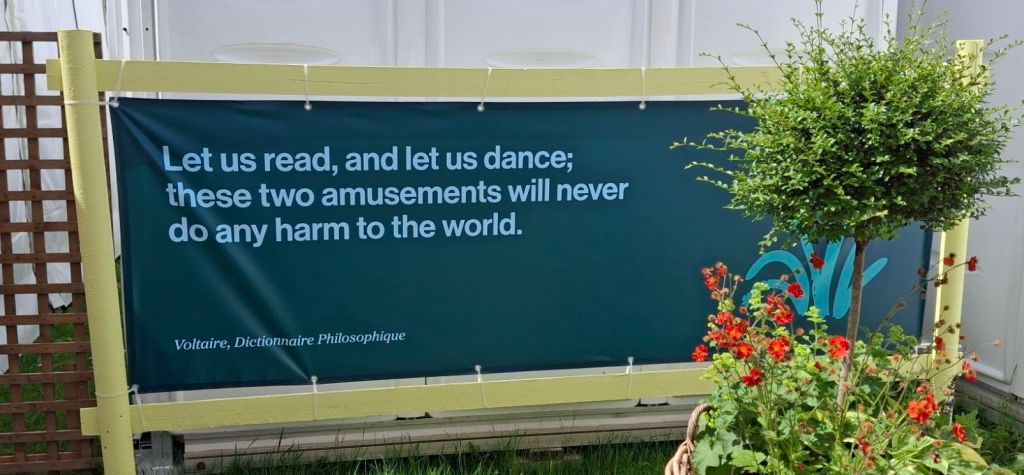
Comedian Chris McCausland got us thinking this week that we all really could benefit from making more of an effort at living (that doesn’t mean doing something big like say ballroom dancing, although if that’s your thing – dance away – Voltaire would approve!).
Who knew Voltaire was envisaging Strictly?
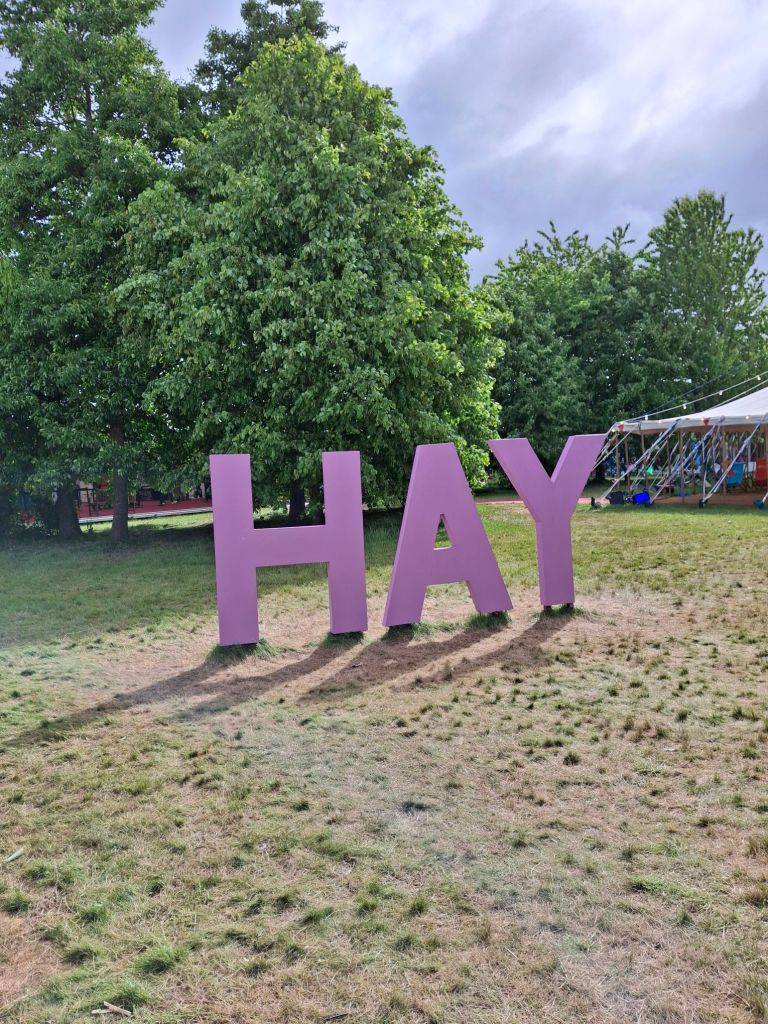
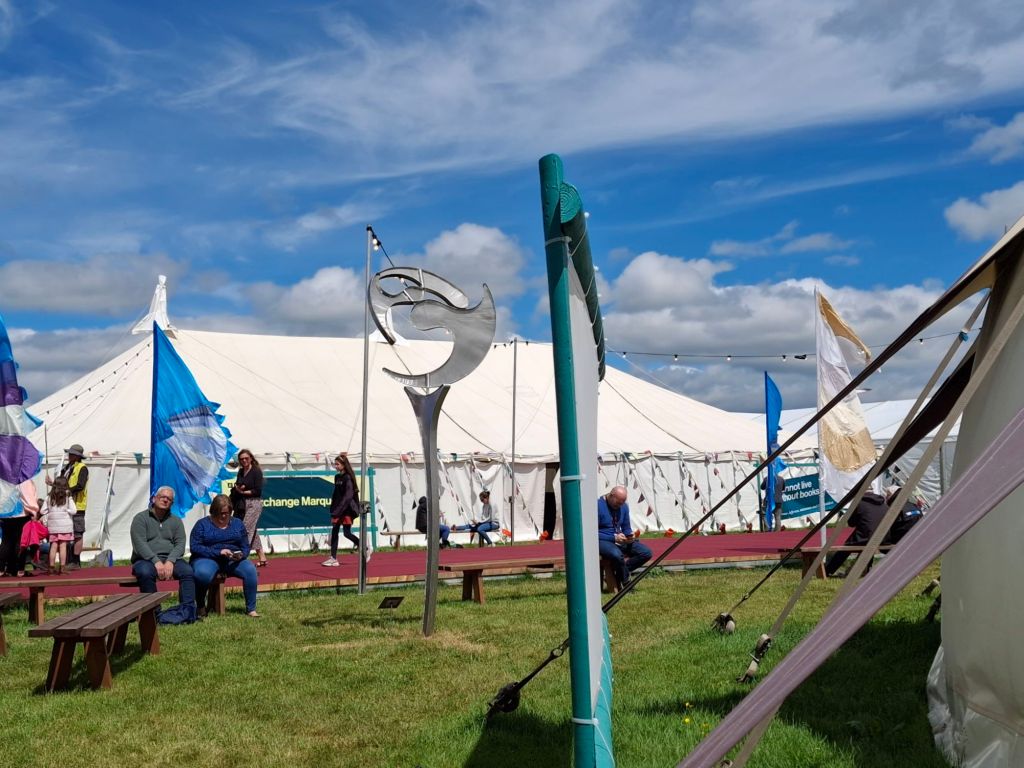
An antidote to pretension at the Hay Festival, where we saw him, McCausland’s insight as for any comedian, is based on observation of how ridiculous we humans can be. In Chris’s case (being blind), his ears are honed to pick up stupidity via sound.
In between making me laugh so much, my ribs ache still, was his serious point about how much effort technology has taken from us. Little things like changing a TV channel. Once we would physically move from our chair or sofa and cross the room to manipulate a button or dial on the TV itself. Then we sat where we were and merely pressed the button on a remote, and now we don’t even have to press anything with voice-activated channel changing. Technology is making tasks, and us, effort-less.
Technology means many of us are living much of our lives remotely. Remote from the experiences of living, remote from the little things that make us healthy, well-adjusted humans, and I offer a solution from personal experience if you feel you’ve become remote from your life.
Narrowboat living as a continuous cruiser. In narrowboat life, at least the way we live it, we are in the moment. We have to be. We practice mindfulness all the time, in the tasks of daily living. In washing up (no dishwasher). In collecting the water we need. We never turn on a tap without thinking about our consumption, and being grateful for the last time we physically went to the water point to fill our tank. In charging our phones, boiling a kettle on the hob, switching on a light, we recognise the effort of installing solar panels and the battery to store it.
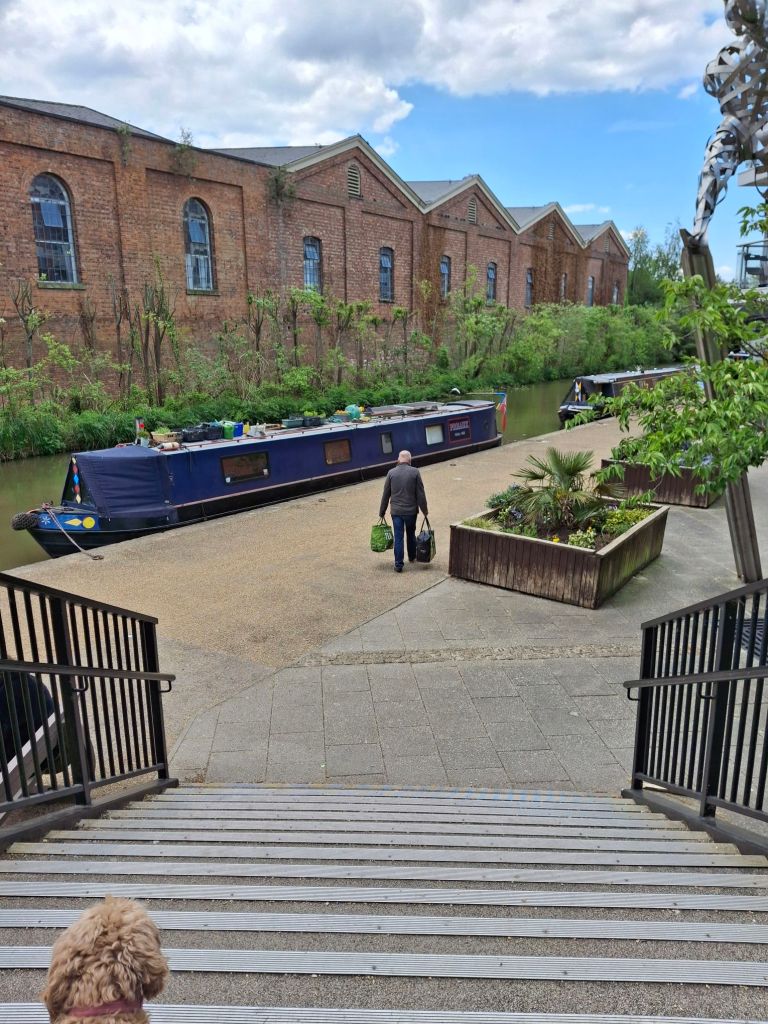
Shopping has to fit in the bags we take with us
We are, because of how we live, aware of our consumption and physically connected to what it takes to keep us going. We walk to shops with our backpacks, occasionally using click and collect but not home delivery although we know some boaters do. Where we can, we use farm shops and markets, buying local products in season from local producers.
In that respect, our lives hark back to simpler times, to life before shopping online.
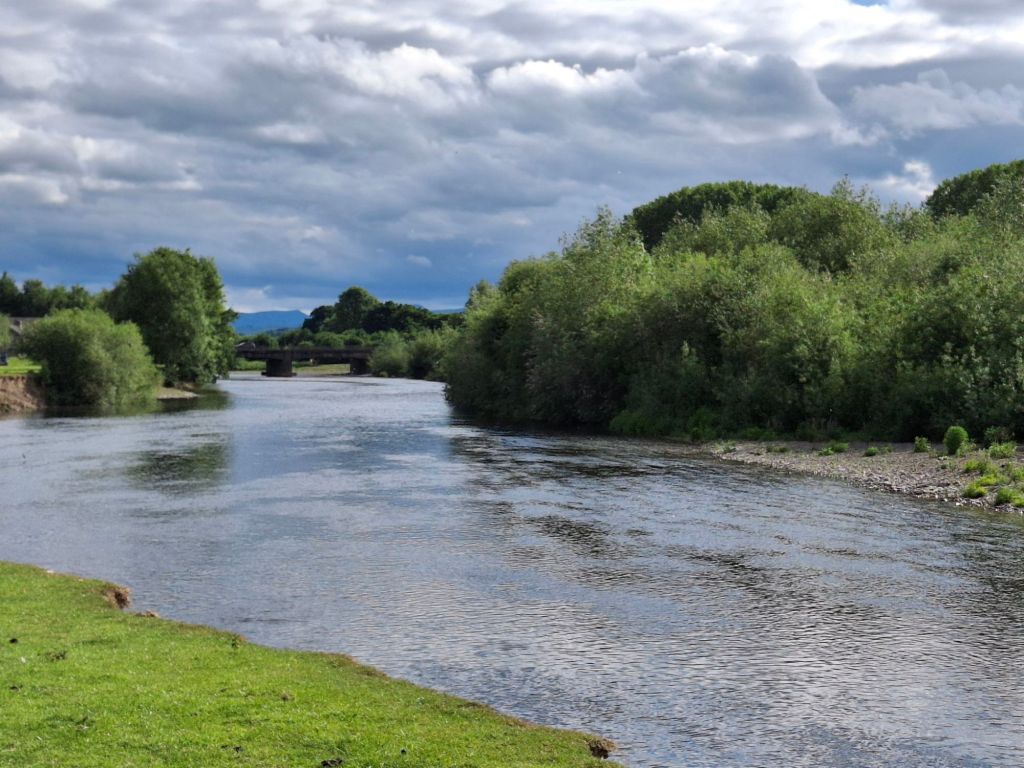
Having spent part of this week at the Hay Literary Festival on the Anglo Welsh border alongside the glorious River Wye, (involving a herculean effort to get there) we encountered Chris McCausland and many other well known names. The festival made us acutely aware of how much reading we do on our boat. We benefit hugely from the book exchanges along the waterways network. They have brought us serendipitously into contact over the years with authors and ideas, prose, and meter we would never have encountered otherwise. Getting our books this way demands effort – finding book exchanges, getting to them, selecting and choosing what to read, and of course selecting and carrying to them what we are offering to others. On a boat, it’s one on, one off, or we get get way too overcrowded. That discipline demands effort, believe me!
We are very guilty of at least one effort-less thing. We don’t have a TV (voice activated or old school). We rely on an iPad to connect us to entertainment remote to where we are. We rarely make the effort to seek out and support local musicians, actors, and performers unless by chance. Rarely do we moor in the places which would allow us to enjoy the stimulation of live entertainment on a regular basis. We’ve just been moored on the Aylesbury Arm in the basin right opposite the Waterside Theatre. Did we visit? Did we support? No. Our excuse when we arrived was that what was on was not something we wanted to see, but we didn’t check the programme again later into our stay.
It’s often an expensive business getting out and supporting the arts. But if we don’t all make that effort of finding a suitable mooring, making that effort of investment of time and money, say once a month or once a quarter, then there may no longer be live music, live theatre, live entertainment to enjoy. We need to put the effort in, put on clothes suitable for being seen in public, get off the sofa, and make the effort to get out out.
We work remotely like so many now – but we recognise we don’t have to live our lives remotely too. We are lucky boatlife allows us a rare connection and contact with our surroundings, with nature and resources. Making more of an effort to live a directly connected and mindful life, ensuring we aren’t withdrawn and distant from the things that ground us and can give us pleasure, is something that can repay us all in physical and mental health and happiness.
You don’t need a narrowboat to adopt those principals (though I find it helps). Just think, “Where can I shun technology and put in some effort in myself?” And then DO IT! The sense of satisfaction, of achievement (even from something like washing up), is a positive.
As was reinforced for us this week, making the effort to get out and about, to hear new views, sounds and perspectives, and see new sights is invaluable in feeling connected with how rich an engaged life can be.Try engaging physically and mentally this week with whatever you can and just see how it makes you feel.













 Pickingupducks