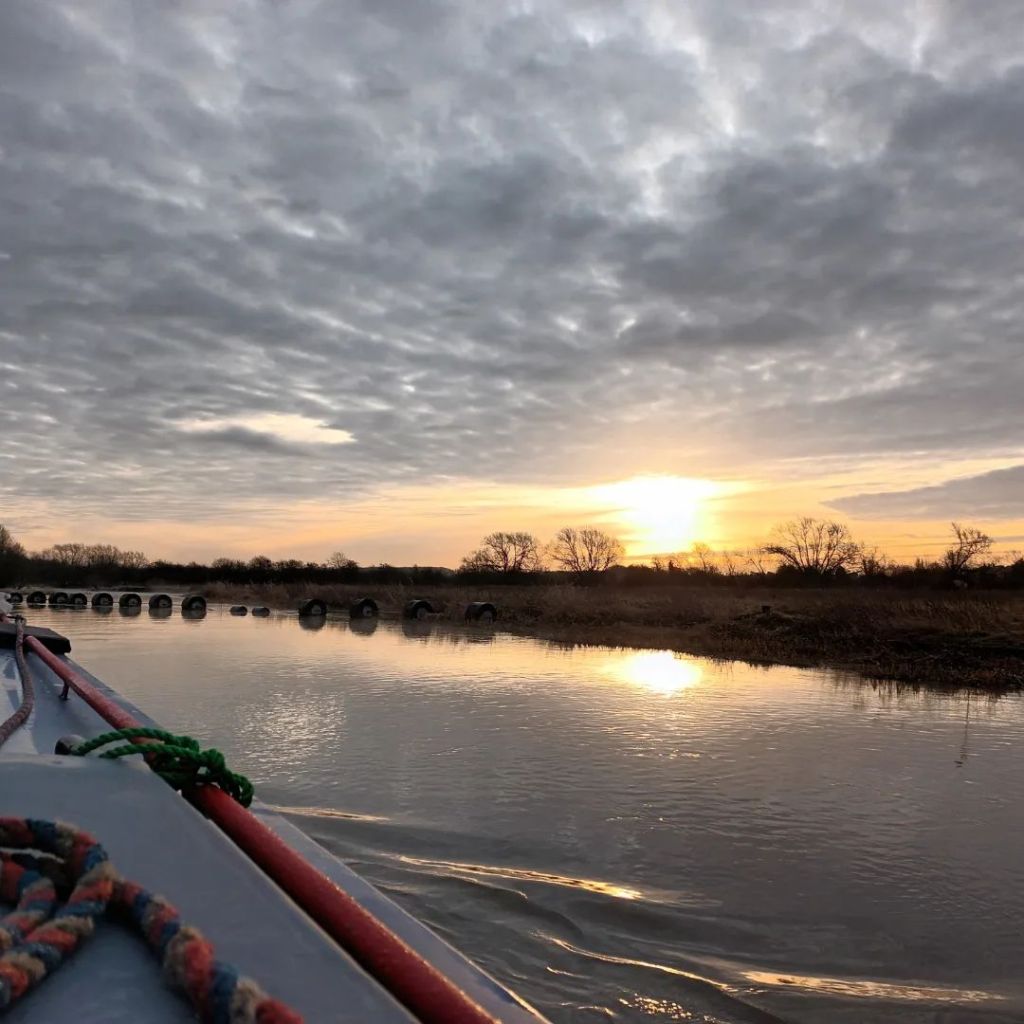
Planning another leap or two this month

If January was our time of hibernation, February is time for preparation.


Preparing for what we need to do, for getting ourselves and the boat to the right place, and making sure we are all where we need to be. It is still a time for planning rather than big movements because this is the winter stoppages season on the inland waterways.

Each winter, when mainly only the hardy continuous cruisers remain on the waterways, Canal and River Trust undertake their major programme of essential repairs and maintenance to the waterways and towpaths. They publish a list in advance for comments, but as with any work to old structures, things can change as it rolls out. Doing one piece of work in one area can flag up issues in another that need tackling, and the significant storm damage this winter already has led to so many more jobs that need doing. This year alone, the planned works were expected to cost around £50m – with the unexpected additions on top of that.


If a lock is closed near you it’s an amazing opportunity to go along and see the incredible engineering architecture of these invaluable structures. When you can see the bare bones, you realise just what lies beneath the water. Sometimes Canal and River Trust hold open days with explanatory boards or experts. You can explore the possibilities online Canal & River Trust

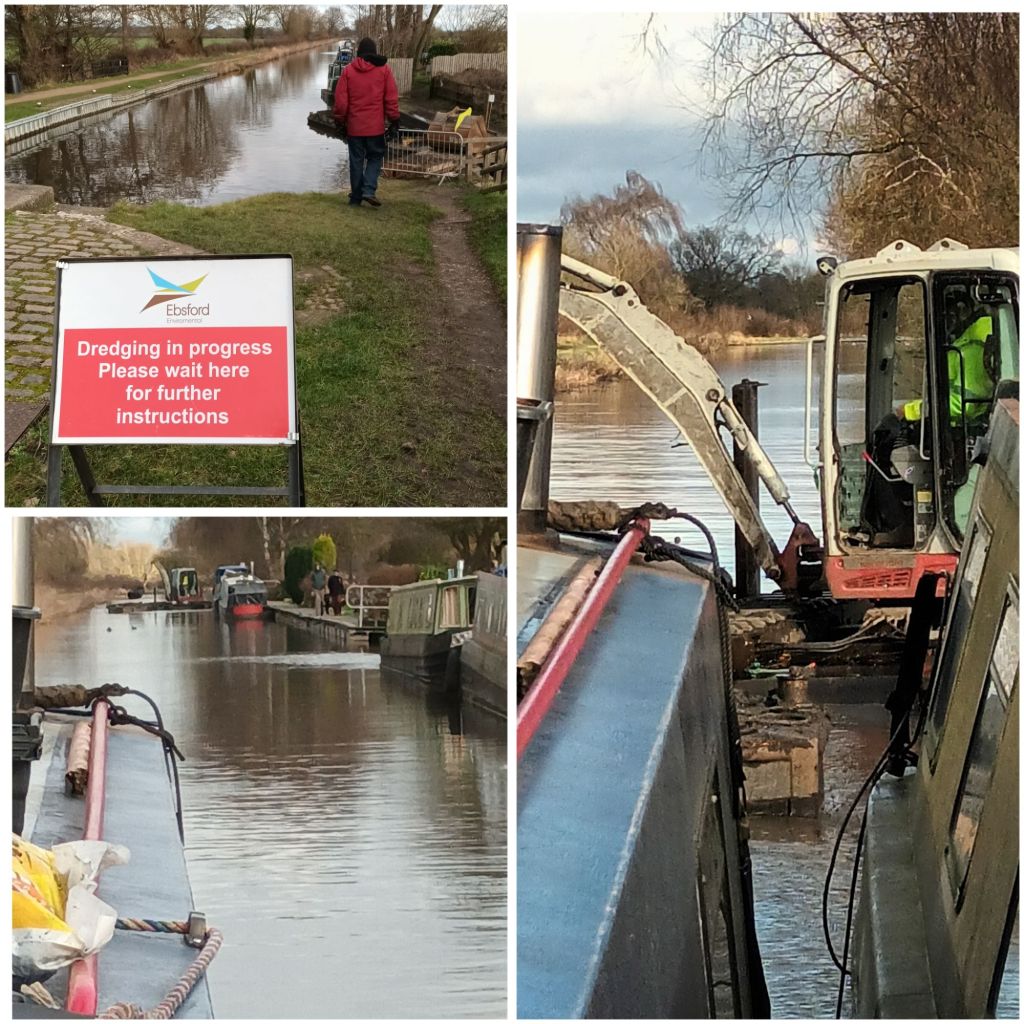
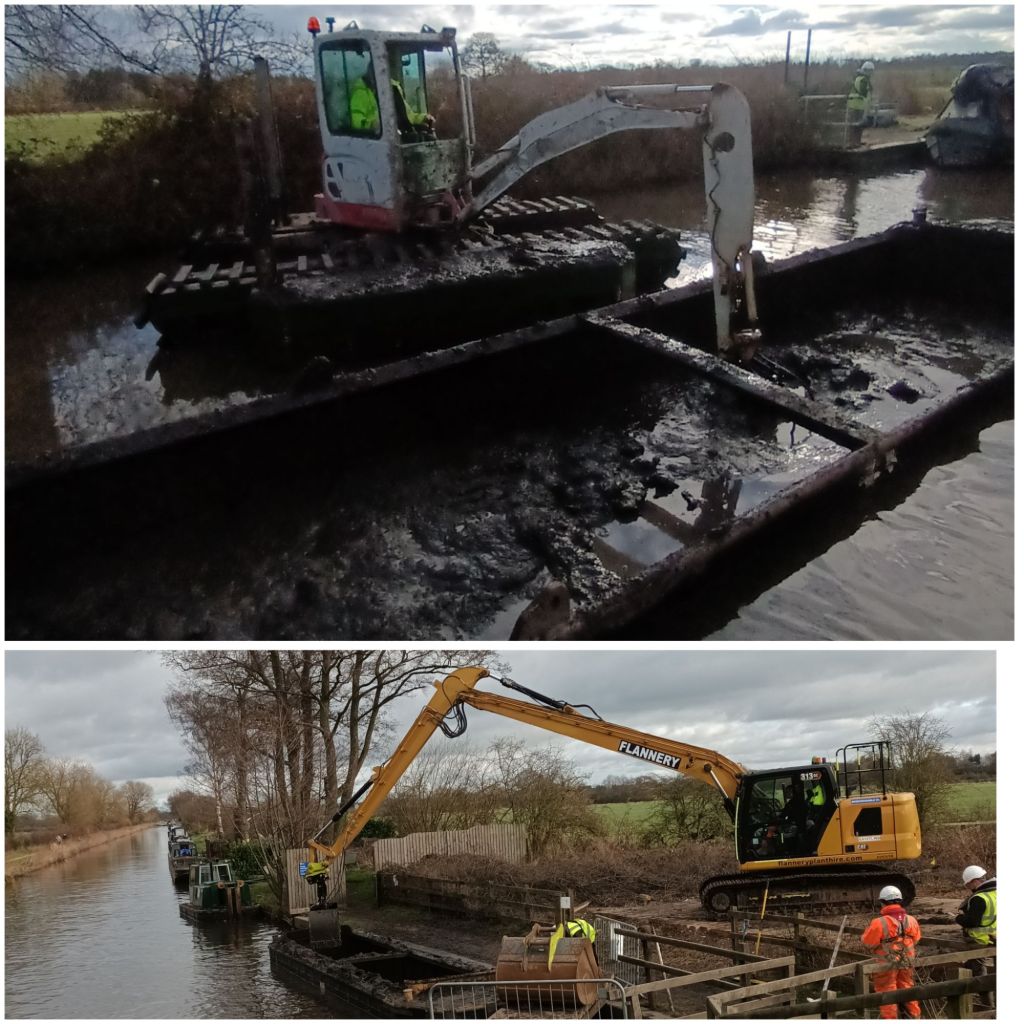
It’s not just closed locks that can bring insight into the architecture of our industrial history – opportunities to watch essential maintenance can be as interesting. Dredging used to be more regularly carried out when commercial loads were at risk of delay. As we’ve seen recently elsewhere in the world – money talks. We got up close to the dredging process and how it works these days on the Trent and Mersey this past week while on the move.


Dredging isn’t just essential for boat traffic – it keeps the ecosystem healthy for wild and plantlife. An excavator with hydraulic legs using a sieved scoop to remove debris and silt from the bottom of the canal whilst letting the water drain back in. The solids were then dropped into a floating barge which was collected periodically by a tug that transported it to a disposal site where the material was moved out of the barge and spread on designated land.


Just as CRT use this winter time to plan ahead to keep the canals operational, we are using this time to plan ahead for ourselves. We moved the boat in two hops this past week, from a mooring where we enjoyed 14 days of ice, storms and calm. We were so grateful that we sat tight when we did and had that period of immobility.

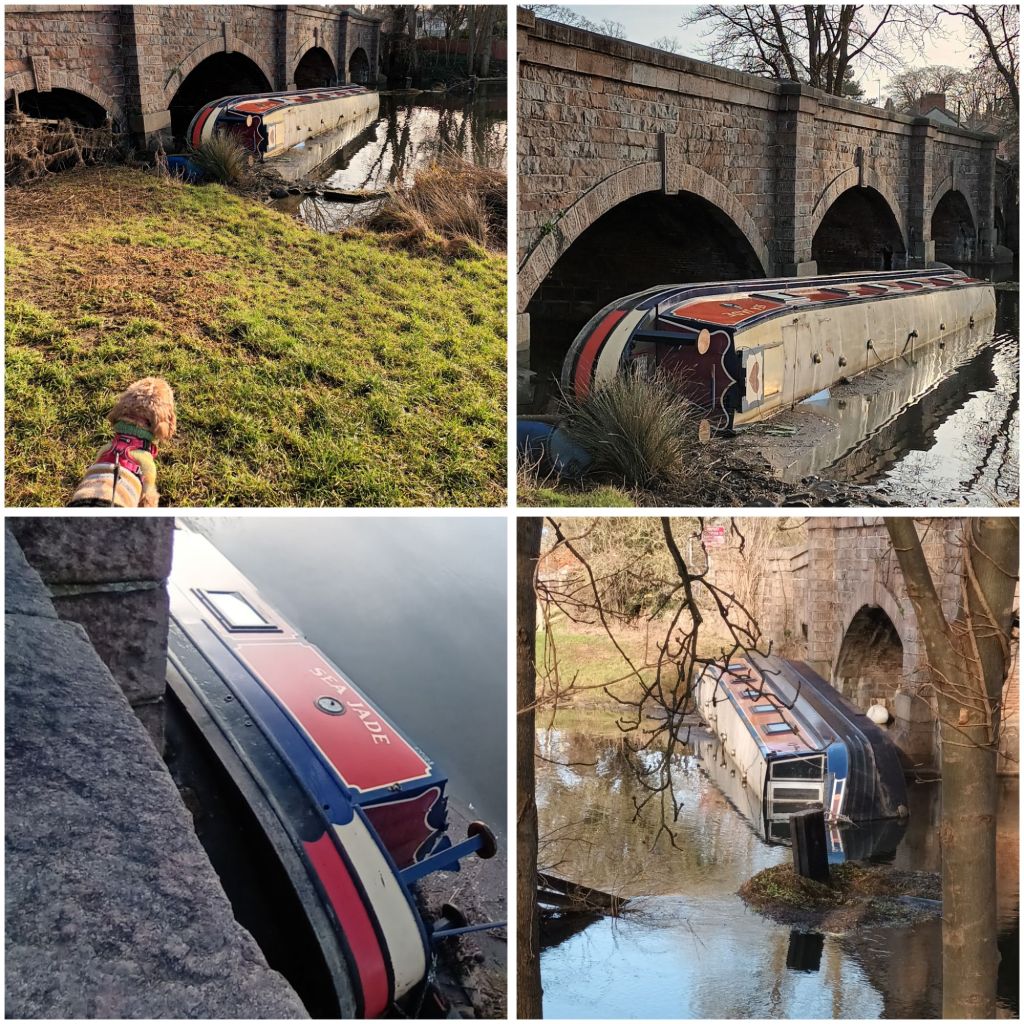
This week I went to see the state of the River Soar where we had aimed to moor, and the narrowboat which was swept away with its entire pontoon mooring during Storm Henk is still blocking the County Bridge at Barrow on Soar, a tragic reminder of the power of flooding water. I feel desperately those for whom Sea Jade was their home but thank heavens they managed to leave the boat in time.


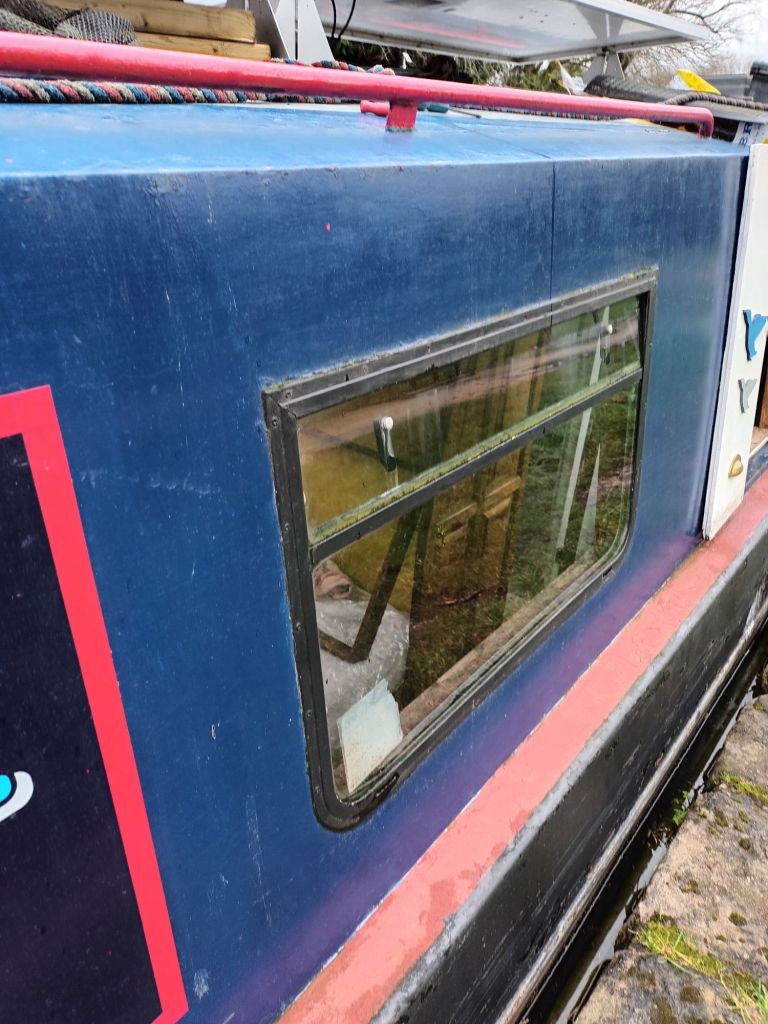
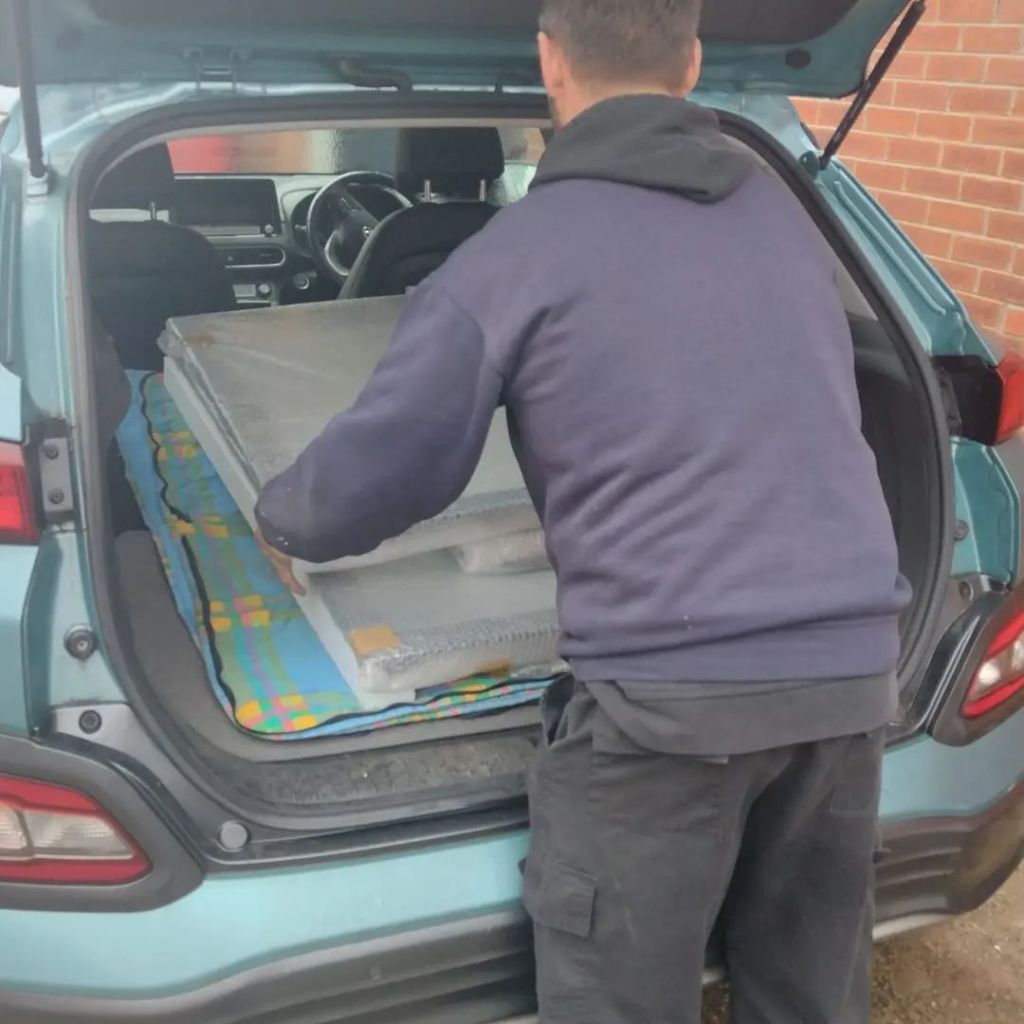
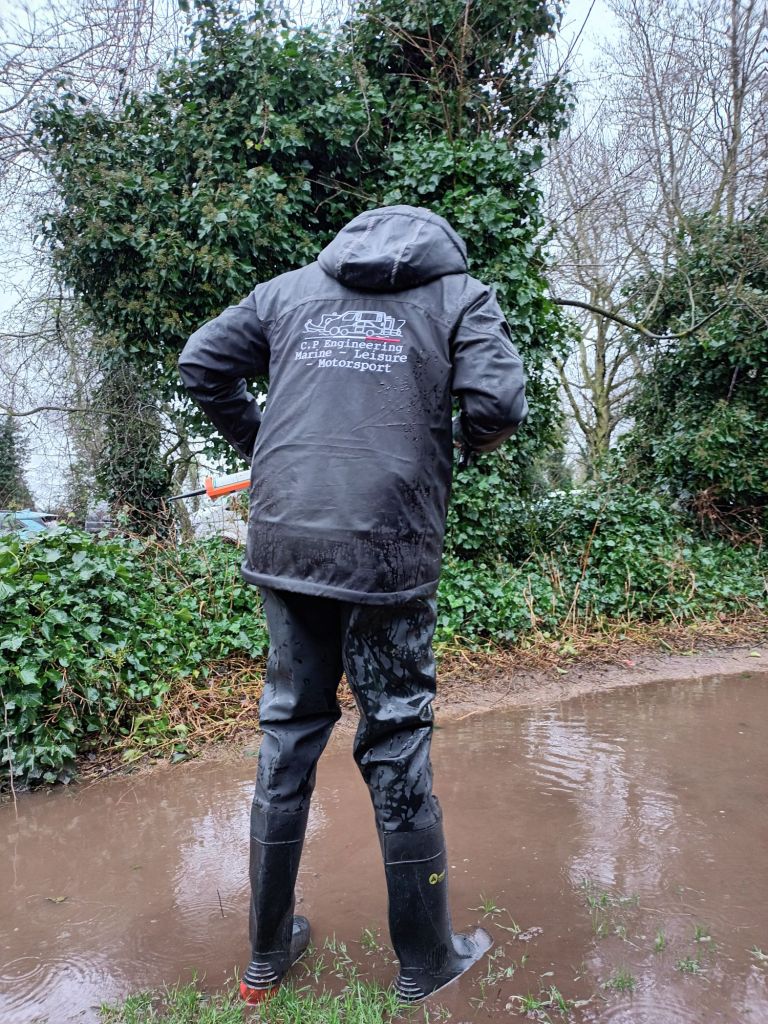
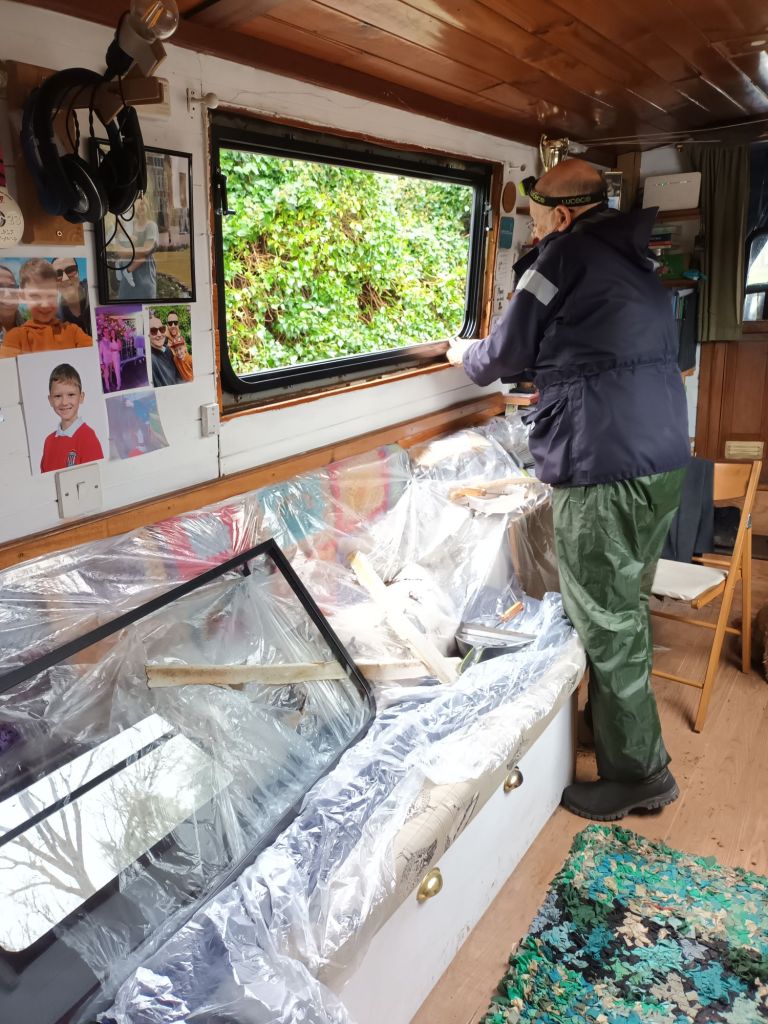
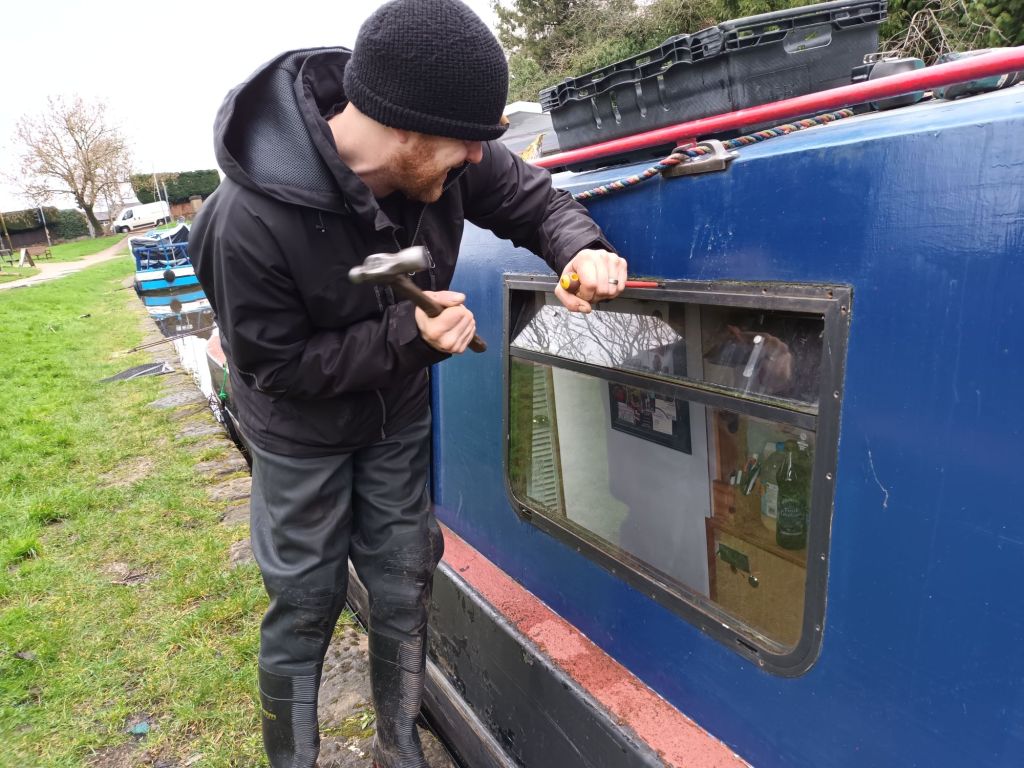
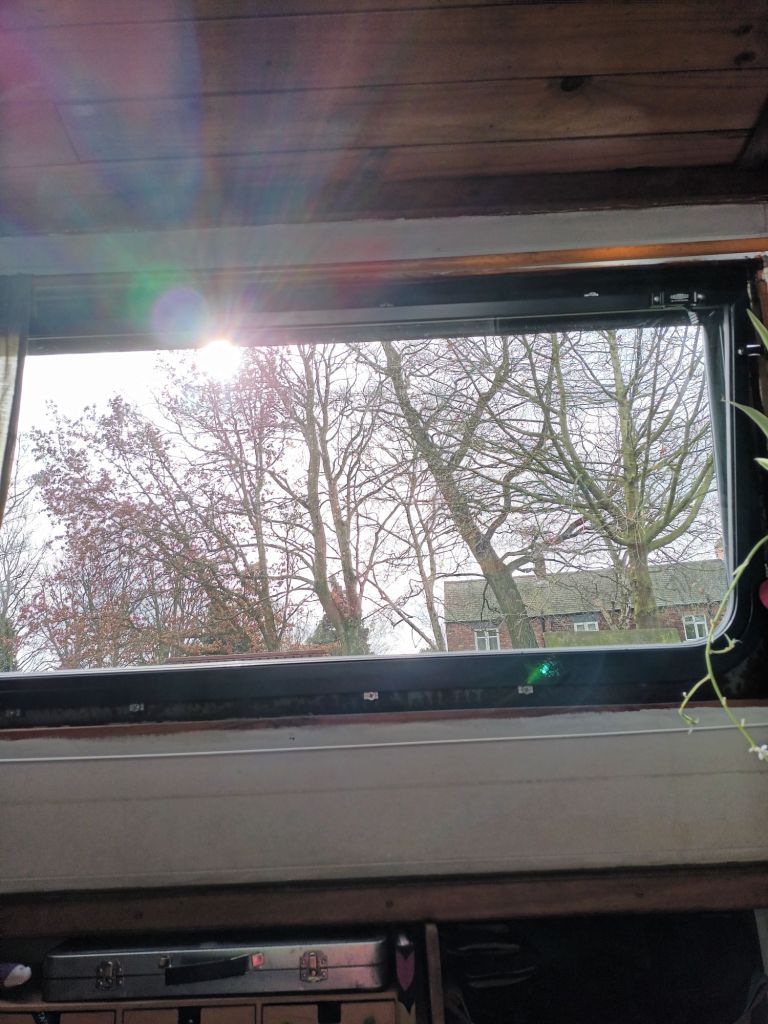
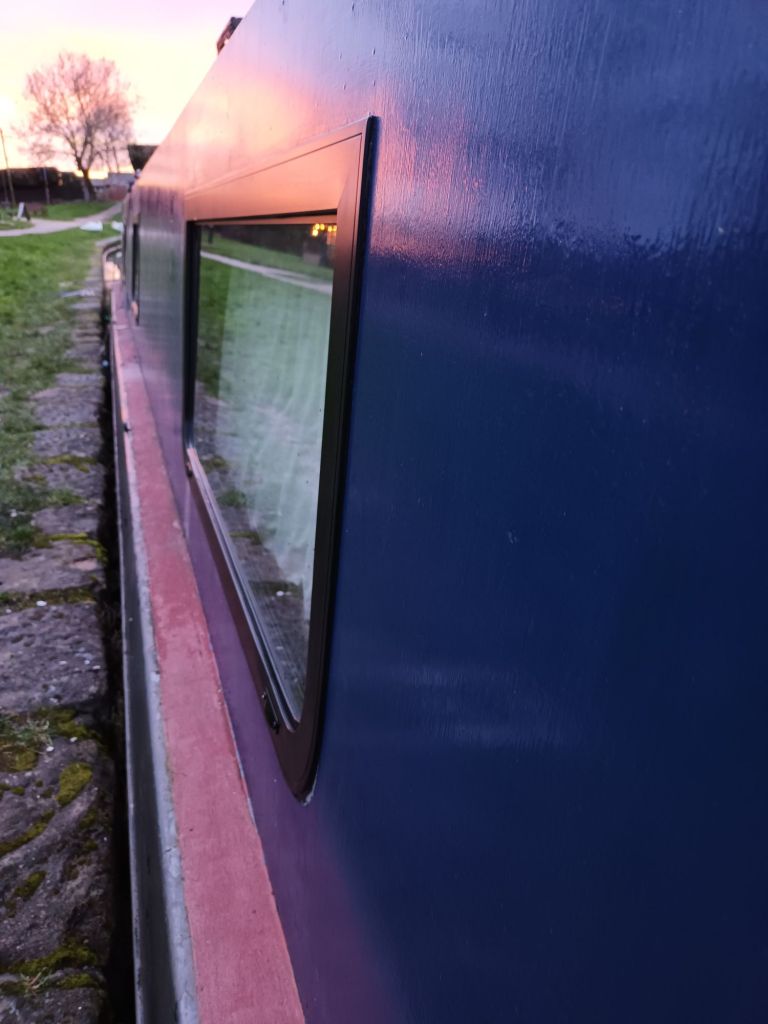
We need to cross another river, the Trent, on our trip into Derbyshire to reach a location where we have arranged to meet a window fitter who will undertake the removal of our good but old windows with new, thermal break, double glazed ones that are currently being manufactured for us in Wigan by Caldwells.


At the moment the river is not in flood, and if we can make that 12 mile, 6 lock hop this coming week we will be able to moor up for a few weeks again.

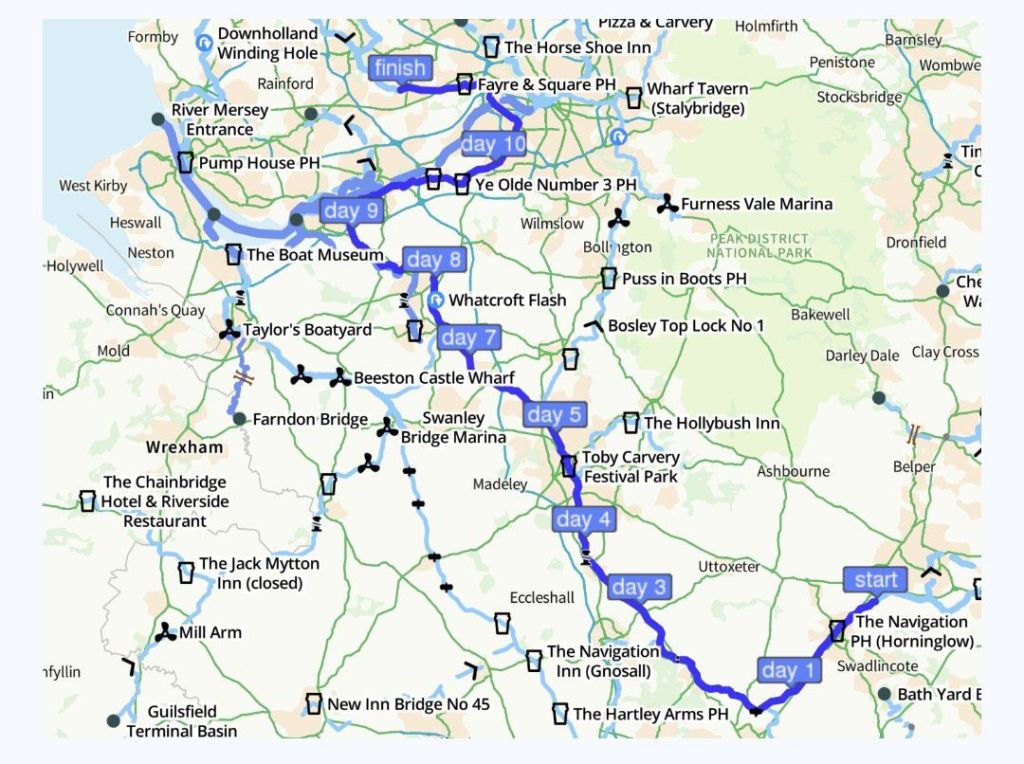
Once we have our new windows (bliss), we are then planning a longer 114 mile, 4.5 furlong and 70 lock trip that will take us along narrow canals, broad canals, through nearly 3 miles of underground tunnels and on part of England’s only privately owned canal, the Bridgewater. It’s a route we know well and will allow us to move our home nearer to be where we want to be – near another member of the family where we can be of use. But we know we can’t do that journey right now – we can only plan it because of the winter stoppages.

There are three current stoppages that would hold us up if we set off now. Two involve the replacement of lock gates in Stone and near Middlewich. These run from 8 Jan to 2 March so by the time we have the windows, we should be clear to start moving with a purpose again.

It is an advantage of a floating home and office that we can take it where we need to be. After several years of moving where we fancied, last year we ‘hurtled’ (always a strange word to use for narrowboat travel) across 201 miles and 200 locks in 21 days to where we hoped we could be useful. It was a series of very special experiences.

Now we are considering a similar, shorter trip in a different direction – another journey with purpose and the pleasurable opportunity to be able to base ourselves in another part of the country where we can do what our lovely family does so well – support each other.

It is an unexpected advantage of this floating life, which, when we first embarked, seemed such an indulgent, selfish thing to do, one that would bring immense pleasure to us alone. Now it seems that we can indulge ourselves and be of use to family too, giving us the best of all worlds. We are lucky and blessed to be able to do this.

Weathering the storms when you live and work afloat

It’s been a stormy, destructive week for so many. Hot on the heels of last week’s Storm Henk we’ve had to contend this week with both Storm Isha and Storm Jocelyn. The winds are still strong, but we seem in a time of respite with sun streaming through the boat windows.

I’ve photoboombed this one!

It’s interesting that we are already approaching K in the storm list, though I’ve seen no indication of when Storm Kathleen will strike. The last time the UK reached the Ks was with Storm Katie in the 2015-15 season. 

Since we moved into our floating home and office in September 2020 we’ve lived through 26 named storms. Some stay in the memory. All require some planning if there’s an advance warning from the Met Office, but you can’t always get everything right.

Our main choice is to get off rivers or avoid getting onto rivers when storms are forecast. This autumn we cruised down to the Midlands from Yorkshire. We had intended heading onto the River Soar to be close to family, but we are so relieved we couldn’t get on initially in October because of strong flow warnings. Since then, there have been storm damage problems along the Soar, and the level of the river has been fluctuating wildly.

Possible to see the top of mooring bollards on the Soar before it got too high

Three boats have sunk on the Soar during the recent storms.  Two still haven’t been recovered  – one up against the County Bridge at Barrow upon Soar and the other at Redhill Marina. 

Canal levels can generally be managed in a way rivers cannot as we’ve seen again this year.

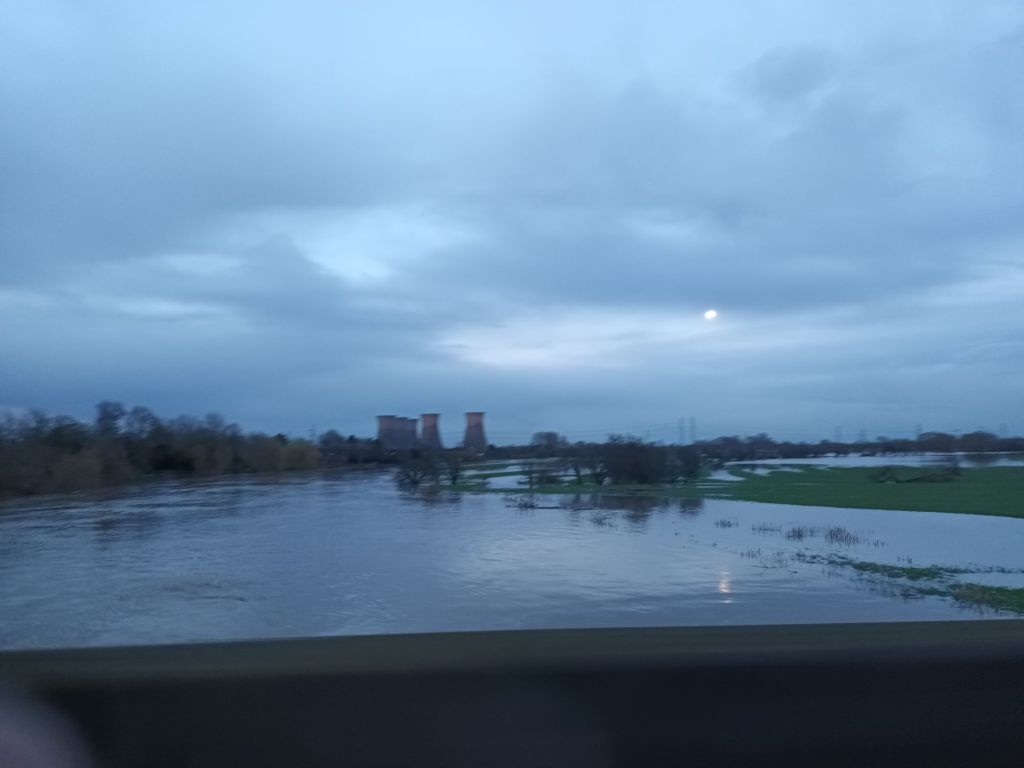
The River Soar discharges into the Trent. The River Trent has reached record levels this month, breaching previous height records set as recently as 2020. There is nowhere for the excess water in ths Soar to go but upwards and outwards.

This area of the East Midlands has been hit with rainfall between October and now, that is 150% above the average rainfall levels set between 1991-2020. Villages have flooded, as marinas too. It is surprising in some ways that so few boats have been swept away and/or  sunk. 

As storms hit, Canal and River Trust the charity with responsibility for our canals and some rivers need to work with the Environment Agency who look after the major rivers to reduce impact of flooding and manage the situation for home and business owners, either floating or static. Storms Babet, Gerrit and Henk have caused significant damage in the Midlands. But it is out of storm time when both need to work on maintenance to ensure drainage and structures are sound and effective.

As liveaboard boaters we seek particular attributes for mooring spots on canals when winds are forecast. We look both up and down. Looking up to avoid obvious tree dangers – ones that look dead or dying, ones that overhang the cut, and ones that look as if they could shed branches onto us. You can’t always get it right, but we’ve been lucky so far. 

We look down to find mooring that gives us maximum security. Rings or bollards set into firm concrete are good, as is strong metal piling alongside sound unfolded towpath that allows us to use chains around it to attach our ropes. 

We moved from a mooring on the Ashby where we were on rings but under over hanging trees on both sides of the canal,  to where we now are on the Coventry. we made sure we were stocked up with water and fuel

We are moored now to metal piling on a sound, well-drained towpath. Whilst there are trees nearby, the slope of the ground takes them away from the canal. we gave some shelter from a hill.

So far it’s been a good choice. Weve been iced in, blown about and had torrential downpours. The result has been a few branches down on the towpath and destruction limited to the bird feeders we’d put out. Mind you, finding them in the undergrowth has led to more destruction of my now less-than-waterproof winter coat.

Designer duck tape!

In 2021-2 we were on the Grand Union Canal in Chester when three violent storms hit within a week. Elsewhere in the country three people died and 1.4million people were left without power as a result of Storms Dudley, Eunice and Franklin. 

Eunice alone with its extensive flooding cost Canal and River Trust an initial £300,000 with a final cost of around £1million. That’s a lot of for any charity to find. This year they’ve had to be sorting fallen trees, towpaths washed away and some structural damage too.

We were able to tie up to mooring rings in that case, set into concrete and it all held us safe. We checked ropes every few hours at the height of the storm. There were waves with white tops coming down the cut at times. it’s only time I’ve felt seasick on a narrowboat.

A bizarre highlight of Storm Franklin was being bashed by a wheelie bin which we fished out. That was a relatively lightweight, if large, piece of debris but that is another issue of storms we shall need to watch when we do move.

There are risks for boaters of weakened buildings and trees as well as large chunks of debris floating in the water. Large branches are probably the worst and most dangerous we regularly encounter after high winds. Flooding leaves thick, slimy mud – lethal around locks and moorings. A drying wind such as we have today is hugely welcome. Let’s hope for many more of them and that Kathleen doesn’t make an appearance at all this year. 

Cracking cryoacoustics at work

Snow blankets, dampens and muffles but ice, ice has a totally different way of changing life and the soundscape.

Ice means you hear new things, you are separated but connected to other boaters in totally different, sonic ways. It disperses sound, it reflect sound waves and helps us hear more clearly.


Like so many across the UK we’ve been watching and experiencing ice this week as we live and work afloat. This week we’re moored in the West Midlands, in the lee of a small hill. That has provided shelter from the icy blasts which have swept across the countryside.

At the start of the week we were watching the ice forming ahead of us on the canal and behind us but it was mid-week before it engulfed us too. If you look along a frozen canal everything looks static, people could even say frozen in time, but this is a noisy, constantly changing environment. The ice creaks and groans, it flexes and cracks, thaws and resets in tiny patches constantly. It is always changing.

Ice changes the nature of a canal, making everything static for a while. Boats stop moving as the sharp scraping ice damages hulls and blacking. Nature forces a pause, a valuable chance to take stock and change pace.

When it began to embrace the boat on Wednesday night, when a boater friend joined us on board for a meal. Whenever one of us moved however slightly, shifting on the sofa, reaching for a glass, there was a growling protest from the encroaching ice. As she left into the icy night and we moved to the stern to say farewell, the gathering snarled in protest at being jostled and forced to reposition.


There are narrowboats opposite us on private moorings, and a sheet of ice now connects us to them in a way thawed water never can. When someone on our boat moves, it creates movement in the water, which nudges the ice sheet. The same happening on the other side of the cut means we know when anyone moves in the other boat as the ice creaks and groans against our boat. In the day, there are other sounds and distractions, but at night, when everything is still, the ice soundscape comes into its own.

We’ve also got ice inside this year because our secondary glazing has failed, but that’s a quiet companion, albeit a bit silently drippy!


The ice is a new entity, it’s an umbilical cord linking us together. It moves to make us aware when people move around their boats in the night, get up to leave for work, and when they are still and quiet. It tells them about us and how we live and move around our boat. In past years, when we’ve been iced in, we’ve always been moored with boats at a distance ahead or behind us, so being moored opposite others is a new experience, a new soundscape for us.

The ice turns the towpath into a crunching sounding board too. We can hear walkers coming crisply towards us. As we’re here for a bit we’ve put the bird feeders out and from the warmth and comfort inside by the stove we’re watching robins, a variety of tits and even a thrush or two enjoying a necessary feed.


Ice isn’t as obvious a view changer as snow, but it makes the familiar look and sound different. The regular neighbours of a feathered kind, the mallard ducks and swans who were round us regularly early in the week, enjoying the clear water by the boat have now moved away as the ice has swamped us. Nonlinear do we hear them tapping as they nibble at the weed on the waterline, or squabble noisily amongst themselves. Mr and Mrs Swan and their two cygnets from last year have taken up residence in a canalside field.

Our seasonal crackling, creaking companion won’t be around for long the meteorologists tell us, by the time you read this we expect the ice to be a mere memory and we will have returned to rain once more. It won’t go quietly either. The thaw will bring new noises to enliven our days and nights.

It is invigorating and refreshing to live seasonally, to be aware of the changing seasons, mindful of how they change the way we hear the world around us.

Coming out makes us appreciate life

Leaving the marina, after a month of shuttling between there and bricks and mortar, to return to continuous cruising is liberating and also strangely different.


We’re back living off grid, no longer connected via a 24volt shoreline to the mains. The gas hob automatic ignition no longer works, the shore light no longer operates and we have to consider each day the state of charge in the batteries to make sure they are not dropping below 50%.

All of that feels like relaxing back into normality. But there are differences, and because of the pause in ‘normal routine’, those differences are more apparent, which helps us to appreciate them. We’ve been fortunate also to be off the rivers at a time when storms and flooding have made them truly perilous.

We are heading back towards the rivers, to the River Soar to be precise, but it will be some months before we get there. We’re back to slow moving on the canals for now, and it feels so, so good.

Living is different in the daytime – there are muddy towpaths to welcome our feet rather than (often slippery) wooden pontoons and compacted aggregate paths. That means more of the outside joins us inside from boots and paws! I get more indoor exercise with a mop!

We’ve been more aware of those frozen nights, giving us a thin coating of ice across the canal, making it creak against the boat as we move inside. Those cold nights also give us the delight of crunchy morning walks.

It is at night that living outside a marina really comes into its own for us. At night where we’re moored this week, there are no lights as there are in a marina. The night is dark, velvety smooth darkness that embraces the boat and together with the hooting calls of the owls, makes for a sound, deep, dreamless sleep. Nighttime in a remote spot is the difference between mono or surround sound, a fully immersive experience.

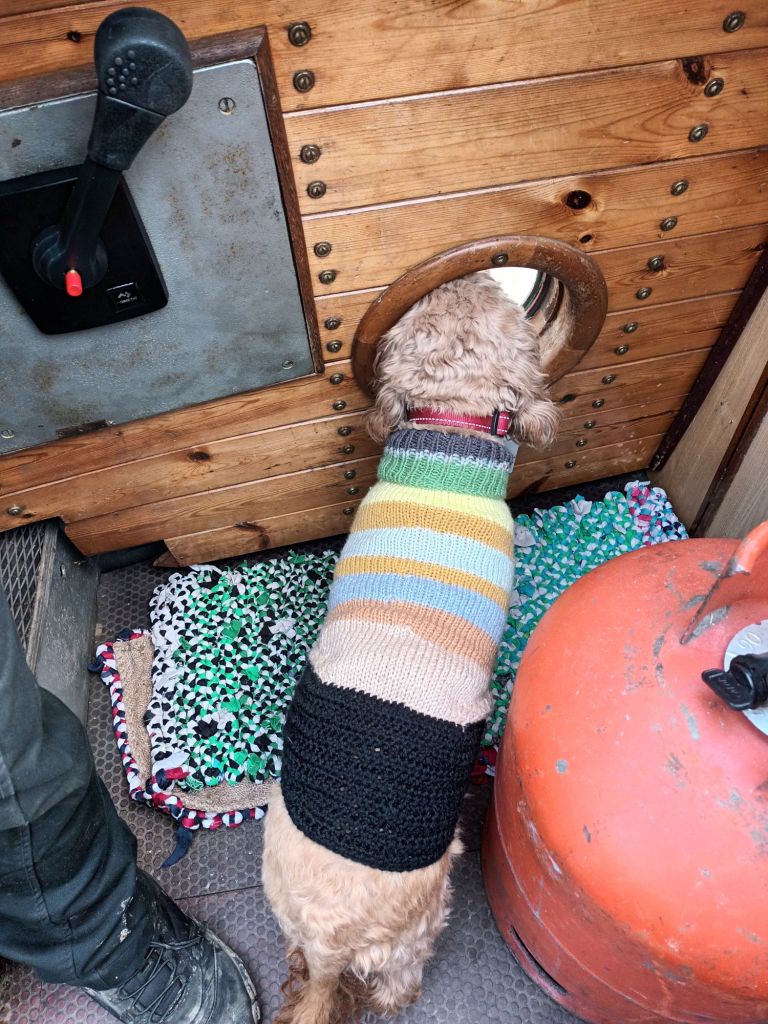
Noise in the marina has been a major issue for Boatdog. The bird scarers in surrounding fields terrified her. As a result she cowered outside her safe space of home and walks became a struggle for her (and us). Now she’s relaxing a bit although there are birds scarers a distance away, which we can still hear, and she does react, but we are reducing her terrors day by day. She enjoys travelling too and on cold days now sports a jumper I made  her from leftover yarn.

We are also back to moving the boat to sort out the basics – filling up with water is no longer available from a tap at the side of the boat, we now need to cruise to a water point. We filled up before we left, though, so that should last us for about three weeks before we need to consider finding a tap. Waste is something we need to sort more often. No longer is it a short haul of the toilet cassettes to an Elsan point on the marina or a short walk to a rubbish bin. We need to plan waste trips!

The nearest rubbish and toilet disposal we don’t need to pay for (i.e. not in a marina) is 11 miles 6.25 furlongs away. We have another 4 days before we need to empty the toilet, so we could actually go further to the next waste point if we want to.

We’ve had the invaluable and essential refill of gas and smokeless coal, too, this week so we are ready to move on.  Mark on Callisto was heading up the Ashby this week, and we caught him whilst we could. It makes economic sense and is supportive of the traditional commercial carrying on the waterways to buy from the coalboats. Most carry diesel, gas and coal, kindling, and in some cases they offer pump out for boats with toilet tanks. Many carry fenders, engine oil and other chandlery too. The other advantage is the sight of a friendly face, a chance for a chat, an opportunity to ask about conditions ahead (or behind) and catch up on news.

There are coalboats along the network, but unless we all use them, all of us, leisure and continuous cruisers, then the future for these essential services is at risk. Theirs is not an easy job – it’s heavy, hard work, but without them our life on the cut would be much more difficult and costly. They moor alongside, load directly onto our roof or into the bow, fill us up, and head off. We don’t have to move – just liaise by text or social media to find out where they are, let them know where we are and what we need. They accept cards, cash, or BACs. In the case of the coalboats, BACS stands for Brilliant And Convenient Service!

So we’re back in the comfortable, comforting  routine of musing over where we go next and at what pace we want to move, how long we want to stop on each chosen mooring, whilst tasty scents from pans simmering on the stove fill the cabin as we slowly cruise. It is leisurely and relaxing whilst being active and demanding at the same time.

Our sojourn in the marina and in bricks and mortar with the family was wonderful and hugely enjoyed. An added bonus has been the increased appreciation of our life together on the water – absence after all, really does make the heart grow fonder for this life we’ve chosen.

Heading out into the unknown

It’s been a harrowing start to the new year for so many. We know of boaters who have lost their homes, been washed off moorings by rising flood waters and either damaged or sunk by water or falling trees.

Not our pictures but these photographers captured the terrifying reality of the past week fot some whose homes have been marooned or lost

We’ve been hugely fortunate having made the decision to base ourselves in a marina with controlled water levels and secure moorings but this weekend we’re heading back out to where we belong – travelling the canals and (eventually when they become navigable again, the rivers).

So this is preparation time. We’re making the most of the mains electricity we paid to be connected to. The washing machine is going flat out and we’ve taken the opportunity to do one really hot wash (we normally wash on cold).

This is supposed to be part of the item in the picture below!

The old throttle and gear handle (officially the Morse control) came off in my hand on Steve’s birthday as we made our way from Middlewich and Steve made one of his fantastic hasty repairs. This is what we use to go forwards, backwards and alter the boat’s speed for mooring so when we’re on the move it’s working hard all the time. Despite its temporary repair it still had to be nursed with care through all the remaining months, and coming up through Atherstone Flight was nerve-wracking wondering if it would snap again.

This is it in pieces still as I write. It needs to be together if we are to move this weekend…

We think it may have been an original handle, so it’s given good service for over 30 years, over many miles and through many locks. Finding a new one at a reasonable price was no mean feat, but Steve sourced one and is now in the process of installing it with his Christmas presents of new throttle and gear cables.

While he’s doing that I shall be filling us up with water while we’re moored right by a water point, emptying all the toilet cassettes, finishing a Spring clean whilst I’ve got the immersion heater working and giving loads of hot water and washing all the rag rugs at the same time.

Measham teapot and ginger jar secured 🤞

I will be checking anything that could suffer from engine vibration is made secure – memo to self we’re running out of non slip fabtic and bluetack! Boatdog will no doubt be staying out of the way, snuggled on her bed that was (to her delight) washed earlier in the week!

Once we’ve finished all frantic activity, we will no doubt indulge in long hot showers in the marina’s showers with their underfloor heating and never-ending hot water!

It has been a good move for us to have had the boat in a marina for the past 5 weeks. We’ve been away from her often, and it’s been comforting to know she would be OK with people keeping an eye on her. When we’ve been back onboard, we’ve been grateful for strong mooring points as storm winds have rocked and buffeted us. We haven’t had to worry about finding moorings away from trees that might land on us or trying to moor into saturated ground. We’ve had the car with us and benefited from secure parking that hasn’t flooded, so the pluses have been many. We haven’t had to contend with flooded, muddy towpaths, either.

But for us, it is time to get back on the cut. We have missed it. We miss moving; miss mooring in dark,unlit places with only owls for company; miss seeing new places; watching wildlife in their homes outside ours; miss the changing views from our windows; miss discovering towns and villagss we would never have stopped in without our floating home: and most of all we miss the feeling of freedom.

Where will we go? We will go safely, and slowly without any rush. Our first intention is to head off the Ashby, along the Coventry, onto the Trent and Mersey. That will take us some weeks – yes, weeks! We are heading into Derbyshire for a major change to the boat! Exciting times ahead.

Whatever the year ahead holds for you, we hope you are warm, dry, and safe. That there are things to look forward to, adventures to be had familiar things to bring you comfort amid much to bring you joy. For us, those all come from our family and living out on the cut.

Wishes for you for 2024

We wish you a healthy and happy year ahead.

We wish you contentment and calm: peace and perspective.

We wish you love and laughter, tears of joy alone, and the chance to make happy memories on your journey through 2024 to last a lifetime.

May you find the courage to follow your dreams wherever they lead, embracing what you find along the way.

May 2024 be special for you and those you love.

And may most (if not all) of life’s locks in the coming year be set in your favour.

Happy Christmas!

This Christmas, some former UK veterans will celebrate having homes thanks to the charity we’ve donated to in lieu of sending cards. They won’t only have a home, but one that floats with all the benefits we know that brings for physical and mental health.

Bringing boats that need new owners, often boats that have been abandoned, back into use for homeless veterans many of whom also feel abandoned, is valuable work. It has galvanised many companies, individuals in the boating world and former veterans to unite in working together to get boats ready for service, but anyone can get involved. We know what it takes to renovate a boat – you need many, many skills!

There are jobs for everyone in such a wide-ranging project. Every boat demands multiple jobs, from skilled plumbing, electrics or engine fettling to making curtains and furnishings. General tasks of sanding, washing, cleaning, scrubbing and when boats are being moved to be worked on, there’s lock wheeling to do (that’s something we’ve been delighted to help with), are tasks for everyone, skilled and unskilled.

Lockwheeling for the amazing Pete Ballinger as he towed nb Capricorn in for Forces Vets Afloat in 2022.

Christmas is a time when every charity is vying to get their important work recognised, seeking donations in an ever-shrinking pot as people struggle with the cost of living and the cost of festive extras. For us Forces Vets Afloat has resonance through its connection with the forces, with canals, with providing people homes which change lives, and in an environment which brings a combination of challenge and calm. If you’re a boater looking to gift your own boat new ropes you can support the charity by buying ropes through their website www.ForcesVetsAfloat.co.uk –

The winds of Storm Pia are rocking our own home, and rain is lashing against the windows as I write this. Being homeless in any weather can be soul-destroying but at this time of the year it seems even more poignant. Having a home which offers shelter and security but can also physically transport anyone to a new, rewarding way of living is a truly remarkable life-changing gift. It’s also entry into a wonderful, supportive community.

Delighted to spot what I was convinced was the Christmas star on the Coventry Canal (actually Chris Hicks’ wind generator but that’s a bit too prosaic for this time of year!) 🤣

Giving isn’t just for Christmas – it can make us all feel good at any time of year. The skipper is off giving blood as I write, something we both organise to so as often as we can through the year whenever we are near a donation point.

Whatever you are giving this Christmas and throughout the coming year – enjoy your giving.


Book keeping at this time of year

As well as the perennial “Isn’t it cold on board?” many people say they couldn’t move onto a boat because of their books.

When we first moved afloat our books were a massive stumbling block, books from childhood, books from academic life, literature we grew up with, those books that drew us back time and time again, and those that formed a fundamental part of us, like Steve’s entire Arthur Ransome collection of which he had two sets – one bequeathed and one gathered over years. We couldn’t fit them all on a 50ft home if we were to live there with them, but we couldn’t get rid of them. What were we to do with these much-loved friends?

Some books were easy donations to charity shops and second-hand book stores, friends, former colleagues, and family, but not as many as we hoped went this way. The rest were divided into two piles – keep and reread before making a decision. We spent a very happy time rereading, and that helped the charity shop pile to grow but still left an alarming number of books to keep. Some were paperbacks, some big hardbacks. Size matters on a boat, but it didn’t make life any easier. There was the world cookbook my late brother gave me, a weighty tome which has his inscription to me on the flyleaf. I can’t part with it, but as a sailor, he would have understood my recognition that it cannot come aboard. But it must be kept. Every book in storage costs so those we are storing we have to love, and to be reunited with one day, either by making more space on the boat (perhaps by saving up for Kev Kyte and his wizard welders to expand our boat by a library), or if we return to bricks and mortar at some point.

We finally put just 8 boxes of books into store (one box of Arthur Ransomes). We have two book cases on board that have to double as storage as well as homes for books. The second set of Arthur Ransome’s reside under the bed (if I’m honest I’m not sure why – maybe they feel at home there)!

What makes this even harder is that we keep acquiring books and reading books, and the canals help us with this. Book exchanges exist across the network, in lock keeper’s huts (like at the Atherstone and Hillmorton flights – T&M and Oxford), toilet blocks (Norbury Junction, Willington and too many more to mention across the network), ex-telephone boxes all over the place (like at Crick near the shop), and in some cases (Stoke Golding on the Ashby, Berkhampstead on the GU) outside houses near the canal. Every one has gems that call out to be brought back and explored, that give us new ideas, new thoughts, new journeys, that terrify, amuse, have us laughing out loud or trembling under the covers hoping the doors are all locked!           

Book exchanges expand our minds in gloriously unexpected ways and allow us to share too

This year I’ve read hundreds of books, and there are always books my wish lists. I’m just finishing this year’s wonderful October birthday gifts. Raynor Winn’s The Salt Path is another story of a couple who were made homeless through trust. They found themselves without a home and facing a medical death sentence. Their story as nomads, walking the coast, is as inspiring and full of hope as it is haunting. Descriptions of nature and its power are familiar, even though the setting is far from us. The reactions of people to them make you question which you would be and which you would want to be – ignorer, giver, aggressor. Winn’s writing has changed how I see those with homes on their backs. It is a book that has made me try to be a better person.

Books change how we behave and act.

Some books are sheer escapism and utterly bonkers like another birthday delight – Jonas Jonasson’s The Hundred-Year-Old-Man who climbed out of the window and disappeared. It gives me hope that proper old age doesn’t have to be boring! Criminals, murder, a 5-tonne elephant named Sonya, incompetent police and even marriage await the centenarian prepared to head off in search of adventure (and vodka).

Mary Colwell’s Curlew Moon has made me tread more carefully on my path, setting me actively planning to head back to the sections of the Leeds and Liverpool Canal, where the distinctive call of the curlew and their unmistakeable outlines abound. Learning more about these delicate ground-nesting birds and their fight for survival keeps me to paths with Boatdog firmly on a lead at nesting times.

Books change our behaviours, thoughts, and understanding.

Living on a boat changes people too. It makes us more generous. We know we can’t keep every book but we can read, enjoy, benefit and then share them for them to wreake their magic on others.

This year on board we will indulge ourselves in the Icelandic tradition on Christmas Eve of Jolabokflod. We will give each other books and experience the joy of reading together in the cosy warmth of the stove. [We don’t have the entire family on board for Christmas – that could be a bit crowded but this year’s family Christmas doesn’t start until 26…we are unique!].

We can’t get up to the amazing Barter Books on our narrowboat to find books for each other from there, but this year we are close to the astonishing Astley Book Farm near Bedworth (thanks @nbmomentous), so we’ve been there to find festive delights for each other. We each chose for ourselves and then bought the other’s choice as well as choosing a surprise for the other! What would you choose?

That’s handy!

As a result, our Christmas afloat with just the two of us and Boatdog will be as indulgent as two bibliophiles could wish.

📚 + 🍷/🍺 = ❤️


Our Christmas Survival Guide

We’ve already begun our family Christmastide, so now seems a good opportunity to share what we’ve learned over the years. Every family is different, so what would you contribute to a survival guide?

2024 festivities have begun for us

Create a plan so everyone can contribute and feel part of the festive season in terms of what they buy, bring and do within their budget or opportunity. We’re lucky in having a family spreadsheet (even more fortunate its not run by me) which lets us all share the costs and shopping for the festive season.

Harmony is what really matters. It’s only a few days so bite your tongue, count to 10, pretend not to hear and/or remember you really do love them all. [This is my personal reminder]

Respect that everyone has different needs at this time of year – it’s a tough time for many.

Identify what brings you (and others) stress at Christmas and pare it down or cut it out, from taking on all the cooking to spending time listening to Great Aunt Edith’s complaints

Simplify everything to make space for what really counts the things you all enjoy and love doing

Take the chance to spend time with everyone and let everyone spend time together

Make some gifts and decorations if you can – homemade says so much about how much you care – or if you’re in Leicestershire come and buy some from the Moving Crafts stall at the Swan Inn, Mountsorrel on Saturday 16th December between 12 and 4pm

Ask what everyone would like to do, to eat, to drink and get them on the list so there’s something for everyone and no one is forgotten

Share the planning, preparation, cooking and entertaining of small children. Each task is fun if you don’t have to do it all or all the time.

One funky homemade Robin getting ready to roost in someone’s tree

Space – we all need it however much we love each other

Understand as much as you can everyone’s perspective

Revel in the free things of the festive season – time to walk together, time to enjoy each other’s company

Value each other – everyone is different and amazing and this is a chance to spend time together

Include everyone who wants to be included in activities and recognise some will want to sit some out

Value traditions or make this the year to create some new ones

Activity is vital – exercise brings rosy cheeks and breathing /head space

Laugh together – my memories of Christmas are us all laughing until my sides hurt and tears stream down my face, usually at something utterly ridiculous


Games are a key part of our Christmases together but Monopoly has been banned for some years the sake of peace

Underline the important and make time for it – that’s what is important not just to you but to everyone around you at this festive time

Indulge in the things you all love – walking tours of nearby Christmas lights, a festive visit to the pub together, carols, or charades

Do remember less is more in food, drink, decorations, and presents but that doesn’t mean you love someone less, just that you’ve put more thought into maximising what matters

Enjoy your Christmas when it comes 🎄

Winter of some content…just

December and winter came hand in hand to a canal near us as they did for many people in diverse locations this week.

We love winter on the boat when it’s crisp and cold outside and cosily comforting inside. The cold as we open the back hatch takes our breath away, but when we return to the boat, we are embraced in the all-enveloping warmth from the stove. My favourite winter activity is stepping down into the boat!


Monday started this week with mud, gloopy, boot-sucking, paw-encasing mud. Tuesday, I spent working at the computer toasting myself gently beside the stove, enjoying the sun streaming through the window beside me. On the odd occasions I moved from the computer to the kettle and back, Boatdog instantly chose to keep my seat warm (or pinch it as the case may be!).

By Wednesday the towpath was crunchy as temperatures dropped and mud froze. It made for much easier walks and running, and brought some stunning sunsets. The evening colours here in North West Leicestershire are truly remarkable, and at this time of the year nothing short of stunning. The only trouble in November is that the light disappears rapidly – not helpful when bumbling off down the towpath for a run and finding oneself returning in near total darkness. At least there’s more chances of seeing tawny owls in the fading light even if it’s almost impossible to see where you’re putting your feet! Memo to self – keep a head torch in your running jacket whatever the time because enjoyment often makes you stay out too long! 


Thursday, though, brought a different feel to the canal as well as the towpath. As we woke and began moving about on the boat, we could hear ice cracking around us. The first freeze of the canal this winter for us had begun. Normally I welcome the ice, but not this week. This week, for once, we had places to go, and ice can stop narrowboats in their tracks.

In the days of commercial canal traffic there ice breakers were employed to keep the waterways open. These heavily plated vessels were generally narrower than a standard barge, that helped prevent them getting stuck in pack ice, particularly around locks or bridges. As the ice became thicker, more and more horses would be attached to pull the boat through the cut. The record apparently was 16 horses attached to a single boat!


This week we are leaving our home for a while to join the family for pre-Christmas celebrations together. Just as in a house, on a boat, freezing weather can cause pipes to burst with horrendous results. We don’t want to completely drain the pipes and water tank. As our only heating is the multi-fuel stove without us being on board there’s no one to stoke the stove, and so everything on board will get cold and potentially damp. That’s not a good feel for any home and its contents.


So another advantage of a floating home is the capacity (theoretically) to move it to somewhere where it can stay warm and safe whilst we’re away. That is unless the canal freezes and stops you moving! Ice can cause scratch damage to blacking and paintwork on a narrowboat. It can be far more serious for GRP cruisers. To be honest, when there’s ice, we enjoy staying put, often enabling us to put off moving day and outstaying the 14-day maximum stay on mooring spots.  However, this year we had booked a space for the boat in a marina where we could attach a mains power cable, pay for electricity and leave a small electric heater working on board to keep the chill off whilst we were off the boat. That prevents pipes freezing, stops mould and damp, and also makes our home rather more pleasant to return to in time. It would be a shame to spend the whole family Christmas celebration wondering what on earth we might be returning to.


Thursday morning was sinking heart time as we were due into the marina on Friday early. The forecast had suggested a cold night, but somehow, the amount of ice around caught me by surprise. The forecast for Thursday night meant an early start on Friday to get to the marina would be impossible. We took the decision (with fingers crossed) that by early Thursday afternoon, if there was enough of a thaw to let us move safely, then we would before the cold air returned to create another freeze.


It was a bit of an anxious morning on Thursday but after lunch there was enough of a thaw to be able to turn the boat and head south once more. We made it to the marina to be greeted warmly and headed to our berth to revel in the sheer bliss of getting off onto a pontoon (duck and goose poo is better in many ways than mud as you step off, and even better when frozen!).


Within hours we were attached to the glories of mains power, and revelling in hot, unlimited showers as well as finding water and waste disposal just steps away. This is how the other half lives it appears, and on the few nights we are on board and the many more we are away this month it will be a real gift to ourselves and our boat.


Boatdog has been a little unimpressed so far because the power has allowed me to put the immersion heater on to heat enough water to give her a nice deep bath to wash away all that previously collected mud! She dried rapidly by the fire and now all clean and fluffy has been able to take up a new role as a fascinated bricks and mortar Guarddog.


As we enjoy our family pre-Christmas Christmas – we wish you a warm and safe start to winter and December.