Wonder is wonderfully inspiring

Sometimes I wonder how I manage to get up in the mornings, and other times I marvel we manage to get anything done at all, such are the myriad distractions on offer but to be able to wonder, to marvel at something created by man or nature can be truly breath-taking and inspirational.

We’ve encountered two manmade wonders in this past week alone – and another that combines the wonder of nature with the ingenuity and skill of man.

Over 50 years ago, the Seven Wonders of the Waterways were compiled. Robert Aickman, supernatural fiction author and active conservationist, was responsible for the original list. Together with LTC Rolt, he co-founded the Inland Waterways Association, and his list was one way of encouraging people to explore the waterways to keep them alive.

This week along we’ve travelled two of them – the remarkable Anderton Boat Lift and the Barton Swing Aqueduct.

The Anderton Boat Lift is something we’ve visited in the past but never been able to travel on until now. It towers on huge metal legs astride the edge of the River Weaver. In huge watertight tanks, each moved by a massive single piston, it transports boats vertically up and down the 50-foot drop between the Trent and Mersey Canal and the River Weaver.

Now transporting leisure boats and a trip boat for the delight of those without a boat of their own, the massive Meccano-like structure was built in 1875 to lift cargo boats carrying salt, pottery and coal to the international port of Liverpool and returning laden with foreign goods.

It is surprisingly slow – and at the moment of departure, it is currently quite jerky when it starts. This is apparently due to the tightness of the seals that were replaced last year.

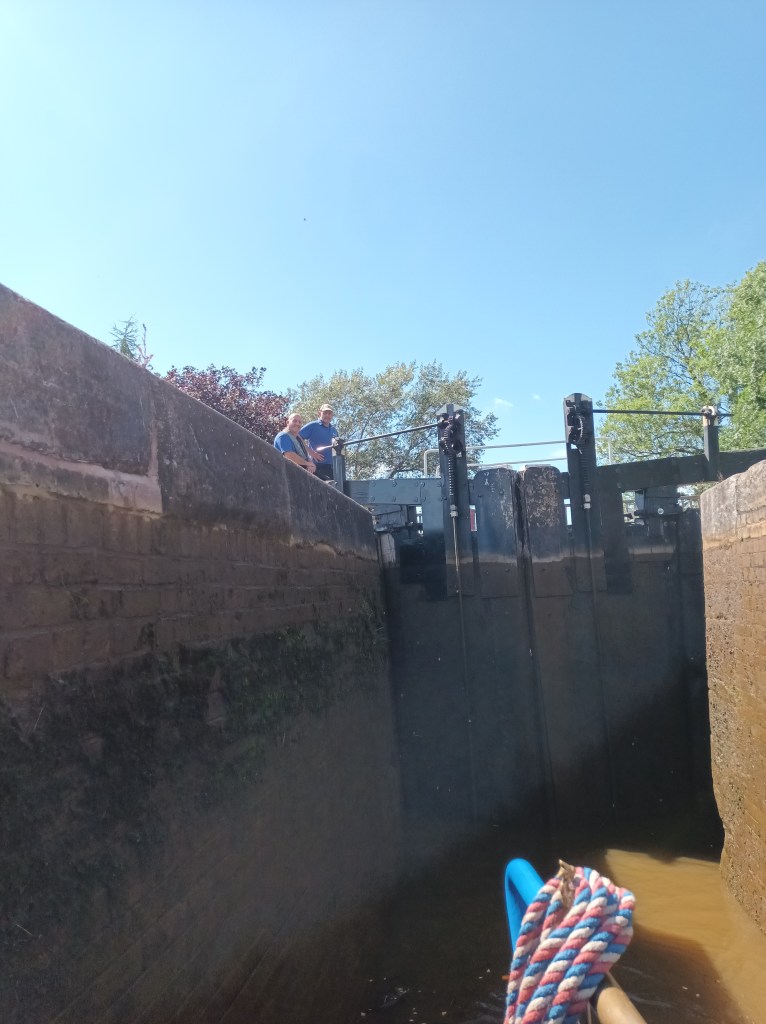
Two narrowboats can be transported a time. One at a time they move into the entrance to the available entry tank when a guillotine gate is opened to let them through. Once both are in and positioned side by side, the gate is closed behind them, and the next water tight gate pulled up to enable them both to move through together at a signal from the operator. This positions both boats in the moveable caisson, they tie to the side, switch off engines and begin their journey. We turned from the Trent and Mersey into the entrance of the lift at 10.18am and at 10.49 we restarted our engine, cast off the rope and headed out onto the River Weaver. It is a remarkable feat of engineering, and certainly wonderous, not least to be still operating today.

We just voyaged to Northwich along the river to buy milk and supplies before heading back the same day, another lift journey up above the Weaver. The journey back was infinitely noisier than the descent courtesy of the boatowner who came up alongside us and insisted on playing his music at volume the entire time. Being British we said not a word – but he couldn’t have heard if we’d tried! Thankfully, we had experienced how remarkably silent the mechanism is on the descent in the company of a delightful couple from South Africa enjoying the waterways.

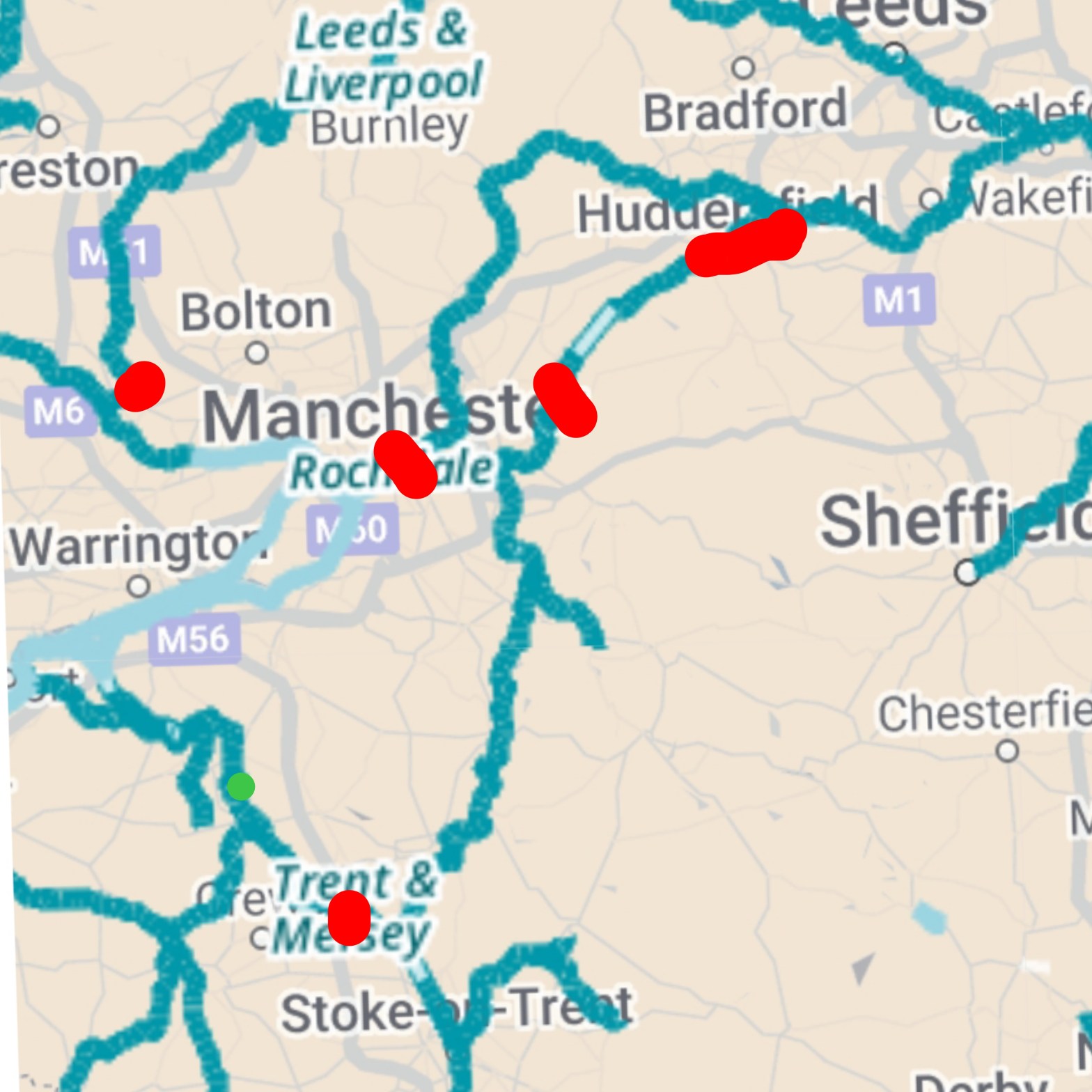
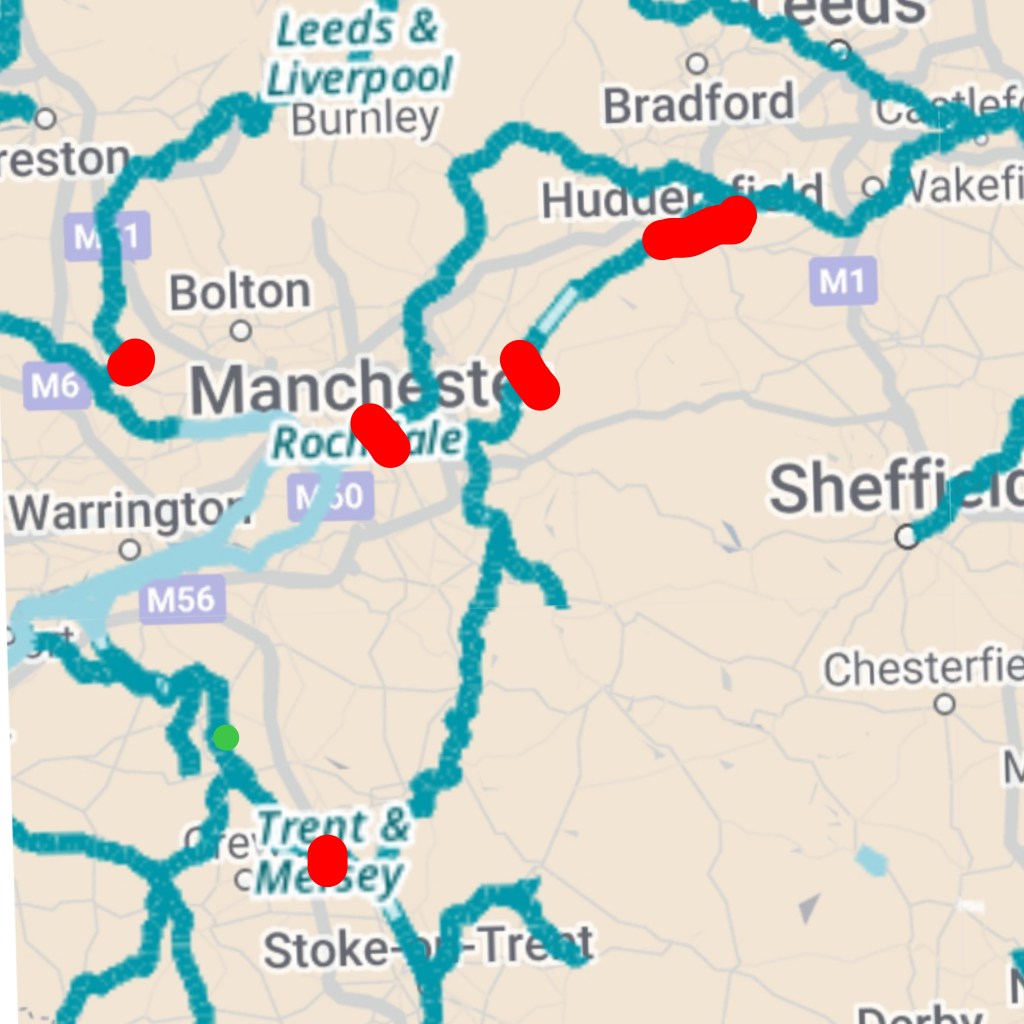
From our return we had just 6 miles 5¼ furlongs remaining on the Trent and Mersey before joining the waters of the Bridgewater Canal, a 39-mile private waterway operated not by Canal and River Trust nor the Environment Agency, but by The Bridgewater Canal Company, an arm of The Peel Group. It stretches from Runcorn to Leigh in Greater Manchester, and features one of the Seven Wonders of the Waterways, the Barton Swing Aqueduct.

This swinging aqueduct enables the canal to cross the Manchester Ship Canal which carries large commercial vessels. It opens to allow these big boats through, and is the first and only swing aqueduct in the world, and still operating today. It was originally opened in 1894 and was designed by Edward Leader Williams, the same engineer responsible for the Anderton Boat Lift.

We have on our travels to date been remarkably fortunate to have experienced and marvelled at four of the other original Seven Wonders of the Waterways –

The Pontcysyllte Aqueduct over the River Dee on the Llangollen Canal

Standedge Tunnel – the deepest, longest at nearly 3.5miles, and highest canal tunnel in the country burrowing under the Pennines

Bingley Five-Rise Locks – a staircase flight of 5 locks completed in 1774 since when they have continued transporting boats 60ft to and from the Yorkshire Dales.

Burnley Embankment – a mile-long embankment through the heart of the Lancashire industrial town carrying boats above the rooftops of terraced houses some 60ft below.

So the one original wonder that we’re keeping as a treat for the future is the Caen Hill Flight of 16 locks which rises across the Wiltshire countryside near Devizes.

Over the years people have added other wonders they’ve found, and we can add many, but on this trip we also discovered the delights and wonders of RHS Bridgewater, a manmade wonder of nature. When we’ve passed before it was a building site and now it is a developing, glorious riot of colour and form, shape and a seemingly effortless blend of formal and informal spaces. Definitely wonderful!

In other news we’re on tenterhooks, trying our first bit of trading this weekend having finally sorted the insurance. GULP! More wonder – will we sell anything????

Managing the stresses and strains of travelling

Managing stress applies as much to the seemingly laidback life on a boat as it does to bricks and mortar, 9-5 working, or travelling across the country in other ways.

This week has seen us travel from Barlaston to Anderton, a voyage of 34 miles and 41 locks through the heart of the Potteries, underground via the Harecastle Tunnel, down the locks of the Cheshire Flight aka Heartbreak Hill, into and through the town of Middlewich and on towards Preston Brook, the end point of the Trent and Mersey Canal.

In the past two weeks we’ve travelled a total of 113 miles and worked 65 locks. At a maximum of 4mph we’re doing well. Drivers stationary on the M6 when we passed underneath them were shouting out that they’d swap with us – needless to say – we didn’t take up the offers!

The weather has been with us too, but this week has been far from plain sailing. For many boats doing this route alongside us, it has been a hugely stressful week, and it could have been the same for us, without our automatically employed anti-stress strategies.

Prevention rather than cure is one key stress management tool. Approaching the Harecastle Tunnel we took the chance to delve into the weedhatch to pull off anything clogging our prop, and managed to get some muck off which would have made steering more difficult. But then, as we headed towards the 2.6 kilometre-long tunnel, we developed a horrible rattling and clunking. We pulled in and tried to resolve the issue – taking off the weedhatch and reattaching it, resiting the paint tins stored around it, and phew – noise resolved before we were ushered into the tunnel and the doors clanged shut behind us.

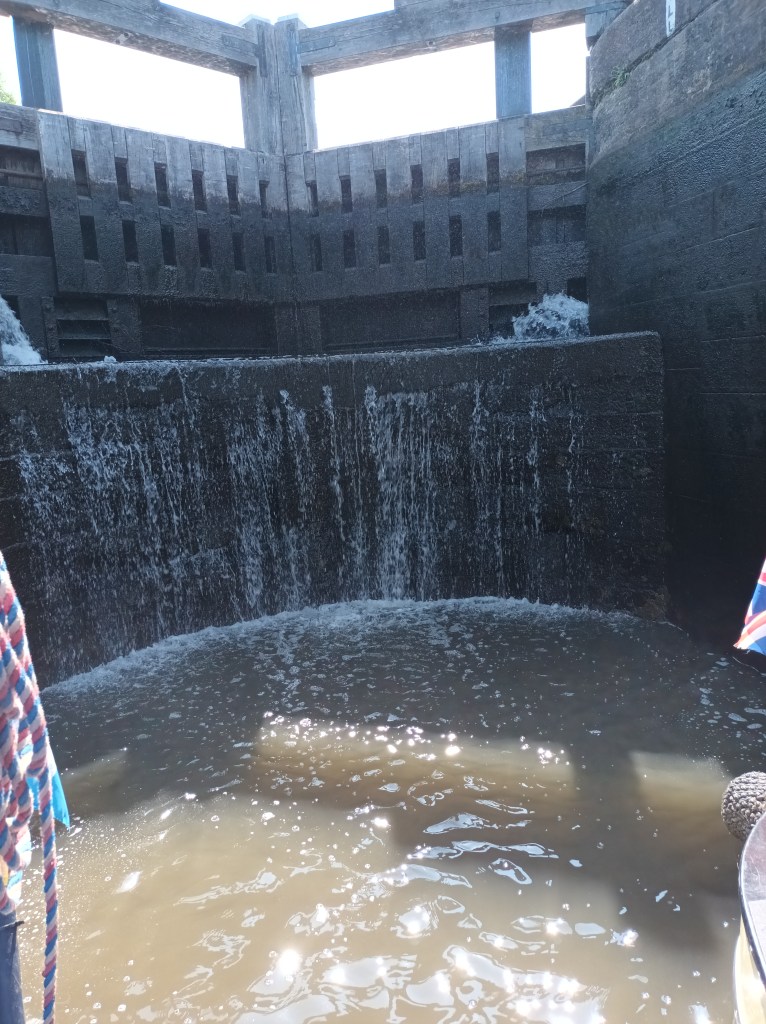
The issue of this week really was, once again, the ageing infrastructure of the waterways network. All was going well until we left Lock 67, Crows Nest Lock, the first of the three locks on the Booth Lane Flight in Cheshire. A man walking a black Labrador called across to us that further ahead, a pound (the stretch between locks) had no water in it at all. As I left the lock, it became apparent that the pound I was entering was low and getting lower. Mud banks had formed at the sides, and I needed to stay firmly in the central remaining channel to avoid getting stuck. Rounding a bend to the next lock, I could see three boats already moored in a queue in front of the lock, clearly aground from the odd angles of their tunnel bands.

I came as near as I dared, managed to moor up, and we set off to explore taking the dog for an unexpected additional and appreciated walk. Sure enough, Canal and River Trust (CRT) staff were already in attendance, and Lock 69 was clearly out of action.

A ground paddle had given way, but by the time we walked down, repairs were almost complete. The issue then was refloating the pounds, both the one between 68 and 69, but also the one above 68 where we were waiting. Below lock 69 another 4 boats were queued, and by the time the dog and I returned to rejoin our now stuck-in-the-mud home, another two boats had appeared behind us.

Around us some boaters were getting stressed by the delay – holiday makers worried about getting back to their home bases on time, boaters out of their marinas for a few weeks with bookings to keep further on, and some people who just hate it when things don’t go according to their plans. The delay was put to productive use for us – time for a cuppa, with biscuit treats (thanks Mum), and an opportunity to make an appointment for a haircut in Middlewich (for the next day so we didn’t have to worry about the length of delay). I also managed to make the dog an appointment in Greater Manchester for her booster in a few weeks time, and Steve had another long conversation with insurers. We are trying to set up a floating trading business and it’s proving a nightmare to get the required public liability insurance so we can get a CRT trading licence. Stock is building up on the boat, making space tight, and we need to sell stuff, but we can’t! Frustrating, but we take a deep breath, recognise it might take time, and keep trying.

We took our coffee onto the towpath for a chat with those around, discovering more interesting people, meeting a delightful travelling cat, and some very friendly dogs as well as their owners. It gave me a chance to really look at some beautiful marsh orchids, growing alongside the towpath on the canalside, orchids I might have missed if I’d been “dashing” from lock to lock. Stress buster no. 2 – look and find the positives in a situation.

Once the water came we refloated almost happily – in reversing to get us off the mudbank, I managed to get hit by a gust of wind and got very close to managing a Suez moment! That felt a bit stressful but with the help of Steve on the bank and a centreline hurled to him we were sorted. The boat ahead of us wasn’t so lucky. The lock was open ready for them, but they were unable to get to it. So wedged on a ridge of mud eas the boat that it took 6 people to get them shoved off and underway once more. Those of us behind edged tentatively past the spot where they’d had issues, trying to stay as near to the middle of the canal as possible.

Boats coming up faced issues too – the Canal and River Trust workboat was wedged in the mud well and truly as we headed down and away. According to a volunteer we met when leaving Middlewich, it took some considerable time to free it.

The solution for us in avoiding stress is to factor in potential delays. We had appointments to keep in Middlewich but we’d allowed ourselves an extra 24 hours of travelling time just in case of delays. If we arrive somewhere early, we have extra exploration or chill time. It’s a bonus – not a stress. We spent a happy 48 hours getting some work done on the boat at Middlewich Wharf, getting my haircut and socialising with friends before we headed off once more.

This weekend, finally, after years of trying, we are going to experience The Cathedral of the Canals, the Anderton Boat Lift. We have booked our slot, and we ready in place half a day early. The 25-metre-tall lift – England’s only working boat lift – will take us the 15 metres down from the Trent and Mersey to the River Weaver below, and we’ll return the same way later in the day. Fingers crossed there are no breakdowns, delays or dramas with this trip – not sure I’d like to be stuck part way up or down – but if we are, I guess I could use the time well to begin knitting a jumper I’ve been asked to make! Find out next week what happens!

The week that was was – high speed, highly positive and unexpected

If we had any doubts about why we live afloat this week has surely banished them. 

We started our week in Braunston, the Northamptonshire junction which has been a focus of the waterways for writers, artists and photographers for generations. It used to be buzzing with working boats, but now houses a flourishing marina, the invaluable Tradline rope and fenders, a chandlery, art business and for those drawn these days by good cakes and breakfasts – the floating attraction of Gongoozlers Café.

An added attraction there was a grass snake swimming across the canal – everyone thought it was a stick at first, and I failed to get pictures although they aren’t uncommon swimmers at this time of year. 

Braunston was where we picked up our 5-year-old lock labourer and apprentice skipper. With him aboard, we moved on, through the triangular junction with twin Horseley Iron Works towpath bridges that forms the meeting point of the Oxford and Grand Union Canals. 

 Through 10 miles we chugged on in the sunshine, passing squawking moorhens chiding their bobbing black pompom chicks, swans calmly marshaling new cygnets and avidly counted ducklings trailing their mallard mums trying to see who had the largest family to cope with – 12 being the record.

After the three double locks at Hillmorton, the crew required a well-earned ice-cream halt even with the help of volunteer lockies. Double locks were introduced to canals to cut down delays and enable faster cargo carrying. 

At Hillmorton we fished out plastics with our nets as we headed down the locks, so that meant a trip to the waste bins before we moved on to Newbold and a mooring before the tunnel near a pub that promised a playground. It didn’t look brilliant but entertained happily for several hours. 

Sunny Sunday took us through the little Newbold tunnel, and on for another 12 miles until we passed through the smallest lock our young labourer has ever moved and with the help of a volunteer too – the stop lock at Hawkesbury Junction.  Stop locks are a matter of a few inches only – they were originally used as a way of water companies controlling use of their waters – in this instance marking the move from the North Oxford onto the Coventry Canal.

We tied up on the Engine House moorings and had just settled for a meal when we met new boaters on their first week out in their new boat – they hit us which is always a good way to make sure you get attention! We were glad to help them sort out mooring for the water and provide a water connector – someone did that for us when we mislaid ours, so we are always glad to pay a favour forward. 

After a quick trip to the fudge boat, it was time for our crew to reduce in numbers and for us to dispose of the car to enable us to travel more rapidly. When leapfrogging a car, we have a choice. One of us can move the boat and the other the car, or we can both move the boat and then one of us or both of us walk or cycle back to get the car. It slows us down and interrupts the flow of cruising.

For our new furry crew member this was obviously another series of new experiences, making it back to the boat from leaving the car by bus, two trains and a taxi. She managed it all and jumped back on board with alacrity when we finally made it home.  

That face 😍

Monday took us from Hawkesbury to Polesworth, moving on in more sunshine through 16 miles and 11 locks. These locks came in a single block or flight at Atherstone. Before we tackled them, we took the chance to nip into Atherstone for some shopping to refill the fresh food stocks although we are self-sufficient at the moment with lettuce, spinach and radishes growing well on the roof. With the help of voluntary lock keepers, boaters taking show boats up to Crick for the Bank Holiday weekend boat show and with holiday boaters as well as some kind walkers eager to help with closing gates, we made it down the entire flight in 2 hours 3 minutes. 

Leaving Polesworth

Polesworth is a Warwickshire village that once provided coal and clay, and food for thought via the Polesworth Circle which attracted literary greats like Ben Jonson, John Donne and others. Its art remains thought-provoking.

Support systems art/words under M42 – pit props, wives and mothers, roots

We headed through Tamworth to Fazeley Junction, dropping down the two locks at Glascote, and moving onto the Birmingham and Fazeley Canal. Such is the nature of the floating community that we waved in passing to boaters we haven’t seen for years, enjoying a shouted catch up as we moved north and they south. Good to see them, and see them looking well. 

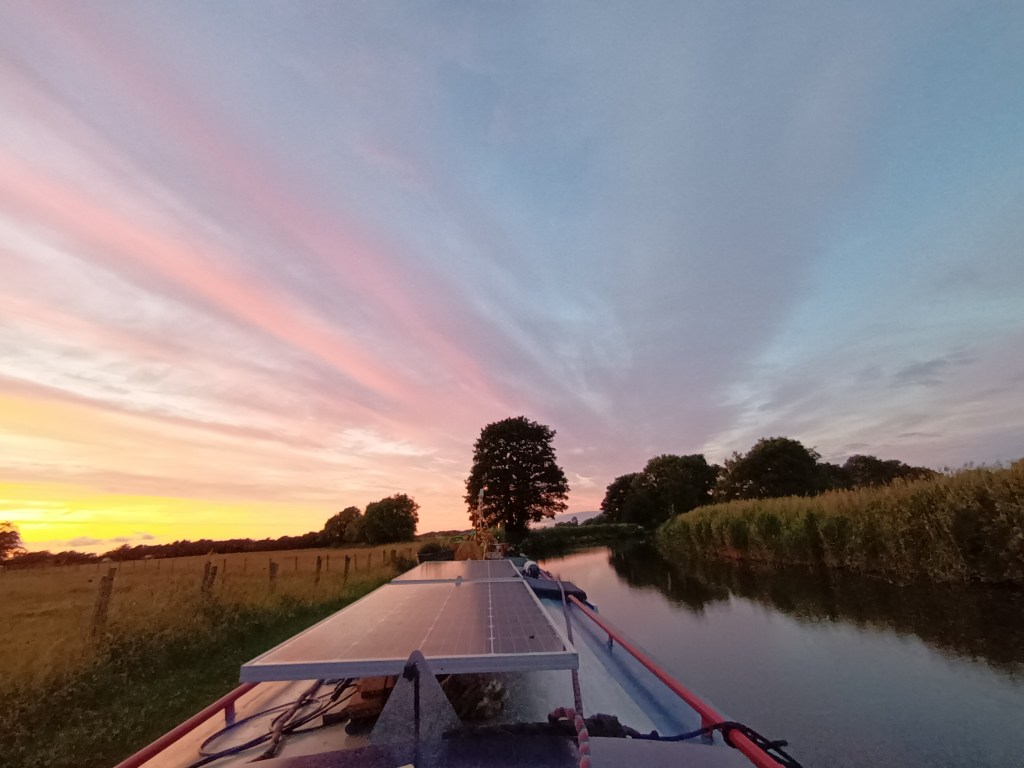
It’s a glorious time to travel the canals – the hedgerows look as if they’ve been iced – thickly laden with white may blossom. The air is thick with scents, from may and from rapeseed growing in vivid yellow swathes across the countryside. Alongside the water nature is putting out the flags for us, bright splashes of colour amid vibrant and varied greens of reeds, the frothing white of cow parsley and swaying curtains of willow.

On New Year’s Eve as 2023 began we were moored before the small swing bridge in Staffordshire at Fradley Junction, handy for celebrating in The Mucky Duck aka The Swan. We moored up there once more, walked through the growing and popular nature reserve surrounding Fradley Pool;  checked the pub hadn’t changed in the intervening months; enjoyed limitless hot water showers at the services (our equivalent of a spa); and watched the bats feeding overhead in the early dusk.  

Early the next morning we turned onto the Trent and Mersey Canal, seeing yet again the changes HS2 is bringing to the area. Metal barriers have sprouted where once there were trees.

Moorings have gone, cottages are empty. Significant towpath work is underway too, perhaps linked to HS2, and its good to see that workboats are being used to transport ballast and planted coir rolls which create bank protection. As always – we met two of them on a blind bridge! 

Twelve miles and 4 locks on Wednesday took us to Great Haywood, a favourite spot of ours with glorious walks around the grounds of Shugborough Hall, and a chance for furry crew to swim (nope, madam preferred to paddle) in the River Trent.  

We managed to moor next to another friend and found an onboard garden to swoon over.

Thursday then was our final long day of travelling, and it turned out longer and contained more surprises than we expected. We aimed on 13 miles and 13 locks to get us to the Staffordshire village of Barlaston midway between the “canal town” of Stone and the heart of the Potteries, Stoke-on-Trent. 

We were doing so well. Manoeuvring round boats searching for their spaces to set up the Bank Holiday Weekend floating market and up through the four deep, cool and dripping locks at Stone.

All was going so well, and we moved on then to the days final 4 locks at Meaford (pron Mefford). Through the first lock and it looked like someone was coming down the second lock, giving us a helping hand through – but that’s when we realised the man opening the paddles of the lock to let the water flow out didn’t have a boat. He turned out to be a Canal and River Trust employee emptying the pound (the section between locks) and lock 33 ahead of us. 

 The issue was with the cill of Lock 33. The cill is a large, raised ledge against which the top gates of a lock close, containing the water. The issue in this case was that something had come loose and when the gates shut, and water levels were lowered water from the pound above was about to escape through a narrow gap into the lock. Pushing water at force through a small space resulted in a powerful jet of water being directed at the back of the boats going down – dangerous for the person on the back at the tiller, and potentially sinking boats as the water could get straight into the back of the boat. Boats going up the lock could face flooding at their bows. So repair work was essential. 

Three staff from CRT emptied the lock. We moored up after the first lock and stayed put until allowed to move. It was about a four-hour delay in the end, but we were able to support the work by letting other boaters behind us know so they didn’t try to get through the first lock. I got some crafting done, had a chance to talk to local people and other boaters, and Steve along with other boaters helped CRT at the site of the lock at issue. Rapid evaluation once the water level dropped combined with repairs involving quick setting cement followed by clay and the lock was ready to work again.  Working coalboat Hassall was the first to be let through to try the lock, and once they were safely through then the rest of us queuing could head through in turn. 

That brought us to Barlaston later than we had expected, as dusk was falling, but we are here, where we wanted and aimed to be. It has been a wonderful, invigorating and uplifting 6 days of travel. We have felt bathed in nature, and sunshine. We are an incredible 79 miles and 24 locks nearer to our next destination and the chance we really hope, to experience yet another of the Seven Wonders of the Waterways.

Time for a change

At last we’re off – heading to new waterways, new horizons and new adventures.

It seems like we’ve been treading water for the past few months, waiting for the London Marathon to come and go, waiting for the date for our welding work to be done – which has been literally lifechanging. We’ve been so lucky to use that time to catch up with floating and static friends, to work hard too, and now we are setting off travelling once more, and it feels exhilarating.

Spending hours each day moving gently through new scenes, new views, villages and towns; waking to new places with great regularity after months of staying put, sometimes for 14 days at a time, is uplifting. It feels like we are taking huge gulps of energising fresh air after months of static or shallow breathing.

Always on the look out to spot new things!

Last night we were moored in a wooded cutting, quiet and peaceful; other nights last week we encountered nights of traffic noise from the nearby A5, from distant trains and who knows where we will choose to moor tonight…

We are headed to the Lancaster Canal – going tidal and trying en route to sort out our final requirement for our crossing – some marine distress flares which seem a tougher requirement than we first thought. Yes, like virtually everything, they are available on the internet, but containing explosives they have to be transported by approved couriers so two £15 flares demand £70 of transportation! I think we’ll wait until we get near the coast and try again.

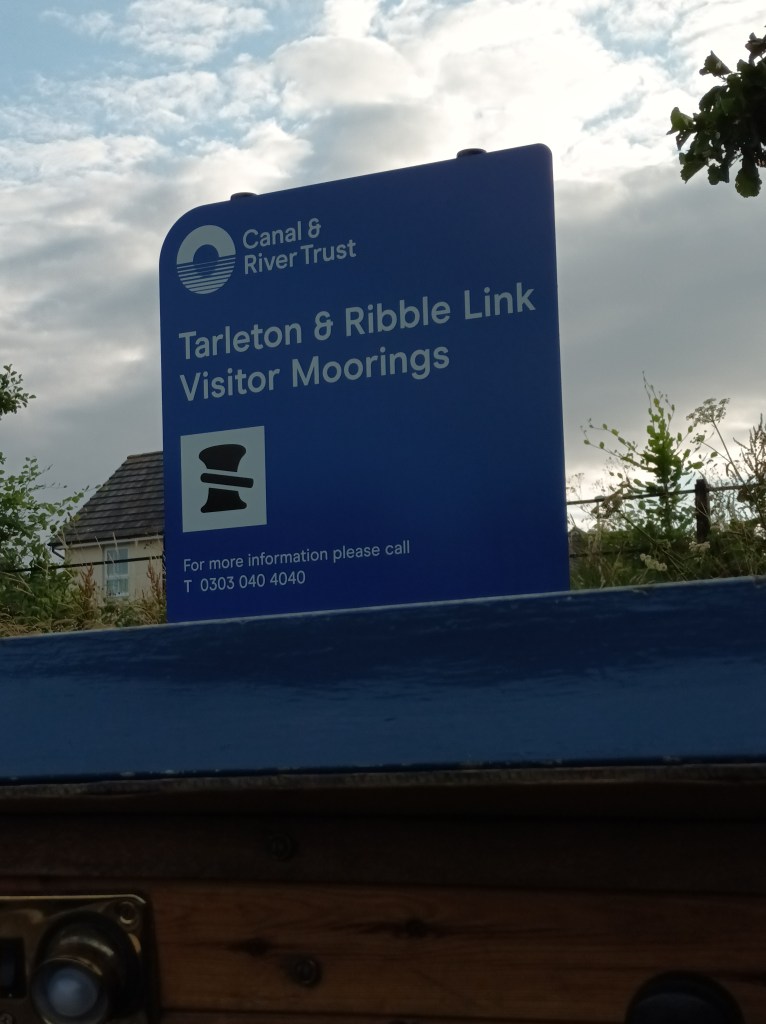
Tides demand bookings for tidal crossings, so we have a booking for crossing the River Douglas and River Ribble of 2 July. Before then we have a long-awaited family engagement in the area of Pennington Flash in the Greater Manchester area.

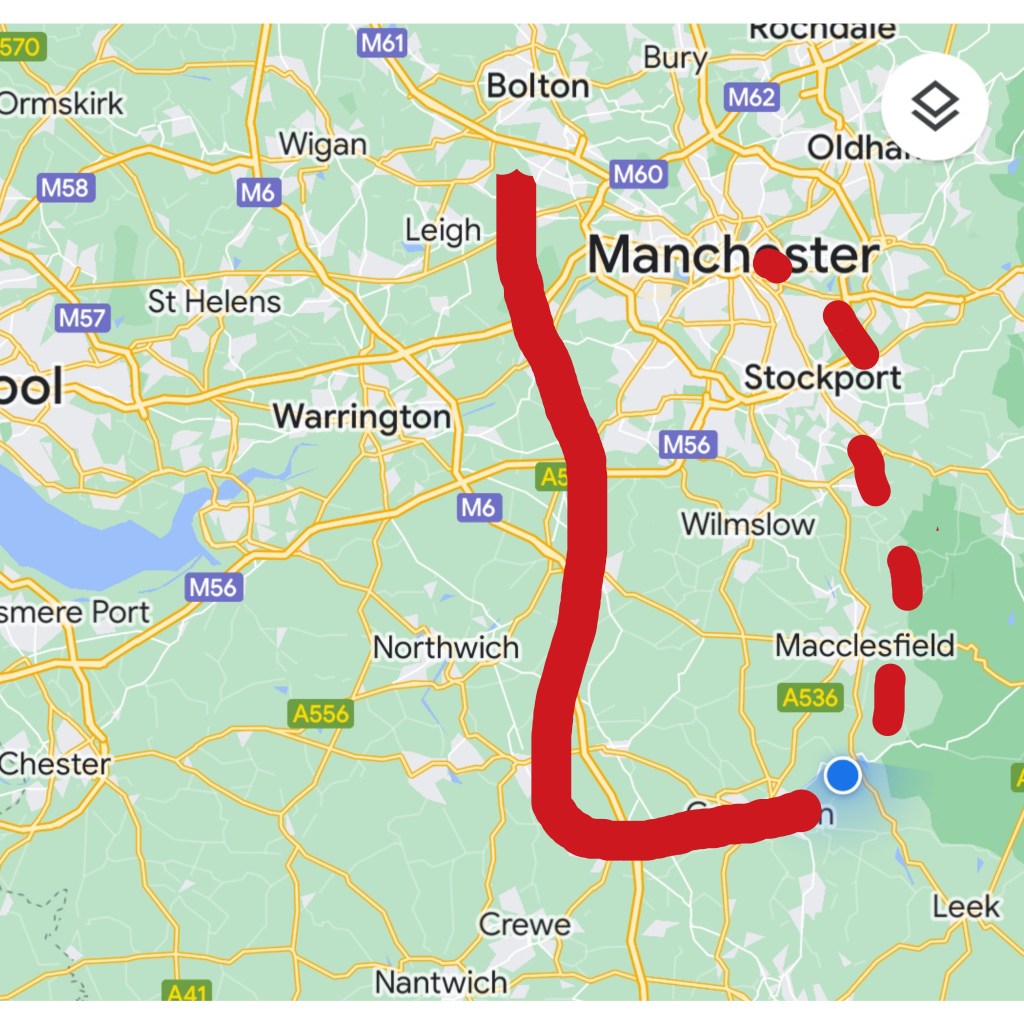
Getting there in a car would take about 2 hours and 20 minutes from where we now are if you used the M6 toll, or about 3 hours on the M1 and M6. Going our route is going to take us between 2 weeks and 4 weeks which is much more civilised, and gets us there in good time. The pleasure of having family on board to share, even if only for a few hours, the delights of the waterways we are blessed to enjoy 24/7 is just wonderful.

From where we had our welding done  in Northamptonshire, we calculated (with the help of canalplan and canal guides) 172 miles and 89 locks to the family meeting point. That takes in 122 miles of narrow canals with 76 narrow locks, the remainder being broad locks and miles on broad canals. We travel 4 miles underground, through 6 tunnels – Braunston, Newbold, Harecastle, Barnton, Saltersford and Preston Brook. Our journey takes in seven canals – the Grand Union, the Oxford, Coventry, Birmingham and Fazeley, Trent and Mersey, onto the private Bridgewater Canal, and finally the Leeds and Liverpool. All of this is familiar territory, areas travelling before over the years, but it’s always changing by season and weather, new views, wildlife and people to see.
Our newest crew member has taken to this life with aplomb. She tried sitting on the hatch at roof level but the convex slope to our mega hatch combined with the breeze in her face wasn’t to her liking.

Instead, she has found her own favourite spot – just where Cola our old boat dog used to sit. She sits looking out of her porthole at the feet of whoever is on the tiller, and watches the world go by. Locks, tunnels, boats alongside, ducks, swans, everything interests her but nothing seems to alarm her. She is in short, a delightful companion afloat. This weekend we have another crewmate on board, so she like us, will enjoy the invigorating company of a 5-year-old too.

After our family meet up we will head off onto waterways new to us, but until then, there’s time to enjoy just travelling again, getting into the daily routine of travelling, mooring, walking in new places, discovering new sights and stories in the places where we pause, and deciding whether they demand a little more of our time, or whether we should move on. What we will find en route is just  one of the many little excitements of slow motion travel, the unexpected is always waiting for us somewhere ahead. This week it was the ingenuity of pool players who live on small boats!

As the old proverb says A day of travelling will bring a basketful of learning, about the world around us and ourselves. Baskets at the ready then!
Heavy metal changes our lives

What a week that was – a week that’s wrought a change we’ve dreamed of ever since we bought our boat in 2018.

For years now we’ve battled daily with the heavy main stern hatch, which extends the full width of the boat. We open it in the mornings to head out into each day. We close it at night to cocoon ourselves away, and every time in between, when we leave the boat or the rain starts or stops, we open and close it. 

It is incredibly useful to have such a large hatch – made getting a full-sized washing machine on board as well as making it easier for us and visitors to get on and off than a standard half width hatch. 

However, for every plus there’s usually a compromise and for us it was the sheer weight of the hatch. It is 80-90 kgs worth of solid metal which has to be opened from underneath so yanked with arms upstretched – a good work out but utterly exhausting.

We’ve talked to various boat builders, boaters and friends to see what they suggest and everyone comes up with cutting it off and fitting it with rollers.

We spotted that marine welder and fabricator Kev Kyte had done something similar for another boater, so we turned to him last year. The earliest he could do anything for us as we also needed the front bulkhead plated too (in its current state, it compromises the structure of the entire boat) was May this year. That gave us some saving-the-pennies-time, and then this week – it happened!

During my 26.2mile Virtual London Marathon, I was eyeing up good spots to get the welding work done. This week, we positioned the boat on a towpath mooring I’d identified with easy access to a car park for them to get their gear to us, and they were with us before 8.30am.

As I write this blog there are angle grinders and welders going at opposite ends of the boat. Kev’s dealing with the hatch at the stern whilst Ben does a sterling job sorting the bulkhead at the bow.

Preparing the bow for plating

To give them access we (with the invaluable help of Wobbly Boater Al) had to remove doors, wood panelling, insulation and everything combustible near the work sites, and clear everything out of the cratch so the whole boat is crammed!

Exit a chunk of handrail

Kev discovered he needed to cut part of the handrails off to get access to cut off the hatch cover.

Sparks fly as the hatch gets cut off
Once both sides were cut, it took two strong men to lift off the hatch

Once removed, it became apparent it had at one time had rollers. They look pretty small and gungy next to their stainless steel replacements and had long since stopped working. 

New rollers alongside an utterly revolting useless old one
Welding housing for the new rollers

It’s only been a week since we were joined by our new crewmate, and she’s been absolutely amazing during all this noisy upheaval. After welcoming everyone, she stood overseeing the works for a bit from her vantage point on a wall before heading inside for a snooze despite the din! Her first selected nap spot was in the shower – in a bucket full of things we’d moved out of the way!

By 1pm all was done – the bulkhead is going to last for another 30+ years and Steve can demonstrate that this massive hatch can now be opened literally with a finger.

This is going to change how we feel and live aboard without a doubt. It also means unsuspecting visitors looking for an east handhold to get on and off the boat won’t get covered in oil from the hatch runners.

As for me – I just can’t stop opening and closing the hatch – wonder how long the novelty will last?!

Probation – for us and a new crewmate

It’s 5 months since our gorgeous cocker spaniel Cola left us, and they have been long, often lonely months without him, for me at least. We had 15 years together, and he was a brilliant family dog.

Non dog lovers may struggle to understand so I shall try and spell out how it has felt. Walks have felt pointless, the sofa feels empty and huge, the lack of moments to indulge in calmly stroking a dog have led to sometimes unbearable tension, and not having someone to care for has made life itself and our boat feel bereft, not as much like a home.

Heaven for some – being surrounded by dogs ❤️

Dogs for so many of us are an essential of life. Companions who give us so much in terms of friendship, loyalty, affection and encourage us to get out in the fresh air whatever the weather. They also depend on us in a way adult humans rarely do.

We decided we wanted to give a home to a dog that needed one. Despite the assurance of rescue charities within reasonable distance to say they would sometimes consider boaters, the only suggestions was singular and for a dog that had struggled to be rehomed.

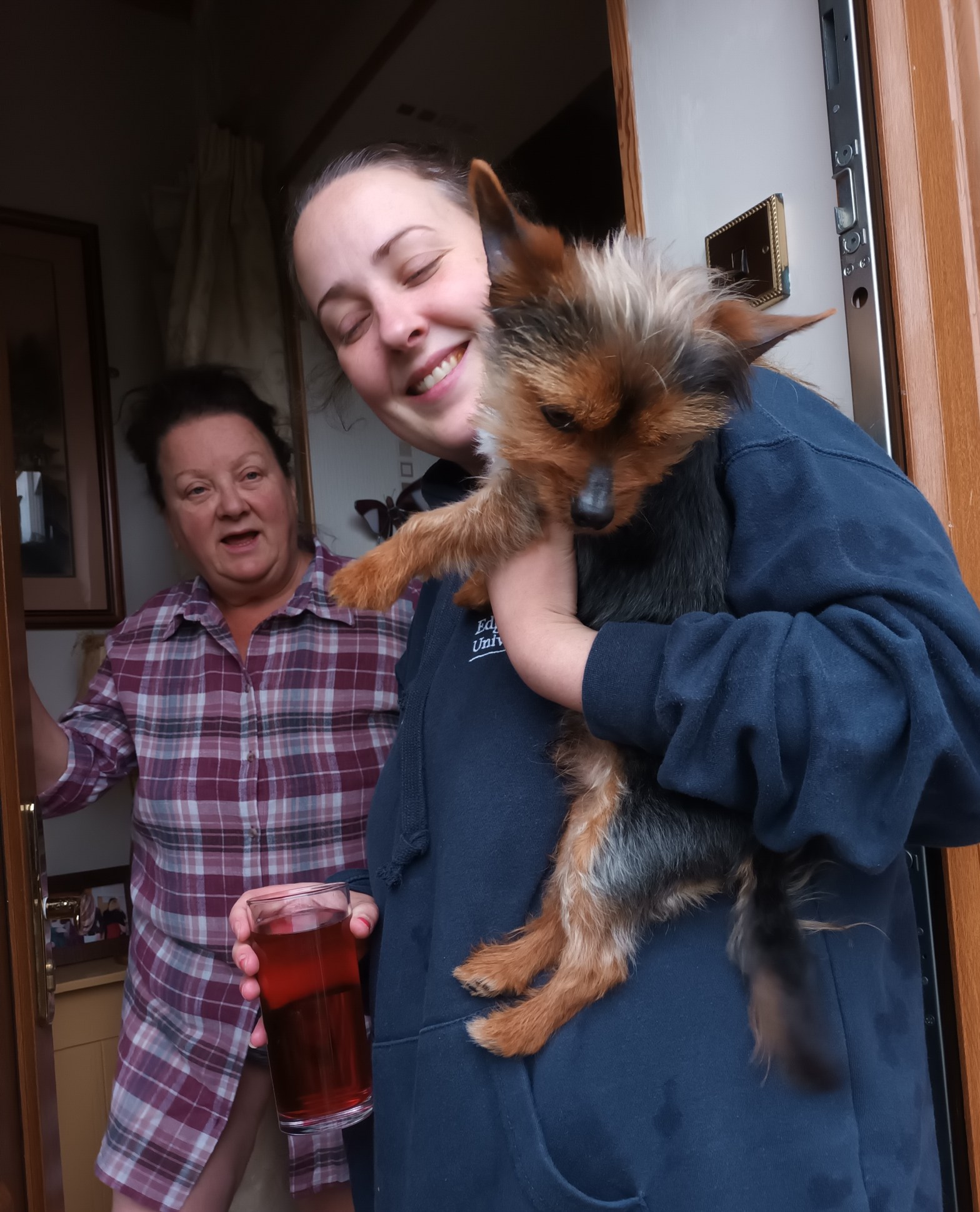
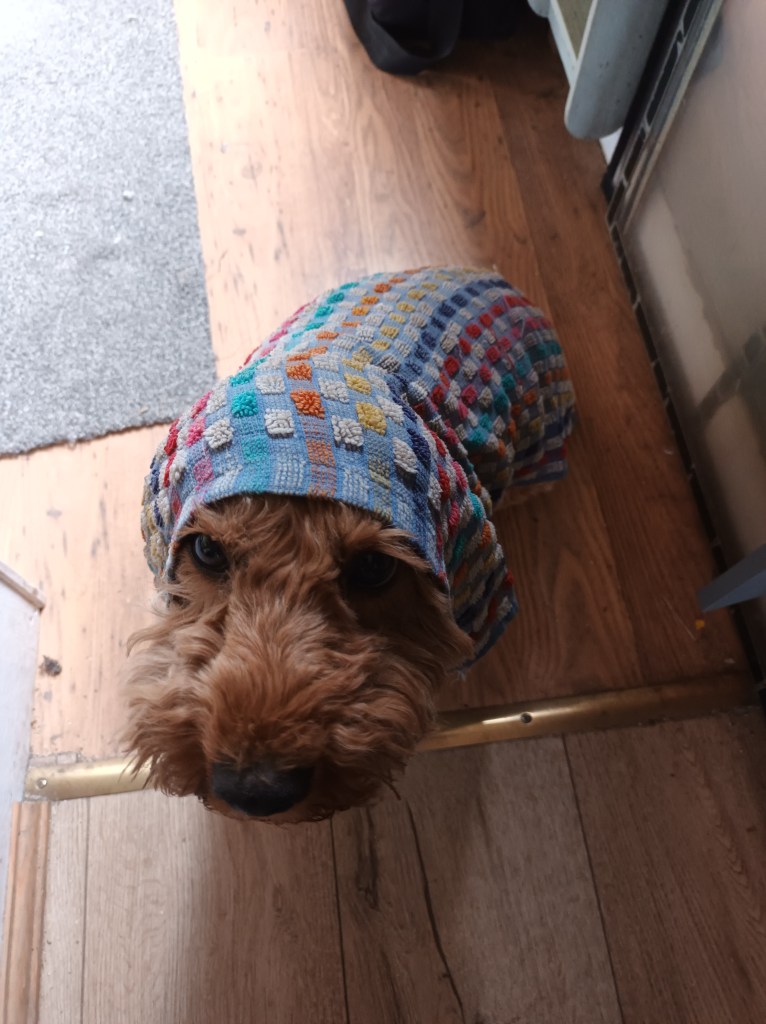
All has changed this week. Thanks to a former colleague we came across a breeder looking to rehome a breeding bitch so we are and the boat are now on probation. Meet our new crewmate/workmate.

Work takes a bit more time like this!

Probation is a testing time for everyone. In any probation situation everyone is on test – and at the end a decision needs to be made. Most of us really want it to work out, and in this situation I most certainly do, so much so I’m scared of wanting it too much.

Luckily for her, she is very different to Cola even if she likes the same sofa spot, so comparisons really can’t be made easily. She’s already caught us out being so much smaller, more agile and more portable than her predecessor – she managed to jump up onto the work surface from the sofa taking out a hanging mug in the process – startling herself and us at the same time. Having learned her lesson though, she’s not repeated that again.

She’s highly affectionate, and very accommodating of people and dogs of all sizes passing by, but unsure of ducks and swans. She also doesn’t appear very fond of water in any form – this morning’s walk involved many towpath puddle detours!

Will she settle on the boat? Boats are not for everyone after all.

We haven’t moved with her onboard yet as we need to travel slowly to the place we are due to get some welding done. If we arrive too early we could have to leave because of mooring restrictions before we need to be there for the work!

Will she like living with us? That’s not for everyone either – ask our daughters!


Will we like living with her – and that has to mean both of us – well, I’m a pushover…

So the million dollar question – will she stay or will she go? Watch. This. Space. I have everything crossed, and believe me it’s an uncomfortable situation to be in for long!

Complete – appreciate – but dynamism demands we look ahead, not back

 A massive thank you from me this week to every generous sponsor whose input willed me on and helps the incredible charity MIND to support individuals with mental health issues, mild and major, and their families. We all need to feel good about being here on this earth, about being us and any work that enables everyone to feel like that is vital.

 I cannot imagine how the 48,000 runners felt in London – all those cheering crowds, the noise, the people. I felt like I was the only one in the peace of rural Northamptonshire!

My 26.2 miles started at a time I chose when I started the London Marathon app as I left the boat (complete with a head torch because I couldn’t sleep through nerves and chose to head out early). It then consisted of 7 miles of sandpaper jogging – wet and dry, wet and dry and then the rain stopped, the sun was up and I had 19.2 miles of clear skies, almost deafening birdsong and often exclusive towpaths to get me to my marathon finish.

I couldn’t have got there without my fabulous family. The first 15 miles were jogging along happily by myself, and by the time I was joined after loo stop no. 2 and water refills, I was well ahead of my planned timings but glad to have company.  Daughter Alice was a massive support in sponsorship, encouraging messages and belief in me when I had none in myself but managed to break her wrist the week before in a gym session. Given the occasional patches of slippy mud and many tree roots to be negotiated, I was relieved she couldn’t actually come and physically join me!

Daughter Freya and soon-to-be-son-in-law Jonny joined me in person after my first half marathon, bringing up front and rear, picking up the pace I set and keeping me entertained en route. Together we headed back the way I had come some hours earlier, looking out for the boat all the time as Steve had moved our home nearer once it became daylight.

At around 22 miles we met Steve, the boat, and a hugely excited 5-year-old grandson with his other Nanny, all keen to offer support. The banana I had been dreaming of was handed over. Freya and I kept going whilst the others sorted things out.

After we passed the boat, my problems started. There appeared to be a fishing match that resulted in fisherman stretched over the next 3 miles of the towpath. It was just too much – trying to pass them, to slip and slide in the mud as I had to move off the main path to get past their massive extended poles (they didn’t all retract them) and manouver round their vast quantities of kit was a stage too far for me. Walking slower by then, and feeling sore and very, very naseauous, we turned. Freya, thank heavens, was doing the calculations. According to the app, we still had another mile and a half by then, so we came back, joined Steve and turned onto a road, the first road for me of the day. It made my rigid calves hurt even more, but we kept going. At one point Freya said the tracking app told her I had finished, her sister messaged to congratulate and ask why I hadn’t called at the end, but my app told me I had to keep going…. Very, very slowly I did, round and round a pub carpark (I had planned a pub finish for obvious reasons) before finally giving up and heading onto the A5 for my finale. My knee and my dodgy hip held out all the way.

With app in hand I crept to the finish and when it exploded with glee to tell me I had achieved 26.2miles in under 8 hours. Sore, slow and getting slower but done. If I can do it, anyone can. Every finisher is a hero and an achiever, whatever their pace, they slogged round 26.2 miles. A mile is a mile at any pace. Pain is more intense if it goes on for longer. It all takes effort, commitment and sheer dogged determination.

Thank you to everyone because when we seek to achieve we need support, people who back us, who believe in us. With that we can all achieve incredible things. I celebrated for the rest of Sunday, and now, well, now we’re enjoying the glory of where we are lucky enough to be living and moving on to what comes next.

As a heads up – we have a new crewmate coming aboard for a trial next week, a change of job and a new business launch to plan – no time to rest – on laurels or anything to be honest!

REPETITION. Boring? Essential? Meditative? The only way to tackle a challenge?

Repetition is a key part of mindfulness, of meditation, of taking time to stop the rush and recalibrate ourselves. It appears in many ways and many forms – the regularity of the stride in running or walking (as so many will experience this weekend), the rhythmic movements of knitting, crochet and many other crafts or of conscious acts of meditation.

Repetition alone isn’t enough to recalibrate. To be mindful and benefit from the repetition, we need to be conscious of the rhythm, aware of the activity, and focused with appreciation.

This Sunday along with thousands of others I shall be willing my legs (and to be honest more importantly, my mind) to travel 26.2 miles in the London Marathon in aid of charity. I won’t be in London but on the towpaths of the Grand Union or on nearby country lanes if the weather gives us too much mud, undertaking the event virtually. Since it began in 1981, the London Marathon has raised £1billion for charities. Thanks to all my wonderful sponsors who have taken me over double what I hoped to raise for MIND, the mental health charity which provides invaluable support to so many sufferers and their families too. Thanks to my wonderful family for taking time out to come and be alongside me and to friends who have given me confidence and helped me train.

Gulp!

There is a point in longer events when we move from conscious thought about the action of our legs, our breathing, to a different state. That may be flow (as per psychologist Mihaly Csikszentmihalyi’s theory about the state of mind when we become totally immersed in an activity), it may be meditation, for me it is the only time I find my mind totally clear of thoughts that normally whizz around. I cease to think. My head is clear. I become more aware of the almost deafening birdsong around me, the vivid colours of trees and water, the scents of plants I pass. My senses are heightened in this state and it revitalises me – usually until some physical niggle breaks the spell.

Concert pianists talk about repetition or practice doing something similar for them once it goes beyond repetition to learn notes or patterns of notes. This may also be the case for other musicians – I’d be interested to know if it is the same for players of instruments that demand more direct physical engagement like brass.

Coronation crochet blanket – lots of meditation!

It needs time for the repetition to create this state in running or walking, playing music and that goes for knitting or crochet too, for the repetition to move beyond clearing the thoughts of the day to focus on the task in hand, to move beyond to the heightened perspective. For some I imagine this is what training the body to daily meditation can also bring, a conscious clearing on the mind which I’m told happens more effectively and rapidly as the individual educates themselves. The repetitious use of prayer beads, or mantras takes the same approach, a focus on which an individual concentrates and thus centres themselves. When running I count, steps, breaths, and then it all just fades away.

For me it’ll be interesting to see if and at what stage of my 62,000+ steps tomorrow that state of focus appears and how long it lasts. Will I even be able to remember? I just know I’ll be grateful for it when it does arrive because it will help me on my journey to the finish.

Every journey however long starts with a step

Living afloat we know a fair bit about meditative repetition that underlies changing scenery. On Monday we will move on again with the boat, back to that gentle repetitious movement of travelling on water at 3mph, which is calming, soothing and in itself a form of meditation. Some boat engines lend themselves to meditation, others set the pulse in tune aligning more to heartbeats or CPR with great thumping beats – all something which will change with all-electric boats in the years ahead.

However you’re spending the weekend and the week ahead, whether you’re running, walking, knitting, meditating, praying, learning, gardening or boat moving – enjoy it – go with the flow and consciously make the most of the little moments.

Open the way to recalibrate and revive your soul.

Maintenance payments- necessary evil or precautionary tale

We all need a bit of maintenance at times – some of us more than others. Homes, offices, boats and ourselves. The saying goes that BOAT stands for Bring Out Another Thousand, so we’re lucky that all this month’s work has been reasonably economical, although it’s adding up and has cost dearly in time.

This week’s mooring spot

Regular readers who travel with us may remember the recent saga of the water pump – and anyone who’s been working on Teams meetings or interviews with me will certainly recall the flatulent noises it’s been making rather too regularly!

Steve went through a systematic researching of every part of the water system. First, he took out the accumulator, but with the existing pump, there were still problems of it firing up day and night (always at inconvenient times). That narrowed things down to the pump, so he took that out and replaced it. We actually had no idea how old the pump was – we knew it wasn’t 1989 vintage as old as the boat because there was an old pump lying around on the boat when we bought her so it seemed there had been at least two in the time.

One water pump replaced

Replacing the pump solved the problem.  Then we had another issue. Without an accumulator the pump is working overtime every time we turn a tap on.  So he replaced the accumulator. The previous one had been quite small and not working as it should have done, so the replacement of the two seems to have resolved issues for umpteen years.

Our home runs on a BETA 35. This is not an historic beast that excites sighs of envy (as a Lister, Gardner or Russell Newbury might). It’s not an engine that needs its own room on the boat (as many of the afore-mentioned), or one on which Steve (it’s lucky that’s not me) needs to lavish loving hours.

Engine’s down there!

Our engine is a reliable, turn-on-and-go sort.  In order to keep it like that it needs regular attention, and we need to keep an eye on the number of hours it runs, so we know what maintenance it needs in terms of oil changes etc. Until now that’s been easy – fire up and glance at the hours meter. That was until it started showing blank. We think it, like us sometimes, doesn’t like too much moisture. So, we’ve been recording manually our distances travelled until this week when Steve ordered a new hours meter and began the trial of fitting it. It’s not quite as easy as you might imagine – not just bung it in where the old one was. The existing hours meter is inside the tachometer, but fitting that sized replacement would be £50-100 with a lot of electronic wizardry required.

New hours counter neatly installed on the right

A new hours meter fitted neatly alongside came in at £12 plus free post and packing, and it’s an electronic mechanically driven version so we can see it at any point – even without firing up the engine. Steve’s doing it now because we’re at 3,000 hours, which gives us a nice easy start point to add to what the new device records.

So that’s all the internal of the last few weeks. Externally we’ve done some painting and our chimney has perished – that’s the only word for it apart from total disintegration!

Chimneys need replacing from time to time and this one hasn’t lasted long – we bought it in July 2021. Being conveniently near some friends who have allowed us to use their postal address to have a parcel delivered has been wonderful – it has meant that we’ve been able to invest in a Little Chimney Company chimney. It’s great to buy from another boater, and these stainless steel chimneys come with high recommendations of durability. I cannot tell you how excited I am about this – been longing for one of these beauties for years (sad?). When the rain stops and the sun is shining I will photograph it in all its glory on the roof.

We’ve gone for a double skinned 18 inch one and it is nothing short of gorgeous. The fire is drawing better as a result (yes, we’ve relit the fire since Storm Nora swept in!)

So we’re feeling sorted inside and out for the time being. Sometime this month we hope to be able to get a shower tray – for the time being we are making do with a plastic tub and trying not to overbalance into the hole in the floor beside it!

We have a few weeks to wait until our major welding work – bulkhead and the main hatch – can be done. As soon as it is, then we’ll be off –  travelling into the wide blue yonder once more. We can then enjoy the journeying.

Our plans are up to the Bridgwater, onto the Leeds Liverpool, over the tidal Ribble Link to the Lancaster, up the Lancaster, back from the Lancaster and up the Rochdale, over to Ripon on the River Ure and of course all of this planning can change in a whim! Plus we have some hugely exciting news about other new plans that we’ll share with you very soon. 

Don’t get sent to Coventry

If living and working on the move has taught us anything it’s not to take anything at face value, or live by what others tell you. Go out there and find out for yourself, and test your preconceptions, particularly if they were built on hearsay, or experiences from the past – things change over time, as do we all and our perceptions.

Cov is a  case in point. The locals we met called Coventry “Cov” with fondness, a far cry from the view of a city where you go to be ghosted, ostracised as in “sent to Coventry”. Heading down the Coventry Canal over the years I’ve lost count of the number of times we’ve turned at Hawkesworth Junction, avoiding the arm that leads straight into the city that gave the canal its name. We heard tales of shopping trolley hell to navigate, rowdy goings on in the canal basin, and a view that it wasn’t worth the journey.

Recently we also began to hear high praise for the basin mooring, stories of good food and a welcoming city with a thriving arts scene. We felt we’d shunned Coventry enough, and this time we steered towards it at the junction.

Coventry is a fascinating city – full of history, full of life, surprisingly full of shops when so many city high streets seem full of boarded up closures, a vibrant aromatic multicultural market serving all tastes and nationalities, and everyone we encountered was warm and welcoming.

The city has many thriving arts venues, one of which, The Tin is in the Coal Vaults right on the well-lit Basin. Check it out before you visit but don’t worry about noise if you’re moored right next to it – we found the noisiest thing about being in the basin was not the heavy metal night but the Canada Geese!

The Portuguese supermarket on the basin, the café too we’d highly recommend, and whilst you’re there take the bouncy bridge over the dual carriageway into the city. There you find history and heritage, art and education interlinked.

The largest collection of British vehicles on 2 and 4 wheels appears in the Transport Museum, and of course Daimler made the first car here in the city in 1897 in a plant alongside the canal.

It’s horsepower of a different type in the control of a female rider that has made Coventry infamous. Lady Godiva protested against her husband’s imposition of brutal taxes on the population in the only way she knew how once her verbal entreaties failed – she rode naked through the city and still does every hour viewed by thousands of tourist, locals and the Peeping Tom. Make sure you’re in Broadgate when the clock chimes any hour and you’ll see what we mean.

Significantly at Eastertide the message for which Coventry is renowed worldwide is that of reconciliation, faith, and resurrection.

The city was severely bombed by German forces in World War II, the cathedral was destroyed and 568 people lost their lives and 43,000 homes were flattened on 14 November 1940, the single night that became known as the Coventry Blitz.

Since then Coventry has become renowned as a living example of destruction, rebuilding, renewal and reconciliation.

Bombs landed in the canal spraying water over homes and yet there was a lack of water to extinguish the fires that raged after the bombing.

The resulting rebuilding, of a new cathedral, of the city and the communities within it has spawned a movement for reconciliation that has involvement globally, particularly within Dresden, a German city which suffered destruction at the hands of the British forces. Coventry blazes a hopeful light.

The elephant is a symbol of the city too, a strong animal who is said to never forget but is also apparently a symbol of redemption of the human race. Coventry doesn’t forget it’s past but builds on it, building a strong and meaningful future.

Whatever your beliefs, have an enjoyable and uplifting weekend. We honestly recommend you don’t wait to be sent, but take yourself to Coventry very soon.