Complete – appreciate – but dynamism demands we look ahead, not back

 A massive thank you from me this week to every generous sponsor whose input willed me on and helps the incredible charity MIND to support individuals with mental health issues, mild and major, and their families. We all need to feel good about being here on this earth, about being us and any work that enables everyone to feel like that is vital.

 I cannot imagine how the 48,000 runners felt in London – all those cheering crowds, the noise, the people. I felt like I was the only one in the peace of rural Northamptonshire!

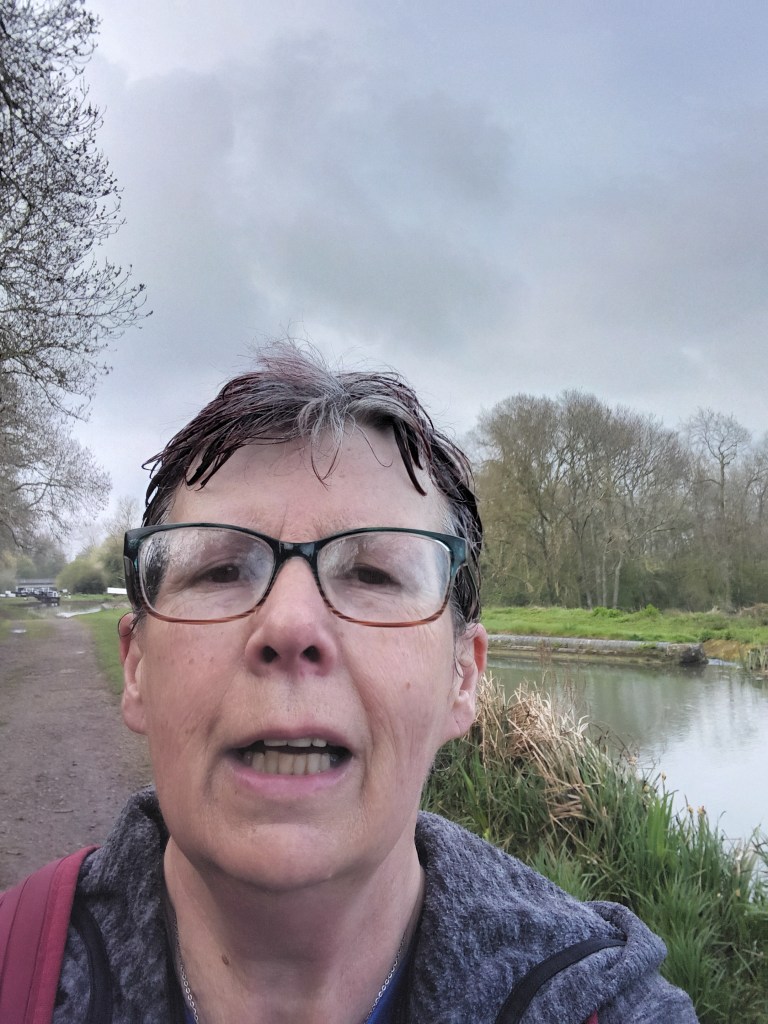
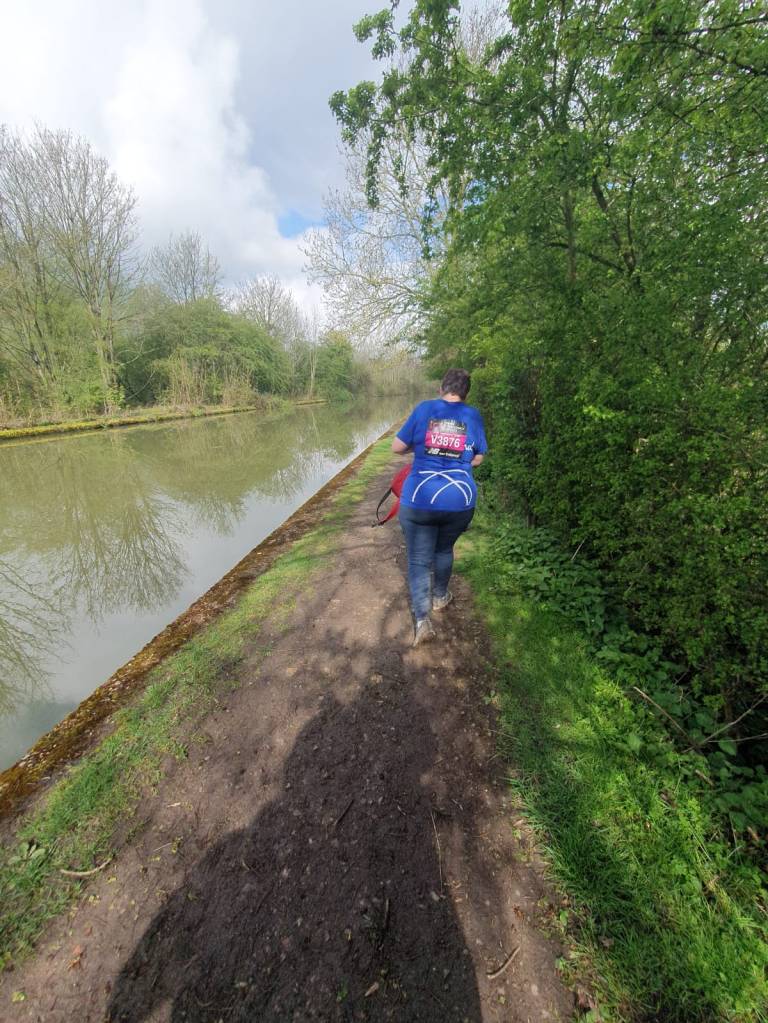
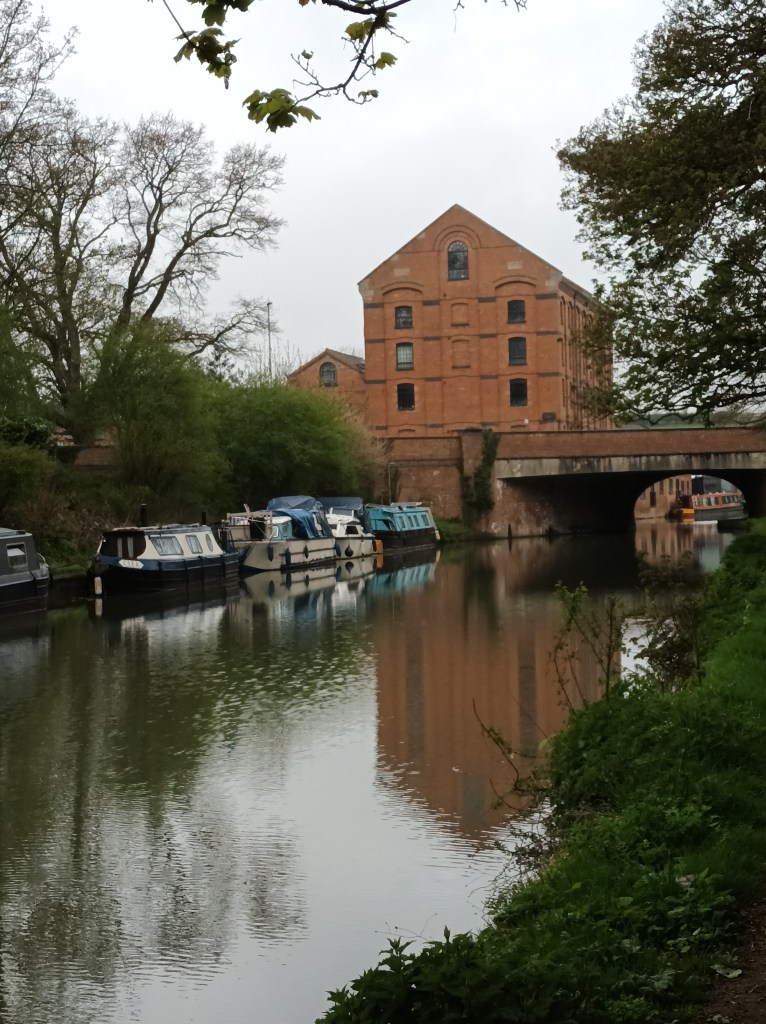
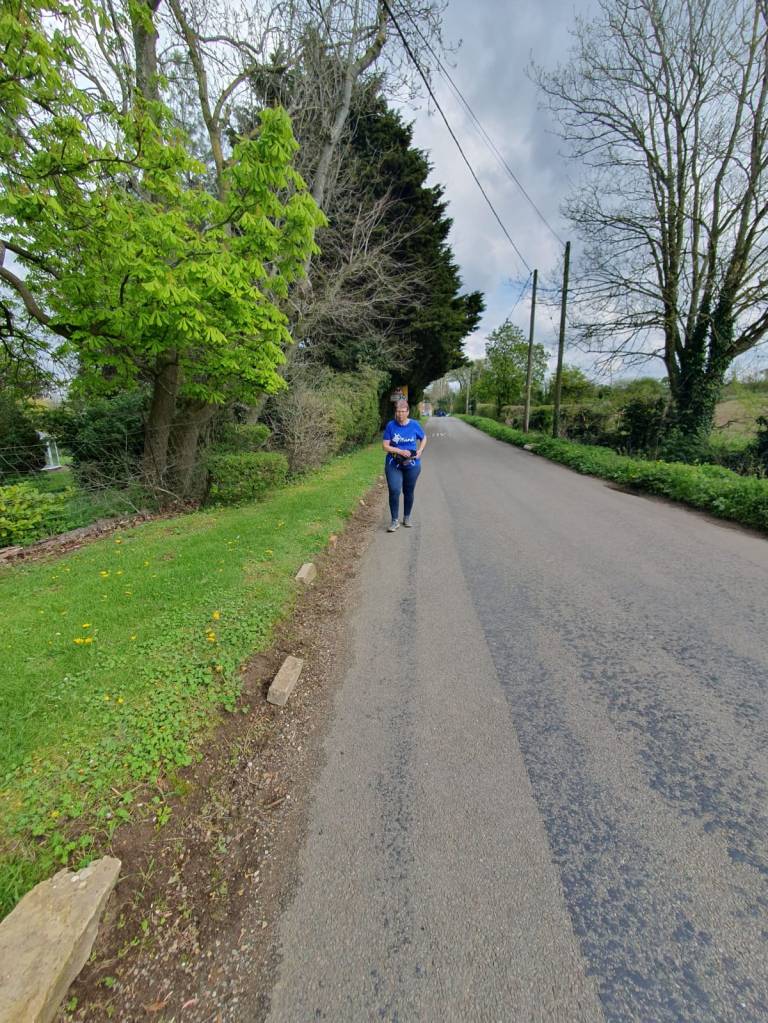
My 26.2 miles started at a time I chose when I started the London Marathon app as I left the boat (complete with a head torch because I couldn’t sleep through nerves and chose to head out early). It then consisted of 7 miles of sandpaper jogging – wet and dry, wet and dry and then the rain stopped, the sun was up and I had 19.2 miles of clear skies, almost deafening birdsong and often exclusive towpaths to get me to my marathon finish.

I couldn’t have got there without my fabulous family. The first 15 miles were jogging along happily by myself, and by the time I was joined after loo stop no. 2 and water refills, I was well ahead of my planned timings but glad to have company.  Daughter Alice was a massive support in sponsorship, encouraging messages and belief in me when I had none in myself but managed to break her wrist the week before in a gym session. Given the occasional patches of slippy mud and many tree roots to be negotiated, I was relieved she couldn’t actually come and physically join me!

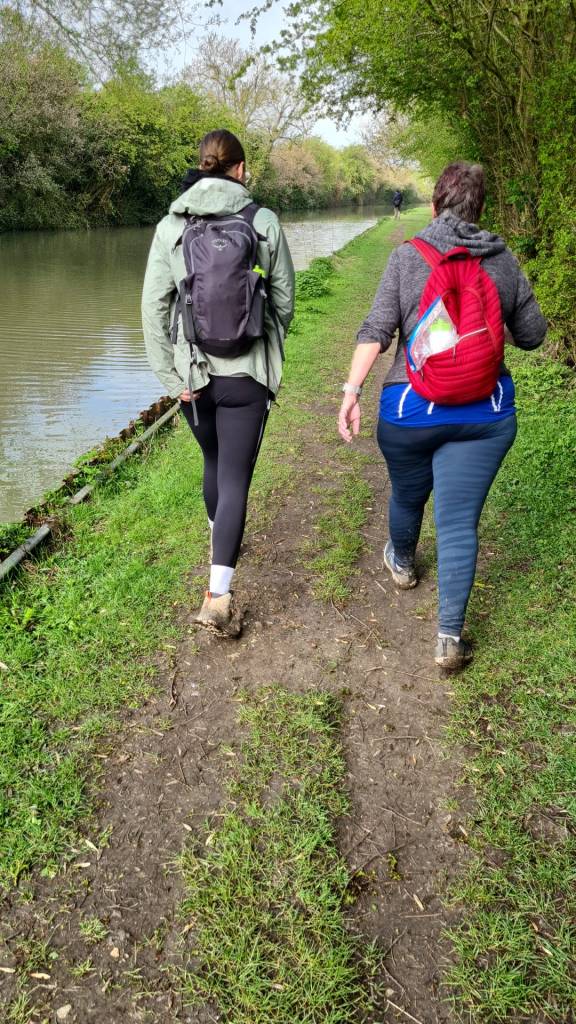
Daughter Freya and soon-to-be-son-in-law Jonny joined me in person after my first half marathon, bringing up front and rear, picking up the pace I set and keeping me entertained en route. Together we headed back the way I had come some hours earlier, looking out for the boat all the time as Steve had moved our home nearer once it became daylight.

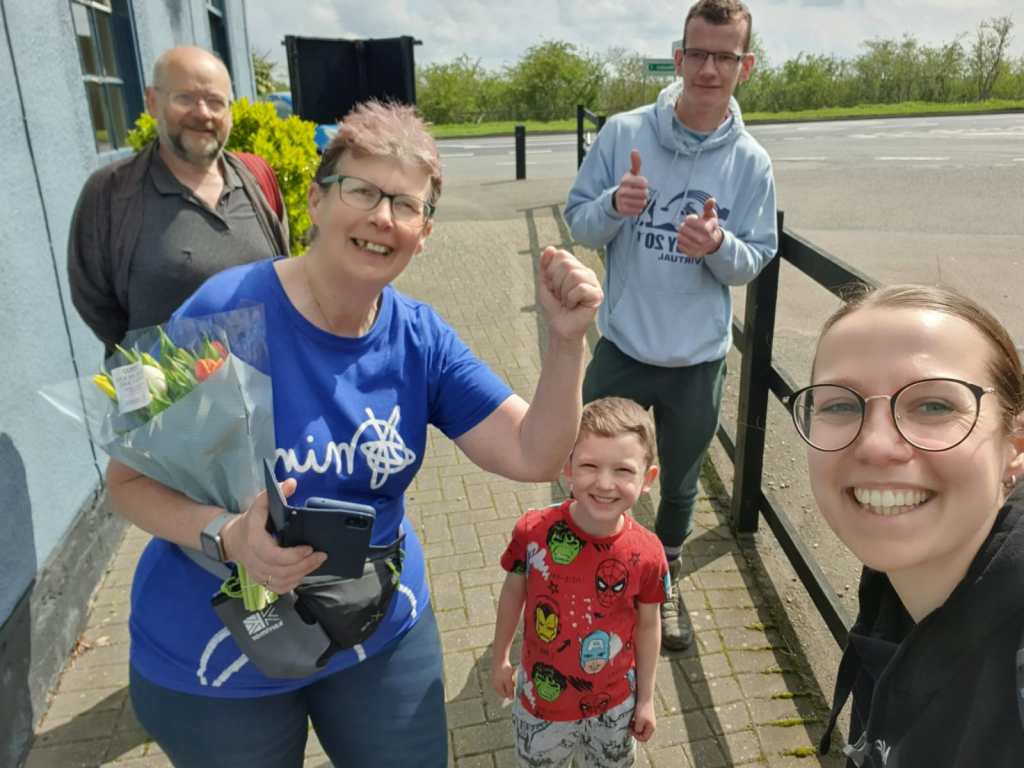
At around 22 miles we met Steve, the boat, and a hugely excited 5-year-old grandson with his other Nanny, all keen to offer support. The banana I had been dreaming of was handed over. Freya and I kept going whilst the others sorted things out.

After we passed the boat, my problems started. There appeared to be a fishing match that resulted in fisherman stretched over the next 3 miles of the towpath. It was just too much – trying to pass them, to slip and slide in the mud as I had to move off the main path to get past their massive extended poles (they didn’t all retract them) and manouver round their vast quantities of kit was a stage too far for me. Walking slower by then, and feeling sore and very, very naseauous, we turned. Freya, thank heavens, was doing the calculations. According to the app, we still had another mile and a half by then, so we came back, joined Steve and turned onto a road, the first road for me of the day. It made my rigid calves hurt even more, but we kept going. At one point Freya said the tracking app told her I had finished, her sister messaged to congratulate and ask why I hadn’t called at the end, but my app told me I had to keep going…. Very, very slowly I did, round and round a pub carpark (I had planned a pub finish for obvious reasons) before finally giving up and heading onto the A5 for my finale. My knee and my dodgy hip held out all the way.

With app in hand I crept to the finish and when it exploded with glee to tell me I had achieved 26.2miles in under 8 hours. Sore, slow and getting slower but done. If I can do it, anyone can. Every finisher is a hero and an achiever, whatever their pace, they slogged round 26.2 miles. A mile is a mile at any pace. Pain is more intense if it goes on for longer. It all takes effort, commitment and sheer dogged determination.

Thank you to everyone because when we seek to achieve we need support, people who back us, who believe in us. With that we can all achieve incredible things. I celebrated for the rest of Sunday, and now, well, now we’re enjoying the glory of where we are lucky enough to be living and moving on to what comes next.

As a heads up – we have a new crewmate coming aboard for a trial next week, a change of job and a new business launch to plan – no time to rest – on laurels or anything to be honest!

REPETITION. Boring? Essential? Meditative? The only way to tackle a challenge?

Repetition is a key part of mindfulness, of meditation, of taking time to stop the rush and recalibrate ourselves. It appears in many ways and many forms – the regularity of the stride in running or walking (as so many will experience this weekend), the rhythmic movements of knitting, crochet and many other crafts or of conscious acts of meditation.

Repetition alone isn’t enough to recalibrate. To be mindful and benefit from the repetition, we need to be conscious of the rhythm, aware of the activity, and focused with appreciation.

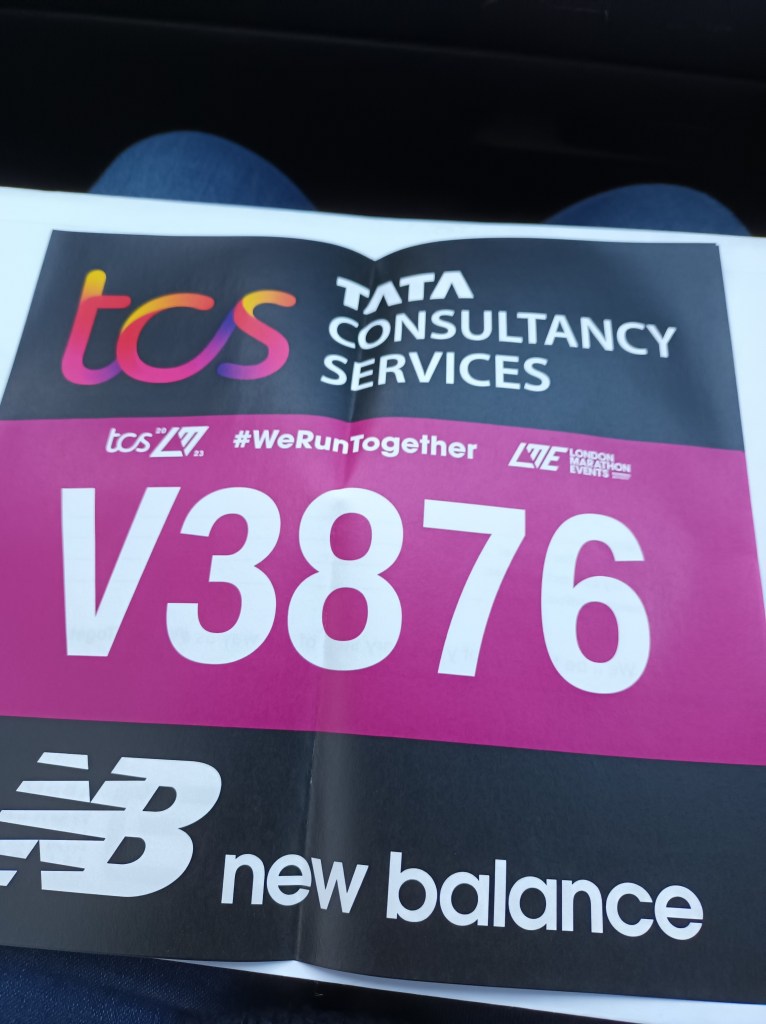
This Sunday along with thousands of others I shall be willing my legs (and to be honest more importantly, my mind) to travel 26.2 miles in the London Marathon in aid of charity. I won’t be in London but on the towpaths of the Grand Union or on nearby country lanes if the weather gives us too much mud, undertaking the event virtually. Since it began in 1981, the London Marathon has raised £1billion for charities. Thanks to all my wonderful sponsors who have taken me over double what I hoped to raise for MIND, the mental health charity which provides invaluable support to so many sufferers and their families too. Thanks to my wonderful family for taking time out to come and be alongside me and to friends who have given me confidence and helped me train.

Gulp!

There is a point in longer events when we move from conscious thought about the action of our legs, our breathing, to a different state. That may be flow (as per psychologist Mihaly Csikszentmihalyi’s theory about the state of mind when we become totally immersed in an activity), it may be meditation, for me it is the only time I find my mind totally clear of thoughts that normally whizz around. I cease to think. My head is clear. I become more aware of the almost deafening birdsong around me, the vivid colours of trees and water, the scents of plants I pass. My senses are heightened in this state and it revitalises me – usually until some physical niggle breaks the spell.

Concert pianists talk about repetition or practice doing something similar for them once it goes beyond repetition to learn notes or patterns of notes. This may also be the case for other musicians – I’d be interested to know if it is the same for players of instruments that demand more direct physical engagement like brass.

Coronation crochet blanket – lots of meditation!

It needs time for the repetition to create this state in running or walking, playing music and that goes for knitting or crochet too, for the repetition to move beyond clearing the thoughts of the day to focus on the task in hand, to move beyond to the heightened perspective. For some I imagine this is what training the body to daily meditation can also bring, a conscious clearing on the mind which I’m told happens more effectively and rapidly as the individual educates themselves. The repetitious use of prayer beads, or mantras takes the same approach, a focus on which an individual concentrates and thus centres themselves. When running I count, steps, breaths, and then it all just fades away.

For me it’ll be interesting to see if and at what stage of my 62,000+ steps tomorrow that state of focus appears and how long it lasts. Will I even be able to remember? I just know I’ll be grateful for it when it does arrive because it will help me on my journey to the finish.

Every journey however long starts with a step

Living afloat we know a fair bit about meditative repetition that underlies changing scenery. On Monday we will move on again with the boat, back to that gentle repetitious movement of travelling on water at 3mph, which is calming, soothing and in itself a form of meditation. Some boat engines lend themselves to meditation, others set the pulse in tune aligning more to heartbeats or CPR with great thumping beats – all something which will change with all-electric boats in the years ahead.

However you’re spending the weekend and the week ahead, whether you’re running, walking, knitting, meditating, praying, learning, gardening or boat moving – enjoy it – go with the flow and consciously make the most of the little moments.

Open the way to recalibrate and revive your soul.

Maintenance payments- necessary evil or precautionary tale

We all need a bit of maintenance at times – some of us more than others. Homes, offices, boats and ourselves. The saying goes that BOAT stands for Bring Out Another Thousand, so we’re lucky that all this month’s work has been reasonably economical, although it’s adding up and has cost dearly in time.

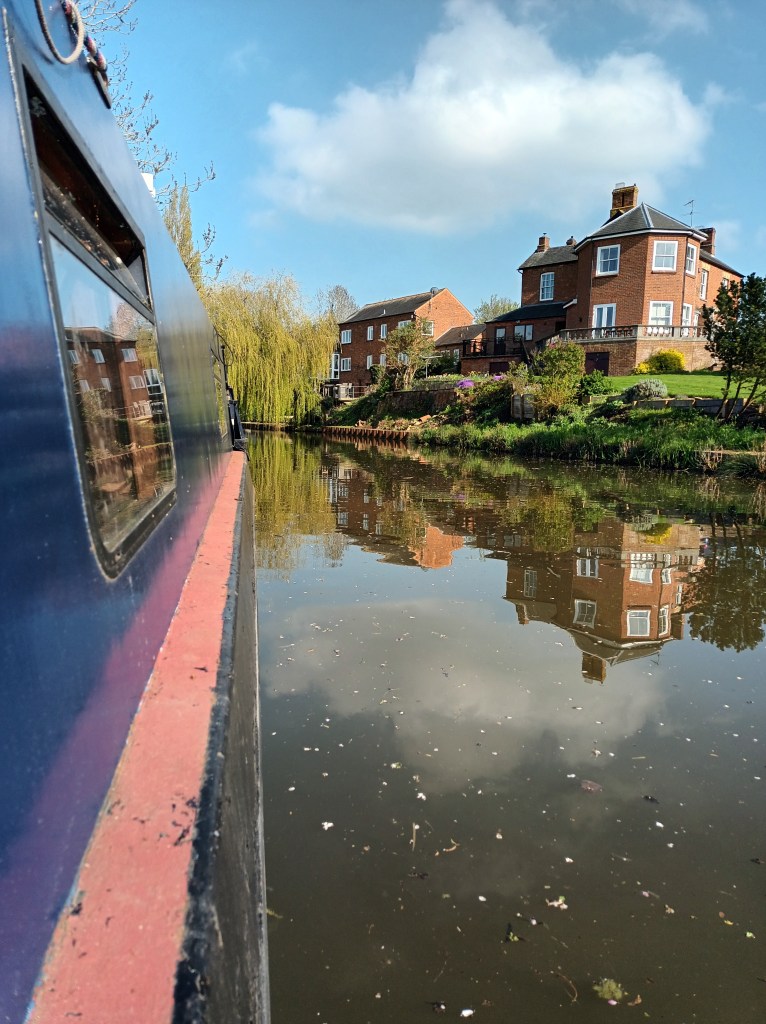
This week’s mooring spot

Regular readers who travel with us may remember the recent saga of the water pump – and anyone who’s been working on Teams meetings or interviews with me will certainly recall the flatulent noises it’s been making rather too regularly!

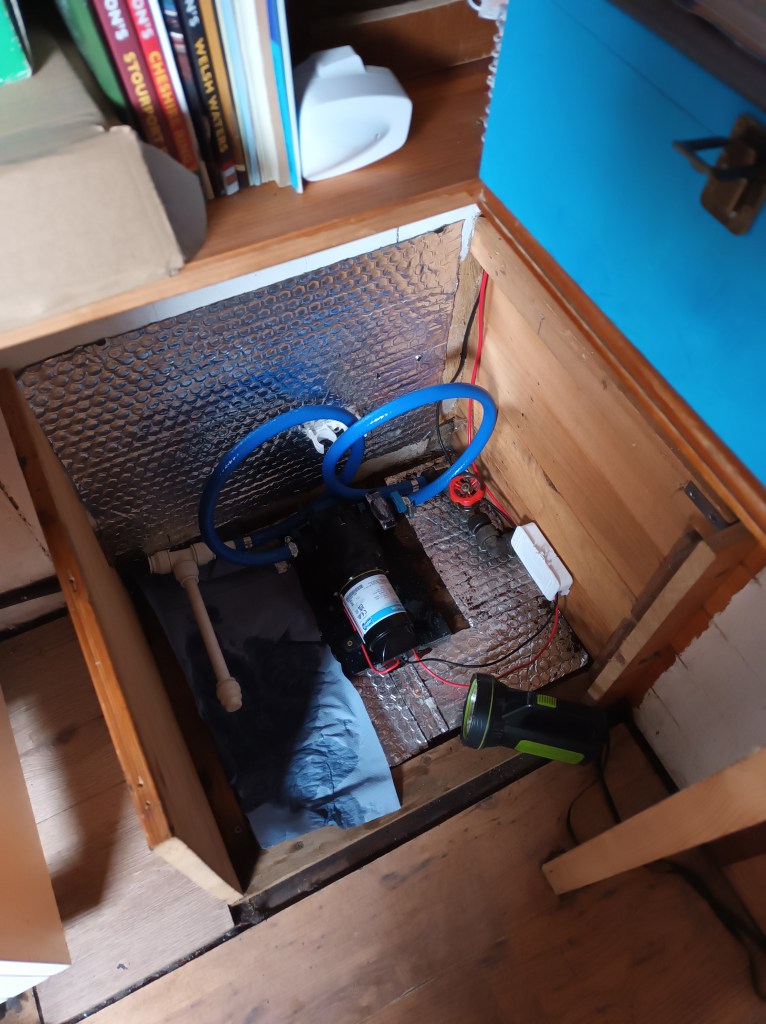
Steve went through a systematic researching of every part of the water system. First, he took out the accumulator, but with the existing pump, there were still problems of it firing up day and night (always at inconvenient times). That narrowed things down to the pump, so he took that out and replaced it. We actually had no idea how old the pump was – we knew it wasn’t 1989 vintage as old as the boat because there was an old pump lying around on the boat when we bought her so it seemed there had been at least two in the time.

One water pump replaced

Replacing the pump solved the problem.  Then we had another issue. Without an accumulator the pump is working overtime every time we turn a tap on.  So he replaced the accumulator. The previous one had been quite small and not working as it should have done, so the replacement of the two seems to have resolved issues for umpteen years.

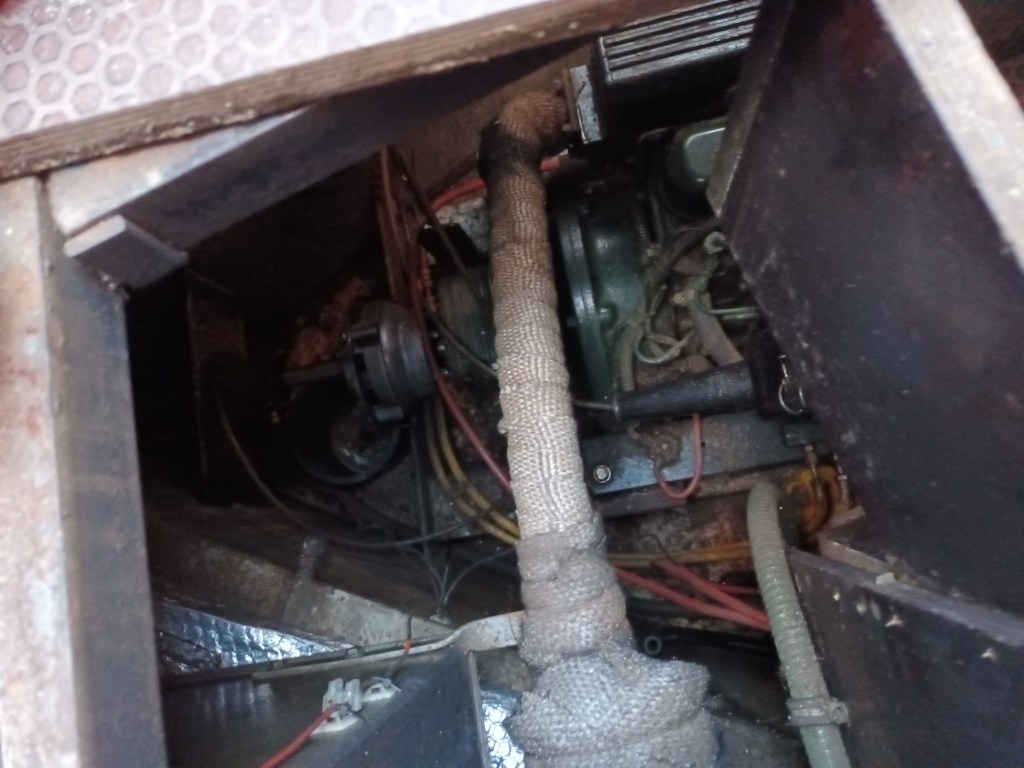
Our home runs on a BETA 35. This is not an historic beast that excites sighs of envy (as a Lister, Gardner or Russell Newbury might). It’s not an engine that needs its own room on the boat (as many of the afore-mentioned), or one on which Steve (it’s lucky that’s not me) needs to lavish loving hours.

Engine’s down there!

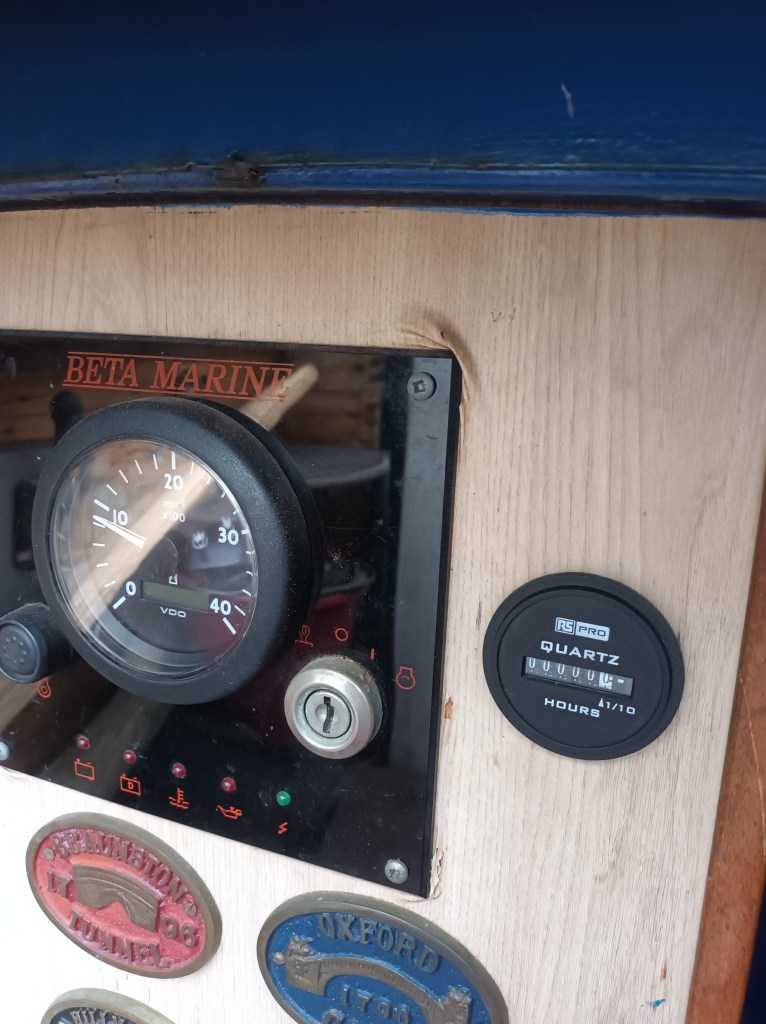
Our engine is a reliable, turn-on-and-go sort.  In order to keep it like that it needs regular attention, and we need to keep an eye on the number of hours it runs, so we know what maintenance it needs in terms of oil changes etc. Until now that’s been easy – fire up and glance at the hours meter. That was until it started showing blank. We think it, like us sometimes, doesn’t like too much moisture. So, we’ve been recording manually our distances travelled until this week when Steve ordered a new hours meter and began the trial of fitting it. It’s not quite as easy as you might imagine – not just bung it in where the old one was. The existing hours meter is inside the tachometer, but fitting that sized replacement would be £50-100 with a lot of electronic wizardry required.

New hours counter neatly installed on the right

A new hours meter fitted neatly alongside came in at £12 plus free post and packing, and it’s an electronic mechanically driven version so we can see it at any point – even without firing up the engine. Steve’s doing it now because we’re at 3,000 hours, which gives us a nice easy start point to add to what the new device records.

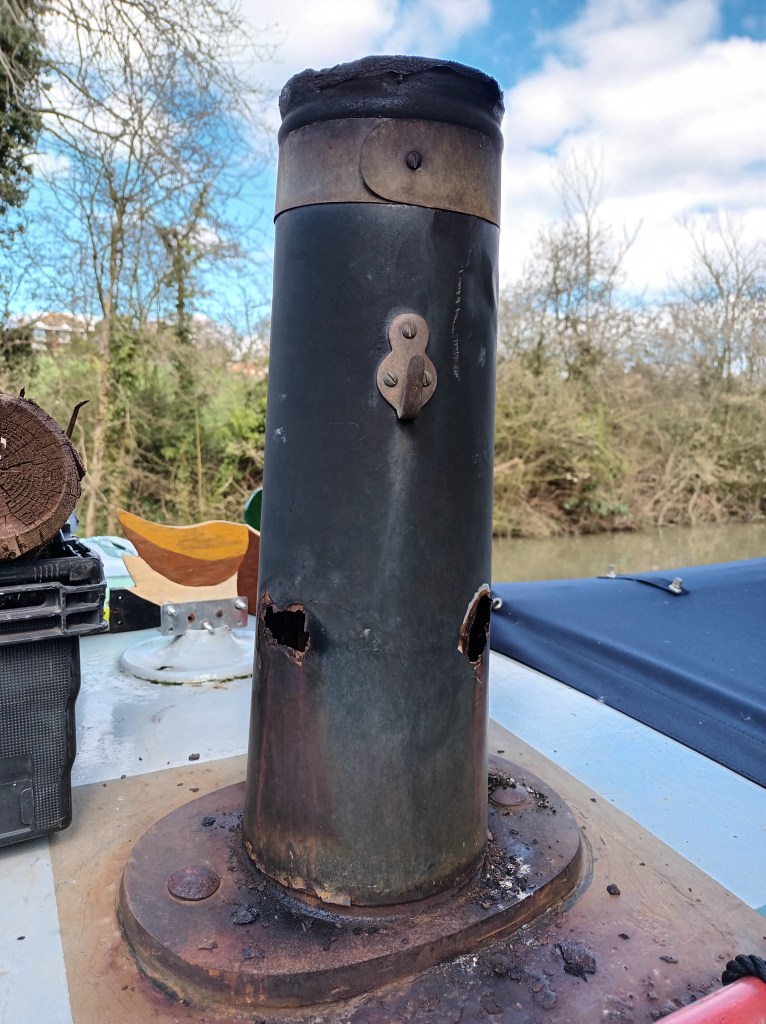
So that’s all the internal of the last few weeks. Externally we’ve done some painting and our chimney has perished – that’s the only word for it apart from total disintegration!

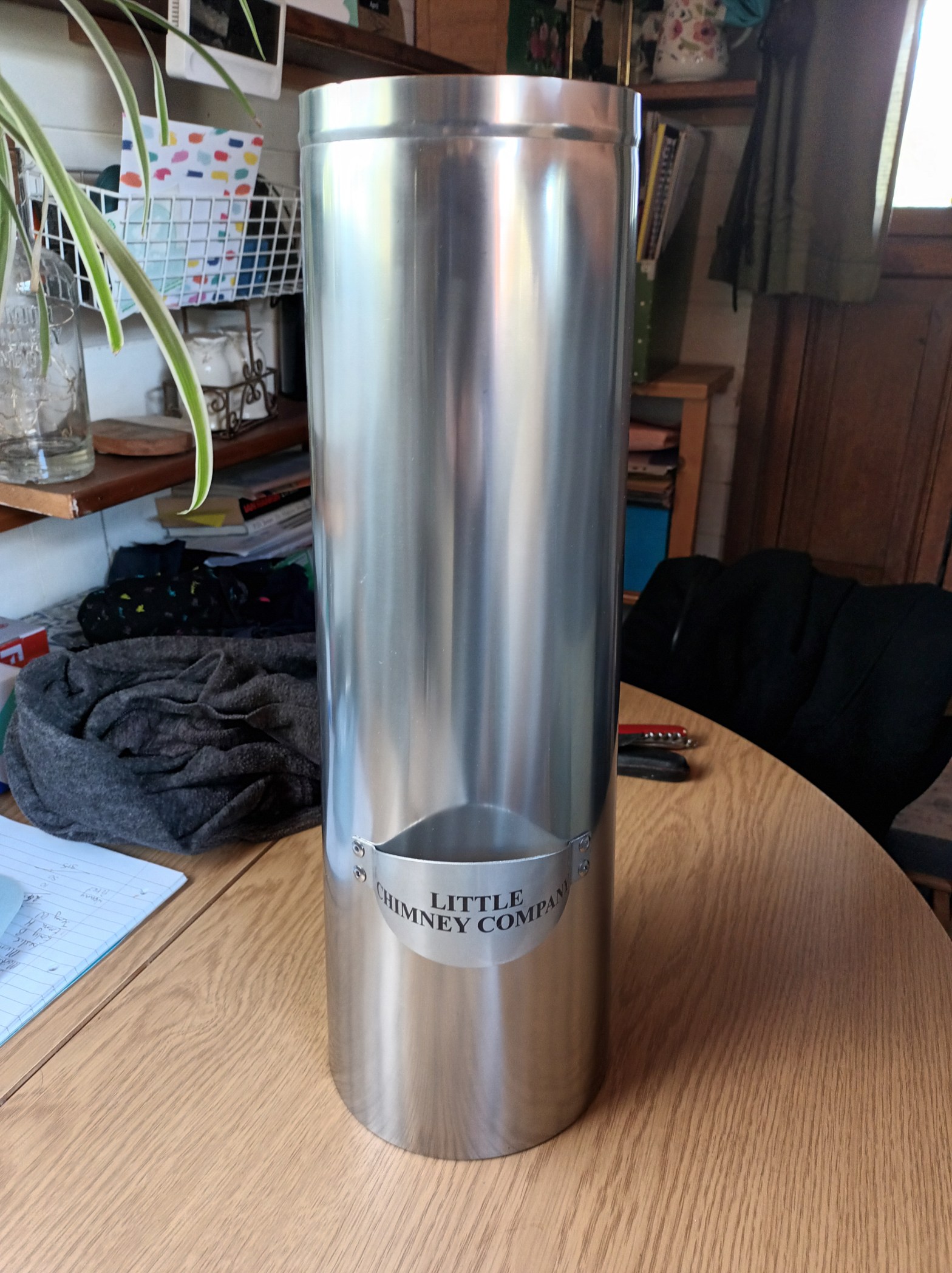
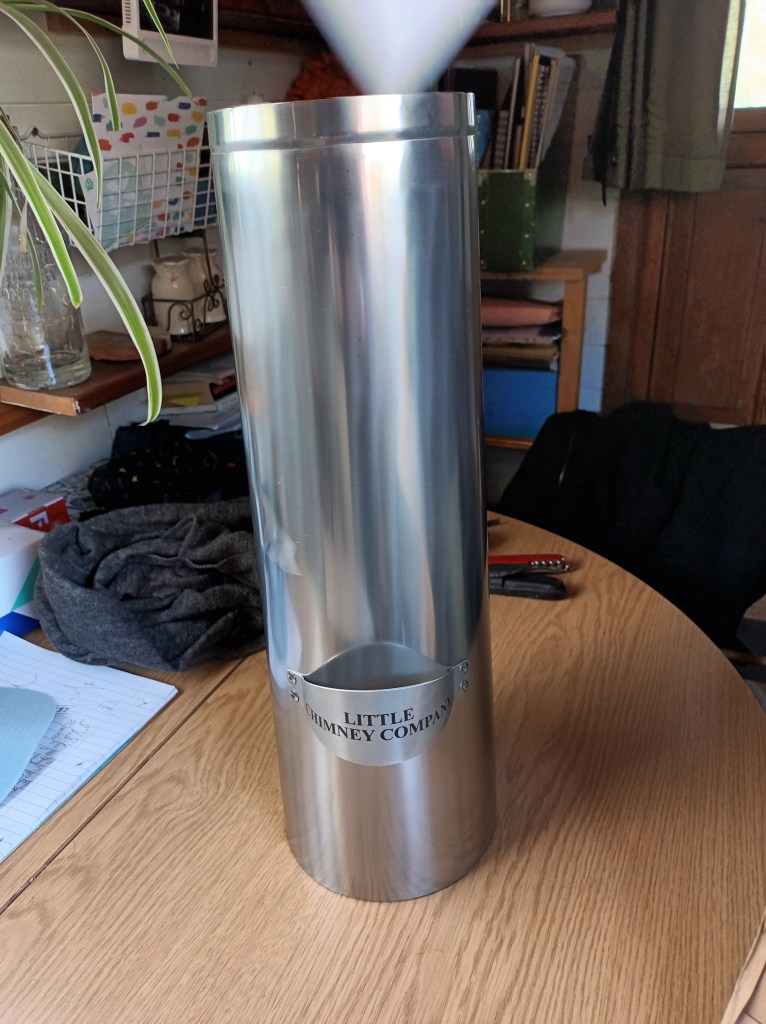
Chimneys need replacing from time to time and this one hasn’t lasted long – we bought it in July 2021. Being conveniently near some friends who have allowed us to use their postal address to have a parcel delivered has been wonderful – it has meant that we’ve been able to invest in a Little Chimney Company chimney. It’s great to buy from another boater, and these stainless steel chimneys come with high recommendations of durability. I cannot tell you how excited I am about this – been longing for one of these beauties for years (sad?). When the rain stops and the sun is shining I will photograph it in all its glory on the roof.

We’ve gone for a double skinned 18 inch one and it is nothing short of gorgeous. The fire is drawing better as a result (yes, we’ve relit the fire since Storm Nora swept in!)

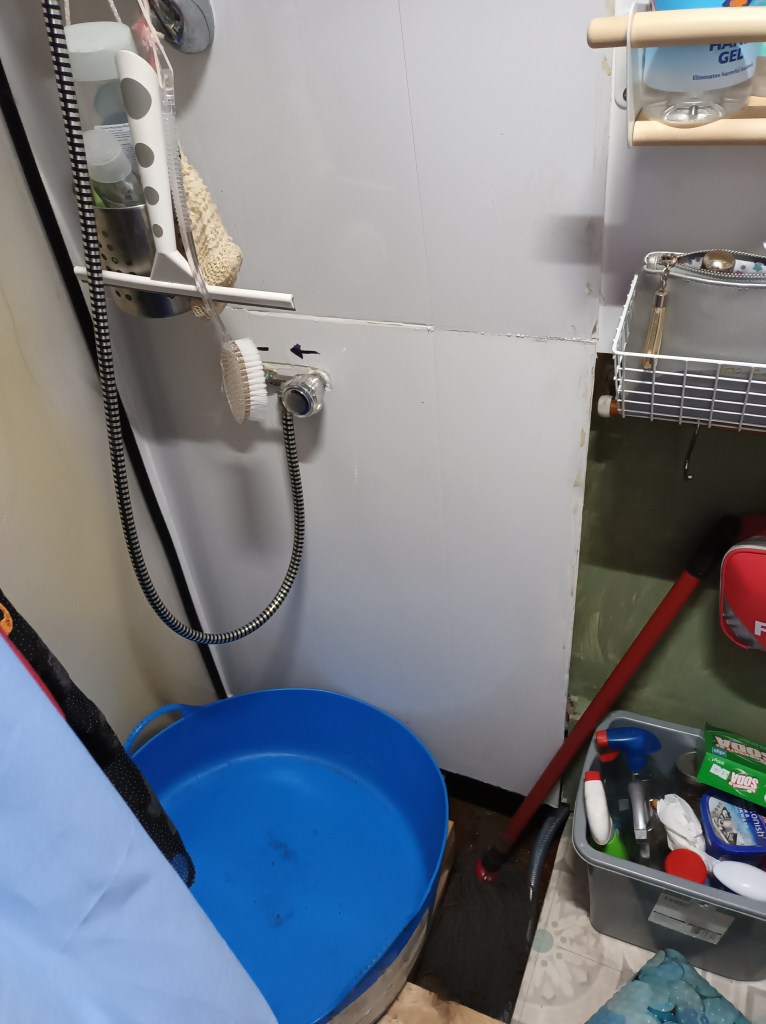
So we’re feeling sorted inside and out for the time being. Sometime this month we hope to be able to get a shower tray – for the time being we are making do with a plastic tub and trying not to overbalance into the hole in the floor beside it!

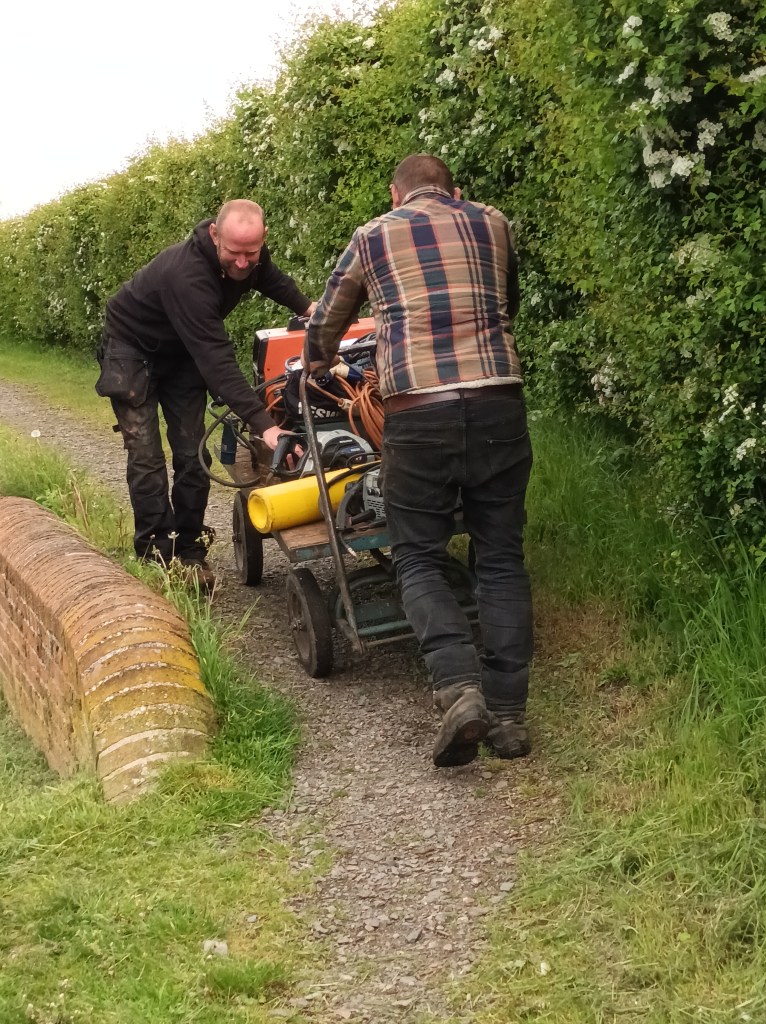
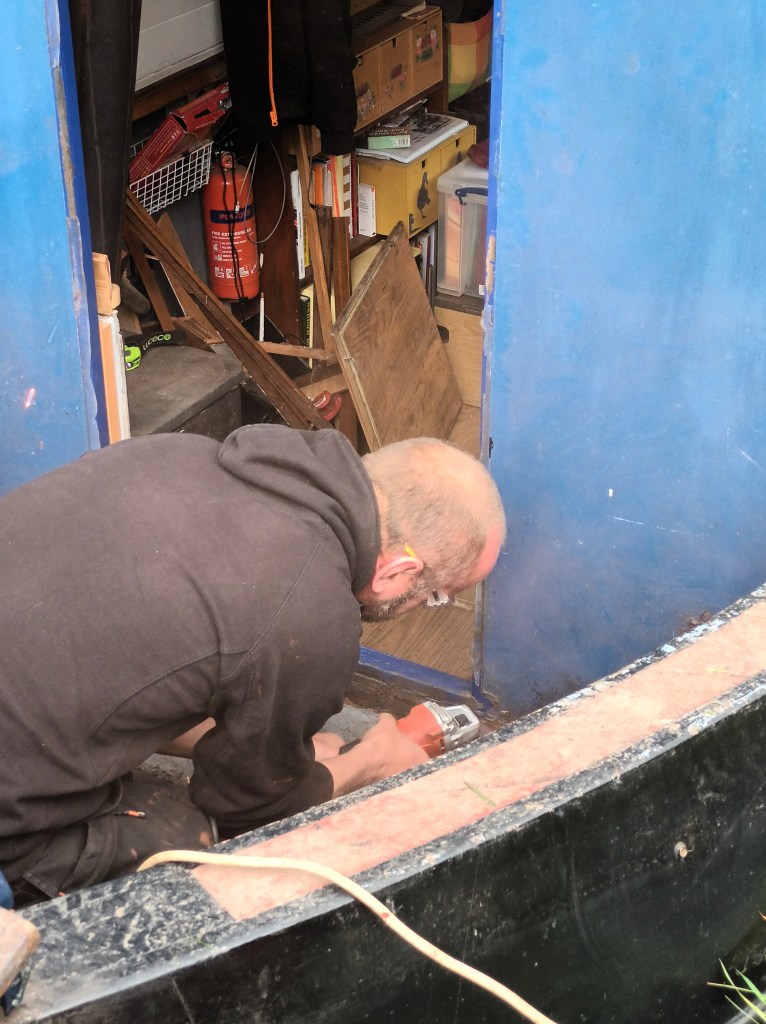
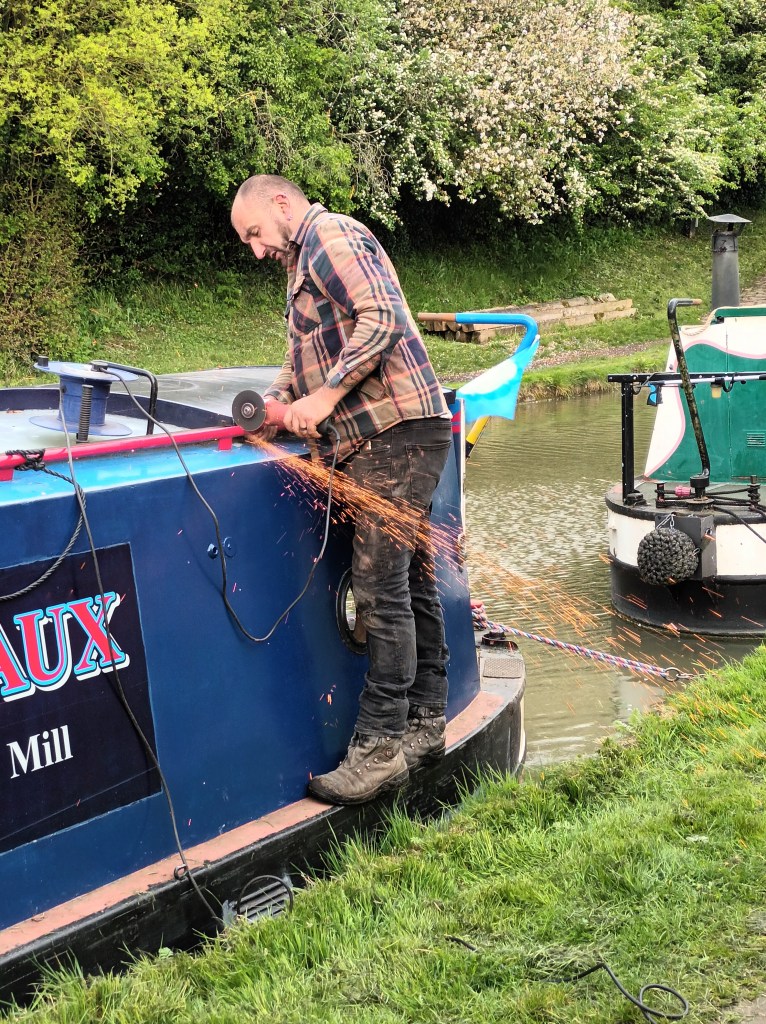
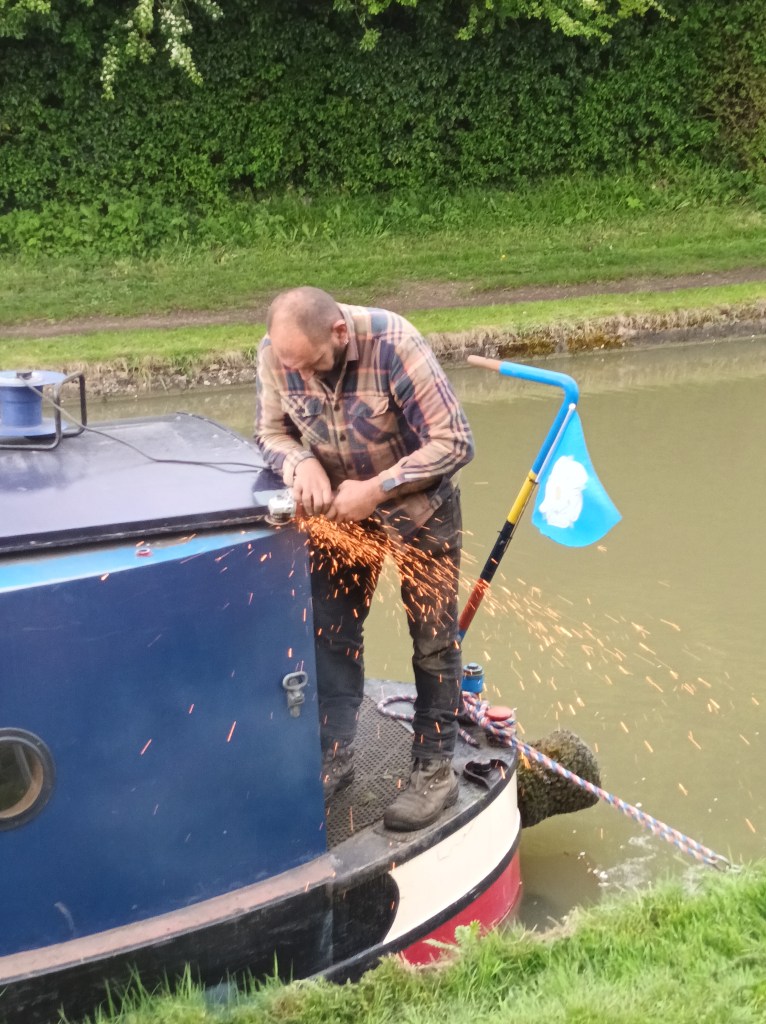
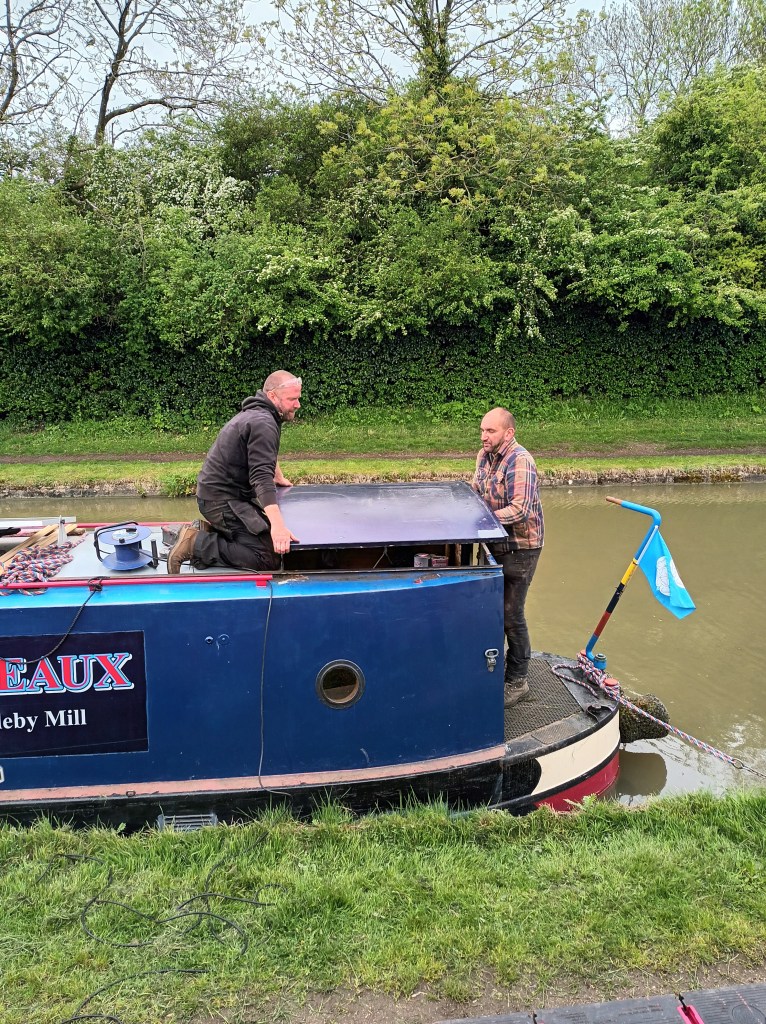
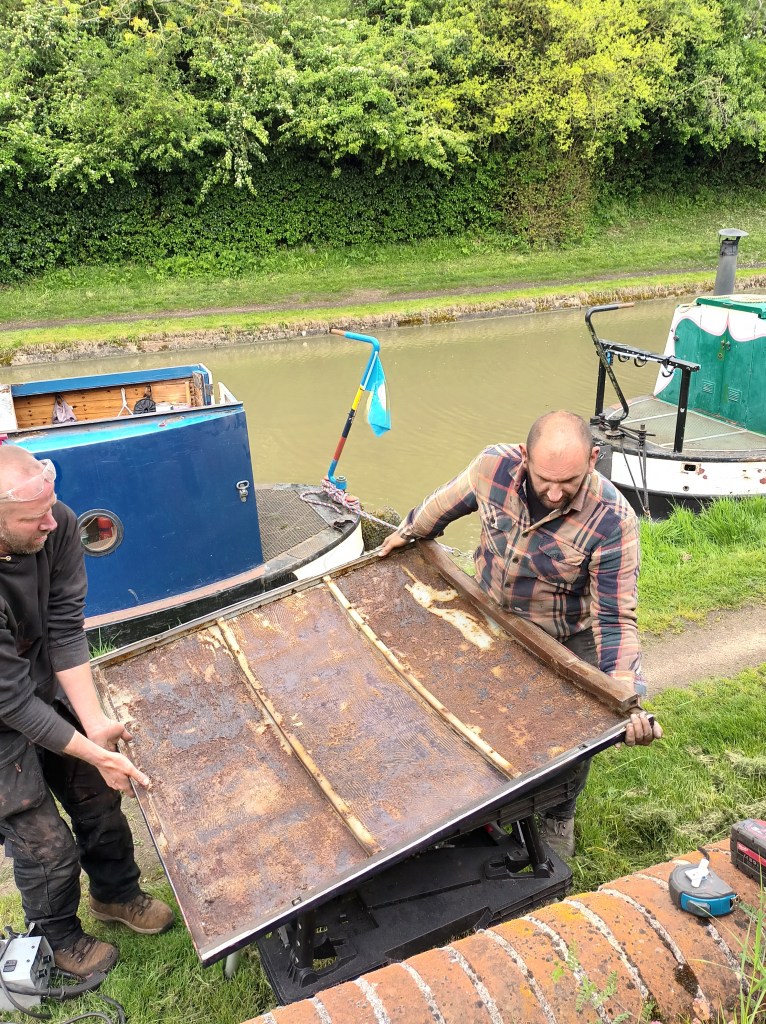
We have a few weeks to wait until our major welding work – bulkhead and the main hatch – can be done. As soon as it is, then we’ll be off –  travelling into the wide blue yonder once more. We can then enjoy the journeying.

Our plans are up to the Bridgwater, onto the Leeds Liverpool, over the tidal Ribble Link to the Lancaster, up the Lancaster, back from the Lancaster and up the Rochdale, over to Ripon on the River Ure and of course all of this planning can change in a whim! Plus we have some hugely exciting news about other new plans that we’ll share with you very soon. 

Don’t get sent to Coventry

If living and working on the move has taught us anything it’s not to take anything at face value, or live by what others tell you. Go out there and find out for yourself, and test your preconceptions, particularly if they were built on hearsay, or experiences from the past – things change over time, as do we all and our perceptions.

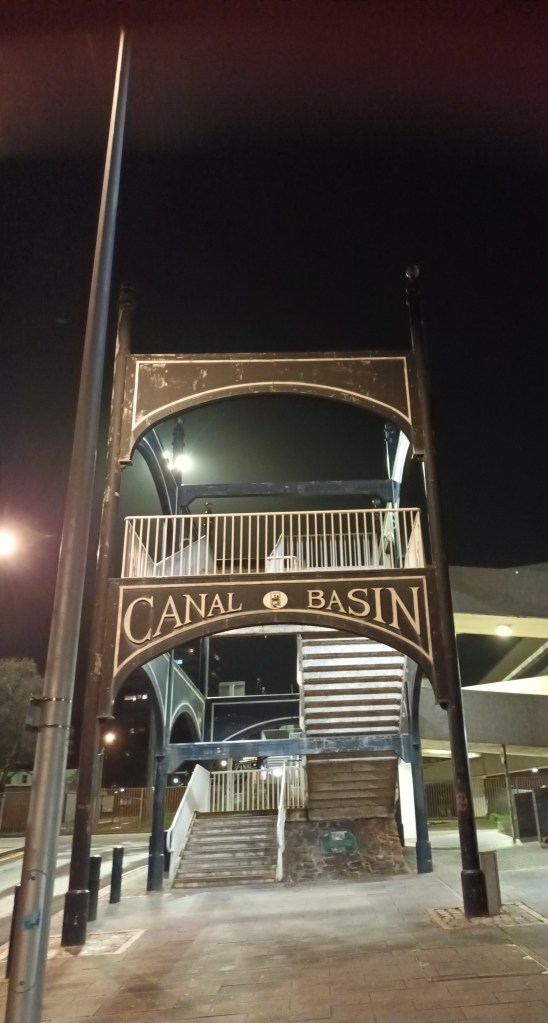
Cov is a  case in point. The locals we met called Coventry “Cov” with fondness, a far cry from the view of a city where you go to be ghosted, ostracised as in “sent to Coventry”. Heading down the Coventry Canal over the years I’ve lost count of the number of times we’ve turned at Hawkesworth Junction, avoiding the arm that leads straight into the city that gave the canal its name. We heard tales of shopping trolley hell to navigate, rowdy goings on in the canal basin, and a view that it wasn’t worth the journey.

Recently we also began to hear high praise for the basin mooring, stories of good food and a welcoming city with a thriving arts scene. We felt we’d shunned Coventry enough, and this time we steered towards it at the junction.

Coventry is a fascinating city – full of history, full of life, surprisingly full of shops when so many city high streets seem full of boarded up closures, a vibrant aromatic multicultural market serving all tastes and nationalities, and everyone we encountered was warm and welcoming.

The city has many thriving arts venues, one of which, The Tin is in the Coal Vaults right on the well-lit Basin. Check it out before you visit but don’t worry about noise if you’re moored right next to it – we found the noisiest thing about being in the basin was not the heavy metal night but the Canada Geese!

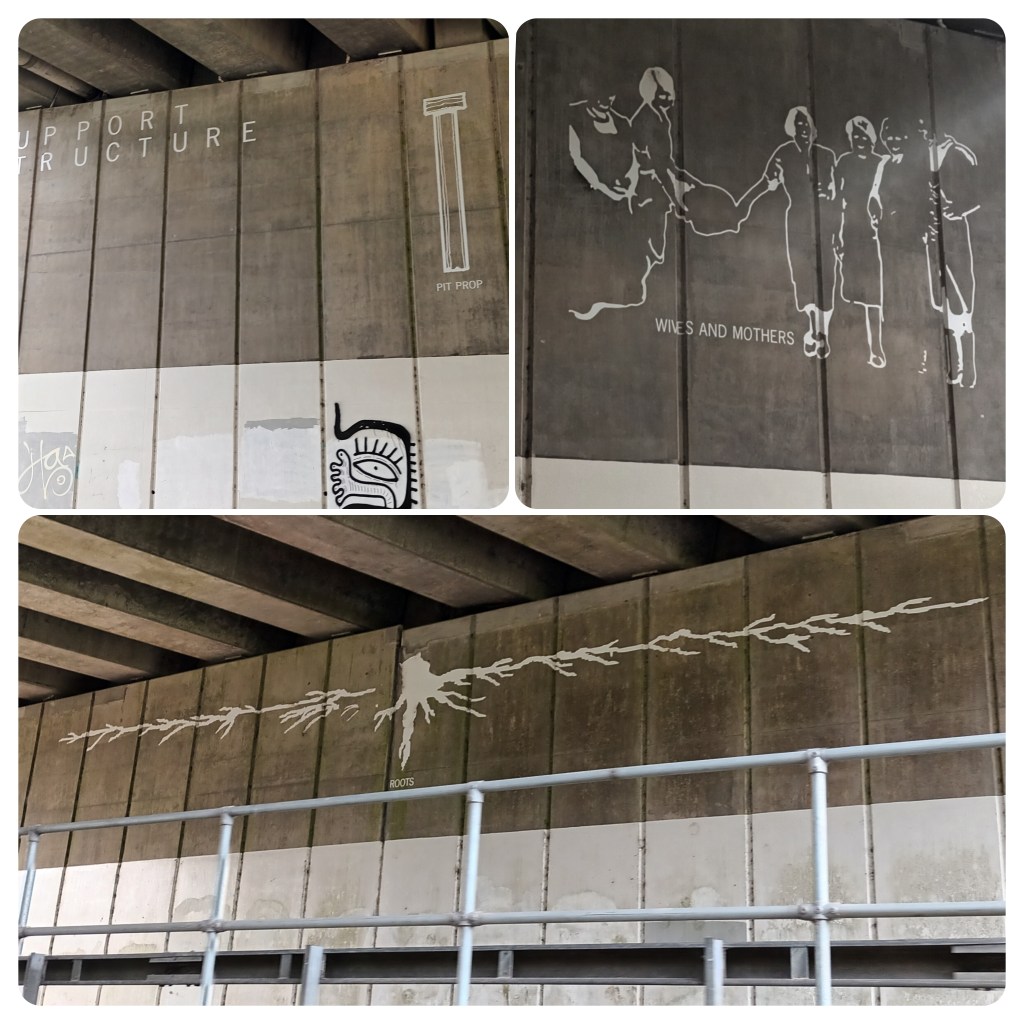
The Portuguese supermarket on the basin, the café too we’d highly recommend, and whilst you’re there take the bouncy bridge over the dual carriageway into the city. There you find history and heritage, art and education interlinked.

The largest collection of British vehicles on 2 and 4 wheels appears in the Transport Museum, and of course Daimler made the first car here in the city in 1897 in a plant alongside the canal.

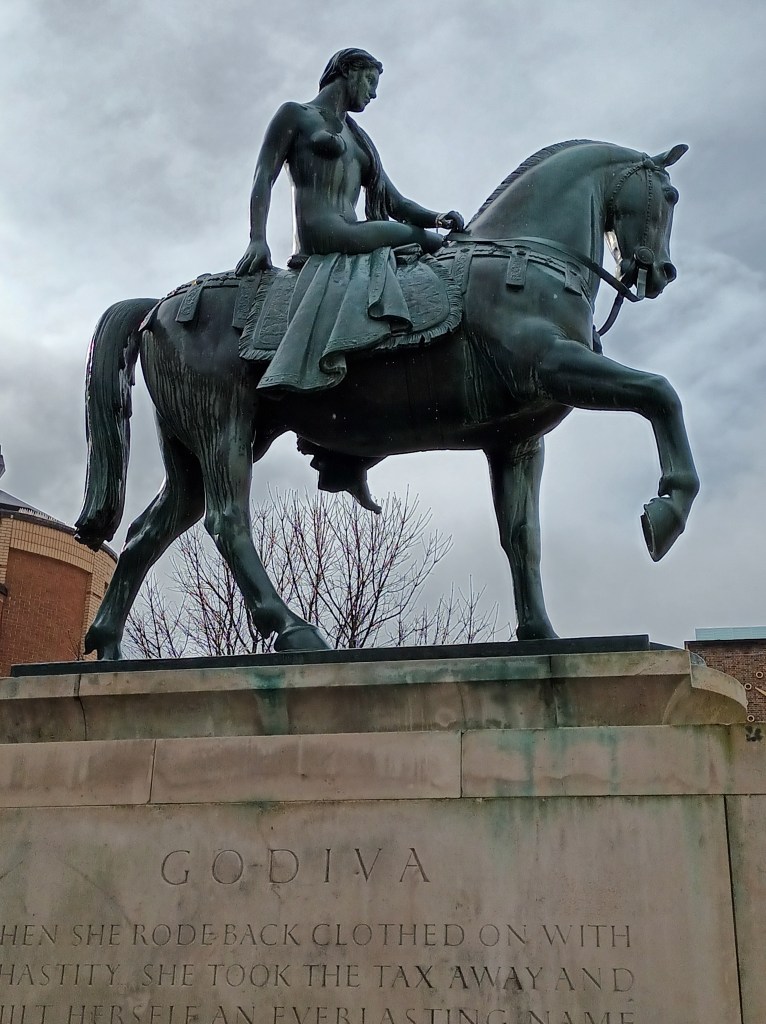
It’s horsepower of a different type in the control of a female rider that has made Coventry infamous. Lady Godiva protested against her husband’s imposition of brutal taxes on the population in the only way she knew how once her verbal entreaties failed – she rode naked through the city and still does every hour viewed by thousands of tourist, locals and the Peeping Tom. Make sure you’re in Broadgate when the clock chimes any hour and you’ll see what we mean.

Significantly at Eastertide the message for which Coventry is renowed worldwide is that of reconciliation, faith, and resurrection.

The city was severely bombed by German forces in World War II, the cathedral was destroyed and 568 people lost their lives and 43,000 homes were flattened on 14 November 1940, the single night that became known as the Coventry Blitz.

Since then Coventry has become renowned as a living example of destruction, rebuilding, renewal and reconciliation.

Bombs landed in the canal spraying water over homes and yet there was a lack of water to extinguish the fires that raged after the bombing.

The resulting rebuilding, of a new cathedral, of the city and the communities within it has spawned a movement for reconciliation that has involvement globally, particularly within Dresden, a German city which suffered destruction at the hands of the British forces. Coventry blazes a hopeful light.

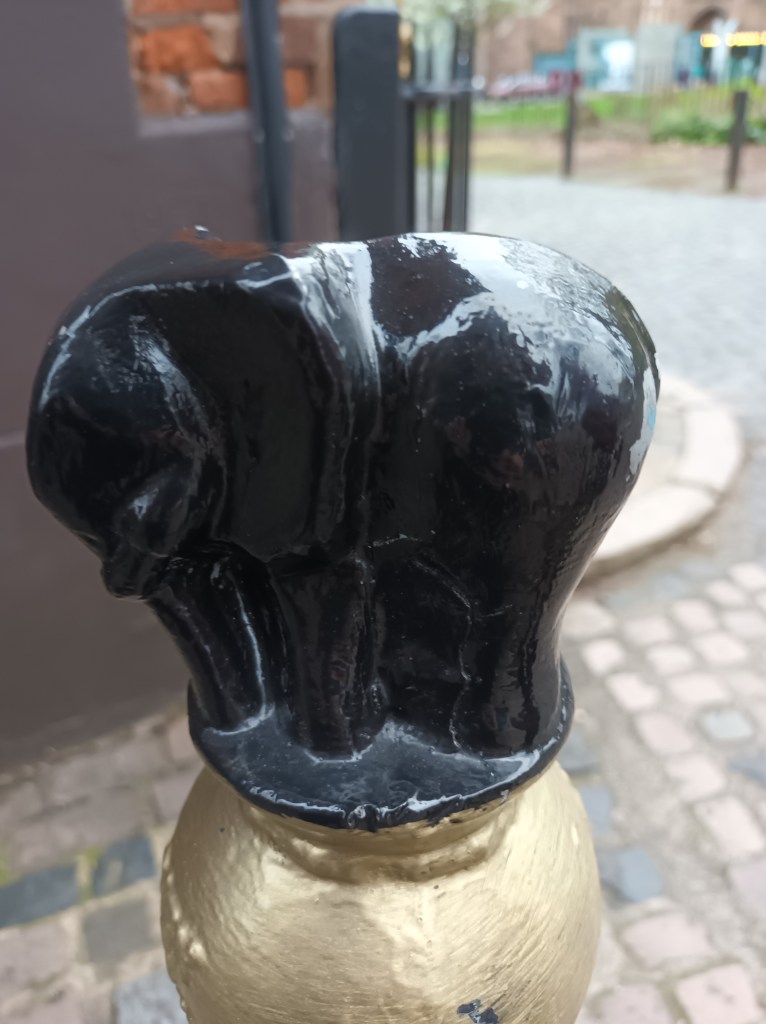
The elephant is a symbol of the city too, a strong animal who is said to never forget but is also apparently a symbol of redemption of the human race. Coventry doesn’t forget it’s past but builds on it, building a strong and meaningful future.

Whatever your beliefs, have an enjoyable and uplifting weekend. We honestly recommend you don’t wait to be sent, but take yourself to Coventry very soon. 

Sort your life out – online and in person

Boaters know only too well the impact of too much stuff. Life becomes more difficult – it’s physically more difficult and uncomfortable to move around an overcrowded boat. Life also becomes mentally more difficult – “the clutter effect” psychologists say. It results in increased stress, lower life satisfaction and I’m not talking about hoarders, but those of us inclined to squirrel things away.

Melon baller or bottle foil cutter? Essential?

It may be for the best of reasons – rainy day mentalities ‘that’ll come in handy one day’; the desire to keep records in paper form not just online; or a desire to hold onto memorabilia that means something, often only to you, but sometimes to others too. 

It’s not just TV shows who talk about decluttering, or tidying consultants (yes – they exist and cost a fortune!). I’ve just had the privilege of helping family members sort part of their home ready for a significant downsize. It has been thought-provoking, causing me to think long and hard about how we all deal with the things we consider important, or necessary to keep, and how we deal with those things others consider important or necessary to keep. The two are not always the same. After all “One man’s trash is another man’s treasure.” It applies to physical things as much as it does these days to emails or photographs on our phones. My phone keeps shouting at me now that I’m about to run out of space, and it’s all down to the photographs I can’t bear to delete even though I think I’ve saved them in the Cloud. 

Clutter, physical and mental, real and digital affects how we live. We are all living longer which this means we have longer to amass stuff, to spread it around us, and perhaps we end up cramping our style for longer because we are literally cramping our lives. 

Need to know the day and month and have a mask holder these days!

In part we feel satisfaction when we look at treasured possessions. They may evoke memories of those we love, remind us of happy times, make us feel joyful or contemplative. Too many of them though, and that valuable feeling can be lost, literally swamped. Clutter means we can’t see the message at the heart. 

Being able to clearly see what we believe matters to us is important. If we don’t see it, or appreciate it regularly, then perhaps we need to question why we have it. 

When we packed up our bricks and mortar home and moved onto a narrowboat – see a previous blog – it was done in a flurry of optimism, of enthusiasm and excitement. That kept us going through the tough decisions, the agonising over what to keep, what to give away and what we had that really amounted to junk. We also kept a few things in store – the ship’s wheel from my late Father’s last ship, some cartoons my late brother drew, childhood Dinky toys and lots of photographs, many of family no longer with us.

A bit too much in store to be honest

Weirdly most of what we disposed of came from employment, that fundamental around which our lives had revolved. Changing to live rather than work – working only when necessary changed our perspectives on the importance of associated papers, journals, books etc. Many were gifted, some papers shredded and others were recycled. 

Looking at family members’ papers – they won’t mind me disclosing they are in their 90s now they too had papers from throughout their long careers. Many kept for over half a century in many cases not looked at for at least a decade. Like letters kept from past years, going through them resulted in the many memories or at times, the realisation that there was little point in having kept something when all it resulted in was “Who’s this?” or “What’s this about” or even the unanswerable “Why did I keep this?” I have to hope they enjoyed the task of reviewing at a manageable number of items, enjoying the memories and being in control of the decisions of what should go and what should stay. There was too much for them to review though in one go so much has been boxed for other days, but their surroundings are clearer which may make the process easier and certainly safer going forward. The choice of filtering must be theirs.

Clearing and sorting gives whole new living spaces

Their thousands of photographs, slides, transparencies (so many unidentified) made me realise the importance of making sure someone knows why you have kept something – it’s hard for others to appreciate the value of something if you can’t identify it. Those of us downsizing and clearing out have a responsibility to make sure that what we do keep (because we’d like to hand it on), has meaning to and for those we hand it to. 

That labelling and categorisation is part of streamlining our possessions. Doing that means items have relevance and value to others who can then make a decision on what they want to do with them. It also means we can appreciate what we have, and decide if we really want to keep it. Books, clothes and photographs are often among the hardest things to shed, but it really can be quite liberating to at least reduce them.  

The Swedish, as they always seem to do, I’ve discovered have a word for sorting things out so those who might inherit them know what they are dostadning. It means death cleaning, and it’s about proactively clearing out possessions before death so you don’t put the onus on others to decide what to keep or dispose of. I’ve discovered Margareta Magnusson’s book The Gentle Art of Swedish Death Cleaning, which set me wondering at what age the process should start, but then I looked around the boat and decided that it needs to start now. If we haven’t used it or appreciated it in the past 12 months, it needs to go – clothes, books, papers, etc. It is a chance to sort out things we want to keep or to hand on to others. In the main, this is physical, but the digital also needs thinking about today.

So when to start this process – well we’re all living longer lives giving us more chance to accumulate stuff as a result so I think we all need to recognise we have more time to get rid of things, and perhaps also recognise that many of the memories we value are the ones in our heads and hearts.

I owe a huge thank you to the family members I was helping. I now know we all need to ask ourselves a few simple questions that should enable pain-free decluttering making our living environments more pleasant.

  1. What do we need with us daily
  2. What do we want to keep and why
  3. What do we want to keep for others and do they know its importance

Anything not covered by those is out – in our case, off the boat, and out of the storage we’ve had it in. We are about to move to a new storage location so that is a spur to reduce what we have, to move less, have less to worry about and quite frankly if we are keeping things that we can’t answer those simple questions about with clarity and conviction then we need to dispose of it. Keeping the wisdom of William Morris in mind will assist.

'Have nothing in your houses (or boat) that you do not know to be beautiful or believe to be useful' 
William Morris
Useful – practical and handmade at a memorable workshop

After all, things aren’t what matter most in life. People, experiences, shared moments. These matter.

Leaving home

How do you leave your home for the holidays? Empty the fridge, check doors and windows are closed, pull the front door shut, turn the key in the lock, perhaps even set a burglar alarm, and head off. 

Similarly how do you leave the office for a break? Put up an out-of-office email, log out and walk away?

It doesn’t vary that much for us living and working on a boat, but demands a bit more logistical planning. A week ago we headed off bound for Cornwall together, then individually to Hampshire and Lancashire.

Before then we recced the canal looking for a good place to moor. What makes a good spot to leave a boat for a time varies, partly on the time of year, partly on the length of stay, and partly on individual preference. As our boat is our home, we tend to be a bit fussy about where we leave it. We don’t currently have alarms or cctv as some boats do. We’ve seen Internet connected camera doorbells, automatic lights, and all manner of security device on boats which owners have to leave for weeks at a time. Maybe the time has come to think of such things?

We do look for a mooring spot somewhere with other permanent resident boats around. Our first Christmas away from the boat (a time when one can expect many boats to be empty) we put the boat into a marina, but since then we’ve employed our principal of leaving it near other, occupied boats. 

We like to chain if going away – wet weather and passing boats can result in mooring pins pulling loose or jiggle ‘nappy pins’ out

So this time we had the car with us (our method of travelling south), so we wanted to leave the boat on a mooring spot that wasn’t too far from a place we could park to load and offload, that was near other occupied boats, and that had mooring rings, piling or edging to the canal to which we could attach chains for more secure mooring. Ideally we wanted all of this in a rural but not remote or inner city location. We had the opportunity to leave the Ashby Canal before we left and before works closing one of the bridges near the start of the canal closed it to navigation but we decided staying on the Ashby rather than turning onto the Coventry Canal would suit our purposes. 

Ducks on ice at Duck Corner showing the lay-by

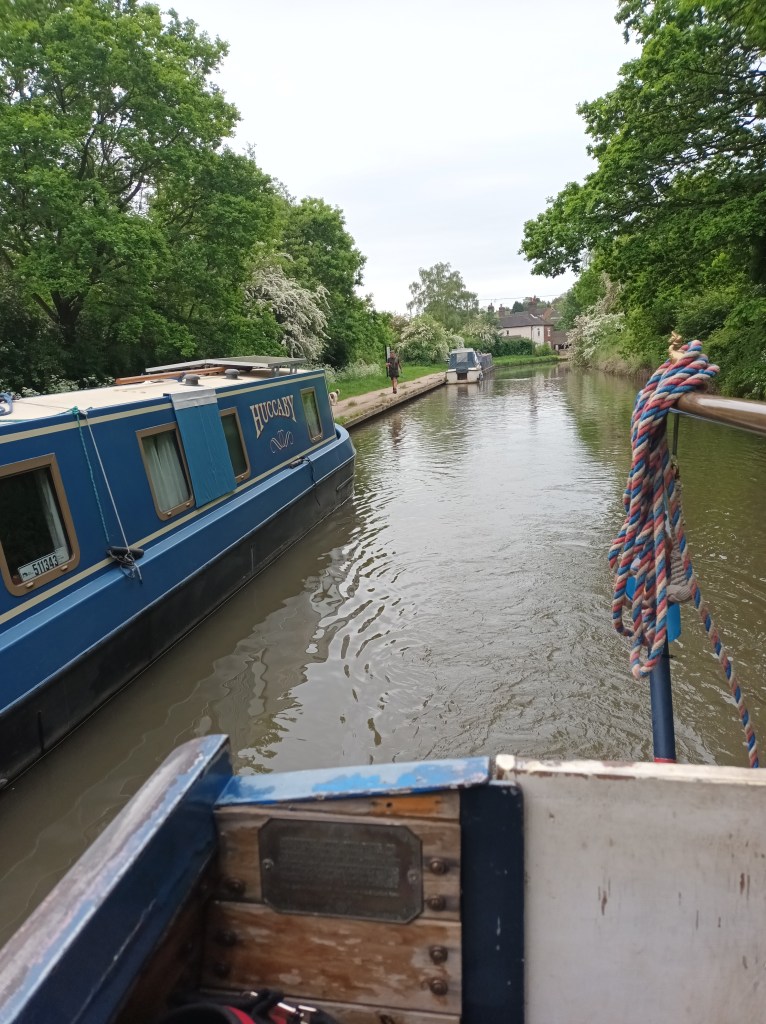
We had been moored at Duck Corner – so named for obvious reasons – on the outskirts of Stoke Golding. Ideal in some ways except we ended up moored on the road side where there is a layby, and we became aware in the evenings whilst we were there of youngsters pulling up in cars after dark. It’s very obvious to people regularly visiting such a spot if a boat is empty – they may not bother with it at all, but better safe than sorry. So we moved. Our original plan was to move only a few hundred yards to a quiet and popular location where we knew there were mooring rings near a great farm shop. When we got there, there was no space to be had – nose to tail boats. So we moved on, and returned to a mooring we knew from some years ago, opposite some residential moored boats and near another farm shop (the Ashby is very well provided!). 

Chains deployed, ropes made fast, we packed up our stuff, turned off and cleaned out the fridge, loaded the laptop to come with us, turned off the internet, and the irritatingly faulty pump along with all the electrics. That way, the solar keeps the batteries topped up even if there isn’t too much sun. 

Laden with bags of gifts for friends and family, laptop, clothes, shoes for all weathers and coats we headed off down the towpath towards the car. I got distracted as I left the boat (that’s my excuse anyway) and closed up, following a heavily laden Steve to the car. We cast a backward glance, all looked well and we headed off. 

About half way down the M5 I began to wonder if I remembered actually locking the boat up rather than just closing it… Eventually I voiced my concerns but we decided that it could be a safety feature. Anyone wanting to break in wouldn’t need to do much damage if the door just opened when they tried it!

By the time we arrived in Cornwall we decided maybe we should contact some very good friends who live in a bricks and mortar home some 15 miles from where we had moored, and who had offered to pop by and check on her. We messaged them and explained there was no rush, but told them how to check if the boat was unlocked, and how to lock it if it actually was. I have to say I was interested to know what the response might be!

Sure enough, the next day this WhatsApp arrived – proving my incompetence and the generosity of friends going out of their way to check for us. That is the first time we have had boat security!

Aren’t friends with a non-judgmental sense of humour wonderful?!

We had a wonderful break away and Steve returned first en route for Lancashire and found the boat happily bobbing securely on her mooring. An encounter with a neighbour’s wheelbarrow led to a conversation, and it was apparent that our absence on board had been noted but people were keeping a friendly eye out for us. 

When I then returned from Hampshire after a decluttering mission and assistance to Covid-stricken relatives in their 90s the boat was still safely where we had left her (I always wonder when we come back separately if Steve is going to move her just for “fun” to confuse me). 

A good time was had!

I think our next trip away may well be Christmas! In the meantime, we have many miles to travel – a lot of them on foot for me as I train for and complete the London Marathon. I’m doing it for MIND, whose work supporting mental health is nothing short of essential. If you haven’t sponsored me yet and feel you can – please do. I and those who benefit through the work of MIND will be hugely grateful. https://2023virtualtcslondonmarathon.enthuse.com/pf/deena-ingham

Next week, sometime when the closure ahead is lifted, we will head off once more, shaking off the sluggish pace of winter and cruising to locations familiar and fresh at our usual lively 3mph!

Good to be home with a rainbow to celebrate

Channelling our inner detectives – hell with water

Living afloat we are very aware of the importance of water for life and for transport.

News stories this week warn of a current drought risk across parts of England. That’s a commercial danger for agriculture. The map from the UK Centre for Ecology & Hydrology indicates it could affect our cruising plans this year. The River Trent for example, has below average river flow at the moment, although the River Ouse in Yorkshire is already in flood. We can’t do anything with that, just wait and see where we can go. 

It is though water on the boat which is occupying our thoughts at the moment. Water is still leaking from the water tank into the bilges so we have a regular role of mopping out… and in addition we have to keep our water pump turned off. A few times a day we trot down the boat, switch it back on, fill a 5-litre bottle with water that we can then use to fill the kettle, wash, cook, clean, and flush the loo. Then we trot back and switch off the pump once more. 

As with every problem there’s a temporary fix whilst we work through the options to create a permanent solution.

Our onboard water system consists of a main tank, a water pump, an accumulator, a cauliflower (calorifier or hot water tank), a pressure release valve, the plumbing between them and then a kitchen tap, bathroom tap, shower, flushing toilet and washing machine. 

At the moment we know we have two issues with the water system – at least two we’ve identified. 

  1. Main water tank lid leaking – we have a huge lid over the 500l tank that sits in the bow. The well deck floor is lumpy and bumpy, the old lid is rusted round the edges so they don’t create a perfect seal. When we fill up with water the water flows out of the gaps and into the bilges of the boat. It’s big job to grind one away and rebuild the other and big means £££. Making those two surfaces totally flat and sealing via new bolts combined with a small amount of sealant would stop water leaking out when we fill the tank and it sloshes about. For the moment a large amount of sealant will have to resolve the leakage issue, to date 2 x 300ml tubes around there to date haven’t done the job yet and eagle eyes are still required at filling up time. Our temporary fix is filling only until water squirts out, mopping out the bilges and we’ll add more sealant too. 
  2. Water pump going off intermittently – once we’ve got the water on board and kept it in the water tank (rather than the bilges) we need the pressurised water pump to take that water where we need it within the boat. Cold water flows through the kitchen cold tap, basin tap, shower, toilet, hot water tank and washing machine. Hot water flows back from the hot water tank to them all. That’s the theory and it is working but the water pump should only come on when the pressure drops off. It is noisy and uses power so it is intensely irritating when it goes off every 4-5 minutes. It’s using power each time (a little bit but power nonetheless) it makes a loud noise which is irritating and we’re being reminded each time that we have a Problem.

Since we bought the boat we have worked our way round her aged plumbing. We added a flushing toilet which needed plumbing in, and a washing machine. We replaced the shower and basin as well as the kitchen sink and tap. In November last year we had the water tank efficiently sand blasted, cleaned and resealed.

Water tank before…

This alert indicates a series of possible issues:

  • We have a leak in the system
  • It could indicate we have a problem with the accumulator which accumulates pressure avoiding the need to use the pump constantly and reduces pressure so you don’t get banging and rattling in your pipes
  • It could also indicate a leaky pressure relief/release valve
  • Faulty water pump. 

In a process of elimination, we are steadily working our way through the potential possible causes in a bid to find a solution:

  • Leak in the system – we traced it through hoping the pipes that run under the bed or behind the shower wall aren’t at fault. Couldn’t find any evidence of leaks – phew.
  • Accumulator – firstly we used a bicycle pump to pump the pressure into it behind the rubber membrane that holds the air to create the pressure in the water. It was evident that was losing pressure and we don’t know hold old the accumulator is anyway. It obviously wasn’t working as it should have done. We removed it with only a slight leak in the process to see if it was that causing the problem…it clearly wasn’t the only issue because the pump still keeps going off!
  • Leaky relief/release valve – we didn’t know we had this originally! Steve found it by chance when initially exploring the system. He found the valve stuffed in the back of the wardrobe (perhaps not the most logical location as when the pressure built up and the release valve worked it dripped the resulting water into the wardrobe aka waterrobe). The PRV was fixed as part of the washing machine installation when we had a proper drain installed that channels the water from the valve into that drain and out of the boat.
  • Faulty water pump – this is possibly the final option and most expensive but we can’t honestly think what else there is that could be the issue. Advice from a friendly boatyard indicates that they expect pumps in hire boats to last for 6 years in a really good situation – and they aren’t being used 365 days a year. We’ve had our boat for nearly 5 years and have no idea how long the pump had been in before then. The pump contains a cut-in switch, a cut-out switch, a motor, a pump mechansim – all of which seem to work.
Accumulator removed

As the water tank was completely emptied and refilled during repair work it is possible some muck  may have got into the pump as we’ve now discovered that we don’t have a filter between the water tank and the pump. That could then have accelerated wear to the valves of an already aged pump. 

Old water pump in situ

We could dismantle the pump, rebuild it with new bits may be finding the one problem area and fixing it en route. That could still leave the possibility of something else going in the aged pump, and all that fiddling about would take time, provide useful learning but also result in a long time without water.

Another final attempted solution is to replace the pump. The friendly boatyard have one coming next week for us to try. If it works we pay for it, if it doesn’t we give it back. We’re thinking there’s an advantage in having a new pump anyway at this point, one with a warranty on it, and hopefully giving us another 6 years. We also want to install a filter. 

It’s a bit of a drip feed story this one – will our plans solve the problem? Watch this space!

How are your batteries? Are we running down?

At work or at home how often do you think about flicking a switch and getting power to illuminate your life or recharge your devices? Bet you only really think about it when you flick the switch and nothing happens?

Living and working off grid as we do 24/7, power is not something we take for granted, or indeed can afford to take for granted. All our power is drawn from 3 x 100 amp hour leisure batteries neatly stowed under the floor of the rear deck in the engine bay. We also have a small starter battery which starts the engine.

Initially those leisure batteries were required to charge the lights, a water pump and a camping fridge. Since then we have significantly increased the amount of power we require daily – we now have a fridge with a mini freezer section, a washing machine, a flushing loo, an Internet router, our phones and computers.

We charge devices via USBs and AC plugs and sockets. The batteries also power the inverter with which they recharge a power drill, a hoover and electric toothbrush (no, we aren’t reduced to sharing one – Steve prefers manual!). 

All this extravagance means we are using approximately 0.65 of a kilowatt hour daily. If we are cruising (running the engine on red diesel), then the engine recharges the batteries as we cruise. But we don’t cruise every day. Work, ice, closed navigation and life often mean we happily moor up for days, occasionally weeks at a time without moving. 

This week’s mooring spot

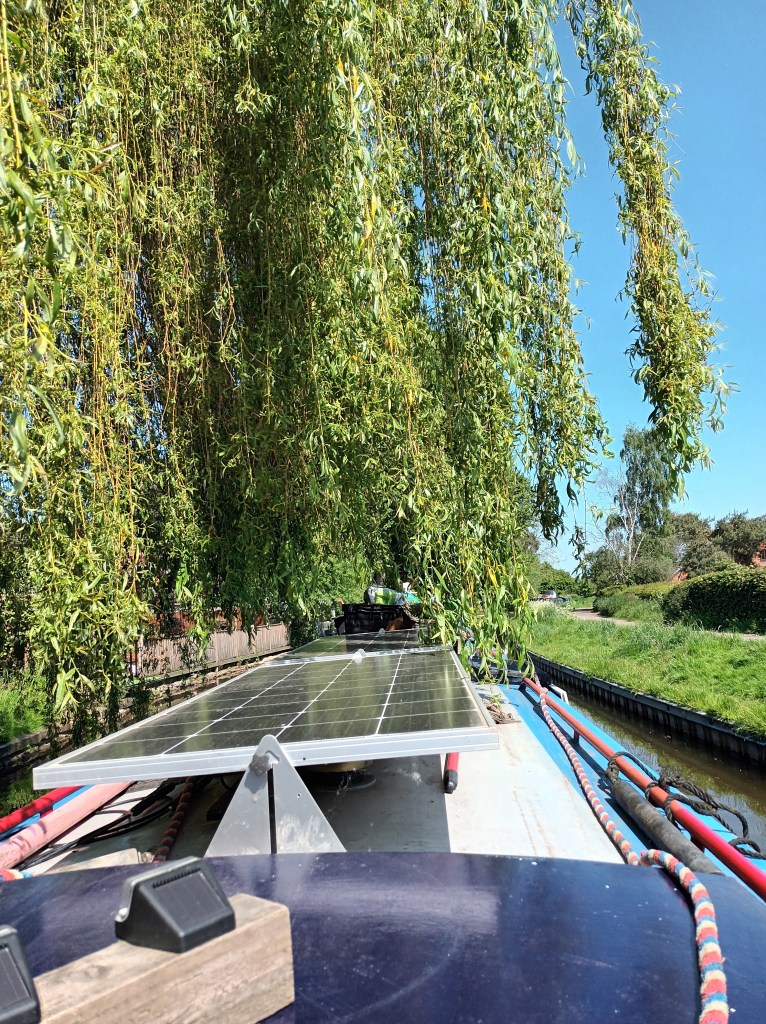
One of the most vital elements for our moored up, off grid living on our 50ft nb Preaux is our solar power system which also charges those leisure batteries without using any red diesel. Steve installed two 175 watt Victron panels two years ago during the 3rd lockdown.

Together they have a perfect-situation capacity to generate 350 watts peak power. That means mooring in the optimum place, with the panels sparklingly clean and angled perfectly at a brilliant sun… that doesn’t tend to happen to be honest although we do take solar into account whenever we can when mooring. The highest peak power we’ve ever achieved was 260 and we were chuffed with that. 

At the start then, the first kilowatt hour of cost us £500 per kilowatt hour (basically the installation cost). Now it works out that each kilowatt hour has cost us £3.03 – it’s going down rapidly as you can see, and because the system means we don’t need to run the engine so often to charge the batteries which we do when there is no or poor solar, then we save £8.36 a week in diesel costs – a power profit. 

5th Feb 2023

Solar generation isn’t exclusive to the summer either. In the past 30 days we have generated 8.1 kilowatt hours of energy. That means in February and March the sun and our panels generated 41% of our power needs. The first day of the year when solar generated 100% of our daily requirements was 5th February. We generally expect to be self sufficient between March/April and the end of October. The first day after the summer last year when we needed to run the engine to top up the batteries was 27 October – up to then solar was recharging the batteries fully every day. 

So since we installed the panels and the associated cabling and gubbins that makes them work and allows us to monitor them (well, to be honest allows me to press a button on a panel a few times a day to see the percentage of charge in the batteries). Steve takes a tech approach and monitors it via his phone what the panels and sun have generated for us. Since they were installed that’s a total of 175 kilowatt hours of electricity.

Nearly there- 98%

That all sounds good – power for free (or free ish after purchase and installation costs) but a damn good deal anyway. That allows us to save (theoretically) towards the degenerating elements of our system, and to offset the current lack of government assistance in heating terms (the £400 for every household has specifically excluded boaters like us who are continuous cruisers travelling the system, although it has been paid to second home owners…).

A discriminatory statement

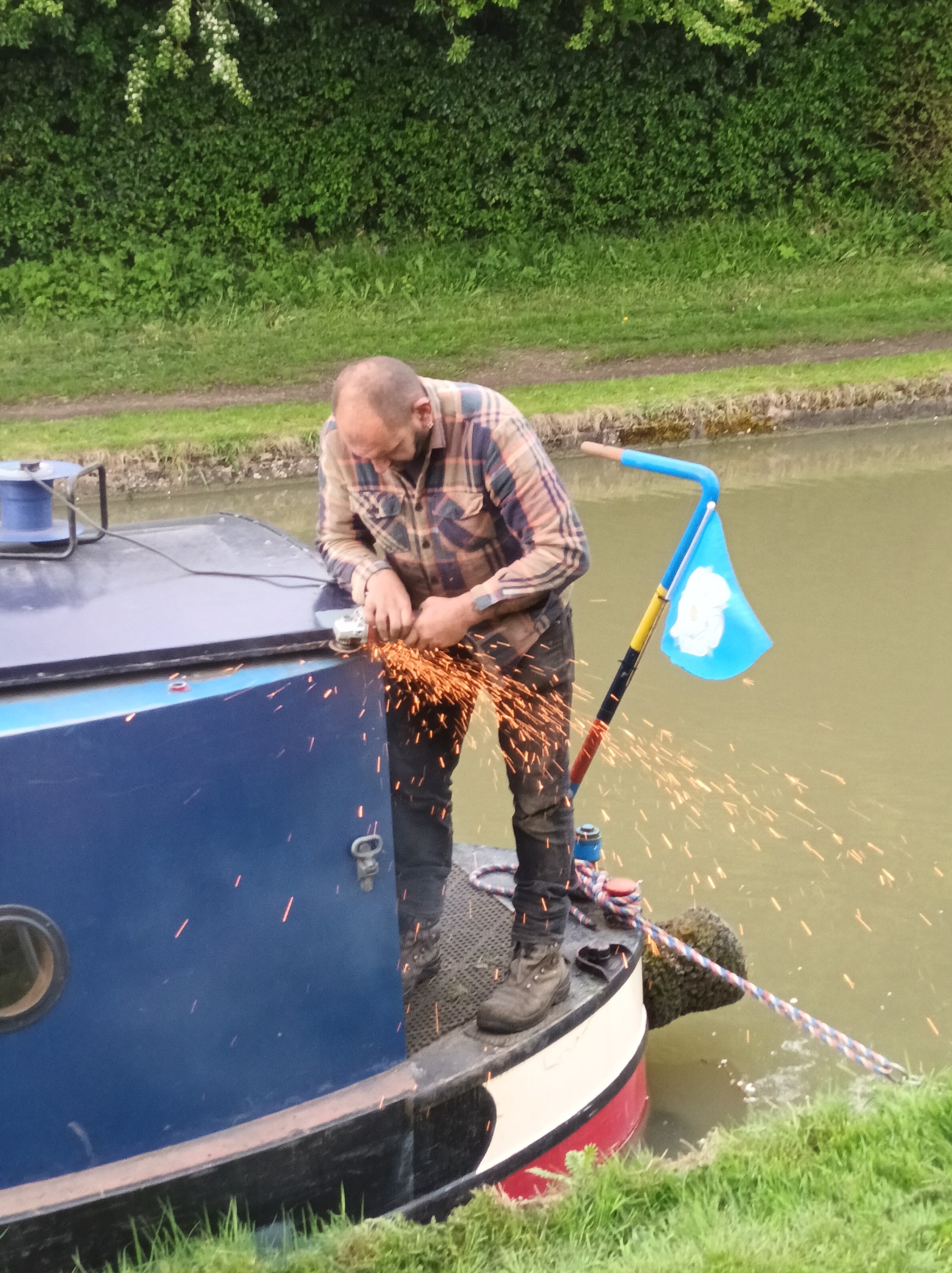
The deteriorating elements of our power system are the batteries themselves, and in the very long term the solar panels. Batteries don’t last forever – as anyone purchasing them for children’s toys knows only too well. Even rechargeable batteries have a finite life too. What you pay for a single battery can range from £100 to £1,000. We fly a Yorkshire flag, a symbol of economy, frugality and sustainability. We went for the £100 batteries and we nurture them with care. Technically the advice when we bought them was that looked after well (more on that in a moment but it doesn’t mean I’ve been knitting them jumpers for the winter….) we could expect 2 years per battery. We bought all three at the same time 2 years and 2 months ago now so our nurturing has paid off so far. 

Should I knit rainbow beanies for the batteries to show I care ???
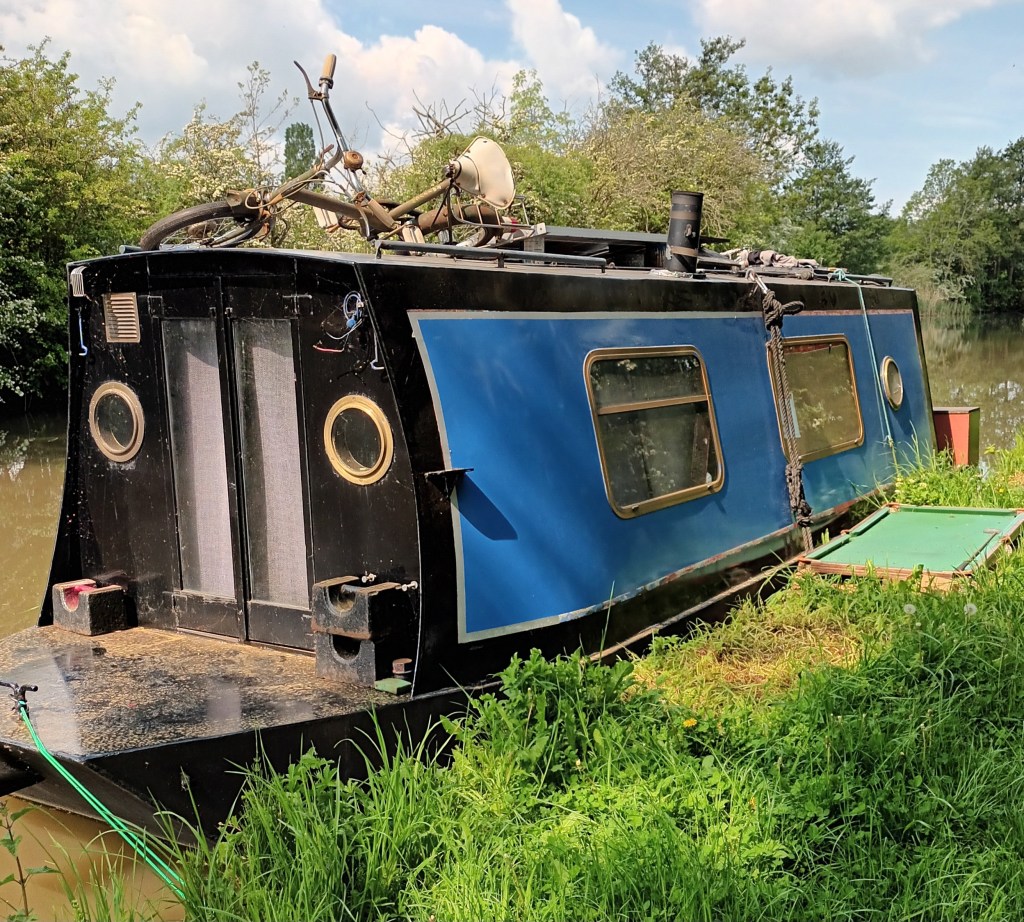
We don’t let them drop below 50% charge at any time. We charge them to 100% at least once a week but in reality as often as possible. So when might they give up and how will we know? Well we rather hope they will gradually degrade, taking longer to charge etc but you never know, they could just suddenly pack up, plunging us into darkness. We shall see, and at the moment there is significant pleasure in knowing recharging regularly and taking care of our power system is paying off. 

The thousand dollar question – how long will they last? It’s fun waiting to see!

It may sound a faff, but solar is better for the environment, and checking our batteries several times a day is a small price to pay to be independent of the National Grid. It gives us another reason to rejoice when the sun comes up.

All this makes me reflect that whilst we look after our batteries on the boat we also need to look after our own batteries too, to make sure we recharge ourselves and keep ourselves in good shape. Something we’ve determined we’re going to do – very soon. 

Comfort zone 0: Benefit immense (apparently)

History tells when the Athenians learned the Persians had landed at Marathon en route to attack Athens in 490 BC, a messenger ran to Sparta for help. This first ‘marathon runner’ covered 260 kilometres of rugged terrain in less than two days! A runner (probably the same poor chap) subsequently ran from Marathon to Athens some 40 kilometers (nearly 25 miles) to announce the Greek victory at the Battle of Marathon.

The marathon as an event of 40 kilometers was first included in the 1896 Olympic Games. It was the British royal family who made it longer. Queen Alexandra asked that the 1908 Olympic marathon should start on the lawn at Windsor Castle. Competitors ran to the finishing line in the Olympic stadium 26.2 miles away, a distance which has stuck. 

Crowds supporting runners at Tower Bridge

The reasons people run marathons are as varied as the events and the runners themselves. Millions have and do run for causes close to their hearts. The London Marathon will take place next month -an annual event since 1981. Since then it has become the largest annual charity fundraising event, raising more than £1 billion for charities large and small, and has been completed by over a million people. Some run that entire 26.2 miles dressed as rhinos, carrying fridges, even in stilletos.

In the biggest single change to the event, the virtual London Marathon was introduced as a result of the Covid lockdown in 2020. The marathon that year was cancelled in April at the height of the pandemic, and postponed until that autumn. A decision was then taken to run the 2020 event totally differently. Elite runners ran a course in London but everyone else had the option to run wherever they were living, reducing the need for travel and crowds on trains. Runners used an app tracking their progress – a virtual marathon. Bedecked in their numbers they ran in October, a time when it was thought less conducive to the virus spreading. 

That was our first year living and working on our narrowboat. We stayed moored around our former home area purely so Steve could continue training and complete his virtual run from the boat before we set off cruising to pastures new. 

Running club friends from Poplar Running Club in Loughborough joined him for stretches of the run, family in Sileby provided loo stops on a looping route and I ran a water, gels and jelly baby station from the boat which proved useful not only to him but also to other London Marathon numbered virtual runners passing by.

The following year we took our home down to London (with all the sights en route) for the in-person marathon – again held in October. We moored at Little Venice.

From there, Steve completed the London Marathon in person supported by us all. It was his fourth marathon, and he said he would make it his last. He had been training almost continually since 2018, having originally intended to run in-person in 2019, and he felt his marathon race was run. He found training alone in unfamiliar places incredibly tough.

For me, the furthest I’ve ever completed was a half marathon of 13.1 miles. My last was the first Maratai Half Marathon in New Zealand. Just 40 minutes drive from  Auckland on the incredible Pohutukawa Coast, the run embraces stunning coastline with white sand beaches and includes two regional parks,at  Omana and Duders. The event organisers say “A lap around stunning Duders Regional Park does include some modest elevation…” That modest elevation takes in the highest point in the park, the Oturia Trig Point 200+ metres above sea level from which the views are stunning but the climb to and descent from is not. 

I made it up, almost crawling on hands and knees the last few yards, admired the view and began to head down. It was not easy and I slipped and slithered, tumbling twice and finding my left knee was complaining bitterly by the time I got back down to sea level. The remainder of the race was hobbling and hopping but I completed it, and the medal was nearly as good as the view. 

After that I ended up back in the UK with a knee that didn’t work as well as it might. Treatment for a meniscus injury, a time on crutches, and I’ve managed a few parkruns but nothing longer. Now though the time has come to really test myself, and that knee. It’s my turn to try a marathon, to raise some funds for charity and prove you’re never too old for a challenge.

Do I look like a marathoner? Maybe I should do the whole 26.2 miles glass in hand! https://2023virtualtcslondonmarathon.enthuse.com/pf/deena-ingham

On 23 April I shall set off not with all the runners in London, but from wherever we end up being moored that day to complete 26.2 miles. It won’t be easy. Hopefully, the left knee and injured right foot will both hold out. Whatever happens, my marathon journey won’t be fast, and it won’t be pretty, I won’t be dressed as a giant brain, and I know I am pushing myself out of my comfort zone. I may end up jeffing or walking much of the distance but I shall do it to raise funds for MIND which helps so many people improve their mental health. My supporters on the day will be cows and ducks in the main and maybe I’ll meet some other virtual runners en route.

Living afloat brings me joy and peace. Being close to nature and particularly water 24/7 has immense well-being benefits. I am aware that millions of people never have those daily moments of simple joy that I experience and which help to reset my mental compass. I feel the campaigning work of MIND around the triggers of mental distress for millions is essential – workplace stress, debt, poverty, and mental health discrimination. 

I aim to put the legwork in to raise funds for MIND – modest funds I appreciate but funds that will make a difference none the less. I don’t have a clue what my route will be, or even where I will be completing my Marathon, but I intend to complete it, litter picking on the way for added purpose even if I am on my hands and knees at the end. Please, if you can spare a pound or two, would you sponsor me to support the work of MIND and spur me on by your generosity?

https://2023virtualtcslondonmarathon.enthuse.com/pf/deena-ingham

I won’t be carrying a fridge, a rhino costume, or wearing stilletos, and I don’t like running (although I do like what it does for me mentally and physically) but I vow to complete my marathon, and I shall suffer in the process – not least in training. With your help I aim to slog it out and raise vital funds to help people via Mind.

My longed-for finish won’t be as fast, dramatic or hopefully as irreversible as the original marathon runner’s. When he arrived in Athens – he made his pronouncement, collapsed with exhaustion and died. I need to keep going – we have journeys to make, locks to navigate and more adventures to experience.

We don’t know what we’ve got ’til it’s gone

We take so many things for granted – lights that come on at the flick of a switch (thanks to our batteries and solar), water that runs at the turn of a tap (thanks to our tank and Canal and River Trust water points) and these days the apparently vital ability to summon maps, search engines and all the realms of the internet  when we want.

This week we’ve been internet chasing. Started fine – good signal on everything. And then we had to move the boat – not far but far enough to create a problem. It doesn’t mean a move of miles – moving just a few feet can change everything.

One aerial raised

We have a 4G router linked to an aerial (which we need to remember to lower when travelling and sometimes remove when lowered because bridges are too low for it to pass). This system operates on a mobile wireless network which we have on 3. Then we have one phone linked to an O2 network and another linked to EE.

One router

That way we spread the load and stand a chance if one network has poor connectivity in a place, rhat one of the others is likely to be good. This week has challenged that theory… we’ve also been grateful for our small mobile wireless connector when all power vanished to the main aerial connected router.

That unexpected and first ever time power failed to the router happened not on a day when we didn’t really need it, well it wouldn’t would it? Nope, disaster happened with 8 minutes to go before I was due on a work Teams call. Pow – power vanished – only to the router – everything else seemed fine, so the batteries were working… a total mystery. No time to spare for much investigation but out with the sim and a quick change to an old mobile router that dangles in a window.

Ducks abound inside and out around the mobile router

That was fine until another boat passed by – another metal box cutting across a signal. We had 3 boats pass and all waited kindly until it was my turn to be talking on the Teams call so colleagues had a very truncated and intermittent view of my thoughts! (Probably ideal really, but it was a circumstance of which I was totally unaware until signal returned and they got me back again to tell me to repeat myself…from where? from part way apparently! It took a bit of deciphering to work out what to say, all the while willing no other boaters to pass by!

After work, we moved again… thinking a more open aspect should be better. It was for solar, but connectivity and phone signal was even worse. By then, though, my working week was over, so it didn’t matter as much.
It had, however, made me realise how inclined these days we are to turn to the television via the Internet in the evenings.

Instead this week we have indulged and it has felt like an indulgence, a real treat. We have been crafting (creating children’s crowns for the coronation), completing jigsaws and reading in the evenings in addition to our ubiquitous hotly competitive Scrabble games. We’ve also enjoyed the sight of the moon with Venus and  Jupiter in a glorious celestial sight.

We shall move again when we really feel we need the internet (and a decent phone signal), but until then, we are floating happily in a creative, productive, and peaceful disconnect.  Try it sometime and see what you think!

Go wallow in Internet silence!